WCC credit card #4 and laying the whole mess bare

The truth laid bare: unravelling Warrnambool City Council’s spending and connections means entering a tangled, seemingly endless web.

Carol Altmann – The Terrier

Today is the final episode of Season One of House of Cards meets Warrnambool City Council meets Game of Thrones, where all the lines in the ever-thickening and outrageous plot come together and I lay it all out on the table.

The opening scene in this special, double episode is yet another corporate credit card – we are now up to number four – which has the same pattern of spending on the backs of ratepayers that has become so depressingly familiar: the dinners, the drinks, the endless coffees, the lunches, on and on and on.

I have been sitting on all of this information for a very, very long time, hoping the council would eventually throw open the windows, but it hasn’t and it won’t, so I am doing it for them.

I will start with credit card #4 and a snapshot:
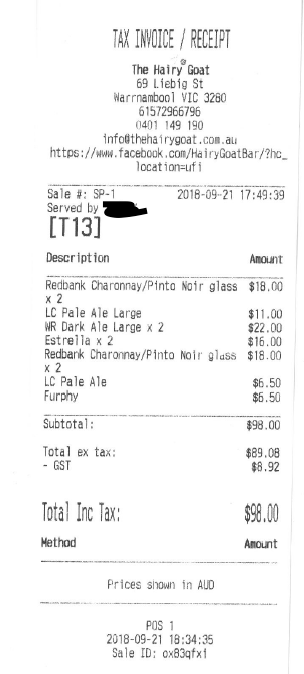
Exhibit A is $98 worth of drinks at the Hairy Goat on a Friday night on 21 September last year, which is around the time when, supposedly, the council was cracking down on its credit card use after “discovering” the inappropriate and over-the-top spending of former tourism chief David McMahon.
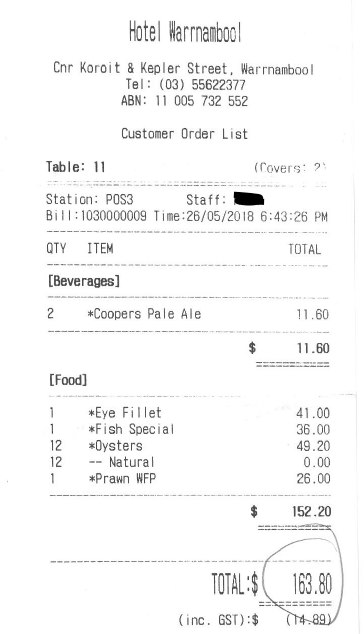
Exhibit B is a $163 dinner for two people at the Warrnambool Hotel on a Saturday night, 26 May last year, which included a dozen oysters au naturale and, wait for it, a plate of eye fillet. (Whoever gets to play the eye fillet in the eventual movie of this saga is going to become a star).
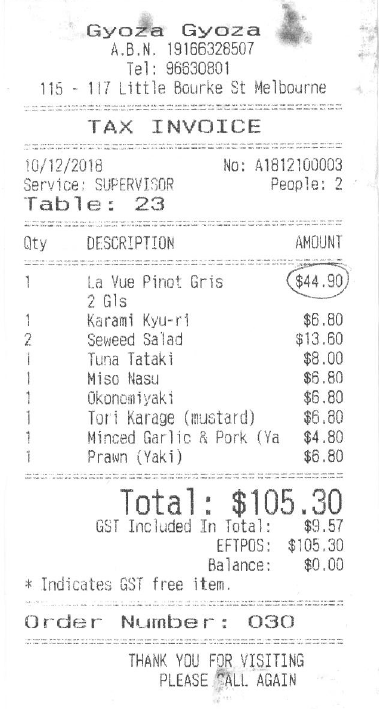
And then there is Exhibit C, a receipt from 10 December last year – after the council re-wrote its floppy credit card policy – where two people spent $105.30 on dinner at the Japanese cafe Gyoza Gyoza in Melbourne, of which $44.90 was soaked up by a bottle of pinot gris (with two glasses).

This outing was enjoyed just a week after the council decided to apply to break the rate cap and bump our rates up by 4.5% this year and the next.

What a ****** cheek.

Like you, I have had a gut full of the excuses and the ducking and weaving and hiding behind Utopia inspired spin that does nothing to comfort ratepayers that this long age of entitlement, slack governance and lack of accountability is well and truly over.

It needs to be rooted out and that’s why it’s time to name names.

Credit card #4 is held by the Manager of Economic Development and Investment Shaun Miller, he of the two jobs and who, after being named in relation to those two jobs, prompted an email from CEO Peter Schneider asking me not to name staff.

I tried that tack, but the council has done nothing since to convince me that it intends to get to the bottom of the rot which runs so deep. (#notAllstaff)

In fact all the signs point to yet another cover-up, so the gloves are coming off, because my only motivation through all of this is to expose the truth. So here are some truths.
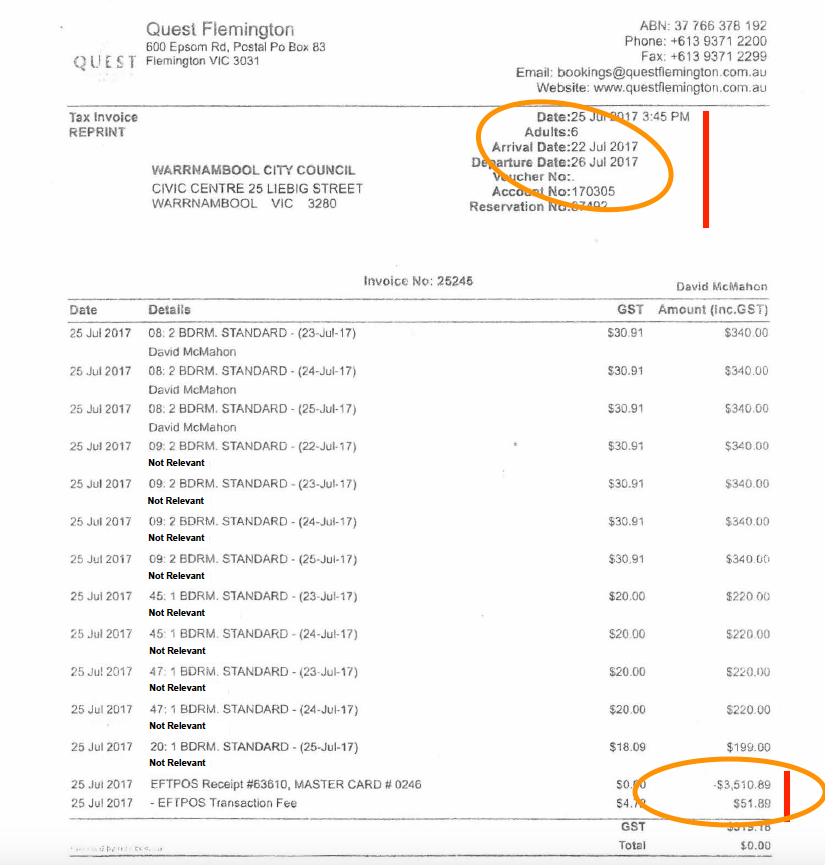
The accommodation invoice from the WCC delegation to the 2017 Victorian Tourism Conference at Flemington Racecourse.

Mr Miller travels around a lot. I can now reveal he is the mystery man who, you may recall and according to an invoice paid for by his former colleague, Mr McMahon, arrived two days early, on a Saturday, for a conference in 2017 that was held at the Flemington Racecourse which, on that Saturday, was hosting a major racing event.

A coincidence? Maybe, because our council thrives on coincidence.

Certain people don’t like me naming Mr Miller. When I wrote about his two jobs, there was a barrage of abuse and behind-the-scenes threats, perhaps because these people suspected that I knew more than I was writing about publicly. They were right, I did. More about that shortly.

I have not had any direct response from Mr Miller about his credit card use, however I did get another polite email on his behalf from Mr Schneider last Friday night, but it said nothing new and provided no explanation for the receipts above.

Mr Miller’s spending is signed off by his superior, Director City Growth Andrew Paton.

Mr Paton is the owner of credit card #3.
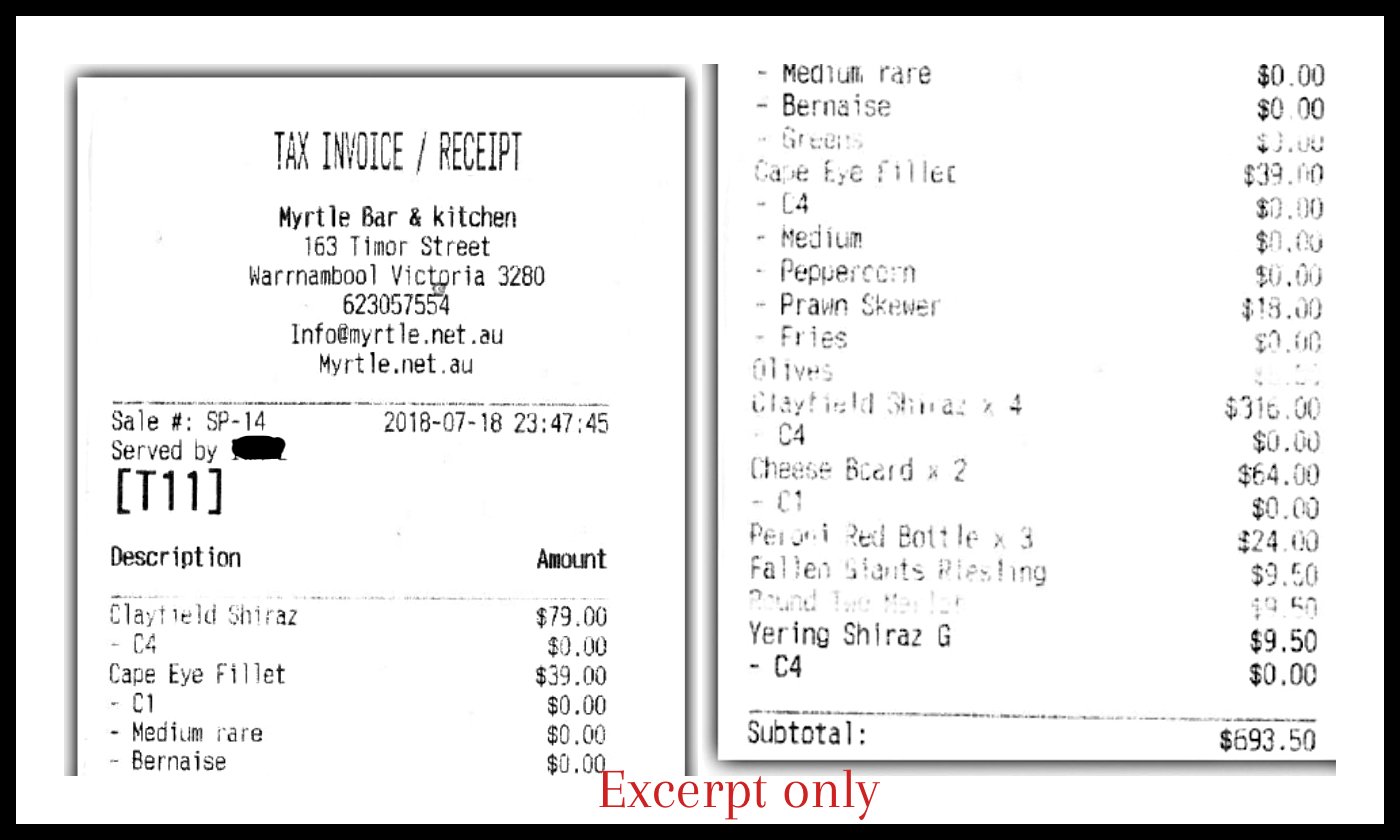
This is the card that was used, among many other things, to pay for the $1476 dinner at Pippies, and the $700 dinner at the Myrtle Kitchen which included five bottles of wine at $79 a bottle.

Mr Paton was very polite in his response to my emailed questions last week, but he is gagged from answering me directly, such is the council’s tight grip around the throats of those who might wish to talk to journalists.

If he could have spoken to me, Mr Paton might have explained the purpose of the boozy Myrtle Dinner which was attended by four people, including himself and Cr Sue Cassidy.

Cr Cassidy is another name that is significant to this story because Cr Cassidy is one of two councillors on the council’s Audit and Risk Committee. This committee is important because, well, it is designed to keep an eye on audit and risk, ie. the use of public money.

This is the committee that has just been put in charge of the external audit into the use of council credit cards.

You guessed it, Barry the Bullshite Detector has been having a meltdown.

So let’s paint the picture: Mr Paton is the boss of Mr Miller and was the boss of Mr McMahon and was the manager responsible for signing off on all the questionable spending on their credit cards, while at the same time using his own credit card to pay for a long, boozy dinner attended by Cr Cassidy who is a member of the council Audit and Risk Committee that will now oversee the investigation into those cards.

The House of Cards ain’t got nothing on this.

And rolling along behind the scene of this car wreck are three specific side stories that I also want you to know about.

(Intermission. Lights up. Toilet break. Grab a choc top. Right, away we go…)
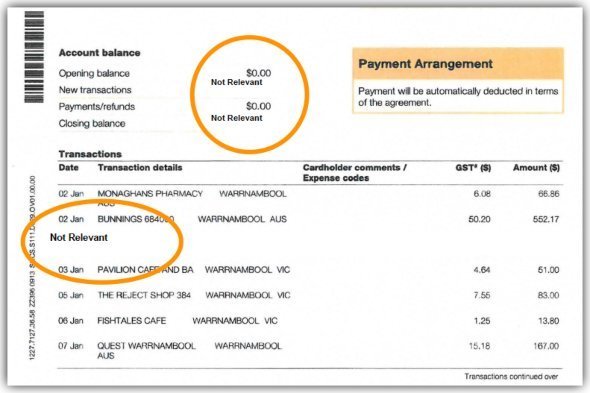
An example of the redacted credit card statements provided by the WCC via a lengthy and costly Freedom of Information process.

Side story one: Freedom of Information. As you know, none of this – none of it – would have seen the light of day had it not been for a Freedom of Information application that I lodged almost a year ago, asking for Mr McMahon’s credit card receipts.

The council did everything it could to stop me getting that information fully and efficiently and the whole process took nine months and a lot of money (#thankyouTerrierTipJar).

Even after the nine-month wait and all that money, we would not have known about the secret repayments and behind-the-scenes deal between Mr McMahon and the then CEO Bruce Anson last November, had it not been for sources.

That whole, disgraceful cover-up was only exposed, here, in July.

And who in the council was in charge of responding to my Freedom of Information applications about the credit cards?

The CEO’s executive assistant, Wendy Clark.

So, to try and find out information that ultimately involved the actions and decisions of the former CEO, I had to go through the former CEO’s executive assistant.

And if I wanted to dive deeper and detail the tens of thousands of dollars of credit card spending on behalf of Mr Anson – he didn’t use his own corporate card to buy, for example, the cases of wine enjoyed after council meetings  – I would need to go through the same executive assistant.

Does that pass the pub test?

And just to tangle that web a little more, Ms Clark, the CEO executive assistant, is the senior staff member who has lived in a council-owned CBD apartment for more than 30 years and for most of that time has leased it on nothing more than a handshake deal.

That suspect arrangement existed until I started asking questions and learned, wait for it, a written lease had been miraculously signed just a few weeks before my probing.

This is the rotten culture I am talking about.

It stinks and it has to end.

Side story two: former tourism chief Mr McMahon was a bully and made life hell for a lot of people, especially women. He came to the council with a reputation as a bully that somehow escaped the attention of those who hired him, but which I have since substantiated.

This is how this whole story started, not from people contacting me to talk about his credit card abuse – although that was raised too – but because of Mr McMahon’s foul-mouthed bullying and a desperation to be heard, because nobody in council was listening.

I told  Cr Tony Herbert about this bullying when we met last August in the meeting that he now fails to remember much about at all. Cr Herbert did nothing. The council did nothing. #goodbloke #heLikesAdrink

Nothing happened to Mr McMahon – he stayed in his top job while so many around him fell away, distressed and exhausted, and he stayed there right up until his dishonesty around his credit card expenditure finally caught up with him last July.

How was Mr McMahon hired in the first place? Why was he allowed to get away with all that he did? And why on earth – why on earth – did current CEO Mr Schneider praise him upon his departure?

This is how the council boys’ club works and it is part of the rotten culture that I am talking about.

It stinks and it has to end.
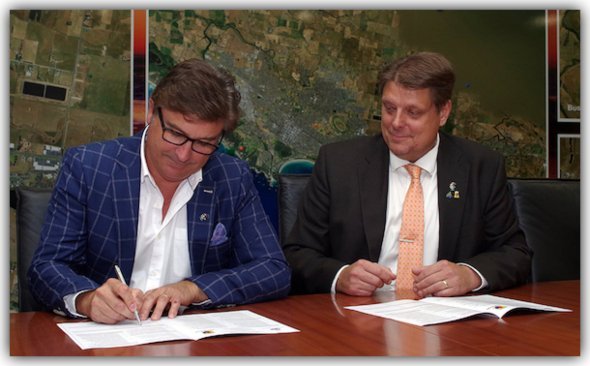
Mayor Tony Herbert signs an MOU with the Mayor of Mariestad Johan Abrahamsson after a delegation from Mariestad and Nilsson Energy visited Warrnambool last April. Image: WCC

Side story three: Mr Miller has two jobs. One is full-time with the council and the other, as I reported recently, is with a start-up called Acusensus, which Mr Miller joined in March this year as International Business Development Manager and for whom he works 7.6 hours a week.

The chairman of Acusensus is a smart, charismatic guy called Ravin Mirchandani.

Before Mr Miller joined the WCC in 2016, he and Mr Mirchandani were in upper level management at a company called Mack Valves, which makes valves for things like hydrogen pumps.

Mr Mirchandani is still the director/chairman of Mack Valves and is now also the Australian representative of a group called Nilsson Energy, based near the regional city of Mariestad, Sweden.

Mr Mirchandani became the Australian rep of Nilsson Energy after going to see its work in Mariestad in June last year and, it seems, came away very impressed.
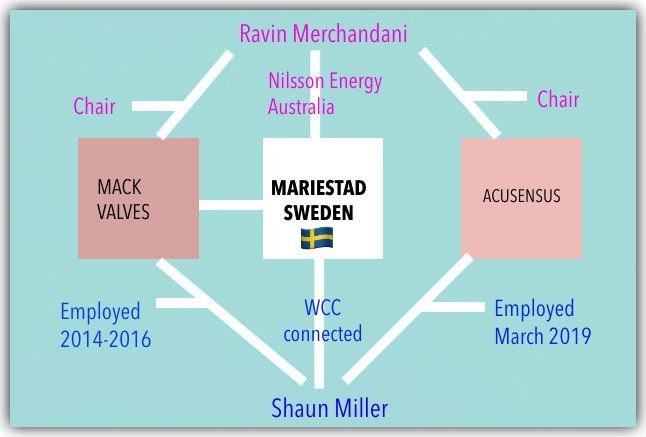
Ten months later, in April 2019, Mr Mirchandani was part of a delegation from the city of Mariestad and Nilsson Energy that was invited to visit Warrnambool and talk about using hydrogen electricity, which is the next big thing and has companies jostling for a slice of the action.

Mr Miller was a key driver and organiser of this Warrnambool visit, which saw Mr Mirchandani share the stage at Deakin Uni with government reps.

As a result of that April trip, Warrnambool CC and the city of Mariestad signed an MOU to share ideas and information and keep the momentum moving.

Tomorrow night’s council meeting (2/9) will decide whether to send our Mayor, CEO and a council staff member – I wonder who that might be? – to Sweden to visit Mariestad before the end of the year. The public will help pay for the cost of that trip.

And this is the nub: nowhere, at no time, has there been a public declaration by the council of Mr Miller’s active business links to Mr Mirchandani and any potential conflict of interest that may arise from the Mack Valves/Nilsson Energy Australia/Acusensus connection.

In fact Mr Mirchandani’s name is missing from the list of names in tomorrow night’s council agenda of those who visited Warrnambool with the Mariestad delegation in April.

Zero transparency.

This is the rotten culture that I am talking about.

It stinks and, despite hundreds of hours of investigation into all of the issues above, I am still only just touching the surface.

Curtain falls. Lights up. Credits roll.

Credits: all of the brave people who have trusted me to tell the truth, I see you and I want to thank you. And Dad, as I write this on this Father’s Day, I see you too, even though you are long dead. My Dad was a bricklayer who got up at 5am every morning to make the money to pay his rates. I have done the best I can to get the fresh start in Warrnambool that we all deserve; it is now up to our elected officials, and our leaders, to press the reset button. On we go.
Terrier Tip Jar


A silent old shed speaks volumes about WCC waste

Carol Altmann – The Terrier

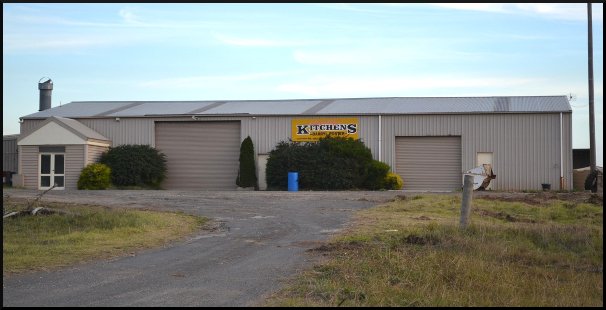
It isn’t pretty, but this old shed speaks volumes about the waste that has gone on within the Warrnambool City Council (#notallWCCstaff) over the past decade.

Long-time followers of this site may remember that this shed cost the council more than $100,000 in 2015: $40,000 to buy it and $63,000 to pull it down and relocate it from Wangoom Rd to west Warrnambool.

It is my understanding that it has since been sold off by the WCC for $2000.

$2000.

It has basically been reduced to scrap metal, at a loss of $101,000 to ratepayers.

That is $101,000 that could have been used far more productively elsewhere.

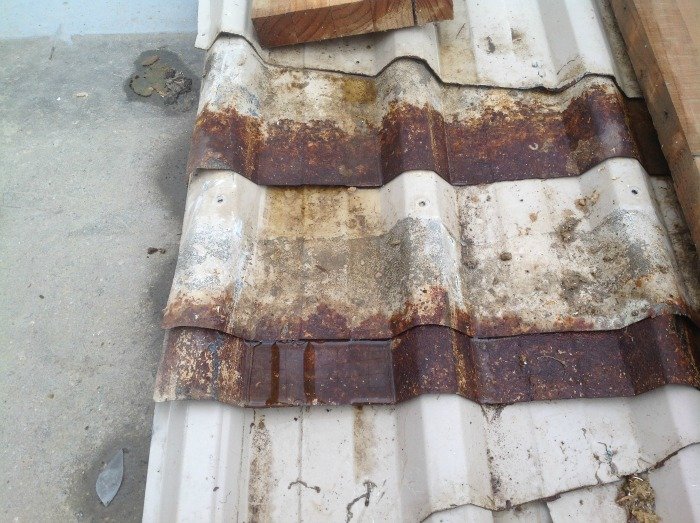
The back story to this shed is that it was supposed to become part of the WCC depot, but the cost of reassembling it, and its poor, rusty condition, saw that idea tossed out the rollerdoor before it had even rolled.

The condition of some of the panels removed from the former Wangoom Rd shed bought by the WCC in 2015.

The WCC tried to cut its losses early by auctioning off the shed before it was moved from Wangoom Rd, but it was passed in at $20,000 after failing to attract a single bid: nobody wanted to pay good money for a rusty old shed that would cost a mozza to move and re-assemble.

We – the poor old ratepayers – were stuck with it and have since taken a $101,000 hit.

How does this sort of waste happen? (#notallWCCstaff)

This is the question underpinning the push for a forensic look at all council spending from the last 10 years and the decision making and policies around this spending, because it is this decade of waste that is now coming home to roost.

It goes beyond the council’s 81 corporate credit cards, even though credit card spending is a full-colour, big-calorie category that leaps off the page.

It extends to rusty sheds, and roundabouts, and toilet blocks, and Flagstaff Hill upgrades, and $3 million blowouts on Liebig St, and trips to China, council marquees at the racecourse, endless conferences, blowouts on the Simpson St tunnel, the exorbitant contract to run the pound….you get the picture.

Ratepayers expect to pay rates.

But what ratepayers also expect is a clear return on their investment.

We want to see the council spend our money wisely and cautiously: every cent of it.

It doesn’t matter if the dollars are coming from ratepayers or taxpayers – it is all public money and this is why Ratepayers Victoria is taking such a close interest in what is happening in Warrnambool right now.

Ratepayers Victoria has written again to the council this week, in light of Mayor Tony Herbert saying he didn’t believe there was a need for an independent audit into the council, even though all the other councillors now agree that there should be one.

RV is joining the call for a full review of council spending, going back 10 years:

“We would respectfully suggest that unless council conduct a 10-year retrospective audit of all council staff and councillor expenditure and publish it fully and frankly then you will not sufficiently address the groundswell of community anger,” the letter says. (Read the letter in full here).

RV is spot on there.


At the end of the day, all ratepayers are asking for is transparency and accountability: two little words that roll off so many councillors’ tongues and turn up in so many council reports.

Transparency, accountability…and showing us value for money.

It’s not much to ask for, and the community is asking for it now.

If you would like to support the work of The Terrier, please consider throwing something in the tip jar.

Terrier Tip Jar


Is W’bool City Council a bloated boys’ club? The sums say yes.

Despite rate capping and a growing staff salary bill, life at the top of the Warrnambool City Council remains lucrative.

By Carol Altmann

Some time ago, a young Warrnambool lawyer who likes to crunch the numbers told me that our council was big, fat and bloated with an unsustainable salary bill for a city this size.

More recently, there has been a steady stream of people, all women, contacting me to say the council had turned into a dispiriting boys’ club, despite more women on the ground.

Having taken a closer look, I believe they are both right.

Let’s start with the bloat.

There are 731 people working at Warrnambool City Council (full time, part time and casual) and last financial year the cost to ratepayers was $31.5 million.

At the same time, the council collected $31.05 million in rates (not counting the $4.7 million waste management fee, which goes directly to providing a garbage service).

Look closely at those two figures again and you will see that every single dollar collected in rates  – $31.05 million – is equivalent to the amount needed to cover the cost of the staffing bill of $31.5 million. 


This financial year, the gap will widen.

WCC staff costs will jump by another couple of million to $33.2 million and rates, meanwhile, will bring in $31.97 million, which would actually not cover the bill.

With a cap on rates, something needs to give, and perhaps the first place to look is in the upper deck, where the salary packages are lucrative compared to those working at the grassroots.

According to figures given by the council to a parliamentary inquiry into rate capping, in 2016 the council had 21 senior officers each earning a total salary package of more than $120,000 a year – that equates to more than $2300 a week (before tax and including super, etc). 

This figure, by the way, doesn’t include the CEO, Bruce Anson, who has a package currently between $310,000 – $320,000.

When I asked the council if it still had 21 senior officers earning a total salary package of more than $120,000 a year, it was hard to get a straight answer.


Instead, it provided a convoluted response about the intricacies of the Local Government Act and a list that shows only seven senior council staff now earn a package of more than $130,000 a year, including the CEO and someone who does not report directly to the CEO, but who earns a sweet package of $145,000. (Who could that be?)

I am not sure where the other 15 staff have disappeared to, but I suspect they are still earning more than $120,000, and I suspect they are among the 22 senior people listed in the council’s “organisational structure” on its website, although I don’t know this for sure.

I can confidently say, however, that the vast majority of these big earners are not women, which brings us to the second point about the council becoming a boys’ club.

Leaving aside broader and worrying allegations that I have been receiving about how the boys’ club operates – I will save that for another day – I am going to focus simply on the numbers.


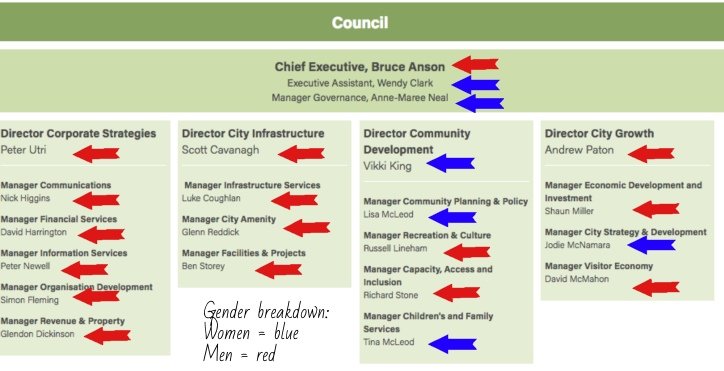
Check out the chart below:


As you can see, there are only six women in the council upper ranks, and only one, Community Development head Vikki King, holds a director position.

Two departments – Corporate Strategies and City Infrastructure – don’t have any senior women at all and City Growth has just one.


But wait, the council will say, we have more women than men on staff, which is absolutely true. There are 497 women, but only 227 full-time equivalent (45%), which means the majority are casual and part-time.

By contrast, there are 234 men, of which 163.8 are full-time equivalent – this is 70%.

As we all know by now, just having women around doesn’t make a place gender equal.

What really matters is what the women do, the positions they hold, and the influence they can wield (just ask the Federal Liberal Party) and, on this score, our council is seriously lacking.


If you are interested in transparency within government, visit The Guardian’s new The Transparency Project, which is exactly what journalism used to be about and can continue to be, thanks to donations, crowdfunding and partnerships rather than paywalls.

If you would like to support local, independent journalism, please consider making a contribution below. Thankyou to all of you who have already done so. 


Donate


WCC leasing deals: a wall of silence…and a shiny new shed

The council-owned residence at the Archie Graham Centre is part of a former bank building.

By Carol Altmann

The Warrnambool City Council has pulled down the shutters on its leasing rules that have allowed a senior staff member to rent a council-owned apartment for more than 30 years.

It is two weeks since the story broke about a senior staff member renting a central apartment at the Archie Graham Centre for 31 years (@ $190 per week) and another staff member renting a beachside house for 14 years (@ $221 per week), with no end date for either lease.

Despite an enormous response to the story from people wanting to know more, the person in charge of such things, Revenue and Property Manager Glendon Dickinson, has declined to be interviewed.

A whole series of questions I sent to both him and the WCC media manager, Nick Higgins, have been left hanging.

These questions include basic things like who sets the rent? How often is the lease renewed? How were the tenants selected? How is the rent paid? Does the rent include utility bills?

After several days, the only comment forthcoming was this:

“Our leases are guided by State legislation including the Residential Tenancies Act.”

Do you find that answer satisfying? I find it insulting: not to me, but to all WCC ratepayers, who actually own these buildings.

The public service has very different rules around transparency, compared to a private company, but what we are seeing at WCC is not transparency, but secrecy.

One thing that is impossible for the WCC to ignore, however, is the new garage and sealed driveway that has appeared behind the apartment in question at the Archie Graham complex and has cost ratepayers $43,000.

The single garage was built by council to replace a dilapidated three-bay garage (two bays of which were used to store council junk) that was demolished to make way for new works at Heatherlie homes.

I understand the single garage was budgeted at $12,000. The project came in “around” $43,000.

Mr Higgins said the final cost included the garage ($11,638), rebuilding a collapsed retaining wall, restoring a garden bed and “the sealing of a previously gravel laneway”.

This laneway, which is the expensive part, is not used by Archie Graham clients, but, according to Mr Higgins, only “used by neighbouring tenants and the residential tenant at Archie Graham”.

The $43,ooo was pulled from the capital works budget for the Archie Graham Centre, the managers of which must be either scratching their heads, or beating it against a wall, at such an expense.

In explaining the cost, Mr Higgins said the council had received more rent from the “flat” over the years than it had spent on maintaining it.

You would hope so.

The rental income from the “flat” had also helped subsidise the maintenance of Archie Graham, he said.

Again, you would hope so. Paying rent, after all, is part of the deal when leasing a property.

But both of these things, really, are beside the point.

The point is that we still don’t know the full details of this lease agreement and how it came about.

The WCC – unlike dozens of councils I have looked at – does not have a property leasing policy which is designed to keep things transparent.

The only way WCC ratepayers would know these leases exist is to visit the council offices and ask for a physical document that very few people know is there.

So why does any of this matter? What is the public interest?

Well, first, the properties are owned by Warrnambool ratepayers. They are the “landlords” here and I think they deserve to know what is going on.

Second, these two leases are unlike any of the WCC’s other residential leases. Every other WCC residential lease either provides public housing for disadvantaged tenants, or short-term accommodation for new staff.

Thirdly, the leases are not part of a salary package and are not required as part of a job description, such as a caretaker at a caravan park.

So, combining all of these factors, the crux of this issue is twofold:

  1. How did two council staff, out of more than 350 staff, manage to secure leases in prime-location, council-owned and maintained houses, that have lasted for decades?

  2. Do these arrangements breach the Local Government Act?

I still don’t know the answer to #1 and I may never know.

But I do know that under the Local Government Act, if a council lease is to be for more than 10 years, the details must be publicly advertised. This is to allow people to a) know about it and b) have a say.

So how does an ongoing lease of 30-plus years slip under the radar?

Simple.

Break the lease into, say, five year lots – and keep renewing that lease each time. Presto, you have a lease that stretches for decades, with very few people knowing about it, and nobody having a say.

Something doesn’t add up here and until it does, we need to keep asking the questions, no matter how uncomfortable. And this is what I plan to do.

If you would like to support local investigative journalism, please make a small contribution below.

Donate


WCC continues to close off public scrutiny

meeting
The Warrnambool City Council has decided to become more transparent by moving more of its business behind closed doors. Image: thenerve.org.

Analysis – Carol Altmann

It would sound like a line from Monty Python if it weren’t so serious, but the Warrnambool City Council is increasing its transparency by moving more of its business behind closed doors.

That’s right: as part of its decision to finally podcast its monthly meetings so people can listen online, a majority of councillors agreed (4-2) to no longer allow councillors to ask questions in “general business”, but to have such questions restricted to council briefings, which are closed.

On top of this, the podcasts will be edited, as necessary, by the Chief Executive Officer before they are released.

This is not about transparency, but about control.

It is part of an ever-increasing damage control mentality that is engulfing the council because some councillors refuse to stick to the script and raise issues that are uncomfortable or potentially embarrassing.

These are issues, I would strongly argue, that the community has every right to know about.

Take, for example, the recent decision to spend up to $50,000 on a shed that nobody else wanted and which will cost up to another $90,000 to move (it is still sitting out on Wangoom Rd, by the way). This issue was raised by Cr Brian Kelson in general business, as were questions about the saga of the missing Loch Ard ingots (and other historic items) from Flagstaff Hill.

Does the public have a right to hear about these things as part of an open council meeting? Of course it does.

porter shed
The council’s purchase of a unwanted shed for up to $50,000 was among the issues that have been revealed through general question time. Image: Bluestone Magazine.

The truth, however, is that it is becoming increasingly harder for anyone to ask questions of the council, or to express a public opinion on its performance.

This has even extended to the council monitoring comments by the public that appear on social media.

Bluestone is among those who have been sent letters by the council in response to comments made on Facebook – in our case it was a broad, hot-headed swipe by a reader claiming the council was “corrupt” – asking for proof of the statements made so it could investigate them further.

While such hyper-vigilance against alleged corruption is admirable, the message from the council is clear: we’re keeping an eye on you.

Working alongside this monitoring is a well-oiled public relations machine inside council, where information is issued via a carefully prepared media release and then dutifully reproduced almost verbatim by the mainstream media.

This way, the council hopes you, the ratepayer, only get to hear all of the “good” news, because nobody has the time, or opportunity, to find out more.

Like Oliver Twist, Bluestone always asks for more, but, like Oliver Twist, we are rarely obliged.

Let me give you just one example.

Whats-in-the-box
Image: www.lemauricien.com

Earlier this year, Cr Jacinta Ermacora made front page news with revelations that $250,000 had been spent on sorting out various legal disputes and in-fighting between councillors over the past two years, including $150,000 to employ a governance officer to handle these issues.

Such an extraordinary revelation deserved greater scrutiny and so Bluestone asked for a breakdown of this $250,000: where had the money gone and on what? And what was the role of this governance officer? Was she hired to deal only with litigious matters between councillors or was her role much broader?

Despite several emails to Cr Ermacora, the council’s director of corporate services Kevin Leddin and the council’s media manager, Nick Higgins, we are still waiting.

In the meantime, there has been not one shred of extra information given to the public about where a quarter of a million dollars of their money has gone.

The next step, if we were to pursue it, is to lodge a Freedom of Information application, which costs money and can take months.

Having said that, we have recently lodged FOIs for other matters, including the investigation into the “Wilma Wright” letter writing saga, and the investigation into the missing artefacts from Flagstaff Hill, because it is one thing to report the outcome of those investigations, but quite another to learn how they came to these conclusions.

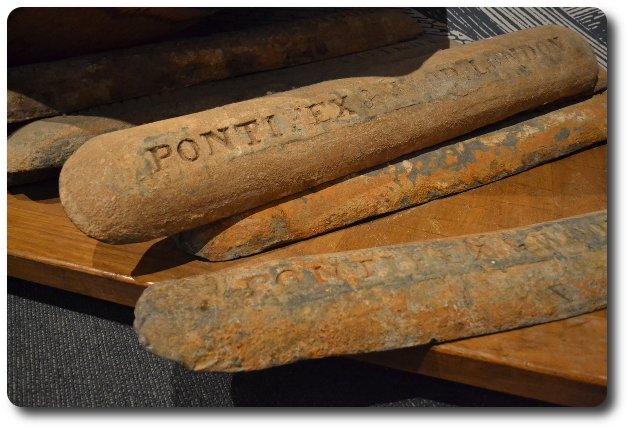
A close-up of the Loch Ard ingots, each of which bear the maker's mark.
The full extent of items missing, unaccounted for, or lost at Flagstaff Hill Maritime Village was only exposed after questions asked in an open council forum.

This is the tightly managed WCC world which already operates and the removal of general question time it is only going to make it worse.

There are also moves afoot to make it harder for the public to ask a question at council meetings, and journalists will need permission to record an open meeting, which in this age of digital media is so ridiculous it is beyond comprehension.

Combine this with a new policy that says councillor emails can be monitored and reported back to the CEO and you are inching toward a system based on paranoia rather than transparency.

This is a concern for the media, of course, but it should be of even greater concern for the people of Warrnambool.

As I have written about before, the ability to ask questions of our government bodies, be they state, federal or local, is critical to a thriving democracy and each time information moves behind closed doors, we become further disempowered.

foi
www.lemauricien.com

The council is justifying all of this because of laws around defamation, copyright, privacy and conflict of interest, all of which already influence how the council operates and should not change one iota because of podcasts.

But if we needed any more proof that such undemocratic changes are unnecessary, we only have to look at other councils who podcast or live stream. We picked one – Hobson’s Bay City Council, around Altona.

It has been podcasting since at least early 2014 and a quick look at a council agenda and minutes reveals there are “Questions from Councillors”, “Public Question Time” and, lastly, “Urgent and Other Business”.

That looks like a council leaning forward, not turning inward.

The fact that a majority of our councillors, unlike Hobson’s Bay, support less transparency, rather than more, is completely at odds with why we elect councillors in the first place.