Lyndoch: potential conflicts of interest, and a new exec
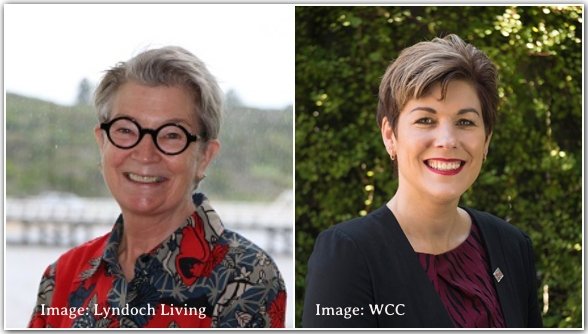
Former TAFE executive Julie Bertram, now a permanent part of the Lyndoch Living executive, and former W’bool City Councillor Sue Cassidy, now Lyndoch chair.

Carol Altmann – The Terrier

Oh, the tangled web. Warrnambool can be a very, very small place when it comes to who knows who, and who ends up where, how, and why.

Which is why I asked Lyndoch Living this week how it manages the potential conflicts of interest around Lyndoch board member and now Lyndoch chair, Sue Cassidy.

I asked this because Ms Cassidy, who joined the Lyndoch board in 2017, is married to David Cassidy who operates Cassign: a very successful signage company that has operated in Warrnambool since 1983.

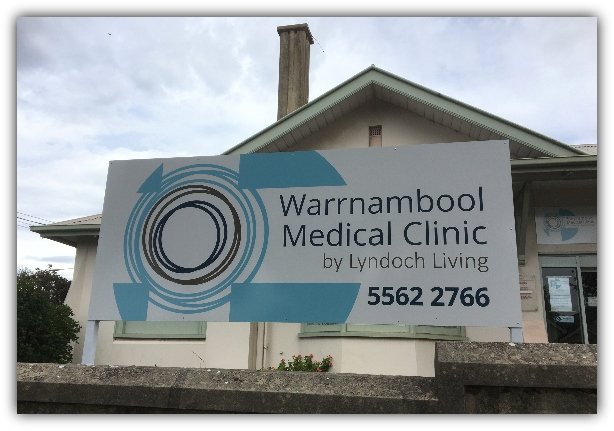
Cassign has done a lot of signage for Lyndoch Living these past few years, including the Lyndoch bus and the new signage at the Warrnambool Medical Clinic that, last year, was bought by Lyndoch Living for $1.3 million.

Cassign also provided the installation work for the swish flat-screen TV that now sits at the drive-through entrance to Lyndoch Living.

Most recently, as I understand it, Cassign replaced old signage outside the new Swinton Wing with a sparkling new sign that, among other things, directs people to the “Lyndoch Medical Hub”.

I know more than I probably need to know about Cassign, because I have raised the issue of potential conflict of interest before, when Ms Cassidy was a Warrnambool City Councillor and voted on issues to do with racehorse training on our local beaches.

At that time, I questioned how Ms Cassidy could be part of any such discussions when Cassign sponsored horse races in Warrnambool.
In response, Mr Cassidy sent me a series of long and passionate emails setting out why – in essence – my stories were all a crock and there was no potential conflict of interest and his wife was a modern woman who ran her own business, while he ran his.

I saw it differently – and I still do. Which brings me back to Lyndoch Living.

This week I  asked Lyndoch Living (and Ms Cassidy) whether Lyndoch put out a tender for its signage work and, given Cassign has done at least some of this work to date, how it managed any perceived conflicts of interest.

The answer, as always, was no answer.

We shall have to make up our own minds.

In the meantime, you may recall that a couple of weeks ago I wrote a piece about Lyndoch looking for yet another senior executive to add to its ballooning executive team which has grown from 37 in 2017 to almost 60 in 2019.

This newly created position – Director of Research, Enterprise and Education – was worth more than $100k a year, was advertised only internally and for only around 10 days, leading me to speculate that someone was already lined up for the job.

That someone, I took a punt, was Julie Bertram, a retired director from South-West TAFE, who this year has been filling a maternity leave position in the Lyndoch executive.

Lo and behold, guess who today was announced as the winning candidate for the job? Ms Bertram.

While Ms Bertram is no doubt perfect for the role, the bigger question is why Lyndoch’s executive team seems to have an ever-increasing number of new staff in roles that, between them, must cost a fortune.

For what purpose and for what return to Lyndoch and its residents?

This latest position comes on the heels of Lyndoch recording a $1.9 million deficit – its fifth deficit in five years.

It also comes amid unconfirmed reports that Lyndoch’s at-home gardening staff will soon be dismissed because they are costing Lyndoch money.

And it comes as we start the countdown to Lyndoch’s full financial figures for 2020 being released in January through the Australian Charities and Not for Profit Commission.

I wonder if the food bill for Lyndoch will have increased from the paltry average of $13 per resident, per day, in 2019?

The silence from Lyndoch is always deafening when it comes to my questions, but rest assured that I will keep asking.

As always, if you would like to support the work of The Terrier, please visit the tip jar.
Terrier Tip Jar


Red zone: Lyndoch posts $1.9m deficit, assets slide by $20m

Despite a 2019 spending spree which included buying the Warrnambool Medical Clinic, Lyndoch’s overall asset base is going south.

Carol Altmann – The Terrier

Lyndoch Living last financial year recorded a $1.88 million loss – its fifth deficit in five years – and its bottom line has gone backwards by $20 million since 2015.

This, unlike what was reported in the local paper after last Tuesday’s invitation-only Annual General Meeting, is the reality behind the spin.

Here is the nub: Lyndoch is not growing, but going backwards, and we need to know why, especially as it pushes on with a $100 million masterplan funded mostly through loans.

We also need to ask why, in the face of such losses, Lyndoch continues to hire more executives on executive salaries, but more about that later.

First to the numbers, which are so easy to spin.

What Lyndoch pushed in the newspaper, and in a piece of puffery it produced for the AGM called a “Community Report”, was a measure called an “underlying profit” of $2.18m.

As has been pointed out by Deloitte, underlying profit is one measure that can be “useful” to judge financial performance, but can also be “misleading if used to mask bad news”.

And Lyndoch had some bad news.

The thing is that Lyndoch’s $2.18m “underlying profit” doesn’t take into account expenses such as interest on loans, depreciation, under-performing investments, and taxation.

These are real costs and when these costs are factored in, Lyndoch’s “profit” vanishes.

In fact these costs chewed up more than $4 million and Lyndoch ended the financial year not in surplus, but $1.88 million in the red.

This is the figure we should be looking at.

This is the  “total comprehensive income” – and it is not good news.

Even more troubling, however, is the slow and steady decline in Lyndoch’s bottom line (its net assets) over the past five years.

This has fallen by a staggering $20 million from $69m in 2015 down to $48m in 2020.

Despite Lyndoch last year buying the Warrnambool Medical Clinic, the Health Spot clinic and the May Noonan hostel in Terang for a cost of around $3.3m, its asset base has not improved, but gone backward.

As one learned accountant said to me last week, “this is a company that is diminishing, not growing”.

Again, this is not good news.

Like last year, we will have to wait until late January to see the line-by-line figures reported by Lyndoch to the Australian Charities and Not-for-Profits Commission, because these days Lyndoch provides just a simple snapshot at its AGM.

Only by seeing the line-by-line figures will we see the full picture.

Nobody asked a single question at the AGM (test: try and find the video buried on its website here), which is not surprising, given Lyndoch does not allow any outsiders to become members let alone board members.

To me, the fact Lyndoch now has a new, fast-tracked president in hairdressing salon owner Sue Cassidy, who has no experience or qualifications in health, disability or aged care, is troubling.

But the lack of any open and robust accountability around Lyndoch in real-time is frightening.

I do, however, know this: just three days after posting a $1.88m deficit, Lyndoch advertised for yet another high-paid executive to join its ever-expanding executive team.

This newly created position for a “Director of Enterprise, Research and Education” is being advertised internally only and applications close in less than two weeks, which suggests someone is already being lined up for the role.

(My tip is the Acting Director of People and Resilience, Julie Bertram, a retired director of South-West TAFE, who has been filling a maternity leave position.)

It’s a powerful role and includes acting as CEO when the CEO is on leave, which previously fell to the Director of Nursing.

Five years ago, when Lyndoch hired its new CEO Doreen Power, Lyndoch had 37 people in administration. By 2019 it had 59.

All indications are that it is now above 60.

I wonder how the nurses and personal care workers and “hands-on” staff caring for the residents across Lyndoch feel about that?

As always, I wait for the board or our local MPs to ask the hard questions on our behalf and, in the meantime, we all just keep chipping away.

If you would like to support the work of The Terrier, please consider a small monthly tip into the tip jar.

Terrier Tip Jar


Public confidence in WCC crashes to an all-time low

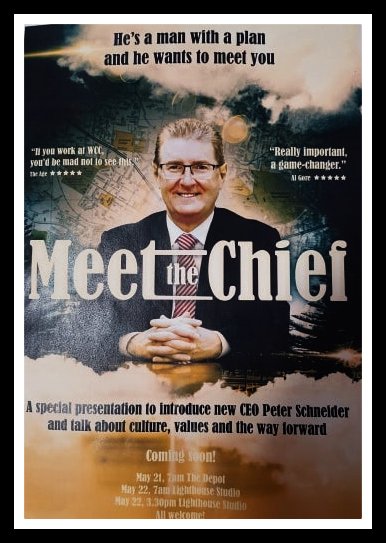
The appointment of a new W’bool City Council CEO in Peter Schneider came with high hopes, but he has struggled to turn the ship around.

Carol Altmann – The Terrier

Today (22/6) the Warrnambool City Council fell off a cliff and we need to know, right now, what our CEO Peter Schneider is going to do about it.

The annual WCC community satisfaction survey results released today show the overall performance of the WCC is at its lowest recorded level – ever.

Absorb that for one second.

Its overall score of just 42/100 is lower than the darkest years of the past decade.

It’s far lower than the regional average (56) and the state average (58), despite several councils having been dismissed, exposed or shamed.

Confidence in our council’s direction has crashed to just 32/100.

The ability to make community decisions scored a paltry 38/100.

Of the 28 different areas independently measured – from parking to tourism to traffic – satisfaction was down on every single measure, bar one (the environment, which stayed the same).


This is not just a failure, but a full-blown crisis.

As the survey company warned in its summary, it is going to take a mammoth effort to turn around.

We are looking to you, Mr Schneider, for answers and direction. This is why we pay you more than $320,000 a year.

But what do we get from our chief?

Well, today we got this statement to Katrina Lovell from The Standard:

“While we can look at the challenging issues that were playing out at the time the survey was conducted – horses on beaches, a councillor resignation, the Reid Oval design, The Lookout proposal, free car parking, ongoing investigations into management of credit cards and the start of COVID-19 restrictions – the reality is that many in the community are not happy with our performance and we must address this,” he said.


We get more excuses.

We get “not happy”.

Where is the plan, Mr Schneider? Where is the hope for change and real connection with the community you serve?

The council would have had these survey results for some time, and yet we don’t get even a hint of a plan, but more platitudes.

I, for one, am sick to death of the platitudes.

And where is the statement from our Mayor?

This is why we have a Mayor, to speak on behalf of the six other people elected to represent us.

Are they shocked? Outraged? Saddened? Determined to start working on this from first thing tomorrow morning?

We have silence.

They just don’t get it. Even after a report card littered with metaphorical Fs and Es, they still can’t reach across the divide and say “we hear you”.

In the meantime, there is a second survey that was released about a week ago, that we won’t see. This is the staff survey which, I have a sense, is equally as shocking.

The WCC will not be releasing those results. I wonder why.

Bring on October – and vote for change.

[The community survey report is 163 pages long and buried on the WCC website. I will drill down into it as the week unfolds. You can find it here.]


Lyndoch: more spent on lawyers and consultants than food

Would you like a lawyer with that? Figures reveal Lyndoch has spent less on food in the past two years than on expert advice. Image: Shutterstock

Carol Altmann – The Terrier

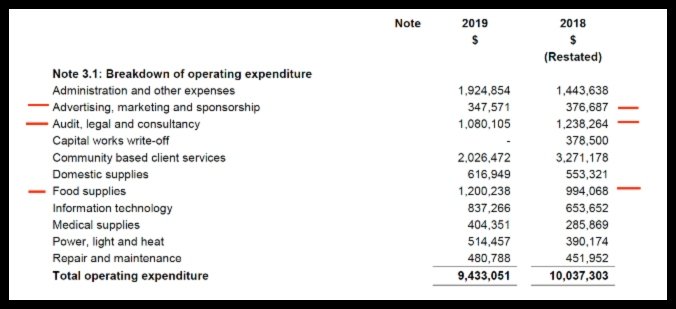
In the past two years, Lyndoch Living spent more on lawyers, consultants and accountants than it did on food for residents.

In 2018 and 2019, Lyndoch shelled out an astonishing $2.318 million on accountants, lawyers and consultants, while it spent $2.194 million on food supplies.

In 2018, the gap between the two was especially stark, with less than $1 million spent on food supplies – $994,068 – compared with $1.238 million on accountants, lawyers and consultants.

Chew on that for a moment and I suspect you will feel the same sense of indigestion that came over me.

These unpalatable facts are among the many that fall out when you take a close look at Lyndoch’s financial statements – and a lot of terriers are now taking a good, hard look at the figures, both old and new.

This is how we know that in 2013 the food bill was $992,516, which is not that far off the $994,068 that was spent five years’ later.

Did I miss something? Has the cost of groceries gone down?

I can tell you that what residents pay to live in a nursing home has certainly not gone down nor stayed the same for the past five years.

If you are going to cut costs, surely as an aged care home you don’t start with the food bill?


Judging by the 2019 financials, there is plenty of fat to trim elsewhere, starting with administration costs and the ever-growing number of staff  in the corporate area (59 and counting).

Not surprisingly, the cost of food vs lawyers/consultants/auditors was not mentioned at the Lyndoch Living annual general meeting last October and we can only make the comparison now because of two things:

The full figures have finally been released via the Australian Charities and Not-for-Profits Commission, and, for the first time, legal fees and consultants’ fees have been published in the audited statements.

Lyndoch Living bought the Warrnambool Medical Centre business for $1.3 million and plans to relocate it to a new building at Lyndoch.

Speaking of auditors, wow, has that bill shot through the roof.

Last year, Lyndoch’s auditing costs tripled from $13,950 in 2018 to $48,500 in 2019, which is five times what Lyndoch paid for auditing in 2013 ($9800).

Lyndoch changed auditors from local firm McLaren Hunt (which used to be Coffey Hunt) and replaced them with RSM Australia.

Perhaps a stack more number crunching needed to be done because Lyndoch decided to become a company limited by guarantee, buy two medical centres and also the May Noonan nursing home in Terang (I will write more about the medical centres soon).

But even the auditors were paid small beans compared with the $2.25 million spent on lawyers and consultants in the past two years.

$2.25 million.

Oh my goodness, I really am in the wrong business.


This $2.25 million would include hiring consultants for the $100 million masterplan and to write the (secret) business plan for the new medical centre that Lyndoch intends to start building soon, even though it’s still not sure how much money it needs to borrow to pay for it.

The lawyers, I assume, would also have been hired to guide the masterplan, to set up Lyndoch Healthcare Pty Ltd, and to oversee how Lyndoch now operates as a company limited by guarantee.


There are also the less obvious fees, such as the solicitor “retained” to provide advice to the company secretary, who doesn’t have legal or accounting qualifications.

All of this – millions of dollars in consulting, legal, accounting and administration bills – is such a long, long way from where Lyndoch started as a much-loved, community owned facility for our aged to see out their final years in comfort.

Back in the beginning, people donated their time and their own money to make sure Lyndoch found its feet and this is why there remains such a strong, emotional connection between Warrnambool and our iconic aged care home.

The board needs to get that.

Lyndoch has to grow and keep up with the times, we all get that, but how it is growing – and at what cost – remains at the heart of this investigation and we will keep going.

More soon.

If you would like to see The Terrier keep digging, click on the link below to throw something in the tip jar.


New figures confirm Flagstaff Hill is done and dusted

The new advertising campaign has failed to produce any major increase in visitor numbers.

By Carol Altmann

New, full-year figures for Flagstaff Hill Maritime Village confirm that despite a $3 million upgrade, the village is in a death spiral.

As I wrote a couple of weeks ago, the reality is a lot worse than the pumped up picture given by adding free visitor numbers to the totals.

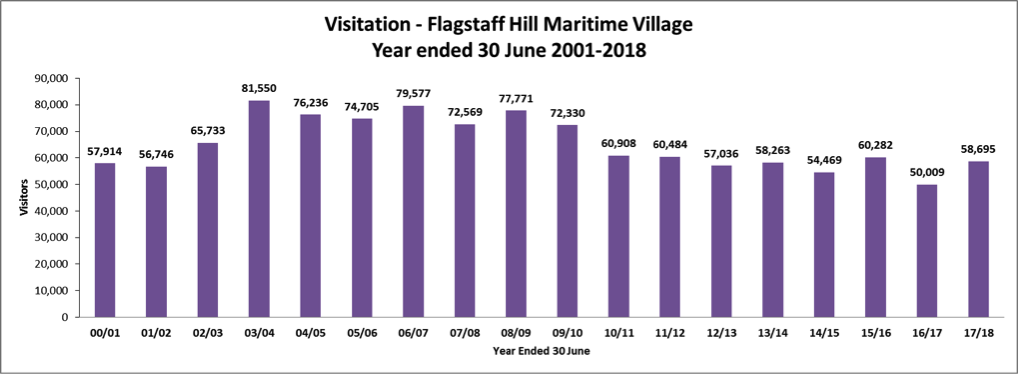
Earlier this week Warrnambool City councillors were told that only 50,000 people paid to visit the site or attend the revamped sound and light show in 2017-18. (Just for comparison, Sovereign Hill averages more than 450,000 visitors a year).

I can almost hear their jaws hitting the table.

Another 8500 people, roughly, turned up for free events in 2017-18 and while that might make us feel good, it is not helping to pay the bills. In fact it adds to them.

To be super clear, 50,000 paying visitors is not sustainable. The village needs at least 80,000 to break even, and more if it is ever – ever – to turn a profit like it used to back in the 70s and 80s.


As it stands, the council is paying more than $500,000 a year to keep the village afloat. This financial year and next, it expects to spend a total of $1.1 million.

What an absolute waste of money and what really grates my wick is that all of this was so utterly predictable.

The council knew, tourism experts knew, and even Blind Freddy Down The Street was on top of it, that sticking a $3 million BandAid on top of a weeping wound is not going to fix it.

Yearly figures released to the Warrnambool City councillors this week. They include free entries that average 7000 a year. The village was closed for six weeks in 2016-17.

Four years ago, Flagstaff Hill was seriously weeping.

An expensive masterplan commissioned by the council concluded that to make any real difference, to actually turn the place around and give it a whole new lease of life, it would have to spend close to $15 million.

We didn’t have $15 million to spend.

So what do you do? Like a home renovator who has run out of money, do you keep trying to patch the house up, or do you cut your losses and move on?

Our council decided to keep patching: Maremma dogs, Oddball, a new light and sound show about hunting whales, hologram characters instead of real people, a new entrance, stuffed toys…patch, patch, patch.

And meanwhile the poor volunteers – without them we would be in even deeper trouble – and the exhausted council staff just kept trying their best while avoiding the bleeding obvious that the cobblestoned pathways weaving through the village were mostly empty.

Flagstaff Hill is a site with huge potential, but the conversation on its future needs to start now.

Ratepayers and taxpayers have every right to be outraged by this waste of money.

We have been let down by our leaders and decision makers and fed a steady, fatty diet of bullshit and spin and now, here we are, with no plan for the future of Flagstaff Hill.

That clear-eyed planning should have started at least five years ago, when the numbers began to slide and the writing was on the wall that Flagstaff Hill has had its day.

It is not Sovereign Hill – which operates under an entirely different structure and system – and it is not IMAX. It was great, once, but times have changed…dramatically.

Now we know the truth, we need to ask our council to set out a new vision for the Flagstaff Hill site.

What does it have in mind? What are the possibilities? What are the limitations? (Being on Crown land is one of them).

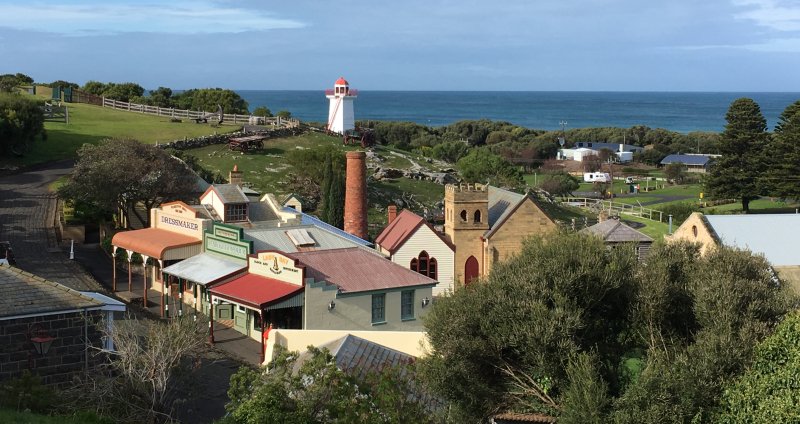
The Flagstaff Hill site is magnificent. The views are spectacular and the lighthouse section is authentic, historic and already showing its appeal as accommodation. What’s next?


Whatever happens, we can’t do it on our own. It will need partnerships or investors or entrepreneurs to not only help set the course, but to fund it.

We only have to look across at the revitalised Fletcher Jones site, currently being transformed into The Warrnambool Motor Museum, to see what is possible. A decade ago, that site was almost given up for dead.

The same can happen with Flagstaff Hill, but we need to ring the bell and start turning away from the rocks now, or the greatest shipwreck of all will be itself.

If you would like to support local, independent journalism, please make a small contribution below.

Donate