Did the WCC backdate a lease to cover its backside?

Carol Altmann – The Terrier

Why did the Warrnambool City Council last July suddenly move from a handshake deal to a written lease for a council-owned flat rented by a staff member for more than 30 years?

This question needs a whole separate story, and this is it.


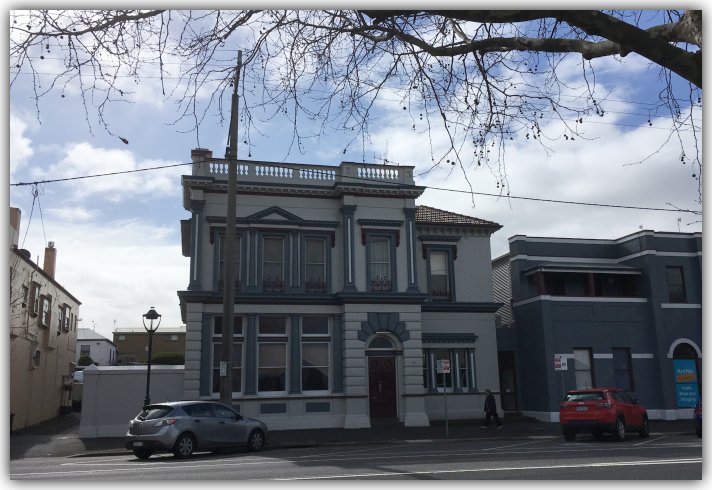
To re-cap, the property in question is attached to the Archie Graham Centre at 130 Timor St, where the senior council staffer has lived since 1987.

And as I wrote yesterday, thanks to Freedom of Information* we now know that for decades the council had nothing in writing to cover this tenancy, including rent payable, any bond, term of the lease, utilities, repairs and replacements.

The council instead relied purely on a handshake deal, until July last year.

Why July last year?

Stay with me here, because this is where things get murky.


On 30 July 2018 I asked the council my first questions about this tenancy.

On 21 August 2018, the first story was published, prompting a huge response from readers.

In the days before that story was published, the council refused to provide a copy of the lease and shut down questions by saying it had “nothing further to add” – case closed.

Not quite.


I lodged an FOI application* asking for a copy of the lease agreement. These things take time, often a long time, and a copy of the lease was finally provided in mid December 2018.

The lease provided started on 1 July 2018 and ends on 30 June 2019 (and included at least three typos – see photo below).


It was immediately obvious to me that there was something odd about this lease document.

The big red light was the start date: 1 July 2018. 

Was it just a massive coincidence that I asked questions on 30 July 2018 about an on-going lease that just happened to be put in writing – after 30 years – from 1 July 2018?


The smell of fish was getting strong, but it became overwhelming when I asked the council spokesman in April why the council suddenly decided to put the lease in writing last July.

Here is his answer in full:  “While a verbal lease agreement is legally acceptable – and was accepted by both parties to the lease – given the external interest in the property Council decided to prepare a written lease.” (my emphasis)

So the written lease was in response to questions by The Terrier.

But hang on, there’s another red light: the official council date stamp on the lease is 18 June 2018 – five weeks before I began asking questions. (See photo below).
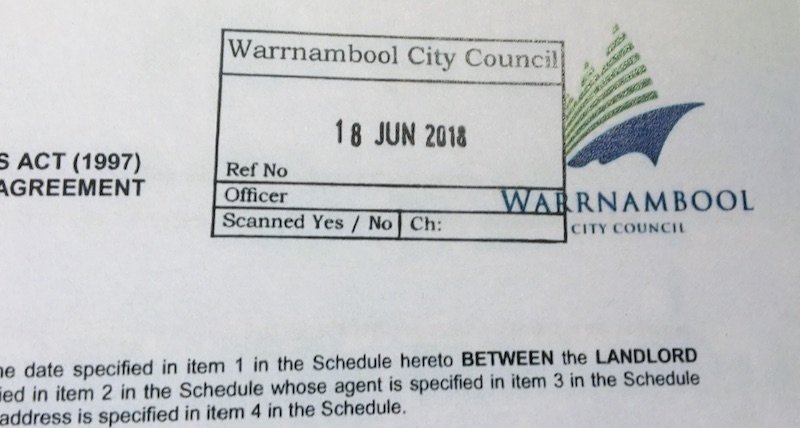
 

I went back to the council spokesman and asked if he could explain how the date stamp pre-empted my questions, and the explanation shifted.

The written lease was now the result of an internal review.

This review of council properties was apparently held in early 2018 and, blow me down, after 30 years, it zoned in on 130 Timor St.

“External advice was sought and provided and one of the actions arising from this review was the preparation of a written lease for 130 Timor Street,” the spokesman said via email.

“The lease was drawn up in June 2018 and executed by the tenant and returned to Council on June 18,” he wrote (my emphasis).

Wait a second. Which one was it? Was the written lease prompted by The Terrier’s questions in July, or by the internal review?

I again asked the council spokesman – (are you still with me?) –  and, this time, it was both:

The move to have written leases for Council residential properties – although verbal lease agreements are legally acceptable – had two drivers. 

“One was you, the other – which preceded your interest – was external advice and a review undertaken by our property manager,” the spokesman said via email on 8 May. (my emphasis).

Whichever way I look at it, this date stamp just doesn’t add up. You can’t draw up a lease in June in response to questions asked in July.

So what am I trying to say here?

Well, I am saying that I believe when The Terrier started to ask questions and asked for a copy of the lease, this written lease was hastily prepared and dated retrospectively, to make it appear as if it had always been in place.


I don’t know who was involved in the preparation of this lease, but it was ready to go when I lodged my first FOI.

I believe things came unstuck, however, when I lodged a follow-up FOI, asking for a copy of any earlier written leases for this property.

There were none and this exposed the handshake deal that had been in place for 30 years – a handshake that I don’t believe we were ever supposed to know about.

Given the conflicting explanations, all the markers point to that conclusion.

Does any of this matter?

Yes, because this whole saga strikes at the very heart of the WCC’s transparency, governance and accountability for managing our public assets: that is the nub of it.


A 30-year handshake deal for a council-owned apartment might be legal, but it is a very dubious way to run the show.

As for the possibility of manipulating date stamps on documents, well, I will leave that for you to contemplate.

And this is why I am not naming the tenant. The name doesn’t matter: what matters is that this whole situation has been sanctioned by our council for years, to the point of hurriedly drawing up a lease, and this is of serious concern to me.


This is what makes this whole story of public interest and why I have pursued it for almost a year.

A final word from the council spokesman:

“Council no longer has verbal lease arrangements in place for residential properties that have a lease of more than 12 months.”

That, at least, is a start to ending the rot.

***

This story is the Terrier Tip Jar at work. All of the above is now public because of a series of Freedom of Information applications that were paid for by supporters of The Terrier. To be part of it, click below:

Terrier Tip Jar


Nothing in writing for 30-year lease to WCC staff member

Carol Altmann – The Terrier

Almost a year ago, The Terrier revealed a senior staff member of the Warrnambool City Council had been living in a council-owned, CBD apartment for more than 30 years.

Since then, I have been trying to get a copy of the lease.

As it turns out, there wasn’t one: the deal was based on a handshake deal.

This handshake deal – a verbal lease agreement – apparently covered everything from annual rental reviews, to repairs and the $12,000 replacement of a garage.


First, a quick recap.

The council-owned apartment in question is in the old bank building at 130 Timor St, which is part of the Archie Graham complex and where the staff member has lived since 1987.

According to the council responses to my questions last July and August, the apartment is leased for $190 a week, with the rent reviewed annually.

Any repairs to the property were also included in the rental agreement, it said, including a $12,000 garage that was built for the tenant mid-last year after an old garage was demolished as part of larger works at Archie Graham.

(To get the full background, you can find my earlier stories here and here and here. You can find the council’s original response and justification for the ongoing lease here. It essentially argues that because the property is linked to the Archie Graham complex, it would be difficult to rent out to most people.)

Given the prime property is owned by the people of Warrnambool, I was keen to see a copy of the lease agreement that had covered its use for three decades.


The council refused to supply a copy, so last October I lodged a Freedom of Information* application and in December last year was given a copy of a lease.

This lease shows a start date of 1 July 2018 and and end date of 30 June 2019. (More about this document later).

I lodged a second FOI application, this time for a copy of the lease that was in place before 1 July 2018 and that is when things shifted from the unusual to the unbelievable.

This FOI revealed that there was no written lease in place for a public building, for 30 years, before the one I was given that shows a start date of 1 July 2018.


To quote the FOI officer: “I have conducted a thorough and diligent search for the document you have requested, however as a result of gaining internal advice I have been informed that the document does not exist.”

“The reason for the nonexistence of the document is that prior to the current written lease, the preceding lease was verbal,” she wrote.

Verbal lease agreements are not illegal, but for long-term leases they are rare and I would suggest in government they are virtually non-existent.

The only time a verbal lease might be used in the public service is for short-term rentals, say up to three months, while a new staff member finds their own accommodation.

When it comes to a council lease of more than 30 years, for a CBD apartment owned by the public, you would assume a written lease would be mandatory.


I doubt you would find any other council among the 79 in Victoria that would have a similar, handshake deal in place with a council staff member, or anybody else for that matter.

In fact, when I first wrote about this apartment last year, I couldn’t find any other council that rented long-term accommodation to a staff member unless it was part of their contract, like a caravan park caretaker.

So it begs the question of who at the WCC started this handshake deal in 1987?

And who has since agreed to it continuing?


Most importantly, how did the successive WCC officers in charge of managing council properties ever keep track of it?

Were the annual rent reviews and any increases jotted down on a Post-it note?

And what about responsibility for repairs and replacements – including the $12,000 garage – was that documented in writing? Was there an understanding about the use of power, gas and water? How about a bond?

Apparently all of this detail was kept in somebody’s head.


This on-going, open-ended, verbal-only arrangement came to an end last July, when a written, 12-month lease was finally put in place, which opens up another whole storyline.

To be blunt, I believe how this written lease suddenly came about smells more than a fish-cleaning bin at the Hopkins River on a hot summer’s day.

That is the next instalment and you can read it tomorrow night.

****

This story is the Terrier Tip Jar at work. All of the above is now public because of a series of Freedom of Information applications that supporters of The Terrier have funded. To be part of it, click below:
Terrier Tip Jar


Titbits: WCC staff meet the Boss, and those Aquazone dollars

Carol Altmann – The Terrier

The Warrnambool City Council offices were buzzing yesterday as dozens of staff were seen piling into the Lighthouse Theatre studio for what some passers-by thought might be a mass union meeting.

But no, it was not a union meeting, but a meet-and-greet with new CEO Peter Schneider who still remains a bit of mystery man since starting the new job in February.

According to a somewhat embarrassing movie-style internal flyer that was, I guess, a bit of fun from the council’s public relations team, the sessions were a chance to MEET the CHIEF.

“He’s a man with a plan and he wants to meet you.”

Heavens.

This blockbuster event was a chance for staff to be introduced to Mr Schneider and “talk about culture, values and the way forward”.

The flyer “reviews” said it was a presentation not to be missed and a real “game-changer”.

This all sounds positive, even if the flyer scares me with its machismo, slightly Trump-esque tone.

Hopefully there are plans for a a public screening of this “blockbuster” so we can all hear about Mr Schneider’s culture, values and the way forward too.

An update on last night’s Facebook post about $985,000 being spent at Aquazone this year to improve water treatment and air quality at the pool.

I wondered out loud where the money was coming from, given the 2018-19 budget set aside $540,000 for the water treatment works and next year’s budget makes no mention of any Aquazone works at all.

The answer came today from council spokesman Nick Higgins who said the rest of the money dates back to the 2017-18 budget, when $420,000 was set aside to fix the roof, but was never spent.

Further investigations, he said, revealed the roof was being ruined by an old air handling system, so it was decided to fix the roof AND the air circulation problem in one.

So this is why, as we speak, the whole she-bang adds up to close to $1 million.

Pools are expensive to maintain and it seems heated, indoor pools are even more expensive: in 2015, the council spent $178,000 re-tiling the changerooms at Aquazone and the pool is not yet 20 years old.

Hold your breath, because I sense the $985,000 this year is just the beginning.


Titbits: spending up, trees down and doin’ the Sharp shimmy

Carol Altmann – The Terrier

There are so many wasteful decisions being made in our city at the moment that I’m going to throw it all into one big bowl for you and call it a dog’s breakfast.

First, the Warrnambool City Council has just advertised three new senior management positions at around $100,000 a year that will add, roughly, at least another $300,000 a year to its wage bill.

This comes, of course, as the council awaits to hear whether it is allowed to raise rates above the 2.5% cap to 4.5% for the next three years because it needs to save $700,000 a year.

Hiring more senior staff…while trying to save money. I can’t work that one out.

The three new positions include not one, but two management positions to work on developing Reid Oval so that it can host AFL practice matches, even though council-operated childcare and home care services may have to be cut and the art gallery (still) gets just $15,000 a year to spend on buying new art.

Welcome to the spending priorities in the city of WooBoo.

The third position is a project officer who will help develop the new joint library with TAFE.

All three positions run until 2022, which means a total salary bill of at least $300,000 x three years = $900,000.


This comes on top of the current contingent of senior council staff already earning over $100,000 and any consultants that, no doubt, will also be brought into the mix.

In 2016, the council had 21 staff earning a total salary package of more than $120,000 and, last year, it spent $900,000 on consultants. Let’s not forget the CEO position also attracts a salary of more than $310,000.

My eyeballs are watering.

Any day now the Essential Services Commission will rule whether the council has done enough to cut its discretionary spending, which brings us to the Sharp shimmy…

As we know, Sharp Airlines is shimmying off stage and ending its passenger service from Warrnambool to Essendon.

This is not a shock. In fact, it was entirely predictable, given the airline planned to close the route in January, but was offered $300,000 of public funds to try and turn things around by May: an almost impossible task.

Should Sharp have taken the money? Should it have just said “no thanks, we’re closing and that’s it”?

That is up for debate, but the bigger question is why did our council – our financially strapped council – provide $78,000 of that money? Why?

Sharp didn’t ask for it, but the council – apparently via former CEO Bruce Anson – handed it over anyway.

It is this sort of waste that makes ratepayers’ hair stand on end. Which brings us to chopping down trees for more bitumen.

Paving paradise: an old New Zealand Christmas tree is chainsawed to make way for a new footpath in Kepler St. Image: supplied.

As we know, the council recently and reluctantly saved two 115-year-old Moreton Bay fig trees from being axed to make way for a new footpath, only to last Friday cut down an 80-plus-year-old New Zealand Christmas tree in Kepler St…to make way for a new footpath.

It did so without consultation or notification, which means its tree policy is not worth the paper it is written on.

A council spokesman told the newspaper (I didn’t get any answers to my questions on this topic) that the tree had to go because the public was baying for a high-quality roundabout at the corner of Timor and Kepler streets.

Did you hear any baying? I didn’t.

Did you see any petition with hundreds of signatures saying please build us a high-quality roundabout on Kepler St? I haven’t.

What I have heard is person after person saying please stop wasting our hard-earned ratepayer and taxpayer dollars.


What I have also heard is people saying please stop turning our CBD into an urban wasteland of cement and concrete and pavers, where trees are seen as a problem, not part of the solution.

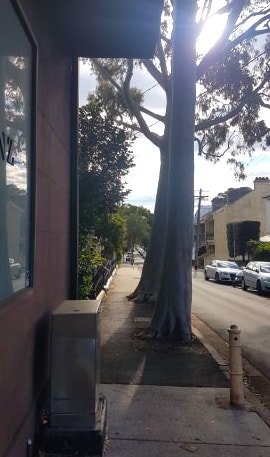
Meanwhile, in Paddington, the trees and pavement and pedestrians get along just fine. Image: supplied.

Other cities, truly cosmopolitan cities like Hobart and Sydney, value their trees.

In Hobart, they put rubber matting over the roots to protect the pavement and the tree.

In Paddington, Sydney, they let the trees grow right up through the pavement and people go around them or use the path across the street. Radical, hey?


The revitalisation of the CBD started out as a reason for celebration, but after a $3 million cost blowout and an ongoing obsession with building enormous pedestrian crossings and new roundabouts, it has turned into a financial nightmare.

We can only hope that we all wake up soon.

If you would like to support local, independent journalism, please consider making a contribution below. Thankyou to everyone who has given a tip!

Terrier Tip Jar


Ouch! WCC sports ground fees climbing by 100%

A move toward a 100% fee hike to use council sporting grounds is now in its second year and starting to hurt. Image: Sportsflix

Carol Altmann – The Terrier

It’s amazing what falls out of a budget when you give it a good hard shake, like the 100 per cent fee hike over four years for the use of Warrnambool’s public sports grounds.

Ouch! How is that for a whack in the cahoonas?

Just like the big whack to register your dog in 2019, the new fee structure started as part of an earlier Warrnambool City Council budget (2017-18), but the full impact is only starting to bite as sporting clubs receive their second batch of bills.

With my stellar sporting career now well behind me – (err, cough) – I had no idea this fee crunch was happening.

Local clubs certainly do.

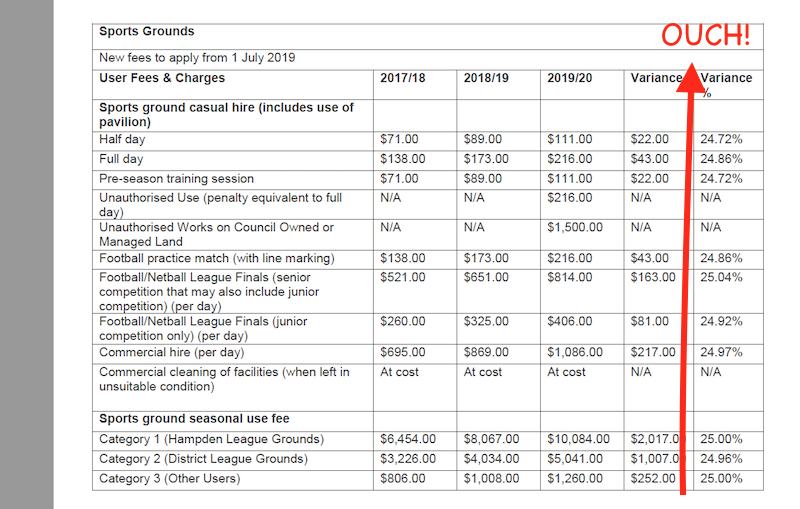
Having paid 25% more last financial year, clubs are now paying another 25% on top of that, and will do so again, so that by the end of 2020-21 the user fees will have fully doubled.

You can see the fee increases for yourself in the snapshot below, but, for example, a District League, Category 2 sportsground that was costing a cricket club $2581 per season in 2016-17 was bumped up to $3226 the following year, and by the end of the next financial year will cost $5041 per season.

The change is all part of the council’s move to a stronger “user pays” system to off-set the costs of maintaining and operating its 14 sports grounds, which cost around $635,000 a year.

Before the major fee hike, only about 10% of this cost was covered by the clubs.

The council is now moving their share of the cost to 25%.

This might all make sense financially for the council, but for small, not-for-profit sports clubs, it is proving a big pill to swallow.


As one cricketer said to me, we have to remember that the $5000 fee for his club is for only the length of a cricket season, not a full year, and that many clubs already rely heavily on volunteers, sponsors and donations to survive.

Back when the idea of a major fee hike was first raised, at the end of 2014, club representatives piled into the Lighthouse Theatre to listen to council recreation and culture manager Russell Lineham explain the council’s thinking and, at that time, he assured clubs that nobody wanted to see them go out of business.

Now that the 25% a year increases are actually here and starting to hurt, it appears that some clubs are worried about just that. It also appears that some councillors are worried too.


In a letter to clubs earlier this year, Mr Lineham said the council had received both written and verbal feedback from clubs and, as a result of their concerns, the fee structure was now under review.

“Council officers will undertake a review…to determine whether any changes can be made to improve the equity of fees levied to the various tenant clubs,” he wrote.

In the meantime, however, the winter season bills are due and must be paid.

So if you see a sporting club out turning sausages at Bunnings, be sure to buy one…or two…or even three.

If you would like to see The Terrier keep digging up, sniffing out and chewing on local issues, please consider throwing something in the tip jar.

Terrier Tip Jar