Are the financial fears around Lyndoch Living now coming to pass?

Speculation is mounting that financial concerns around Lyndoch raised more than 18 months ago – and ignored – are now coming home to roost. (Modified cartoon from original by Cam Cardow, Ottawa Citizen.)

Carol Altmann – The Terrier

The plot thickens around the departure of the Lyndoch Living CEO, Doreen Power, with speculation that Ms Power’s sudden exit up the Princes Highway is linked to financial issues surrounding Lyndoch that are now under investigation.

I’ve spent the past nine days digging into exactly why the axe fell so quickly on the CEO last Thursday week (Aug 4) after years of allegations about Ms Power’s management style fell on deaf ears and the Lyndoch board continued to back her to the hilt.

As was reported here, Ms Power was confronted by board chair Sue Cassidy and treasurer Kane Grant and, soon after, left her office armed with two bags of belongings.

As was also reported here, the day before Ms Power left, WorkSafe had received a long list of complaints about Lyndoch lodged by a law firm on behalf of the complainants.

This could have been the final blow.

But no.

I have since learned there is mounting concern about Lyndoch’s financial position, including whether information relied upon to build Lyndoch’s financial picture has been accurate.

These concerns include:

the financial impact of changes to the payment system for home care packages, with Lyndoch no longer having access to a big pot of home care funds ($2.5 million as of March 2021) that sat in its bank account;

whether this big pot of funds for home care packages was used to pay for other services – say, for example, toward the new medical clinic – in the hope it could be later topped up by home care clients (a Ponzi-style approach);

the financial impact of much greater competition in home care packages, which has gouged Lyndoch’s home client list;

the financial impact of having between 50 and 55 empty beds across Lyndoch and May Noonan Hostel – unprecedented;

concerns about the impact of rising interest rates on the $12 million borrowed by Lyndoch to fund its new $22m medical clinic;

concerns about the financial impact of having five apartments for sale in the Waterfront Living complex;

the difficulty of selling these apartments amid concerns about the deteriorating condition of their exteriors;

concerns Lyndoch must legally pay out the owners and/or estate of these apartments after a certain time, regardless of whether the apartment has sold;

concerns raised by residents within Waterfront Living about the location and use of their annual maintenance fee/sinking fund.

That’s a lot to take in, but it all comes down to cash flow: what Lyndoch expected to bring in, what it has to pay out.

And the terrible possibility facing the Lyndoch board is that all is not what it seemed.

Two important things to say here:

First is that residential accommodation bonds are guaranteed by the Federal Government, so – regardless of where this ends – these are protected by law and residents and their families can take comfort they are not at risk of losing their money.

Second is that the resignation of the most recent Chief Financial Officer was clearly yet another warning bell.

In fact four Chief Financial Officers leaving in four years is not just a warning bell, but a big loud hooter that wakes everyone in the night.

If what I am being told now is correct, and I believe it is, then what we have always feared is coming to pass.

We tried to warn the board and they didn’t listen.

Collectively, this house-of-cards scenario was raised more than 18 months ago on this page, by the Terrier, then by former Chief Financial officer Allan Conway, and then by the Keep Lyndoch Living group which formed because of unanswered questions over Lyndoch’s finances.

Mr Conway set the alarm bells off, but nobody listened.

The Keep Lyndoch Living team led by Jim Burke and Prof James Dunbar tried to raise the alarm, but nobody listened.

And The Terrier – 162 stories later – tried to raise the alarm, and nobody with the power to act, listened.

But the board is listening now and so it must, because they are responsible for not asking the hard questions.

It is now incumbent upon the board chair Sue Cassidy and treasurer Kane Grant to step up and tell us what is going on.

They need to assure the community that all is well, that none of what I have raised here is correct, that Lyndoch’s finances are exactly as they should be, and that Ms Power is on annual leave because she decided to take a holiday to Port Douglas.

Now is the time for plain speaking, not bullshite about annual leave.

Now is the time for absolute, rock solid, honest truth.



Lyndoch posts record loss as it ploughs on with masterplan

Lyndoch Living aged care is sailing into un-charted waters with big borrowing, big spending and a sharp decline in its overall equity.

Carol Altmann – The Terrier

Lyndoch Living’s full financial figures dropped late today and here is a quick snapshot:

Lyndoch last year posted a record loss of $4.029 million – almost $2 million up on the loss of the previous year.

In 2020, it posted a loss of $2.4 million.

In 2019, it posted a loss of  $1.88 million.

In 2018, it posted a loss of $1.77 million.

In 2017, it posted a $846,000 surplus.

Er, is this supposed to be how a not-for-profit operates? Not breaking even, but running at continual losses?

More importantly, Lyndoch’s net worth has dropped to $40 million in 2021, down from $48 million in 2020 and $69 million in 2015.

This net worth/equity figure  comes from adding up all of Lyndoch’s assets (around $100m), and subtracting all of its liabilities.

Lyndoch’s assets have hovered around the $100 million mark for several years now.

What has changed are the liabilities – they keep going up, up and up.

In 2018, Lyndoch’s liabilities were $37 million

In 2020, Lyndoch’s liabilities were $47 million.

In 2021, they were up to $60 million.

All of this cuts deep into Lyndoch’s overall financial position.

Lyndoch is borrowing big, it is taking risks, it is investing in a $22 million medical centre that is due to be finished mid-year, ploughing ahead with its $100m masterplan and somewhere in all of that is a whole lot of hope – by us – that it will all work out.

Hold on to your hats, me hearties.

[The full figures are available through the Australian Charities and Not for Profits Commission. I will pull apart the figures in detail in coming days.]


Shrinking or growing? Crunching the numbers on Lyndoch

Carol Altmann – The Terrier

Lyndoch Living is definitely getting bigger, but is it getting better? The numbers say no.

The reason I keep writing a lot about our community-owned aged care home is to put on the public record what is happening under the change of leadership and change of direction since 2015.

It’s important that we – as the community who own Lyndoch – keep track of what is going on, because nobody else is telling us.

We are the custodians of Lyndoch and the community will be here way past whoever happens to be in charge, so yes, we need to keep track of what is going on.

We owe it to Lyndoch, the residents, the staff, and those who helped create Lyndoch more than 50 years ago.

This is why tonight I am running this little chart, because it captures how Lyndoch is travelling financially.

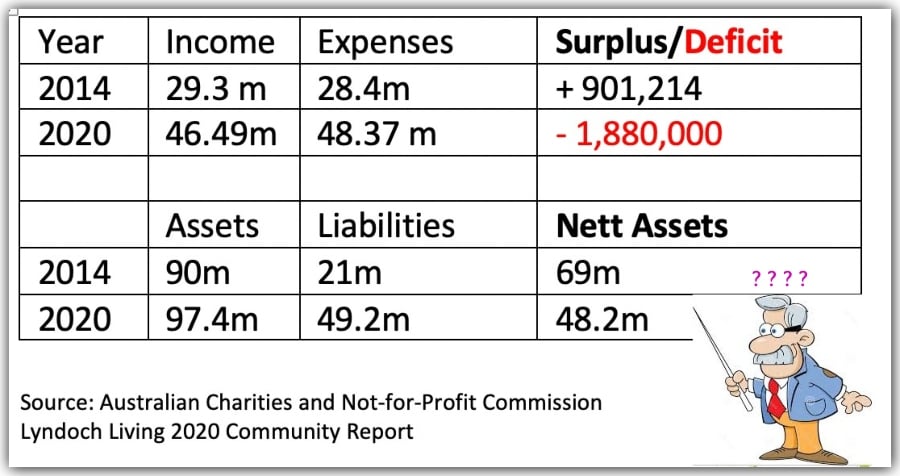
It shows that before 2015, Lyndoch ran at a small profit/surplus or was break even.

This year, it posted its biggest loss – close to $2 million.

Lyndoch has run at a loss for five of the past six years. From my research, this is unprecedented in recent times.

At the same time, its assets have gone up, but so have expenses – they have more than doubled.

This has meant a $20m cut to its net assets in just six years.

Is this visionary? It is sustainable? And why, when it comes to cost cutting, do we hear of cuts at the coalface, and not in the corporate?

Speaking of which, it’s worth remembering that the very first thing to happen under the $100m masterplan now being rolled out by Lyndoch was an upgrade of the corporate area.

Out with former CEO Rhys Boyle’s old wooden furniture and in with the fingerprint resistant glass table.

We still don’t know how much that corporate re-vamp cost but it was an early sign of the shifting priorities.

We still don’t know, exactly, how much the Swinton Wing re-vamp and extension cost, but estimates are it blew out by $2m to $13 million.

And coming up next is a new two-storey medical clinic to be built next to Scoborio Reserve with, it is said, radiology, pathology, acute care and educational facilities alongside up to 20 GPs.

Lyndoch will bulldoze Tomlinson Wing and its gardens to make way for more glass and cement.

How much will that all cost to build and set up? We don’t know.

Is this all necessary? Is it all sustainable?

These are the questions I would like to ask the board – our eyes and ears at the table – and I am sure you would like to ask too.

In the face of their silence, we just keep pressing.


Red zone: Lyndoch posts $1.9m deficit, assets slide by $20m

Despite a 2019 spending spree which included buying the Warrnambool Medical Clinic, Lyndoch’s overall asset base is going south.

Carol Altmann – The Terrier

Lyndoch Living last financial year recorded a $1.88 million loss – its fifth deficit in five years – and its bottom line has gone backwards by $20 million since 2015.

This, unlike what was reported in the local paper after last Tuesday’s invitation-only Annual General Meeting, is the reality behind the spin.

Here is the nub: Lyndoch is not growing, but going backwards, and we need to know why, especially as it pushes on with a $100 million masterplan funded mostly through loans.

We also need to ask why, in the face of such losses, Lyndoch continues to hire more executives on executive salaries, but more about that later.

First to the numbers, which are so easy to spin.

What Lyndoch pushed in the newspaper, and in a piece of puffery it produced for the AGM called a “Community Report”, was a measure called an “underlying profit” of $2.18m.

As has been pointed out by Deloitte, underlying profit is one measure that can be “useful” to judge financial performance, but can also be “misleading if used to mask bad news”.

And Lyndoch had some bad news.

The thing is that Lyndoch’s $2.18m “underlying profit” doesn’t take into account expenses such as interest on loans, depreciation, under-performing investments, and taxation.

These are real costs and when these costs are factored in, Lyndoch’s “profit” vanishes.

In fact these costs chewed up more than $4 million and Lyndoch ended the financial year not in surplus, but $1.88 million in the red.

This is the figure we should be looking at.

This is the  “total comprehensive income” – and it is not good news.

Even more troubling, however, is the slow and steady decline in Lyndoch’s bottom line (its net assets) over the past five years.

This has fallen by a staggering $20 million from $69m in 2015 down to $48m in 2020.

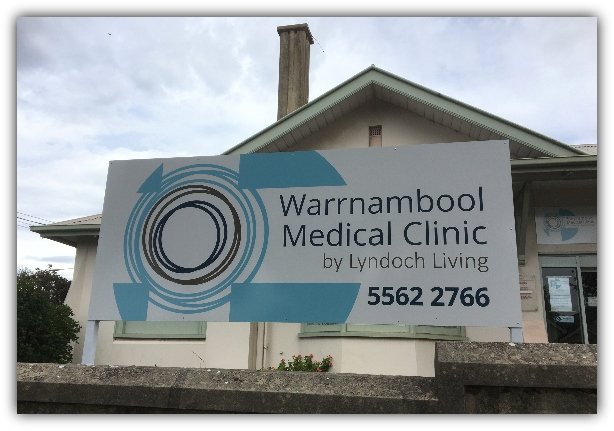
Despite Lyndoch last year buying the Warrnambool Medical Clinic, the Health Spot clinic and the May Noonan hostel in Terang for a cost of around $3.3m, its asset base has not improved, but gone backward.

As one learned accountant said to me last week, “this is a company that is diminishing, not growing”.

Again, this is not good news.

Like last year, we will have to wait until late January to see the line-by-line figures reported by Lyndoch to the Australian Charities and Not-for-Profits Commission, because these days Lyndoch provides just a simple snapshot at its AGM.

Only by seeing the line-by-line figures will we see the full picture.

Nobody asked a single question at the AGM (test: try and find the video buried on its website here), which is not surprising, given Lyndoch does not allow any outsiders to become members let alone board members.

To me, the fact Lyndoch now has a new, fast-tracked president in hairdressing salon owner Sue Cassidy, who has no experience or qualifications in health, disability or aged care, is troubling.

But the lack of any open and robust accountability around Lyndoch in real-time is frightening.

I do, however, know this: just three days after posting a $1.88m deficit, Lyndoch advertised for yet another high-paid executive to join its ever-expanding executive team.

This newly created position for a “Director of Enterprise, Research and Education” is being advertised internally only and applications close in less than two weeks, which suggests someone is already being lined up for the role.

(My tip is the Acting Director of People and Resilience, Julie Bertram, a retired director of South-West TAFE, who has been filling a maternity leave position.)

It’s a powerful role and includes acting as CEO when the CEO is on leave, which previously fell to the Director of Nursing.

Five years ago, when Lyndoch hired its new CEO Doreen Power, Lyndoch had 37 people in administration. By 2019 it had 59.

All indications are that it is now above 60.

I wonder how the nurses and personal care workers and “hands-on” staff caring for the residents across Lyndoch feel about that?

As always, I wait for the board or our local MPs to ask the hard questions on our behalf and, in the meantime, we all just keep chipping away.

If you would like to support the work of The Terrier, please consider a small monthly tip into the tip jar.

Terrier Tip Jar


Lyndoch’s big spend-up powers on despite $1.77m deficit

Lyndoch Living last year recorded its third and most significant deficit in the past four years. The latest financial results will be released next Tuesday at its 2019 AGM.

Carol Altmann – The Terrier

Here’s a little figure that slipped by without too many people noticing: last year Lyndoch Living aged care recorded a deficit of $1.772 million – its largest loss in recent years.

You won’t find this figure in the Lyndoch 2018 annual report online, nor will you find it any media reports, but it can be sifted from a federal website that collects the financial records of charities. Such is my reading list.

It was here I learned that Lyndoch went from an $846,563 surplus in 2017, to a $1.772 million deficit in 2018. It is the third deficit in the past four years under CEO Doreen Power and her board. 

To be clear, Lyndoch Living is a not-for-profit, publicly funded body that is not designed – thankfully – to record fat surpluses on the back of caring for our infirm and elderly.

But nor is it intended to run at a loss without a detailed explanation.

As it happens, the 2019 Lyndoch AGM is next Tuesday (Oct 29), so I wanted to dive into last year’s figures before we find out how Lyndoch is faring this year.

And before I go any further, I also want to make it super clear that Lyndoch Living is full of terrific, hard-working staff who are devoted to making the lives of residents the best they can be. (Hello to you, staff! I know many of you read The Terrier, but are unable to comment. That’s okay, I see you.)

Lots of great stuff happens at Lyndoch.

But it is also blindingly obvious that Lyndoch Living is changing, and Ms Power has, since taking over in January 2015, had her foot to the pedal with big-buck projects and a very different management style.

Aiming high: A $100 million masterplan is now being rolled out at Lyndoch, but where is the money coming from?

In the past 12 months in particular, Lyndoch Living has been on a buying spree.

It bought the May Noonan Hostel in Terang, and the Warrnambool Medical Clinic practice, and the Health Spot practice in Warrnambool, and in the next couple of years, plans to build a new “super clinic” on Hopkins Rd as part of a full-blown, $100 million masterplan to be rolled out over the next eight years.

(Ms Power has a liking for “super clinics”, having overseen an $8 million one in her last job, at Plenty Valley.)

I’m all for a spruce up, but $100 million is serious money.

Lyndoch’s corporate area was first in line for an upgrade – funny how that happens – and now work on Swinton Wing is in full swing, at an expected cost of $11 million.

The simple question behind this head-spinning, full-throttle expansion is: where is the money coming from?

I want to be reassured, as I am sure others do, that this is not yet another case of corporate grandstanding, with big-ticket, capital works projects blitzing the basics like having enough qualified staff looking after our old folk.

(Watch the short Lyndoch Living video below for the full masterplan shebang.)

The Lyndoch Waterfront Living apartments, which are now five years old, are proof of where glamorous projects can stall.

Stage two of that multi-million dollar project has been put on ice after stage one failed to sell out and several apartments on the south side, facing Marfell Rd, remain empty.

Which brings me back to the deficit.

The deficit is just one part of Lyndoch’s big financial picture, but it is also a keyhole for us to peek through, to see what else is happening to our much-loved Lyndoch that has been a part of the local landscape for more than 60 years.

Here is some of what I have been able to unpick so far:

One of the reasons behind the $1.77 million deficit was the cost of “community based client services” going up by almost a third, or $1.2 million.

I emailed Ms Power and the Lyndoch board president, Kerry Nelson, last Wednesday for more detail about these services and the reason for the cost increase. I didn’t get a response.

It begs the question though, with growing demand for home-based care, why spend a fortune on a “super-clinic” and not these services?

Another reason for the deficit was a drop in the value of a Lyndoch building by $1.75 million.

I asked Ms Power and Ms Nelson more about this too, but there was no response.

Overall, Lyndoch last year had assets valued at a whopping $99.7 million – including $6.6 million in cash – and its liabilities were $36.9 million, leaving its overall position at $62.7 million.

That is a nice, fat cushion, but it is also the lowest bottom line in the past five years – in 2014, the total equity was $4 million higher at $68.9 million.

Sorry for so many figures, but it is the only way to pull this apart.

Lyndoch CEO Doreen Power has been all guns blazing since taking over in January 2015. Image: Lyndoch Living.

Here is one more interesting stat: the amount spent by Lyndoch each year on food for clients and residents.

In 2014, Lyndoch spent $1.021 million on food and in 2015 and 2016 it fell below the $1 million mark.

Last year, it spent $1.003 million on food, which is still less than it was five years ago in 2014. Why?

Has a contract changed? The cost of bulk groceries gone down? Are they being bought from elsewhere? Are chia seeds cheaper than homemade chicken soup?

(I was going to put these questions to Ms Power and Ms Nelson as well, but after not receiving any answers thus far, it seemed pointless.)

I will leave aside staffing figures, staff changes and staff morale for now – that is a whole separate story to come shortly – but having pored over a swag of Lyndoch financial reports and deficits, I still don’t know the answer to my simple question:

Where is the money for the $100 million masterplan coming from?

I did ask Ms Power and Ms Nelson this question, but there was no response.

Unfortunately I am going to be away on Terrier duties and unable to attend the Lyndoch AGM at 4pm next Tuesday, but perhaps someone will throw up their hand and ask this question because remember, Lyndoch belongs to us, the south-west community.

In the meantime, I am going to take a punt and say “the bank”, which means “loans”, which means “debt”.

If so, is wading into deep debt a good idea and will it vastly improve the daily lives of those in Lyndoch’s care? That, Terrier readers, is the $100 million question.

If you would like to support the work of The Terrier, please consider throwing something in the tip jar.

Terrier Tip Jar