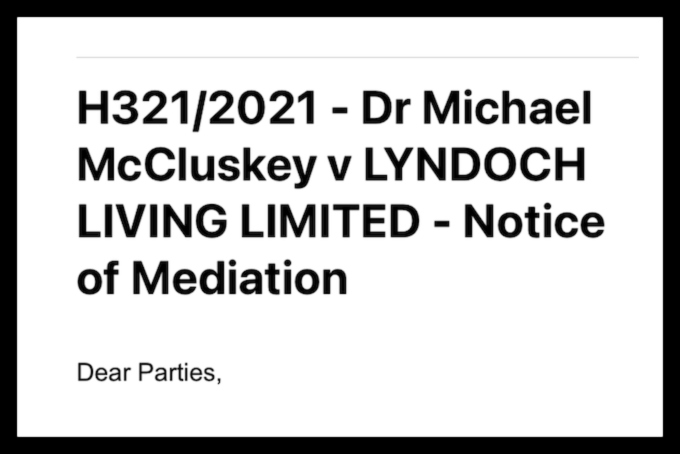
Fight4Lyndoch Living community rally: the speeches

More than 400 people gathered on Scoborio Reserve, next to Lyndoch Living, to rally for greater transparency around the aged care home. Image supplied.

Carol Altmann – The Terrier

For those who couldn’t make it to the Fight4Lyndoch rally last Sunday, here are links to speeches and statements from:

Federal MP for Wannon, Dan Tehan;

Member for Western Region of Victoria, Bev McArthur;

Membership applicant Dr Michael McCluskey;

Former Lyndoch Living nurse Sandy Hockley;

Community advocate Diane Riordon.

Member for South-West Victoria Roma Britnell also gave a terrific speech, but unfortunately a hard copy was only in dot point form, so I have not included it here.

[A video of my speech is available on The Terrier Facebook page.]

I also wish to repeat the simple statement of support offered to the rally by former Lyndoch CEO Rhys Boyle.

Rhys guided Lyndoch for 20 years until his retirement in 2014:

“I support a re-evaluation of the facts to ensure that meaningful and informed decisions are being made that secure the future of Lyndoch,” he wrote.

More than 350 people turned out for the rally on Scoborio Reserve last Sunday, to stand in support of residents, their families and staff, and to hear for themselves the concerns around Lyndoch Living.

Those concerns come down to three main issues:

1. Declining residential care standards, staff shortages and staff resignations;

2.  The financial viability of Lyndoch and, in particular, the sustainability of the $22 medical clinic;

3. The cutting out of the community from Lyndoch, including the end of community/general memberships.

While we await to hear whether the Aged Care and Safety Commission will re-accredit Lyndoch in August, the community fight continues.

For while the commission can act on the first point – residential care – it doesn’t deal with the other two points.

It’s up to us, as the community which owns Lyndoch, to make sure Lyndoch remains transparent and accountable to the community.

After the enormous response to the rally on Sunday, despite the freezing morning, our resolve has only strengthened.


VCAT challenge to Lyndoch’s rejection of members rolls on

Carol Altmann – The Terrier

An update: Warrnambool vet Dr Michael McCluskey is marching on with his VCAT challenge against Lyndoch Living and its flat rejection of members from the wider community.

He now has a date.

Following VCAT’s acceptance of Dr McCluskey’s case late last year, a mediation hearing date has now been set for a videoconference on 10 March.

Dr McCluskey is testing whether Lyndoch Living has broken anti-discrimination laws by refusing to accept his membership application on the basis of his name and gender.

He is not the only one.

I – and one other  – also lodged a complaint with VCAT on these same grounds and, just an hour ago, had an email to say the case had been accepted and a mediation hearing will be scheduled in the near future.

Mediation is the first step in the VCAT process.

As we know, the Lyndoch Living membership application form allows only for a name and address.

On this basis – a name and an address – the Lyndoch board has rejected more than 130 applications for membership over the past two years.

As a result, Lyndoch has no general members.

Along the way, it has also failed to explain why it has rejected every application, including those from health professional and academic Prof James Dunbar, Order of Australia recipient Vicki Jellie, senior South West Health care nurse Kate Sloan, former aged care director Janet Dunn and experienced local business people, such as Marie Bird.

A bucket load of applications was also received from everyday people across the community – like me – who care about the future of Lyndoch, which has been a community asset for more than 60 years.

We are not letting go of our input into a much-loved community asset that easily.

Dr McCluskey said he was extremely pleased VCAT had accepted his application.

“Allowing a broad based community representation amongst Lyndoch Living’s membership is of utmost importance in my opinion if we are to see optimal outcomes for the vulnerable and those most at need amongst us,” he said.

Dr McCluskey said he could speak from personal experience about the importance of maintaining a thriving, community-based aged care home, as he was also a carer.

“We are currently providing 24/7 in home care for an elderly family member and that experience has heightened my awareness as to how crucial it is that we have community based aged care centres operating as caring and effectively as possible.”

Aside from his VCAT challenge, Dr McCluskey is preparing to try again with his membership application for Lyndoch.

He hoped the appointment of local consultant Robert Lane to review Lyndoch’s board membership would lead to an opening up of general memberships.

“I am hoping the appointment of an outside consultant will create a fresh ‘set of eyes’ and lead to a wiser mindset within the decision makers at Lyndoch Living,” Dr McCluskey said.

The shutting out of the community from Lyndoch Living is just one thread to this complex story, but it is a critical one.

General memberships are the only bridge between Lyndoch being fully transparent, or remaining a closed shop where the board has total control and the community remains at arm’s length.

I can only come back to the question of why – why would Lyndoch not want general members?

The challenges to VCAT provide some hope of an answer and – perhaps – a change.

Another challenge will be revealed shortly. Watch this space.


WCC candidate Michael McCluskey chats with The Terrier

CANDIDATE MICHAEL McCLUSKEY

10 QUESTIONS FROM THE TERRIER:

What three main skills could you bring to the Warrnambool City Council as a councillor?

Diversity of employment background having worked as a courier driver, dairy farm hand, Employment Officer in the Federal public service and then as a veterinarian including servicing the agricultural industry. Along with this I have studied extra units at university level in economics, law and psychology and have a passion for finance and efficient business practice.

Firm belief in the importance of a harmonious and cooperative council that is blended with respectful independence of thought. I subscribe to the notion of cherishing those who challenge the status quo as progress is often driven by those who are prepared to go out on a limb as long as they do so in a respectful and collaborative manner.

My strong desire to see decisions based on best available evidence as opposed to being blinded by adherence to a particular ideology. Group think and alliances are often an anchor that holds back progress and rarely benefit the community

Do you see any particular issues, projects or problems in Warrnambool that you would like to work on as a councillor?

The list of specific issues is long however all the best ideas in the world are of limited value unless we have a harmonious council that respects each and every other councillors views. Having a mature and adult approach then leads to a creative and solution focussed council.

I’m acutely aware that economic and social well being are intimately intertwined. Both need nurturing in order for current and future generations to thrive.

Given the Covid19 crisis council needs to support and advocate for local business including hospitality and tourism. Social issues such as domestic violence, affordable housing, mental health, speedier access to surgical services and sustainability are all crucial issues.

Do you think the council could be more “open” with residents and if so, how?

Most definitely.

‘Sunshine is the best disinfectant’.

Openness and transparency are crucial for creating trust in council at the grassroots community level. When we have that, the community feels more inspired and energised to achieve outcomes. Fragmented council that is dogged by personal agendas ‘eats’ into the fabric of community goodwill.

Covid 19-inspired Zoom meetings, whether for work or personal get togethers, highlights just how easy technology can bring council closer to community

The next 12 months is going to be challenging due to the impact of Covid-19 – do you have one or two key idea/s for how WCC could support residents and/or businesses?

Firstly deal with the waste and inefficiency within council itself. As axed CEO Peter Schneider had previously noted ‘the answers to most challenges we face, lie with’.

There is too much wasted expenditure and too many reports and not enough positive action

Speed up the planning process
Reduce rates
Be proactive – approach every business to see how council can help in removing any unhelpful impediments to operations

Do you have any ideas on where the council could cut costs, if necessary, to keep rates at the state cap?

Having worked in the public service I have first hand experience how waste and inefficiency can creep into the system particularly if there is no accountability for work efforts. Focussing more effort into improving productivity outcomes within the council itself is far more beneficial than stripping ratepayers and service users of extra money via rate increases.

Draining ratepayer’s pockets in order to feed a bloated council is unfair and unsustainable.

Preferences will decide who is elected to council. Are you planning to preference most highly new candidates, exisiting candidates or you won’t be putting forward preferences:

I don’t do preferences as I prefer to see the voters choose who they want to represent them rather than be dictated to by me. A key question to ask is the ‘horse trading’ that goes on in preference deals about putting the community first, or the candidate?

Another important element that often gets lost is that ultimately preference deals mean little as unless the person voting follows the preference suggestions then they have no impact on the outcome.

Ultimately the power is with the community by how we structure our ticking of the boxes on the ballot paper.

If you were elected, what ways – if any – would you keep residents and ratepayers informed as an individual councillor?

Under the councillor Code of Conduct individual councillors have certain constraints on what can and can’t be said.

More importantly we need council as a whole to be as open and transparent as possible, especially within the way it communicates to the community.

If you were elected, what would you have liked to have achieved at the end of your four-year term?

Putting the community interests above mine. One concern I have often had is the disproportionate number of business owners who get onto council.

This can risk skewing the bias of council and lead to other parts of the community missing out.

Diversity on council is also crucial whether that be diversity of age, gender, work background or ethnic origin.

If elected I would constantly ‘beat the drum’ about the importance of diversity.

As mentioned above, cutting planned excessive rate increases and improving waste within council operations is crucial and will give ratepayers more money in their pocket to help pay for essential items.

Are you a member of any political party? If so, which one?

No I’m not.

In my experience parties are often more concerned with their own survival and looking after vested interests as opposed to putting the community’s interests front and centre. Party ideology can also blind people to looking at the evidence in a rational and considered way.

We only have to look at the USA at the moment to see how towing the party line can threaten the wellbeing of the community.

In the past two years, have you been a member of any local club, organisation or association?

Yes, I have been a long term passionate volunteer and committee member at the Riding for the Disabled Association. RDA provides hands on opportunity to ride and interact with horses for those children and adults in our who struggle with more difficulties than what most others have to in life.

I also served as Director of Finance on a local sporting club for 5 years.

Recently I have joined as a committee member for Water for East Timor which helps facilitate crucial drinking water projects in East Timor. By not having to walk many hours to cart water by hand children are more likely to have more time to access education which is a cornerstone need to help improve our close neighbour’s economic and social well being.

Closing thoughts or ask and answer your own question here:

Voting wisely can give us the change we need. We do have power with our vote to give us the council we desperately need, especially with such a large and diverse candidate base to draw upon at this election.

You can find Michael’s candidate Facebook page here.


By-election: why we are backing Roy Reekie

roy
This time: independent candidate Roy Reekie has our vote for the south-west by election. This will be his fifth attempt at the seat. Image: Supplied.

Comment – Carol Altmann

[dropcap style=”font-size: 60px; color: #DC943C;”] T [/dropcap]here is a great line floating around about the South West Coast by-election this Saturday (Oct 31) – don’t keep voting the same way and expect things to be different!

Yet so many south-west Victorians do just that: keep voting the same party back in year after year and then complain that things don’t change.

You only need to look around our beautiful corner of the world to see the hazards of living in a super safe seat and when it comes to the condition of our roads they are, quite literally, hazardous.

subscribe button10

The roads are dreadful and the train service is old and inadequate.

The local job market – especially for young people – is shrinking as traditional industries close down or dry up, with few adequate replacements.

Portland should have, by now, been sitting at the forefront of the state’s renewable energy industry, but has been hamstrung by the poor policies of the conservative parties at both a state and federal level.

Our key tertiary institutions, South West TAFE and Deakin University, are struggling to either get back on their feet (as in the case of TAFE which was gutted under the Napthine Government) or to keep upright, as in the case of Deakin-Warrnambool.

Warrnambool used to be a humming university town: it is no longer, as bit by bit tertiary courses are shut down, relocated, or moved online.

Mainstreet is struggling, shops sit empty and fibs are told – such as the fib about the number of jobs that would come from a largely automated powdered milk factory and cold store in Merrivale – to make it look like change is happening.

roma ad
Big dollars for big ads: the Liberal Party has gone for wall-to-wall advertising on websites like The Warrnambool Standard.

[dropcap style=”font-size: 60px; color: #DC943C;”] T [/dropcap]he people living in the south-west are not suckers, yet every election that comes along, be it state or federal, I believe we act that way.

We forget all that has gone before and fall for the glossy, big-faced posters that are strung up on fences, even if, in the case of Michael Neoh, they only joined their party (the Nationals) minutes after it became clear they were not wanted by their first party (the Liberals).

Or we are bombarded by advertising from deep-pocketed parties like the Liberals, who have long treated this seat like a personal fiefdom.

And, sure enough, the same party wins each time, and nothing actually changes.

So the roads get lumpier and bumpier, the old train with its old carriages still runs late, and more young people slip into a zone where they leave school, jobs are harder to find and things like “ice” become a way out of reality.

This Saturday, things can be different.

We can make a change – a real change – by voting for an independent, and that independent is Warrnambool legal aid lawyer Roy Reekie.

vote-for-change

[dropcap style=”font-size: 60px; color: #DC943C;”] B [/dropcap]luestone is backing Roy for this election because we believe he has the experience, commitment and creative thinking needed to put the south-west back on the electoral map.

We want to live in an electorate that is no longer taken for granted, and attracts as much attention from Spring St as the other marginal seats around Victoria. As an independent, Roy can make a lot of noise and he can make it now – not stuck on the Opposition benches.

Roy has a range of creative and interesting ideas (you can read more on his by-election Facebook page and his open letter to voters) and, above all, he has shown a unbendable commitment to representing this corner of the world – even at his own expense.

Why else would anyone run five times against formidable odds?

The odds are still formidable – former Liberal Premier Denis Napthine pushed the seat out to an 11 per cent margin – but we are hoping that, this time, the south-west is ready to back a different runner in Roy Reekie and come home a real winner.

[box]A forum featuring all candidates will be held at the Lighthouse Theatre, W’bool, tomorrow (Monday Oct 26) at 7pm. The candidates are: Roy Reekie (independent), Thomas Campbell (The Greens), Roma Britnell (Liberal), Michael Neoh (Nationals), Michael McCluskey (independent), Swampy Marsh (independent), Pete Smith (independent), Jim Doukas (Country Party), Rodney Van De Hoef (independent), Jennifer Gamble (Animal Justice Party), Lillian Len (Australian Christians).[/box]

 You might enjoy these related stories…

Michael McCluskey on education

Roy Reekie on rail

McCluskey endorses marriage equality

By-election: Are we on a road to nowhere?


By-election: Michael McCluskey on education

school_kids

[box]MICHAEL McCLUSKEY is running as an independent in the by-election for South West Coast. Here he writes about improving education:[/box]

[quote]

[dropcap style=”font-size: 60px; color: #8F9F59;”] A[/dropcap]ccess to affordable education is a cornerstone pillar of how successful a society is when it comes to economic and social development. If we look at any community throughout the world the more freedom people have in being able to access education, the more developed and evolved that society becomes particularly in relation to it’s economic and social well being.

Many studies have shown a strong association between better education and economic growth. The impact of this education continues throughout generations owing to the fact that educated individuals are more likely to nurture healthier and more educated generations

Education is one of the key determinants of an individual’s empowerment within their society. It is one of the reasons why totalitarian regimes try to prevent the access of children, especially young girls, to a full and broad education. The International Conference on Population and Development has stated that ‘Education is one of the most important means of empowering women with the knowledge, skills and self-confidence necessary to participate fully in the development process.’ Also a a study by the International Centre for Research on Women highlighted that ‘Women are more likely to control their own destinies and effect change in their own communities when they have higher levels of education’.

Education needs to be thought of as a ‘many rather than one’ pathway.

I think we need to be cautious in our tendency to sometimes believe that Year 12 and beyond is ‘the be all and end all’ of education. The trade, technical and other creative pathways are all valid and important pathways and it is crucial we provide and foster the options that best suit each individual rather than trying to push people down paths that might not be a good fit for them.

subscribe button10

The Victorian ombudsman’s recent report on prisoner rehabilitation highlights the importance of the link between education access and social well being. The report noted that the Year 12 or equivalent completion rate amongst Victorian prisoners has varied between 5 and 7 per cent over the last decade compared to a Year 12 completion rate of 89% for 20-24 year olds in the general population.

I also lament the way the Victorian TAFE system has been underfunded in recent times. It may take a number of years before we fully appreciate the economic and social cost of having failed to properly fund our TAFE system.

I struggle to see the wisdom in bringing in large numbers of foreign workers on 457 work visas on one hand and then on the other failing to provide a well funded and sustainable education system that could train up the skilled workers we need from within our own community.

Our political system needs to do all it can to improve the accessibility to education at all levels for all people.

Dr Michael McCluskey B.V.Sc. (Hons.)

Independent Candidate

South-West Coast electorate

(8 Megan Ct, W’bool.)