Consultants, lawyers and admin soak up Lyndoch millions

Consultants, lawyers and administration costs continue to soak up millions at Lyndoch Living. Image: Forbes

Carol Altmann – The Terrier

Lyndoch Living spent $1.2 million on consultants and lawyers in 2020, and at least another $3 million on its ever-expanding administration.

A deeper dive into the 2020 financial figures reported to the Australian Charities and Not for Profit Commission show Lyndoch has spent at least $1 million a year for the past three years – a total of $3.34 million – on legal fees, consultancies and auditors.

That $3.34 million over three years is more than the food budget for the 200 to 240 residents, but more on that shortly.

Behind the scenes at Lyndoch, a steady stream of consultants has been working on the $100 million masterplan, including – as I understand it – around $99,999 and 99 cents paid to one consultant for the business plan for the medical clinic that will be built on site later this year.

We haven’t seen that business plan, but we can only trust that it’s a good one, because Lyndoch is going into the uncharted waters of borrowing big to finance the estimated $23 million cost.

At the same time, Lyndoch’s administration costs are now more than $3 million a year, compared to $2.5 million in 2015.

The admin budget is hard to follow from year to year, because it keeps bouncing around the balance sheet like a bee in a bottle.

In 2018, it was $3.3m.

In 2019, it suddenly fell to $1.94m after an adjustment or “restatement”.

In 2020, it was back up to $3.07m.

While the figures are subject to the vagaries of various accounting methods, one thing we do know is that the number of admin staff at Lyndoch has gone up.

As has already been reported here, admin staff at Lyndoch shot up from 37 in 2016 to around 60 in 2018, and several other, highly paid souls have joined since.

(Since 2018, Lyndoch no longer publishes a staff breakdown of how many people work in each area.)

In addition to these costs, just under another $1 million has been spent in the past three years on advertising and marketing, including Lyndoch’s sponsorship of the grand annual jumps race at the Warrnambool May Races.

This sponsorship, which was renewed in 2019 and now runs until 2022, was designed to promote its Waterfront Living apartments.

I am yet to hear of anyone buying one of the apartments because they were at the races, but perhaps in between punts they were persuaded.

As it happens, the last of the apartments were sold at heavily discounted prices late last year so Waterfront could finally reach full occupancy.

But enough of the fascinators and corporate suits, what of the budget for residential care?

This brings us back to the kitchen.

I always like to check how much is being spent on food, given this – unlike the races – really is the core business of an aged care home.

In 2019, Lyndoch spent $1.2m on food for around 200 residents, or about $16.50 per resident, per day.

In 2020, this had risen to $1.44m, which looks good on paper, but Lyndoch has also since bought the May Noonan Hostel in Terang, so the number of residents has also increased to around 240.

This means the food budget works out to be the same – around $16.50 per resident, per day.

That is around $6000 in food per resident, per year.

(I suspect the various legal battles funded by Lyndoch against The Terrier have cost the equivalent of that per month.)

Again, I provide this information so the community, which owns Lyndoch, can keep an eye on its direction and priorities behind the marketing and public relations. If you wander over to the Australian Charities and Not for Profit Commission, you can check it all out for yourself.

In the meantime, we keep digging.

More soon.
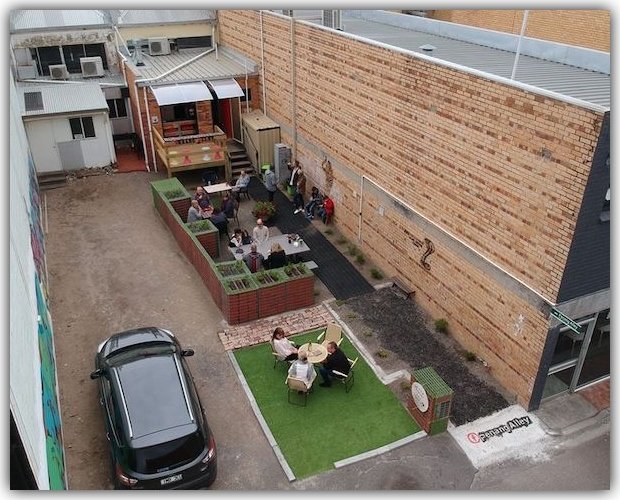


Veteran W’bool City Councillor Neoh falls foul of local laws

An aerial shot of Warrnambool City Councillor Michael Neoh’s family business, Penang Alley, shortly before it opened last December. Image via Penang Alley Facebook Page.

Carol Altmann – The Terrier

You would think after a whopping 16 years as a Warrnambool City councillor that Cr Michael Neoh would know local rules and regulations inside and out, but it seems he has had something of a brain fade around his own family business.

That business is the Penang Alley restaurant at the back of Cr Neoh’s property on lower Liebig St, which opened on Boxing Day and has since operated without a mandatory grease trap, and an illegal back deck that fails to meet building standards.

Whoops!

How did that happen?

Well, part of it seems to be that Penang Alley mysteriously morphed from a ‘pop up’ to ‘permanent’.

When the fake grass and house brick pillars were being installed for the ‘pop up’ last November, I was contacted by competitors who were mightily miffed that a city councillor would set up a temporary cafe to catch the summer trade, when they had slogged it out all winter.

Would Cr Neoh need to install an expensive Wannon Water compliant grease trap like the rest of them, they asked?

And did all of the furnishings meet safety standards?

And how about the wooden deck tacked on to the back? Was it legal?


So many questions and, at the time, so few answers, in fact Cr Neoh – at that time – was also mightily miffed…at being asked to explain:

“The business will meet all the necessary requirements for the classified business,” was his only comment to me, via email.

That was in November.

Penang Alley is still there and, as it turns out, it has not met “all the necessary requirements”.

Finding this out has not been easy and has taken months of questions to the council by myself and the Warrnambool Ratepayers’ Association who, I discovered earlier this year, was also on the case.

The WRA finally got some answers, where I got none.

After two months of waiting, I was pretty much told by the council to contact the WRA and ask them for the responses.

(Around and around we go…)

The upshot to all of this pesky persistence, however, is that it was finally confirmed that a 600mm grease trap to catch all the crap was compulsory  – there wasn’t one – and the timber back deck – used by the public all summer – didn’t meet building standards.

In a word, it was illegal.

(Furnishings, surprisingly, don’t have to meet any health guidelines, other than being clean.)

The council told the WRA that these issues are being fixed.

But how did Cr Neoh, who has been on council since George W Bush was President of the United States, not know he was cutting corners?

And more the point, how did he get away with it?

Warrnambool City Councillor Mike Neoh’s blog page on Facebook: he was first elected in 2004.

Penang Alley is within a shoe toss of the council headquarters and fellow councillors (and most likely council staff) have hung out there.

I wouldn’t get away with it – I get WCC notices in the mail saying that I have 10 days to trim my garden bushes that have crept over the fence or the council will come and do it for me at my expense! Take that, daisy bush!

And you, most likely, wouldn’t get away with it either.

And this, let’s be honest, is what grates the most: the double standards, the two sets of rules, the sense that who you are determines what action is taken, or how fast it happens.

Nobody has an issue with a councillor opening a funky little eatery – go for it – but no wonder it has upset those who were forced to spend time and money doing the right thing from day one.

Yep, that’s enough to give anyone a bad case of entitlement indigestion.

I offered Cr Neoh another right of reply before running this piece. He has not taken it up.

I am tip toeing back into the Tip Jar. If you would like to see The Terrier keep digging, please throw what is affordable into the tip jar below. 

The Tip Jar


Lyndoch: more spent on lawyers and consultants than food

Would you like a lawyer with that? Figures reveal Lyndoch has spent less on food in the past two years than on expert advice. Image: Shutterstock

Carol Altmann – The Terrier

In the past two years, Lyndoch Living spent more on lawyers, consultants and accountants than it did on food for residents.

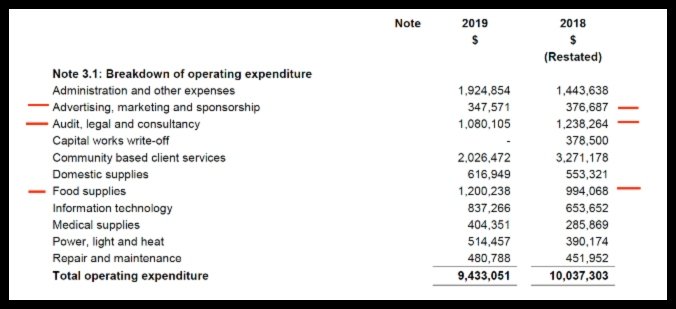
In 2018 and 2019, Lyndoch shelled out an astonishing $2.318 million on accountants, lawyers and consultants, while it spent $2.194 million on food supplies.

In 2018, the gap between the two was especially stark, with less than $1 million spent on food supplies – $994,068 – compared with $1.238 million on accountants, lawyers and consultants.

Chew on that for a moment and I suspect you will feel the same sense of indigestion that came over me.

These unpalatable facts are among the many that fall out when you take a close look at Lyndoch’s financial statements – and a lot of terriers are now taking a good, hard look at the figures, both old and new.

This is how we know that in 2013 the food bill was $992,516, which is not that far off the $994,068 that was spent five years’ later.

Did I miss something? Has the cost of groceries gone down?

I can tell you that what residents pay to live in a nursing home has certainly not gone down nor stayed the same for the past five years.

If you are going to cut costs, surely as an aged care home you don’t start with the food bill?


Judging by the 2019 financials, there is plenty of fat to trim elsewhere, starting with administration costs and the ever-growing number of staff  in the corporate area (59 and counting).

Not surprisingly, the cost of food vs lawyers/consultants/auditors was not mentioned at the Lyndoch Living annual general meeting last October and we can only make the comparison now because of two things:

The full figures have finally been released via the Australian Charities and Not-for-Profits Commission, and, for the first time, legal fees and consultants’ fees have been published in the audited statements.

Lyndoch Living bought the Warrnambool Medical Centre business for $1.3 million and plans to relocate it to a new building at Lyndoch.

Speaking of auditors, wow, has that bill shot through the roof.

Last year, Lyndoch’s auditing costs tripled from $13,950 in 2018 to $48,500 in 2019, which is five times what Lyndoch paid for auditing in 2013 ($9800).

Lyndoch changed auditors from local firm McLaren Hunt (which used to be Coffey Hunt) and replaced them with RSM Australia.

Perhaps a stack more number crunching needed to be done because Lyndoch decided to become a company limited by guarantee, buy two medical centres and also the May Noonan nursing home in Terang (I will write more about the medical centres soon).

But even the auditors were paid small beans compared with the $2.25 million spent on lawyers and consultants in the past two years.

$2.25 million.

Oh my goodness, I really am in the wrong business.


This $2.25 million would include hiring consultants for the $100 million masterplan and to write the (secret) business plan for the new medical centre that Lyndoch intends to start building soon, even though it’s still not sure how much money it needs to borrow to pay for it.

The lawyers, I assume, would also have been hired to guide the masterplan, to set up Lyndoch Healthcare Pty Ltd, and to oversee how Lyndoch now operates as a company limited by guarantee.


There are also the less obvious fees, such as the solicitor “retained” to provide advice to the company secretary, who doesn’t have legal or accounting qualifications.

All of this – millions of dollars in consulting, legal, accounting and administration bills – is such a long, long way from where Lyndoch started as a much-loved, community owned facility for our aged to see out their final years in comfort.

Back in the beginning, people donated their time and their own money to make sure Lyndoch found its feet and this is why there remains such a strong, emotional connection between Warrnambool and our iconic aged care home.

The board needs to get that.

Lyndoch has to grow and keep up with the times, we all get that, but how it is growing – and at what cost – remains at the heart of this investigation and we will keep going.

More soon.

If you would like to see The Terrier keep digging, click on the link below to throw something in the tip jar.


Funky bar brings life back to dead alley


coffin sally_11
The genius behind Coffin Sally’s pizza and bar in Port Fairy is the combined talents of Trent Eggington and Peter Charlton.

[dropcap style=”color: #a02f2f;”] I [/dropcap]t was fog-breath freezing and pouring with rain when Bluestone first discovered Coffin Sally’s bar which, theoretically, should have been as dead as a doornail, given the weather.

Instead this little slice of Fitzroy in Port Fairy was packed with people warming themselves by a roaring fire in an old bluestone fireplace that was built for just such nights, while owners Peter Charlton and Trent Eggington and their fleet-footed staff kept the wine flowing and the pizza coming.

It was like stepping into a party to which everyone was invited and everyone was relaxed, not least of all Peter and Trent who, in their own words, are living the dream.

The pair became friends about seven years ago after working together in pizza shops in Lorne, and – like most of us who work for others – dreamt of some day owning their own business that, in their case, would centre around a gourmet pizza bar.

Peter, who grew up in NSW, is a chef and Trent, from Melbourne, has three years’ training as an architect which has given him a keen eye for what works with interior design. Aside from an appreciation for good food and aesthetics, however, the pair also share a passion for surfing.

“We spent about two years looking for the right place, the right building, that was also by the beach,” Peter explains.

coffin sally_32
Trent’s background in training as an architect has created a space that is as quirky as it is warm and inviting.

[dropcap style=”color: #a02f2f;”] T [/dropcap]he pair originally headed east from Lorne, investigating shops around the Port Artlington area, before deciding to check out Port Fairy and finding not only fantastic surf, but the perfect, vacant building – although it didn’t look perfect at the time.

“When we first saw this place, the walls in the whole back area were covered right up to the roof,” Peter says of the thick bluestone walls that date back to the 1840s.

Peter and Trent took the plunge and started their gourmet pizza business at the front of the shop in 2012 which – with its retro interior, cool music and chilled, expert staff (some hail from Cookie and The Toff, in Melbourne) – set the tone for what was to come.

“It is the first time we have ever done anything like this, so we are still learning, but there has been a slow evolution and things have just grown and unfolded organically,” Trent explains.

After developing a loyal following through their pizzas, Trent and Peter expanded by renovating the middle of the building to create a cosy bar that serves boutique beers and interesting wines and added a separate dining room at the rear that, through clever design, looks like it has been there forever.

“I love old things,” Trent says of his interior design work that features exposed beams, candles piled with dripping wax and blanched animal skulls.

“I love wood and stone and earthy, recycled materials and because we didn’t have much money, we have worked with what was here,” he says.

What was there included the idea for a business name, with the back alley behind the shop known as Coffin Alley because it originally led to an undertakers. The boys simply added an ‘s’.

coffin sally_16
Surfing and small business come together for Trent and Peter who spent two years looking for the right location before deciding on Port Fairy.

[dropcap style=”color: #a02f2f;”] T [/dropcap]he bar opened in winter last year and, like the pizza shop before it, has become extraordinarily successful without one ounce of advertising, but simply word of mouth.

And the pair isn’t finished yet. As part of their organic growth, they hope to eventually expand their kitchen and their menu while sticking to their philosophy of using only good quality produce.

“I think if you don’t get too caught up in making money and just enjoy it, that is how we have taken each step so far,” Peter says.

Besides, there is also surfing to be done.

Despite it being barely 10 degrees, Trent tells me that he, and his kelpie Anchovy, will be heading to the beach straight after our interview.

“It’s a pretty good life,” he laughs.

coffin sally_36
Candles burn well into the night in the back bar…

[box type=”bio”] Coffin Sally is at 33 Sackville St, Port Fairy. Winter opening times are Wed-Sunday. Ph: (03) 5568 2618[/box]


Moooove over cows, the goats are coming!

melissa lewis kids
A house full of happy kids: Melissa Lewis with Mason, 2, Paddy, 4, and one of the 50 goats she is raising for milk production in her venture, Buddy Goat.

[dropcap style=”font-size: 60px; color: #8F9F59;”] G [/dropcap]iven Allansford is deep in cow country, Melissa Lewis is somewhat of a black sheep by using her 20-acre Allansford property to breed and milk goats.

Melissa, who grew up on a dairy farm near Mortlake and is a qualified animal nutritionist, has spent the past 18 months building up a herd of about 50 goats with a mix of Toggenburg (brown and white in colour), Saanens (all white) and British Alpine (black and white) that are all known for their high levels of milk production.

And it is the raw goat’s milk – and byproducts including cheese, yoghurt and icecream – that Melissa is most interested in developing through her Buddy Goat brand, rather than the more conventional path of using the milk to create soaps and cosmetics.

Despite there reportedly being 19 goats on board the First Fleet in 1788, Australia has never really embraced the idea of enjoying a chilled glass of fresh goat’s milk in the morning.

“It’s funny, but the thought of drinking goat’s milk puts a lot of people off and they are far more comfortable with goat’s cheese, yet there are so many health benefits to goat’s milk,” Melissa explains.

melissa lewis2
Melissa Lewis with the former cow dairy that last September was converted to suit the much smaller goats.

[dropcap style=”font-size: 60px; color: #8F9F59;”] M [/dropcap]elissa experienced these benefits first hand when her first son, Paddy, 4, developed asthma several years ago and she changed his diet from cow’s to goat’s milk. The asthma attacks stopped.

“We forget that goat’s milk is actually consumed more than any other milk around the world. It is easier to digest and a lot of people who can’t handle cow’s milk can drink goat’s milk,” Melissa says.

She tells the story of one man who was intolerant to cows milk but tried her goats milk and, for the first time in many years, was able to eat a bowl of breakfast cereal with milk. Another woman uses Melissa’s raw goat’s milk to bathe her young daughter who suffers severe eczema.

Most of Melissa’s raw goat’s milk is sold by a distributor into Melbourne and Geelong where there is a big demand among particularly the Greek and Italian communities for goat’s milk with which to make cheese.

milking goat
Paddy takes an udderly different view of where milk comes from, having been raised on goat’s milk.

[dropcap style=”font-size: 60px; color: #8F9F59;”] D [/dropcap]ue to stringent food regulations, Melissa is currently only permitted to sell her products marked for “cosmetic use only” and “not for human consumption”, but how customers choose to use the milk is ultimately their decision.

Having spent the past couple of years proving there is a growing market for goat’s milk, Melissa is planning to move into the next stage of commercial production.

Last September she and her husband Darcy, a fencing contractor, converted a cow dairy into a goat milking dairy where her girls line up each day – or twice a day when the milk production is high. They also plan to transform part of a large shed on their property into a commercial kitchen.

It is a significant investment, with a pasteuriser costing around $25,000 alone.

For Melissa, however, it is all about diversification. Apart from her own property, Melissa and her sister Nicole Ritchie run a 200-acre farm at Mortlake, across the road from their parent’s 1000-acre property where the sisters also agist cattle.

Two young sons and another baby on the way have also made life a little busier for Melissa, but she still has plenty of energy and enthusiasm for her new venture.

“It’s about trying new things, seeing where they go and diversifying, because you can’t survive off farming alone any more.”

[box type=”bio”] For more information on Buddy Goat, you can contact Melissa at goatsmilk@live.com.au or find her on Facebook here. [/box]

newsletter Art Music StonesYou might also enjoy…


Lana’s garden of Eden

Organic food idea grows and grows

Gorge-ous taste of chocolate

Spread: spreading the love of food

Buffalo cheese a Shaw thing

Small is beautiful at Newton’s Ridge

Thriving on flower power at Naringal