Lyndoch borrows big for $100m masterplan as deficit rises

Despite successive deficits, Lyndoch Living is borrowing big to fund its $100m masterplan. Original image: Disney.

Carol Altmann – The Terrier

Lyndoch Living, having recorded a fifth deficit in six years, is digging into residential bonds to fund its $100m masterplan.

And a warning – figures ahead, lots of figures – as we dive again into the swirling financials of Lyndoch Living.

One, two, three…jump!

When you bob up you will see that figures lodged by Lyndoch Living last week show an even greater loss – a $2.4 million deficit – than was reported at last October’s AGM (the one we were not invited to Zoom, but could watch later on YouTube).

The annual information statement lodged last week with the Australian Charities and Not for Profit Commission reveals a $600,000 increase on the $1.88 million loss reported at the AGM and in Lyndoch’s full financial statements to the commission.

The $2.4 m is the loss recorded by Lyndoch without taking into account the profit from the Warrnambool Medical Clinic, which it bought in 2019. Either way, it is the fifth deficit for Lyndoch in six years.

This doesn’t seem to trouble the board.

As reported here last November, Lyndoch’s overall asset base (assets minus its liabilities) also continues to slide and is now $47.6m down from $69m in 2015.

This doesn’t seem to trouble the board either.

There is a lot to digest in the 60-page financial statement, so I am going to break it into bite-sized chunks tonight and in follow-up pieces.

First, the report shows us that Lyndoch has funded at least part of its $13 million Swinton Wing expansion by doing something it has never done before, which is borrow money.

It has visited the bank and also borrowed a big chunk out of the $26 million it holds in residential bonds paid by residents.

From this $26 million in bonds, Lyndoch has thus far extracted $10,944,323.

By law, as long as an aged care provider can cover its residential bond refunds for the next 12 months, it can dig into the rest and repay it down the track.

If an aged care home defaults, the Federal Govt will pick up the tab, so it’s kind of a taxpayer-backed Ponzi scheme that relies on an aged care home doing the right thing.

It’s also cheap, interest-free money, but concerns about how these bonds are being used is one reason (among many) that the whole bond scheme is now under review as part of the Royal Commission into Aged Care.

The loans, of course, will need to be repaid at some point, including fairly substantial interest on the bank loans, despite low interest rates.

In 2018, Lyndoch paid zero interest on any loans.

In 2019, it paid $62,420.

In 2020, it paid $372,669.

As of 7 July 2020, Lyndoch signed up for another loan from the NAB for $3,386,000 which is due to be repaid by June 2022.

This was needed to fund the “redevelopment of a residential building” which, I assume, was the blowout in cost of the Swinton Wing.

That project, where residents are not allowed to hang any pictures on the walls despite paying huge bonds which helped fund it, grew from a budget of $10 million to $13 million.

Relying big on borrowed money is new territory for Lyndoch, which once upon a time used to spend only what it had, what the government gave it, and what it raised from the public.

But Lyndoch, as we know, is now a long way from those comfortable shores as it sails into a $100 million masterplan under the captaincy of a CEO and board that firmly believes you must spend money to make it.

This is why in 2019 Lyndoch bought the Warrnambool Medical Clinic, Health Spot and May Noonan Hostel, in Terang, for around $3.3 million.

(Lyndoch also recently hired JB Were – who will charge fees accordingly – to look after its complicated investment portfolio. We are not in Kansas anymore, Toto.)

The Warrnambool Medical Clinic last year turned over $3.8m in revenue, but had $2.8m in expenses.

According to the financials, the clinic returned a final profit of $539,249 to Lyndoch Living in 2020 which is not to be sneezed at… but $372,000 of this will be spent this year paying out the original owners of the clinic as the final instalment of the sale contract. Achoo!

The WMC was pretty much break even for last year.

As for this year, well this is when things get interesting, because Lyndoch has the wire fencing up and around its now-vacant Tomlinson Wing (built in 1991 with help from a generous donation from the Tomlinson family), all set for demolition to make way for a new, two-storey Lyndoch medical clinic to replace the existing WMC.

This clinic will have acute care, dentistry, an x-ray machine, up to 20 GPs, allied health, education rooms, a cafe, a chemist and no doubt wonderful indoor plants and a red-and-white colour scheme.

The cost? An estimated $24 million. Where is that money coming from?

The bigger question, however, is will Lyndoch Living thrive or dive under this grand expansion and multi-million dollar spend up? Time will tell.

More soon.
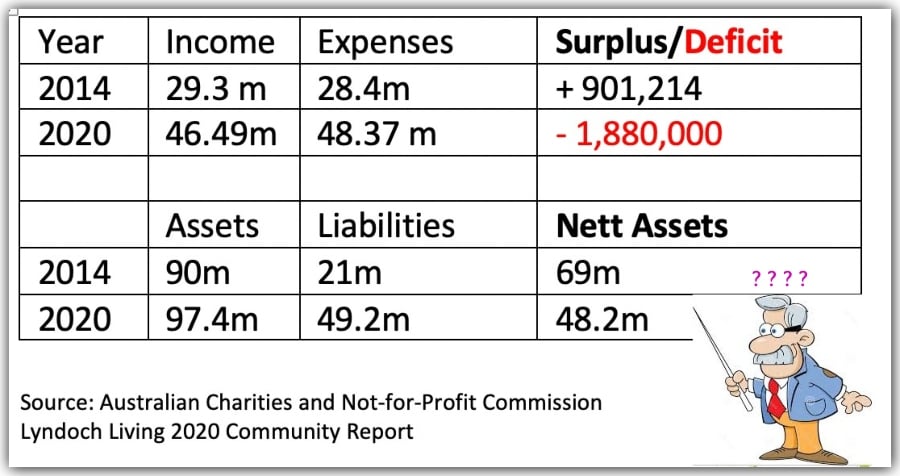


Shrinking or growing? Crunching the numbers on Lyndoch

Carol Altmann – The Terrier

Lyndoch Living is definitely getting bigger, but is it getting better? The numbers say no.

The reason I keep writing a lot about our community-owned aged care home is to put on the public record what is happening under the change of leadership and change of direction since 2015.

It’s important that we – as the community who own Lyndoch – keep track of what is going on, because nobody else is telling us.

We are the custodians of Lyndoch and the community will be here way past whoever happens to be in charge, so yes, we need to keep track of what is going on.

We owe it to Lyndoch, the residents, the staff, and those who helped create Lyndoch more than 50 years ago.

This is why tonight I am running this little chart, because it captures how Lyndoch is travelling financially.

It shows that before 2015, Lyndoch ran at a small profit/surplus or was break even.

This year, it posted its biggest loss – close to $2 million.

Lyndoch has run at a loss for five of the past six years. From my research, this is unprecedented in recent times.

At the same time, its assets have gone up, but so have expenses – they have more than doubled.

This has meant a $20m cut to its net assets in just six years.

Is this visionary? It is sustainable? And why, when it comes to cost cutting, do we hear of cuts at the coalface, and not in the corporate?

Speaking of which, it’s worth remembering that the very first thing to happen under the $100m masterplan now being rolled out by Lyndoch was an upgrade of the corporate area.

Out with former CEO Rhys Boyle’s old wooden furniture and in with the fingerprint resistant glass table.

We still don’t know how much that corporate re-vamp cost but it was an early sign of the shifting priorities.

We still don’t know, exactly, how much the Swinton Wing re-vamp and extension cost, but estimates are it blew out by $2m to $13 million.

And coming up next is a new two-storey medical clinic to be built next to Scoborio Reserve with, it is said, radiology, pathology, acute care and educational facilities alongside up to 20 GPs.

Lyndoch will bulldoze Tomlinson Wing and its gardens to make way for more glass and cement.

How much will that all cost to build and set up? We don’t know.

Is this all necessary? Is it all sustainable?

These are the questions I would like to ask the board – our eyes and ears at the table – and I am sure you would like to ask too.

In the face of their silence, we just keep pressing.


Lyndoch: more spent on lawyers and consultants than food

Would you like a lawyer with that? Figures reveal Lyndoch has spent less on food in the past two years than on expert advice. Image: Shutterstock

Carol Altmann – The Terrier

In the past two years, Lyndoch Living spent more on lawyers, consultants and accountants than it did on food for residents.

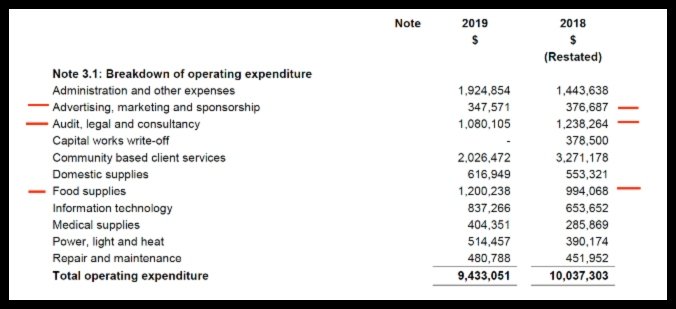
In 2018 and 2019, Lyndoch shelled out an astonishing $2.318 million on accountants, lawyers and consultants, while it spent $2.194 million on food supplies.

In 2018, the gap between the two was especially stark, with less than $1 million spent on food supplies – $994,068 – compared with $1.238 million on accountants, lawyers and consultants.

Chew on that for a moment and I suspect you will feel the same sense of indigestion that came over me.

These unpalatable facts are among the many that fall out when you take a close look at Lyndoch’s financial statements – and a lot of terriers are now taking a good, hard look at the figures, both old and new.

This is how we know that in 2013 the food bill was $992,516, which is not that far off the $994,068 that was spent five years’ later.

Did I miss something? Has the cost of groceries gone down?

I can tell you that what residents pay to live in a nursing home has certainly not gone down nor stayed the same for the past five years.

If you are going to cut costs, surely as an aged care home you don’t start with the food bill?


Judging by the 2019 financials, there is plenty of fat to trim elsewhere, starting with administration costs and the ever-growing number of staff  in the corporate area (59 and counting).

Not surprisingly, the cost of food vs lawyers/consultants/auditors was not mentioned at the Lyndoch Living annual general meeting last October and we can only make the comparison now because of two things:

The full figures have finally been released via the Australian Charities and Not-for-Profits Commission, and, for the first time, legal fees and consultants’ fees have been published in the audited statements.

Lyndoch Living bought the Warrnambool Medical Centre business for $1.3 million and plans to relocate it to a new building at Lyndoch.

Speaking of auditors, wow, has that bill shot through the roof.

Last year, Lyndoch’s auditing costs tripled from $13,950 in 2018 to $48,500 in 2019, which is five times what Lyndoch paid for auditing in 2013 ($9800).

Lyndoch changed auditors from local firm McLaren Hunt (which used to be Coffey Hunt) and replaced them with RSM Australia.

Perhaps a stack more number crunching needed to be done because Lyndoch decided to become a company limited by guarantee, buy two medical centres and also the May Noonan nursing home in Terang (I will write more about the medical centres soon).

But even the auditors were paid small beans compared with the $2.25 million spent on lawyers and consultants in the past two years.

$2.25 million.

Oh my goodness, I really am in the wrong business.


This $2.25 million would include hiring consultants for the $100 million masterplan and to write the (secret) business plan for the new medical centre that Lyndoch intends to start building soon, even though it’s still not sure how much money it needs to borrow to pay for it.

The lawyers, I assume, would also have been hired to guide the masterplan, to set up Lyndoch Healthcare Pty Ltd, and to oversee how Lyndoch now operates as a company limited by guarantee.


There are also the less obvious fees, such as the solicitor “retained” to provide advice to the company secretary, who doesn’t have legal or accounting qualifications.

All of this – millions of dollars in consulting, legal, accounting and administration bills – is such a long, long way from where Lyndoch started as a much-loved, community owned facility for our aged to see out their final years in comfort.

Back in the beginning, people donated their time and their own money to make sure Lyndoch found its feet and this is why there remains such a strong, emotional connection between Warrnambool and our iconic aged care home.

The board needs to get that.

Lyndoch has to grow and keep up with the times, we all get that, but how it is growing – and at what cost – remains at the heart of this investigation and we will keep going.

More soon.

If you would like to see The Terrier keep digging, click on the link below to throw something in the tip jar.


Lyndoch Living pulling down the shutters on scrutiny

Lyndoch Living can’t wait to talk about all the good stuff happening, but digging into the financials is getting harder.

Carol Altmann – The Terrier

What the heck is happening at Lyndoch?

It’s behaving more and more like a private corporation than a community owned home for our elderly and infirm.

Its unadvertised, annual general meeting held earlier this week was, by all accounts, one big self-congratulatory, PR exercise rather than a critical analysis of the last 12 months.

While it’s terrific to celebrate the good stuff, we also want to know the nitty gritty behind the growing “brand”, because Lyndoch is now very much a brand.

So where are the financials?

How are the Lyndoch board and CEO Doreen Power spending our money, be it via residents’ fees, taxpayer dollars or donations?

Was there a surplus or a deficit like the $1.77 million loss of last year?

How many staff have come and gone?

How much is being spent on food for the residents? On medical and health items? How are the public donations going?

And – I ask, one more time with feeling – where is the $100 million coming from for the eight-year masterplan?

The annual report released this week answers none of these questions, in fact, it deliberately avoids them.

The financial statements have been reduced to three, very basic graphs and about 125 words of text – that’s it – for a multi-million-dollar, publicly funded, not-for-profit organisation that is fully accountable to the public.

Well, it used to be.


Things have changed dramatically since Lyndoch changed its corporate structure late last year.

Now, trying to get any detailed information is like prising open the jaws of Barry the Bull Terrier.

I am still trying to get a copy of Lyndoch’s constitution, which it is zealously guarding like a first-edition copy of Harry Potter.

Even old annual reports that were posted on the Lyndoch website were pulled down yesterday.

Maybe this is because I actually read them and crunched the numbers and found a rather large skeleton lurking in the closest: Lyndoch last year recorded its largest deficit in recent years at $1.77m.

Thankfully I took notes and kept copies of the annual reports that could be downloaded, and took screenshots of those that couldn’t.

Good grief, when did it get this hard to find out basic information about our much-loved aged care home?

What on earth is there to hide?

Perhaps it’s because, as I believe, Lyndoch recorded another deficit in 2019, which would be its fourth deficit in the past five years.


I am not an accountant by any stretch, but using the scant details released this week, and my earlier notes, I think Lyndoch Living recorded another operating deficit, this time of around $750,000 and that’s before any other unusual items – if there were any – are added.

Please, Lyndoch, correct me if I am wrong.

The back page of the Lyndoch annual report for 2019 reflects its growing business model.

Using my same, very high-tech accounting methods, I believe its net assets also dropped by a whopping $11 million in the past year from $62.7 million down to $51.2 million.

Hmm, could that be because Lyndoch just borrowed $11 million from the bank to pay for the first stage of the masterplan?

Please, please, Lyndoch, correct me if I am wrong.

There is no question that Lyndoch needed to freshen up some spaces, try different things, move with the times, but surely when big decisions are made and millions are being spent, it must all be open to rigorous scrutiny?


As it sits, to get even close to the full story, we will have to wait until early next year for the full financial reports and all of the gritty details to be released via a government website that oversees charities.

In the meantime, this Terrier is just going to keep digging. More soon.

If you would like to support the work of The Terrier, please consider throwing something in the tip jar.

Terrier Tip Jar