Lyndoch posts record loss as it ploughs on with masterplan
Lyndoch Living aged care is sailing into un-charted waters with big borrowing, big spending and a sharp decline in its overall equity.
Carol Altmann – The Terrier
Lyndoch Living’s full financial figures dropped late today and here is a quick snapshot:
Lyndoch last year posted a record loss of $4.029 million – almost $2 million up on the loss of the previous year.
In 2020, it posted a loss of $2.4 million.
In 2019, it posted a loss of $1.88 million.
In 2018, it posted a loss of $1.77 million.
In 2017, it posted a $846,000 surplus.
Er, is this supposed to be how a not-for-profit operates? Not breaking even, but running at continual losses?
More importantly, Lyndoch’s net worth has dropped to $40 million in 2021, down from $48 million in 2020 and $69 million in 2015.
This net worth/equity figure comes from adding up all of Lyndoch’s assets (around $100m), and subtracting all of its liabilities.
Lyndoch’s assets have hovered around the $100 million mark for several years now.
What has changed are the liabilities – they keep going up, up and up.
In 2018, Lyndoch’s liabilities were $37 million
In 2020, Lyndoch’s liabilities were $47 million.
In 2021, they were up to $60 million.
All of this cuts deep into Lyndoch’s overall financial position.
Lyndoch is borrowing big, it is taking risks, it is investing in a $22 million medical centre that is due to be finished mid-year, ploughing ahead with its $100m masterplan and somewhere in all of that is a whole lot of hope – by us – that it will all work out.
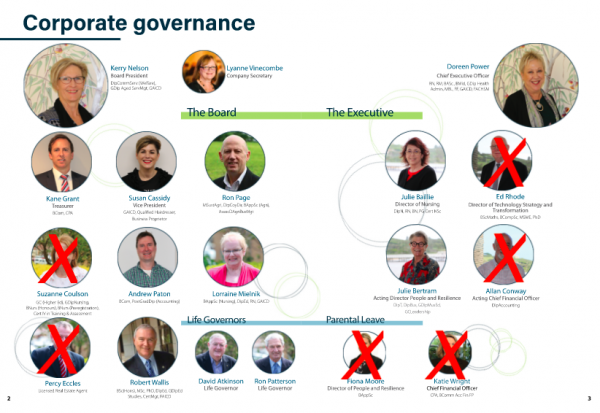
In the past 12 months, six faces have disappeared from the Lyndoch Living board and executive. Image: Lyndoch Living annual report 2020.
Carol Altmann – The Terrier
Another member of the Lyndoch Living board has resigned – the second resignation from the board in two months.
Suzanne Coulson, a researcher and lecturer at Deakin University in the School of Nursing and Midwifery, joined the Lyndoch board in 2017.
I don’t know why Ms Coulson resigned, and I doubt she could speak to me anyway, as all board members are bound by a confidentiality agreement which was introduced after the departure of former CEO Rhys Boyle in 2015.
Ms Coulson’s resignation follows that of veteran board member Percy Eccles, who left in March after serving almost 10 years.
Ms Coulson was one of only two board members with medical qualifications. The other is fellow lecturer in the Deakin School of Nursing and Midwifery, Lorraine Mielnik.
The resignations of both Mr Eccles and Ms Coulson come as Lyndoch Living faces mounting pressure to explain a number of concerns around its plan to build a $24 million medical clinic on site, with fears the project could send Lyndoch broke.
Lyndoch’s former Acting Chief Financial Officer Allan Conway raised the red flag publicly when he said he did not support the clinic project in its current form.
Lyndoch recently appointed its third chief financial officer in five years, with the departures of David Knight and Katie Wright.
Other recent executive resignations include IT director Dr Ed Rhode and Director of People and Resilience Fiona Moore.
A community action group made up of Warrnambool residents concerned for the future of Lyndoch was launched last week – you can follow/like the “Keep Lyndoch living” group on Facebook here.
Community action group forms to question Lyndoch Living
Carol Altmann – The Terrier
A grassroots action group has formed to challenge Lyndoch Living over plans to build a $22m medical clinic that some fear may send it broke.
I have written dozens of stories these past 18 months about concerns around Lyndoch Living and every time there is the same response from readers: what can we do?
Well here is the answer – you can support this action group.
The group – “Keep Lyndoch living” (follow them on their new Facebook page here) – is being led by local people who are prepared to speak up on behalf of the community, and you can stand with them.
The co-chairs are heavy hitters in Professor James Dunbar, who has had a long and distinguished career as a health researcher in Australia and overseas. He moved to south-west Victoria from the UK to become the first Director of the Greater Green Triangle University Department of Rural Health.
Prof Dunbar taught Clinical Governance and Risk Management for Flinders University in Adelaide, Singapore and China, and is an Honorary Professor with Deakin University.
The other co-chair is Jim Burke, a former naval officer and a senior investigator for the Inspector-General of Intelligence and Security until his retirement in 2009.
They are the public face of what they hope will be a united community voice seeking answers from Lyndoch on two broad questions:
how is the medical clinic being financed?
how will it benefit the residents of Lyndoch?
Last month, Lyndoch’s former Acting Chief Financial Officer Allan Conway revealed that, on the information available to him, he had formally advised Lyndoch CEO Doreen Power that he didn’t support the medical centre as proposed.
Mr Conway added that, as a private citizen, he also held fears for the viability of Lyndoch.
Despite this fire alarm from a former, well-respected CFO, the public response from the Lyndoch board has been silence.
In a media release today, Prof Dunbar said the community group had to move quickly, as construction was due to start on the clinic any day.
“If the medical centre resulted in serious financial issues for Lyndoch, the viability of Lyndoch could be threatened,” he said.
“As the community has funded and built Lyndoch over the past 70 years, it is imperative that the medical centre is based on a sound business plan and full transparency.”
Mr Burke said the group will seek a meeting with Lyndoch board.
In the interim, the group has contacted State Minister of Ageing Luke Donnellen, Federal Member Dan Tehan and State MPs Roma Britnell, Bev McArthur and Andy Meddick, to raise the following, specific concerns:
i. The cost of the centre;
ii. How the centre is to be funded;
iii. How loans and interest are to be repaid. Borrowing would be at the current low interest rates, but this cannot be guaranteed in the future;
iv. Whether proper business modelling has been done for the clinic (including full business and operational plans), together with an associated risk management plan;
v. Details of prospective tenants. Whilst an unknown number of GPs from The Health Spot and Warrnambool Medical Clinic have been secured, an advertisement in the Warrnambool Standard on 1 May, 2021 raises concerns about whether an adequate number of tenants in total can be secured where there are general GP shortages in rural areas;
vi. The effect of the Royal Commission into Aged Care and whether this could cause other financial pressures on Lyndoch.
To me, the launch of this group is significant, as I have learned that it’s incredibly difficult for people in Warrnambool to publicly question the decisions of those in authority.
People, I have learned, are often fearful to speak up individually.
Strength, however, lies in numbers and a unified voice.
Whether this group succeeds as a unified voice now hinges on how many people are prepared to stand alongside them as they speak up on behalf of the community.
Long-standing Lyndoch Living board member Percy Eccles has resigned.
Mr Eccles, who has been a Lyndoch board member for nearly 10 years, said in a brief comment today that he resigned because he didn’t “feel I could have any more input, other than what I have already done”.
The ambitious project will be entirely funded by Lyndoch, including via bank loans and borrowing from Residential Aged Care bonds (as is currently allowed under federal aged care laws).
Mr Eccles’ resignation also comes as Lyndoch prepares to announce its new Chief Financial Officer, which will be its third CFO in five years, following the departures of David Knight and, later, Katie Wright who did not return from maternity leave.
Acting CFO Allan Conway – who filled in for Ms Wright – did not apply for the position and has also recently left Lyndoch.
A smaller, interim medical clinic is already under construction at Lyndoch, on the ground floor of the new Swinton Wing.
From what I am being told, there is a growing belief inside and outside of Lyndoch that the smaller medical clinic would be a far less risky investment and the larger medical clinic should be put on hold, if built at all.
In the meantime, we will have to wait and see if the board vacancy is advertised, or if a replacement for Mr Eccles will be appointed behind the scenes, as happened with the appointment of Prof Rob Wallis to replace former racing club CEO Peter Downs.
Tomlinson crashes down: will Lyndoch finances follow?
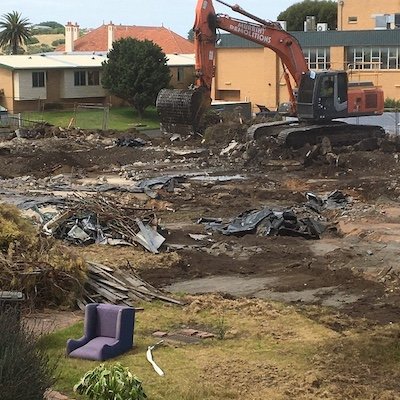
Lyndoch Living’s Tomlinson Wing has been razed to make way for a new $20m-plus medical clinic.
Carol Altmann – The Terrier
Oh a picture paints a thousand words.
Those of us who live or work near Lyndoch Living have this past week watched – and heard – Tomlinson Wing being razed right down to the last lounge chair left lying on its back in the rubble to make way for a multi-million dollar medical clinic.
Such is the secrecy around our community owned nursing home these days, we don’t know how much this clinic will cost – the last figure I saw published by an engineering firm was $24 million, but the plans have changed several times since then.
This clinic will house up to 20 GPs from the Warrnambool Medical Clinic, which Lyndoch now owns, and – presumably – by hiring GPs from elsewhere. It will also have a dentist, an x-ray and an acute care service.
To date, there has been no public discussion on how the business plan stacks up for such a huge investment, or the risks involved for Lyndoch, or the benefits it will bring to Lyndoch residents.
We are being asked to take it all on trust.
And trust is, frankly, in short supply around Lyndoch right now. That is what happens when you stop talking to the public and instead rely on spin.
It’s how you get away with sponsoring a horse race and a corporate marquee at the May Races.
And it’s how you gouge up to 44% of a person’s home care package in admin fees.
So far, this gouging has helped Lyndoch build up a nice little nest egg of $3 million in cash.
No wonder Lyndoch is desperate to pump up its home care package clients: they are taxpayer-funded cash cows.
But is it sustainable? Is this really how home care packages are intended to work?
And, worse, is it a house of cards just waiting to crash, especially as the federal govt moves to close these loopholes?
Which brings me to this:
Last financial year, Lyndoch received almost $2 million more in taxpayer funds to pay for home care packages to help people stay in their own homes.
Did it spend almost $2 million more on supplying services?
No, it didn’t.
It spent almost exactly the same amount as the year before.
So where did this extra $2 million in taxpayer funds go?
Good question!
This was among the questions I asked Lyndoch yesterday in the ever-optimistic hope of a reply.
In the absence of any reply, I have perused Lyndoch’s figures and it appears this $2 million has been invested, which helps Lyndoch’s bottom line look better than it is.
The “surplus” for home care packages shot up from $234,398 in 2019 to $2.5 million in 2020.
A ten-fold increase in just 12 months.
The problem is, it’s smoke and mirrors.
This surplus is not Lyndoch’s money: it’s taxpayers’ money, given to Lyndoch, to provide home care packages.
It’s not supposed to be sitting around in a bank, earning interest and plumping up bottom lines.
It’s supposed to be helping people to bathe, or have their gardening done, or buy a new bed, or to supply hot meals, and if it is not being used for those purposes, then something is terribly wrong.
Fortunately the fed govt knows the system is buggered and is making long-overdue changes that it is rolling out as we speak.
A major change is that the home care money will no longer be paid in advance to places like Lyndoch.
It will be in arrears.
And by September, if new laws go through, the funds will only be paid for what has actually been spent, not sitting there waiting to be spent.
In other words, there will be no $2 million swashing around in Lyndoch’s bank account.
Given the demolition of Tomlinson, Lyndoch has a chance to reassure us that none of the changes planned by the fed govt (home care is just one of them) will make a jot of difference to its financial stability and it can plough on with its $100 million masterplan like there is no tomorrow.
If it doesn’t, or it can’t, then we should listen, very carefully, for the sound of the Queen of Hearts falling.
[Note: Lyndoch is about to hire a new Chief Financial Officer: its third CFO in five years.]