Community bursting with questions for Lyndoch Living AGM
While members of the community can’t officially ask questions at Lyndoch Living’s AGM next week – because they have been denied membership – we can still pose them.

Carol Altmann – The Terrier

Below are 31 questions that have been sent today on behalf of members of the community to Lyndoch Living chair Sue Cassidy for next week’s Annual General Meeting (Dec 14).

Only members of Lyndoch Living are legally entitled to ask questions at the meeting, but – as we know – more than 115 people have been denied membership these past 18 months.

We are shut out of any legal obligations.

My argument, however, is Lyndoch has a moral obligation to answer questions posed by the community.

After all, the Warrnambool community raised $20,000 toward the $80,000 purchase price of Lyndoch in the 1950s.

That $20,000 was essential to the Government providing a grant for the remaining $60,000.

Without that $20,000, there would be no Lyndoch Living, simple as that.

The community has since donated tens, if not hundreds, of thousands of dollars toward Lyndoch via donations, raffles, bequests and salary sacrifice.

As far as I’m concerned, the community and Lyndoch residents are the “shareholders” of Lyndoch Living Limited, and shareholders get to ask questions at the AGM about the company, and its management.

So here are 31 questions, distilled from the more than 50 that were offered by you. We shall see if any answers are forthcoming. Thankyou for being a part of this campaign to return Lyndoch to the community it serves.

1. Why is Lyndoch Living not accepting any new members from the community?

2. Who are the current members of Lyndoch Living?

3. What criteria are used to select member applicants?

4. Why are there no copies of previous annual reports on the Lyndoch Living website?

5. Why is Lyndoch Living no longer advertising board vacancies and how are potential board members identified and selected?

6. Why does Lyndoch Living currently have only seven board members and not nine as required by its Constitution?

7. What steps have been taken to reach the accreditation standards required by February 2022 and to also address the 19 areas of non-compliance at May Noonan Hostel?

8. Is the $22 million primary health care centre (PHCC) fully tenanted in preparation for its opening in 2022?

9. What is the contingency plan if the PHCC is not fully tenanted?

10. Has the cost of the $22 million PHCC been impacted by Covid-19 due to increased costs in construction and materials? When is the building expected to achieve profitability?

11. If a new medical clinic opens at the premises of the former Warrnambool Medical Clinic (as reported by local media), how will this affect the capacity of the PHCC to attract new GPs and retain its existing GPs?

12. Will Lyndoch Living release the Business Case underpinning the Board’s decision to approve the construction of the PHCC?

13. What are the underlying assumptions which gave the Board the confidence to go ahead with an investment of $22m and the assurance that this project will result in a viable, sustainable and successful clinic, which poses no risk to Lyndoch’s ongoing financial position – especially its cash flow and solvency – and ability to prioritise its purpose to provide quality care for the region’s elderly citizens?

14. Will the directors of the Warrnambool Medical Clinic by Lyndoch Living be paid once the clinic is operational from the new premises?

15. Does the Lyndoch Living CEO receive performance bonuses as part of the employment contract approved by the board?

16. What is the current debt of Lyndoch and its strategy for repayment?

17. Can the board identify, separately, how much was spent on consultancies in 2020-21 and how much was spent on legal fees? Was this expenditure signed off by the board?

18. Has Lyndoch budgeted in 2021-22 to repair the nurse call system and resident call bell system?

19. How many staff have left Lyndoch Living in the past 18 months and how much has this cost?

20. What is the strategy to retain experienced staff?

21. What feedback (staff surveys, exit interviews etc) has the board received regarding staff satisfaction at Lyndoch Living and what actions, if any, have been taken in response?

22. Does the Board receive monthly reports outlining all compliments and complaints received, and incidents (falls, wound care etc) and sentinel events which have occurred for the previous month, and does this report include action(s) which will be taken in response? What has been acted upon and lessons learned to ensure continuous improvement in quality of care, and ensure proper oversight and accountability of the Board?

23. What measures are being taken to seek feedback from residents and their representatives, and what is being done to address issues raised by residents and their representatives?

24. Has the board reviewed Lyndoch’s business partnerships and sponsorships and how are these performing in terms of quantifiable benefits to Lyndoch?

25. What is the financial position of Waterfront Living? Is it fully sold and covering its costs?

26. Has there been an increase or decrease in the number of Lyndoch Home Care Package clients in the last 12 months? How does Lyndoch set its fee structures for the packages?

27. How much has the sponsorship of the May Racing Carnival Grand National Steeplechase and Lyndoch corporate tent cost since the sponsorship began, which budget line does this money come from, and what have been the quantifiable benefits to Lyndoch?

28. Is Lyndoch Living currently meeting all of its payments to suppliers on time?

29. How are bequests to Lyndoch solicited and is the approach compliant with the Fundraising Institute of Australia, including charity codes?

30. Has the patient/staff member ratio been met? If not, what has been done to remain compliant?

31. How many falls and pressure wounds were recorded in the past 12 months and how does this compare to the previous 12 months?



Inquiry into aged care a chance to break the fear and silence

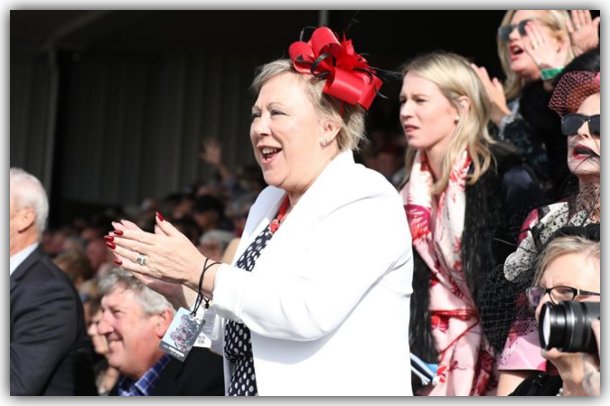
Lyndoch Living CEO Doreen Power cheering on from the stands during the 2019 May Racing Carnival. Image: Lyndoch Living/ Racing Victoria.

Carol Altmann – The Terrier

This week will be a reckoning for aged care across Australia and I can hope it blows the lid right off what is a national disgrace.

We only have to look at our own neck of the woods to see how little official outrage there is to what should be unacceptable.

It’s more than two months since The Terrier revealed an outbreak of scabies within Lyndoch Living, our much-loved, community-owned aged care home in Warrnambool.

When whistleblowers revealed scabies in a Whyalla nursing home last November, A Current Affair and a South Australian MP were on the doorstep demanding answers.

It’s also more than a year since I wrote about staff tearing up sheets and towels to use as facewashers, and more money being spent on consultants and lawyers than on food for residents.

More than a year has passed since I revealed a family member of a resident was sleeping on the floor next to her mother for seven days because her mother had had a series of falls and there was not enough staff to keep an eye on her.

At the same time, Lyndoch senior staff, right up to the CEO, and senior board members, were attending the May Races.

It’s also a year since a leaked copy of a staff survey revealed serious allegations of bullying and intimidation at Lyndoch that went right to the very top.

It’s well over a year since I first wrote about the steady stream of staff who were leaving Lyndoch, sometimes after decades of service, because of alleged bullying, being “targeted”, or given little option to resign and – if they are lucky – given a payout to sweeten the blow. I call it “keep quiet” money.

Is that sort of thing still happening? Yes.Yes, it is.

It’s eight months since we learned two architects from Melbourne were visiting Lyndoch Living despite the “ring of steel” Covid-19 lockdown in that city.

Lyndoch denied they were even from Melbourne.

It’s 18 months since we learned that the community was no longer welcome to become members of Lyndoch: every single membership application from the general community has been rejected, including that of our now Mayor Vicki Jellie.

Board member positions are no longer advertised.

The annual general meeting is no longer advertised.

Has there been an outcry from the board at this lack of inclusion? No.

Regardless, we have still unpicked the fact that Lyndoch has recorded a series of deficits these past five years and will borrow money from residential bonds (as the current laws allow it to do), to fund its $100 million masterplan.

We also recently learned, thanks to two former Lyndoch workers who peeled back the lid, that Lyndoch was gobbling up to 44 per cent in management fees for home care packages.(Again, the laws currently allow these fees.)

And this still doesn’t touch on what I haven’t been able to publish, because Lyndoch is litigious and I have to pick my way through a minefield to report even this much.

Our local political leaders know about most –  if not all – of the above. Some of them have even met personally with those directly affected.

And yet, perhaps despite the best of intentions, nothing has come of it.

That may change after this week.

This week will see the public release of the findings of the Royal Commission into Aged Care and the federal government’s initial responses.

The sad and infuriating story of what people are expected to “put up with” – as aged care residents, aged care staff, the residents families and the wider community – will be laid bare.

It will no doubt emphasise the need for better staffing ratios, better pay, better training and working conditions, better scrutiny of those in positions of responsibility, greater transparency around funding and fees, and why aged care residents should never been seen as “customers”.

But I also hope this inquiry exposes why so many people connected to aged care feel disempowered from speaking up and out about what they know, because they fear the repercussions.

I can tell you that fear and silence around Lyndoch Living is very real, even if not everyone is touched by it.

I know it, several GPs around Warrnambool know it, several lawyers around Warrnambool know it. Our local MPs know it. The families and friends of those directly affected know it.

The release of the Royal Commission findings is our chance as a whole community to speak up for those who can’t do so themselves.

This was the promise the community made to Lyndoch when it was first built more than 60 years ago: first and foremost it would protect and care for the elderly and frail, and those who look after them.

Now is the time to make good on that promise.

New posts straight your inbox? Free here.


Consultants, lawyers and admin soak up Lyndoch millions

Consultants, lawyers and administration costs continue to soak up millions at Lyndoch Living. Image: Forbes

Carol Altmann – The Terrier

Lyndoch Living spent $1.2 million on consultants and lawyers in 2020, and at least another $3 million on its ever-expanding administration.

A deeper dive into the 2020 financial figures reported to the Australian Charities and Not for Profit Commission show Lyndoch has spent at least $1 million a year for the past three years – a total of $3.34 million – on legal fees, consultancies and auditors.

That $3.34 million over three years is more than the food budget for the 200 to 240 residents, but more on that shortly.

Behind the scenes at Lyndoch, a steady stream of consultants has been working on the $100 million masterplan, including – as I understand it – around $99,999 and 99 cents paid to one consultant for the business plan for the medical clinic that will be built on site later this year.

We haven’t seen that business plan, but we can only trust that it’s a good one, because Lyndoch is going into the uncharted waters of borrowing big to finance the estimated $23 million cost.

At the same time, Lyndoch’s administration costs are now more than $3 million a year, compared to $2.5 million in 2015.

The admin budget is hard to follow from year to year, because it keeps bouncing around the balance sheet like a bee in a bottle.

In 2018, it was $3.3m.

In 2019, it suddenly fell to $1.94m after an adjustment or “restatement”.

In 2020, it was back up to $3.07m.

While the figures are subject to the vagaries of various accounting methods, one thing we do know is that the number of admin staff at Lyndoch has gone up.

As has already been reported here, admin staff at Lyndoch shot up from 37 in 2016 to around 60 in 2018, and several other, highly paid souls have joined since.

(Since 2018, Lyndoch no longer publishes a staff breakdown of how many people work in each area.)

In addition to these costs, just under another $1 million has been spent in the past three years on advertising and marketing, including Lyndoch’s sponsorship of the grand annual jumps race at the Warrnambool May Races.

This sponsorship, which was renewed in 2019 and now runs until 2022, was designed to promote its Waterfront Living apartments.

I am yet to hear of anyone buying one of the apartments because they were at the races, but perhaps in between punts they were persuaded.

As it happens, the last of the apartments were sold at heavily discounted prices late last year so Waterfront could finally reach full occupancy.

But enough of the fascinators and corporate suits, what of the budget for residential care?

This brings us back to the kitchen.

I always like to check how much is being spent on food, given this – unlike the races – really is the core business of an aged care home.

In 2019, Lyndoch spent $1.2m on food for around 200 residents, or about $16.50 per resident, per day.

In 2020, this had risen to $1.44m, which looks good on paper, but Lyndoch has also since bought the May Noonan Hostel in Terang, so the number of residents has also increased to around 240.

This means the food budget works out to be the same – around $16.50 per resident, per day.

That is around $6000 in food per resident, per year.

(I suspect the various legal battles funded by Lyndoch against The Terrier have cost the equivalent of that per month.)

Again, I provide this information so the community, which owns Lyndoch, can keep an eye on its direction and priorities behind the marketing and public relations. If you wander over to the Australian Charities and Not for Profit Commission, you can check it all out for yourself.

In the meantime, we keep digging.

More soon.


Red zone: Lyndoch posts $1.9m deficit, assets slide by $20m

Despite a 2019 spending spree which included buying the Warrnambool Medical Clinic, Lyndoch’s overall asset base is going south.

Carol Altmann – The Terrier

Lyndoch Living last financial year recorded a $1.88 million loss – its fifth deficit in five years – and its bottom line has gone backwards by $20 million since 2015.

This, unlike what was reported in the local paper after last Tuesday’s invitation-only Annual General Meeting, is the reality behind the spin.

Here is the nub: Lyndoch is not growing, but going backwards, and we need to know why, especially as it pushes on with a $100 million masterplan funded mostly through loans.

We also need to ask why, in the face of such losses, Lyndoch continues to hire more executives on executive salaries, but more about that later.

First to the numbers, which are so easy to spin.

What Lyndoch pushed in the newspaper, and in a piece of puffery it produced for the AGM called a “Community Report”, was a measure called an “underlying profit” of $2.18m.

As has been pointed out by Deloitte, underlying profit is one measure that can be “useful” to judge financial performance, but can also be “misleading if used to mask bad news”.

And Lyndoch had some bad news.

The thing is that Lyndoch’s $2.18m “underlying profit” doesn’t take into account expenses such as interest on loans, depreciation, under-performing investments, and taxation.

These are real costs and when these costs are factored in, Lyndoch’s “profit” vanishes.

In fact these costs chewed up more than $4 million and Lyndoch ended the financial year not in surplus, but $1.88 million in the red.

This is the figure we should be looking at.

This is the  “total comprehensive income” – and it is not good news.

Even more troubling, however, is the slow and steady decline in Lyndoch’s bottom line (its net assets) over the past five years.

This has fallen by a staggering $20 million from $69m in 2015 down to $48m in 2020.

Despite Lyndoch last year buying the Warrnambool Medical Clinic, the Health Spot clinic and the May Noonan hostel in Terang for a cost of around $3.3m, its asset base has not improved, but gone backward.

As one learned accountant said to me last week, “this is a company that is diminishing, not growing”.

Again, this is not good news.

Like last year, we will have to wait until late January to see the line-by-line figures reported by Lyndoch to the Australian Charities and Not-for-Profits Commission, because these days Lyndoch provides just a simple snapshot at its AGM.

Only by seeing the line-by-line figures will we see the full picture.

Nobody asked a single question at the AGM (test: try and find the video buried on its website here), which is not surprising, given Lyndoch does not allow any outsiders to become members let alone board members.

To me, the fact Lyndoch now has a new, fast-tracked president in hairdressing salon owner Sue Cassidy, who has no experience or qualifications in health, disability or aged care, is troubling.

But the lack of any open and robust accountability around Lyndoch in real-time is frightening.

I do, however, know this: just three days after posting a $1.88m deficit, Lyndoch advertised for yet another high-paid executive to join its ever-expanding executive team.

This newly created position for a “Director of Enterprise, Research and Education” is being advertised internally only and applications close in less than two weeks, which suggests someone is already being lined up for the role.

(My tip is the Acting Director of People and Resilience, Julie Bertram, a retired director of South-West TAFE, who has been filling a maternity leave position.)

It’s a powerful role and includes acting as CEO when the CEO is on leave, which previously fell to the Director of Nursing.

Five years ago, when Lyndoch hired its new CEO Doreen Power, Lyndoch had 37 people in administration. By 2019 it had 59.

All indications are that it is now above 60.

I wonder how the nurses and personal care workers and “hands-on” staff caring for the residents across Lyndoch feel about that?

As always, I wait for the board or our local MPs to ask the hard questions on our behalf and, in the meantime, we all just keep chipping away.

If you would like to support the work of The Terrier, please consider a small monthly tip into the tip jar.

Terrier Tip Jar


Lyndoch Living pulling down the shutters on scrutiny

Lyndoch Living can’t wait to talk about all the good stuff happening, but digging into the financials is getting harder.

Carol Altmann – The Terrier

What the heck is happening at Lyndoch?

It’s behaving more and more like a private corporation than a community owned home for our elderly and infirm.

Its unadvertised, annual general meeting held earlier this week was, by all accounts, one big self-congratulatory, PR exercise rather than a critical analysis of the last 12 months.

While it’s terrific to celebrate the good stuff, we also want to know the nitty gritty behind the growing “brand”, because Lyndoch is now very much a brand.

So where are the financials?

How are the Lyndoch board and CEO Doreen Power spending our money, be it via residents’ fees, taxpayer dollars or donations?

Was there a surplus or a deficit like the $1.77 million loss of last year?

How many staff have come and gone?

How much is being spent on food for the residents? On medical and health items? How are the public donations going?

And – I ask, one more time with feeling – where is the $100 million coming from for the eight-year masterplan?

The annual report released this week answers none of these questions, in fact, it deliberately avoids them.

The financial statements have been reduced to three, very basic graphs and about 125 words of text – that’s it – for a multi-million-dollar, publicly funded, not-for-profit organisation that is fully accountable to the public.

Well, it used to be.


Things have changed dramatically since Lyndoch changed its corporate structure late last year.

Now, trying to get any detailed information is like prising open the jaws of Barry the Bull Terrier.

I am still trying to get a copy of Lyndoch’s constitution, which it is zealously guarding like a first-edition copy of Harry Potter.

Even old annual reports that were posted on the Lyndoch website were pulled down yesterday.

Maybe this is because I actually read them and crunched the numbers and found a rather large skeleton lurking in the closest: Lyndoch last year recorded its largest deficit in recent years at $1.77m.

Thankfully I took notes and kept copies of the annual reports that could be downloaded, and took screenshots of those that couldn’t.

Good grief, when did it get this hard to find out basic information about our much-loved aged care home?

What on earth is there to hide?

Perhaps it’s because, as I believe, Lyndoch recorded another deficit in 2019, which would be its fourth deficit in the past five years.


I am not an accountant by any stretch, but using the scant details released this week, and my earlier notes, I think Lyndoch Living recorded another operating deficit, this time of around $750,000 and that’s before any other unusual items – if there were any – are added.

Please, Lyndoch, correct me if I am wrong.

The back page of the Lyndoch annual report for 2019 reflects its growing business model.

Using my same, very high-tech accounting methods, I believe its net assets also dropped by a whopping $11 million in the past year from $62.7 million down to $51.2 million.

Hmm, could that be because Lyndoch just borrowed $11 million from the bank to pay for the first stage of the masterplan?

Please, please, Lyndoch, correct me if I am wrong.

There is no question that Lyndoch needed to freshen up some spaces, try different things, move with the times, but surely when big decisions are made and millions are being spent, it must all be open to rigorous scrutiny?


As it sits, to get even close to the full story, we will have to wait until early next year for the full financial reports and all of the gritty details to be released via a government website that oversees charities.

In the meantime, this Terrier is just going to keep digging. More soon.

If you would like to support the work of The Terrier, please consider throwing something in the tip jar.

Terrier Tip Jar