Long-standing Lyndoch Living board member Percy Eccles has resigned.
Mr Eccles, who has been a Lyndoch board member for nearly 10 years, said in a brief comment today that he resigned because he didn’t “feel I could have any more input, other than what I have already done”.
The ambitious project will be entirely funded by Lyndoch, including via bank loans and borrowing from Residential Aged Care bonds (as is currently allowed under federal aged care laws).
Mr Eccles’ resignation also comes as Lyndoch prepares to announce its new Chief Financial Officer, which will be its third CFO in five years, following the departures of David Knight and, later, Katie Wright who did not return from maternity leave.
Acting CFO Allan Conway – who filled in for Ms Wright – did not apply for the position and has also recently left Lyndoch.
A smaller, interim medical clinic is already under construction at Lyndoch, on the ground floor of the new Swinton Wing.
From what I am being told, there is a growing belief inside and outside of Lyndoch that the smaller medical clinic would be a far less risky investment and the larger medical clinic should be put on hold, if built at all.
In the meantime, we will have to wait and see if the board vacancy is advertised, or if a replacement for Mr Eccles will be appointed behind the scenes, as happened with the appointment of Prof Rob Wallis to replace former racing club CEO Peter Downs.
Tomlinson crashes down: will Lyndoch finances follow?
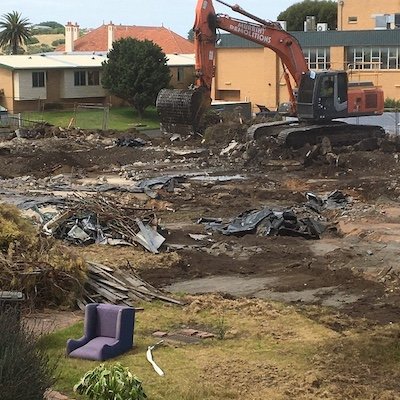
Lyndoch Living’s Tomlinson Wing has been razed to make way for a new $20m-plus medical clinic.
Carol Altmann – The Terrier
Oh a picture paints a thousand words.
Those of us who live or work near Lyndoch Living have this past week watched – and heard – Tomlinson Wing being razed right down to the last lounge chair left lying on its back in the rubble to make way for a multi-million dollar medical clinic.
Such is the secrecy around our community owned nursing home these days, we don’t know how much this clinic will cost – the last figure I saw published by an engineering firm was $24 million, but the plans have changed several times since then.
This clinic will house up to 20 GPs from the Warrnambool Medical Clinic, which Lyndoch now owns, and – presumably – by hiring GPs from elsewhere. It will also have a dentist, an x-ray and an acute care service.
To date, there has been no public discussion on how the business plan stacks up for such a huge investment, or the risks involved for Lyndoch, or the benefits it will bring to Lyndoch residents.
We are being asked to take it all on trust.
And trust is, frankly, in short supply around Lyndoch right now. That is what happens when you stop talking to the public and instead rely on spin.
It’s how you get away with sponsoring a horse race and a corporate marquee at the May Races.
And it’s how you gouge up to 44% of a person’s home care package in admin fees.
So far, this gouging has helped Lyndoch build up a nice little nest egg of $3 million in cash.
No wonder Lyndoch is desperate to pump up its home care package clients: they are taxpayer-funded cash cows.
But is it sustainable? Is this really how home care packages are intended to work?
And, worse, is it a house of cards just waiting to crash, especially as the federal govt moves to close these loopholes?
Which brings me to this:
Last financial year, Lyndoch received almost $2 million more in taxpayer funds to pay for home care packages to help people stay in their own homes.
Did it spend almost $2 million more on supplying services?
No, it didn’t.
It spent almost exactly the same amount as the year before.
So where did this extra $2 million in taxpayer funds go?
Good question!
This was among the questions I asked Lyndoch yesterday in the ever-optimistic hope of a reply.
In the absence of any reply, I have perused Lyndoch’s figures and it appears this $2 million has been invested, which helps Lyndoch’s bottom line look better than it is.
The “surplus” for home care packages shot up from $234,398 in 2019 to $2.5 million in 2020.
A ten-fold increase in just 12 months.
The problem is, it’s smoke and mirrors.
This surplus is not Lyndoch’s money: it’s taxpayers’ money, given to Lyndoch, to provide home care packages.
It’s not supposed to be sitting around in a bank, earning interest and plumping up bottom lines.
It’s supposed to be helping people to bathe, or have their gardening done, or buy a new bed, or to supply hot meals, and if it is not being used for those purposes, then something is terribly wrong.
Fortunately the fed govt knows the system is buggered and is making long-overdue changes that it is rolling out as we speak.
A major change is that the home care money will no longer be paid in advance to places like Lyndoch.
It will be in arrears.
And by September, if new laws go through, the funds will only be paid for what has actually been spent, not sitting there waiting to be spent.
In other words, there will be no $2 million swashing around in Lyndoch’s bank account.
Given the demolition of Tomlinson, Lyndoch has a chance to reassure us that none of the changes planned by the fed govt (home care is just one of them) will make a jot of difference to its financial stability and it can plough on with its $100 million masterplan like there is no tomorrow.
If it doesn’t, or it can’t, then we should listen, very carefully, for the sound of the Queen of Hearts falling.
[Note: Lyndoch is about to hire a new Chief Financial Officer: its third CFO in five years.]
Demolishing more of our precious history is a bridge too far
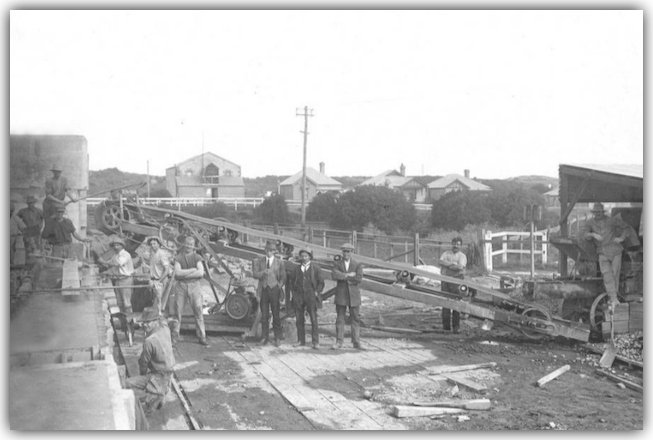
The Stanley St bridge can be seen in the backdrop of this photo taken in 1890, showing workers at a railway reserve unloading huge concrete blocks that would be used to build the breakwater. Image: Warrnambool Historical Society.
Carol Altmann – The Terrier
Will one of Warrnambool’s oldest original bridges survive the wrecking ball? Oh, I hope so.
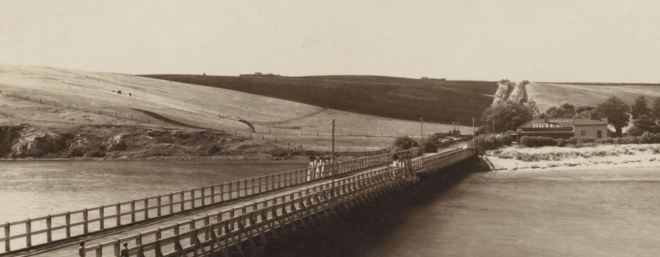
The Warrnambool City Council will soon decide what to do about the failing Stanley St bridge/Edward’s Bridge that crosses the Merri River near the pastel monstrosity formerly known as the Lady Bay Hotel, and which has been in service for 130 years.
Demolition is an option, such is the Warrnambool way.
Just three years ago – in 2017 – the council spent tens of thousands of dollars fixing this very bridge and strengthening the piles that hold it up.
Apart from the piles, the bridge was in “generally good condition” the WCC’s then-infrastructure manager said in a media release.
Even better, the end result of spending these tens of thousands of dollars on repairs was that “the historic bridge will be serviceable for decades to come”.
Decades? Not quite.
Here we are, just three years later, and Stanley St bridge is not only in need of major repairs – another $80,000 will be spent straight away – but is under threat of demolition.
How can this be?
And has the council demanded a refund for the works that failed to extend the life of the bridge for five years, let alone decades to come?
I asked the council spokesman these questions on 20 May and also for a figure on how much the 2017 bridge works cost: there has been no response.
Oddly, these 2017 works didn’t rate a mention in the report to the council meeting on 4 May when councillors talked about how much money they would need to borrow to either knock the old bridge down, repair it, or keep it and build a brand new bridge alongside.
Nobody put up their hand and said, hang on, didn’t we just spend a bucketload of public money a couple of years ago to fix this bridge?
Like the Merri River in flood, so much public money just swishes through and is never seen or heard of again.
The original Hopkins River bridge was built in 1895 and was completely replaced in 2000. It is now in need of major repairs to prevent a catastrophic failure. Image: State Library Victoria.
The same could be said for the Hopkins River bridge which is also in need of major repairs, despite being completely replaced just 20 years ago.
It will soon have $460,000 spent on it to prevent “catastrophic failure” caused by defective concrete and other work that, obviously, couldn’t handle the harsh conditions.
Here’s part of the shopping list for Pontings, according to the tender:
Concrete patch repairs to pre-stressed beams;
Concrete patch repairs to pier headstocks and pier piles;
Crack injection to pier piles;
Silane treatment to pre-stressed beams;
Silane treatment to pier headstocks;
Silane treatment to pier headstocks; and
Protective paint system for pedestrian walkway galvanised beams & plates/cleats.
Cripes, that is some list.
The Stanley St bridge will cost around $2.6m to replace, or $1.2m to repair, with the council to cover half the cost and the remainder from a grant.
Perhaps if we had got it right the first time, we wouldn’t be facing the loss of another piece of our precious history.
My hope is the new bridge, if it must be built, runs alongside the old….and we push for a decent warranty.
Any other option should not be an option at all.
End of the road for retro motel, Caravilla
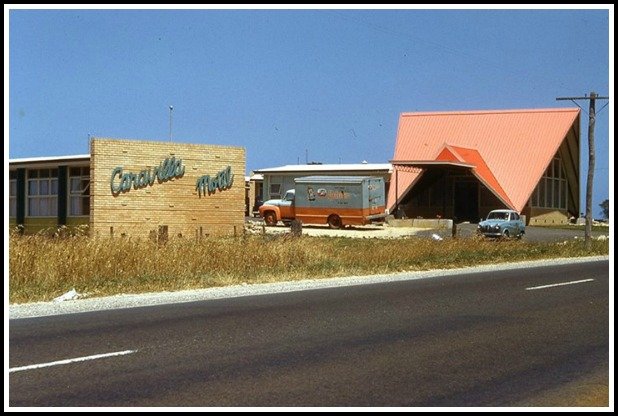
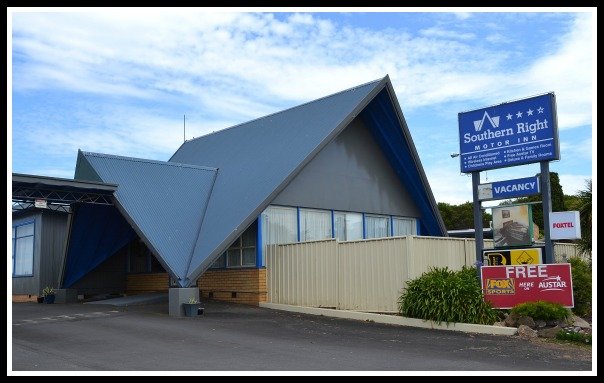
A rare colour image of the 1950s Caravilla Motel, now the Southern Right Motor Inn, in Warrnambool which will soon be demolished to make way for a car yard. Image courtesy of Lost Warrnambool, via ‘Leonie’.
By Carol Altmann
There is a small irony in the fact that one of the earliest motels built in Warrnambool to accommodate motorists will be bulldozed to make way for a car yard.
The Caravilla motel, now known as the Southern Right Motor Inn, was one of several ultra-modern motels to spring up on the eastern entrance to Warrnambool during the late 1950s and early 60s to cater for a generation of post-war holidaymakers on the move.
Now, with the imminent demise of the Caravilla, the Turn-In Motel further along Raglan Parade will be the only Warrnambool motel from the 1950s that is still standing.
Donate!
The motel site has been bought by the Clinton Baulch Motor Group to expand its presence with a new car yard and showroom, with the property keys to be handed over in March next year.
The former Caravilla motel as it looks today with its distinctive ‘Dutch hat’ pitched roof.
While the budget motel has no doubt seen better days, its demolition has a particular poignancy for Jenni DeGrandi, the daughter of draftsman Don Hunt who designed the building.
“It’s very sad for me to see that it’s going,” Jenni told Bluestone.
“As old as it is, I think it is still cheap accommodation for people on a budget holiday (and ) it’s just another piece of Warrnambool’s history going, sadly.”
Don Hunt was part of the well-known architectural firm run by ‘Tag’ Walter and Bruce Auty whose mid-century modern designs are now gaining a new appreciation across Warrnambool and other parts of the south-west.
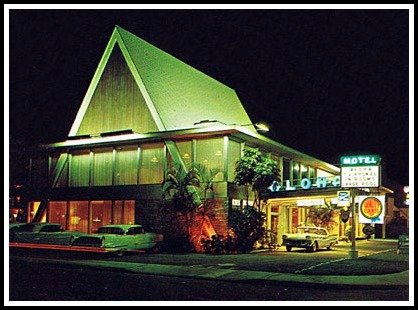
The now demolished Aloha Motel Miami which has a similar high pitched roofline and expansive glazing to the Caravilla. American architects were pushing the boundaries in the 1950s and 60s and influencing styles around the world. Image: Miami Modern.
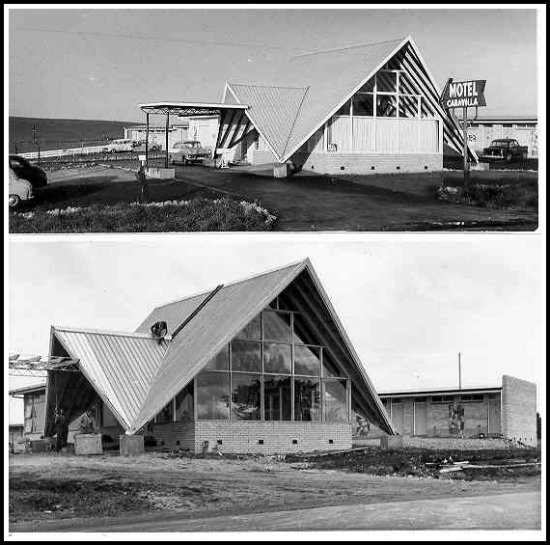
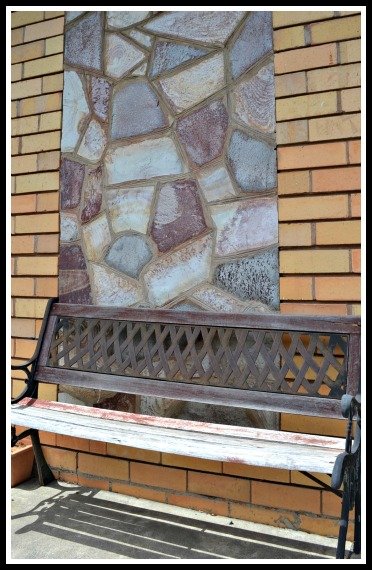
The Caravilla’s reception had a distinctive ‘Dutch-hat’ design with a steeply pitched roofline, while the motel’s ‘wings’ included the signature crazy paving decorative stone that typifies buildings of the era.
As Bluestone columnist Clinton Krause has written previously, it was a period heavily influenced by trends in the United States where energetic and creative designers were busting out of the stuffy confines of traditional architecture to reflect an age of space travel, relaxed home entertaining and the automobile.
This influence can be seen in the Caravilla, which has similar lines to the now defunct and demolished Aloha Motel in Miami, Florida.
Up on the roof: the Caravilla comes to life on Raglan Pde, Warrnambool, in the late 50s. Image reproduced courtesy of Corangamite Regional Library.
English couple Andrew and Mary McKenzie bought the Southern Right Motor Inn just on 11 years ago, three years after it had been reinstated as a motel after serving for many years as student accommodation (Ethel Mitchell House) for the Warrnambool Institute of Advanced Education and later Deakin University.
“We had been to Warrnambool a couple of times and decided we wanted to move here, so Mary started looking for budget motels and we found this on the internet,” Andrew explains.
“We’ve had 10 good years and most people in motels only last five, so we have done pretty well,” he says.
Unlike the Turn In Motel, the majority of the original fittings and features of the Caravilla are long gone, replaced during several makeovers up until the 1980s.
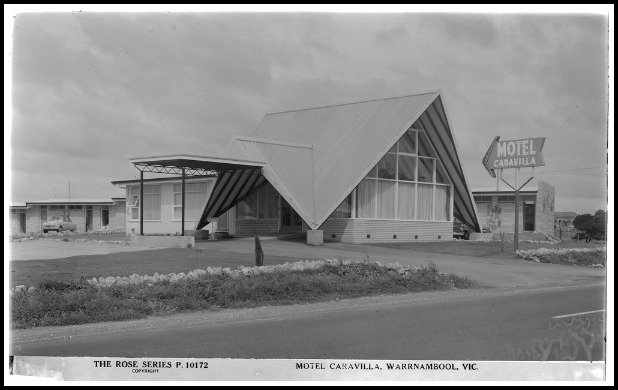
A Rose Series photograph of the Caravilla in 1960 when it was one of the most modern motels in Warrnambool. Image: State Library Victoria.
As a budget motel, however, it has attracted a steady clientele.
“There are a lot of people who either don’t want to or can’t afford $150-plus a night, so it has been great for them. Each year we have had it, apart from one or two years, it has got better and better,” Andrew says.
The Caravilla/Ethel Mitchell House/Southern Right Motor Inn will close in February in preparation for the March handover.
In the meantime, another of Don Hunt’s buildings – a residence at 60 Jukes St, Warrnambool that was built in 1959 – has recently been given local heritage protection.
Faded glory – some of the original crazy paving at the motel. This paving is associated with so many buildings from the 50s and 60s in Warrnambool. Image: Bluestone Magazine
The 1940s maisonettes at 259 Lava St, Warrnambool, were demolished last week, despite being the last example of such maisonettes in the city. Image: Supplied.
Analysis – Carol Altmann
Another irreplaceable piece of Warrnambool’s urban landscape has been reduced to rubble without, it seems, a word of warning.
The well-known, pre-war apartment block at 259 Lava St (next to Aldi supermarket) was bulldozed last Tuesday (14/7), to make way for something which has not yet even been decided but which the owners, the Salvation Army, believes will better suit it needs.
Such was the swiftness of this particular demolition that nothing was salvaged, or offered free to others, so passersby watched in horror as window frames, glass panels, doors and fittings were broken up by a bulldozer and stuffed into waiting trucks.
It is enough to make you weep, and that’s exactly how a Bluestone subscriber felt when she sent us a series of photos she had taken of the travesty.
We posted them on our Facebook page where, within a few hours, they were seen by more than 4000 people and sparked a robust discussion about how we should treat our old buildings, but the debate, of course, was all too late: this building is already gone.
And this was a special building.
We know this because the Warrnambool City Council’s own heritage reports tell us so.
How the twin maisonettes at 259 Lava looked when in tact. They were part of a between-wars architectural movement called Inter-war Moderne. Image: Google Maps.
According to these reports, the apartments at 259 Lava St were one of only two examples of twin maisonettes in Warrnambool built in the “Interwar Moderne” design. This design was originally developed by one of Melbourne’s most notable architects, Robert Demaine, and, in this case, adapted by Marsh Michaelson.
The only other example of such twin moderne buildings in Warrnambool was the side-by-side buildings of “Sandilands” at 1A Liebig St (the former Madden’s building) and 1 Liebig St, known as Colern.
And Colern, despite being originally recommended for heritage protection, recently had that recommendation dropped. Why? Because without Sandilands, it has less architectural significance.
This logic means Colern could be bulldozed too.
Can you see what is happening here?
One domino falls and they all fall: from having three fine examples of moderne design, we could easily have none and those people, like Bluestone, who treasure the character of Warrnambool’s urban landscape, are at a loss as to what to do about it.
Because as it stands, the “community consultation”, if you can call it that, is simply not working.
One half of another example of such architecture, Sandilands, (the former Madden’s building) was demolished earlier this year. Image: Bluestone Magazine.
Nobody is arguing that every old building in Warrnambool needs to be saved, but at least some of the shock at seeing great chunks of our streetscape disappear might be lessened if we all had the chance to have a say.
Part of that process, of course, is also hearing in plain English why a building should go: is it beyond repair? Has it been condemned? Full of asbestos? Are there many other examples of that style around? Will something extraordinary or beautiful take its place?
At the moment we are left in the dark and, once a building is gone, it is left to rumour and speculation as to why.
The council can rightly argue that more information is out there, but it is up to you to find it, buried somewhere in council agendas, reports, minutes, special briefings and papers.
We here at Bluestone keep a relatively close eye on council happenings, and we did not see or hear a word about 259 Lava St being earmarked for demolition.
Cr Peter Hulin, who is currently overseas, made a Facebook comment that he, too, knew nothing – and he is on council!
If he doesn’t know and we don’t know, what hope does the everyday Warrnambool resident have?
Surely we can do better than this and surely we deserve better than this.
Even a simple listing on the council’s website – “Demolition Applications” – would help.
(As it happens, Heritage Victoria held a forum in Warrnambool last Friday (17/7) to see how it could improve the 20-year-old Heritage Act.)
The once-derelict, and heritage listed, building at 222 Timor St has since been transformed into retail and upstairs apartments. Image: Bluestone Magazine.
Built heritage is critical to a city’s character – Port Fairy knows this well – and while Warrnambool is tearing its down, other cities are finding new ways to revitalise old factories, warehouses, shops and houses: especially those in a CBD, where they become highly sought after, and very cool, housing.
Warrnambool lawyer Luke Taylor is doing just this above 222 Timor St (Biba Hairdressing), which was a virtually derelict dump when be bought it, but the 1850s building will soon house two, gorgeous apartments and its renewal is helping to transform that section of Timor St.
My thinking is that we don’t ever really “own” a building – we are merely custodians for a time – and if we are lucky enough to own a special piece of architecture, then it belongs both to us and the community.
Historian Jennifer Bantow also believed this. She was part of a passionate group of people who saved Murweh, the Fitzgerald’s historic home at the north end of Liebig, from being bulldozed in the 80s.
When I last spoke to Jennifer, who now lives in Geelong, she asked me: “So, is Warrnambool still pulling down its old buildings, or has it finally ‘got’ it?”
Judging by the events of last week, the answer is clear.