Lyndoch posts record loss as it ploughs on with masterplan

Lyndoch Living aged care is sailing into un-charted waters with big borrowing, big spending and a sharp decline in its overall equity.

Carol Altmann – The Terrier

Lyndoch Living’s full financial figures dropped late today and here is a quick snapshot:

Lyndoch last year posted a record loss of $4.029 million – almost $2 million up on the loss of the previous year.

In 2020, it posted a loss of $2.4 million.

In 2019, it posted a loss of  $1.88 million.

In 2018, it posted a loss of $1.77 million.

In 2017, it posted a $846,000 surplus.

Er, is this supposed to be how a not-for-profit operates? Not breaking even, but running at continual losses?

More importantly, Lyndoch’s net worth has dropped to $40 million in 2021, down from $48 million in 2020 and $69 million in 2015.

This net worth/equity figure  comes from adding up all of Lyndoch’s assets (around $100m), and subtracting all of its liabilities.

Lyndoch’s assets have hovered around the $100 million mark for several years now.

What has changed are the liabilities – they keep going up, up and up.

In 2018, Lyndoch’s liabilities were $37 million

In 2020, Lyndoch’s liabilities were $47 million.

In 2021, they were up to $60 million.

All of this cuts deep into Lyndoch’s overall financial position.

Lyndoch is borrowing big, it is taking risks, it is investing in a $22 million medical centre that is due to be finished mid-year, ploughing ahead with its $100m masterplan and somewhere in all of that is a whole lot of hope – by us – that it will all work out.

Hold on to your hats, me hearties.

[The full figures are available through the Australian Charities and Not for Profits Commission. I will pull apart the figures in detail in coming days.]


Lyndoch borrows big for $100m masterplan as deficit rises

Despite successive deficits, Lyndoch Living is borrowing big to fund its $100m masterplan. Original image: Disney.

Carol Altmann – The Terrier

Lyndoch Living, having recorded a fifth deficit in six years, is digging into residential bonds to fund its $100m masterplan.

And a warning – figures ahead, lots of figures – as we dive again into the swirling financials of Lyndoch Living.

One, two, three…jump!

When you bob up you will see that figures lodged by Lyndoch Living last week show an even greater loss – a $2.4 million deficit – than was reported at last October’s AGM (the one we were not invited to Zoom, but could watch later on YouTube).

The annual information statement lodged last week with the Australian Charities and Not for Profit Commission reveals a $600,000 increase on the $1.88 million loss reported at the AGM and in Lyndoch’s full financial statements to the commission.

The $2.4 m is the loss recorded by Lyndoch without taking into account the profit from the Warrnambool Medical Clinic, which it bought in 2019. Either way, it is the fifth deficit for Lyndoch in six years.

This doesn’t seem to trouble the board.

As reported here last November, Lyndoch’s overall asset base (assets minus its liabilities) also continues to slide and is now $47.6m down from $69m in 2015.

This doesn’t seem to trouble the board either.

There is a lot to digest in the 60-page financial statement, so I am going to break it into bite-sized chunks tonight and in follow-up pieces.

First, the report shows us that Lyndoch has funded at least part of its $13 million Swinton Wing expansion by doing something it has never done before, which is borrow money.

It has visited the bank and also borrowed a big chunk out of the $26 million it holds in residential bonds paid by residents.

From this $26 million in bonds, Lyndoch has thus far extracted $10,944,323.

By law, as long as an aged care provider can cover its residential bond refunds for the next 12 months, it can dig into the rest and repay it down the track.

If an aged care home defaults, the Federal Govt will pick up the tab, so it’s kind of a taxpayer-backed Ponzi scheme that relies on an aged care home doing the right thing.

It’s also cheap, interest-free money, but concerns about how these bonds are being used is one reason (among many) that the whole bond scheme is now under review as part of the Royal Commission into Aged Care.

The loans, of course, will need to be repaid at some point, including fairly substantial interest on the bank loans, despite low interest rates.

In 2018, Lyndoch paid zero interest on any loans.

In 2019, it paid $62,420.

In 2020, it paid $372,669.

As of 7 July 2020, Lyndoch signed up for another loan from the NAB for $3,386,000 which is due to be repaid by June 2022.

This was needed to fund the “redevelopment of a residential building” which, I assume, was the blowout in cost of the Swinton Wing.

That project, where residents are not allowed to hang any pictures on the walls despite paying huge bonds which helped fund it, grew from a budget of $10 million to $13 million.

Relying big on borrowed money is new territory for Lyndoch, which once upon a time used to spend only what it had, what the government gave it, and what it raised from the public.

But Lyndoch, as we know, is now a long way from those comfortable shores as it sails into a $100 million masterplan under the captaincy of a CEO and board that firmly believes you must spend money to make it.

This is why in 2019 Lyndoch bought the Warrnambool Medical Clinic, Health Spot and May Noonan Hostel, in Terang, for around $3.3 million.

(Lyndoch also recently hired JB Were – who will charge fees accordingly – to look after its complicated investment portfolio. We are not in Kansas anymore, Toto.)

The Warrnambool Medical Clinic last year turned over $3.8m in revenue, but had $2.8m in expenses.

According to the financials, the clinic returned a final profit of $539,249 to Lyndoch Living in 2020 which is not to be sneezed at… but $372,000 of this will be spent this year paying out the original owners of the clinic as the final instalment of the sale contract. Achoo!

The WMC was pretty much break even for last year.

As for this year, well this is when things get interesting, because Lyndoch has the wire fencing up and around its now-vacant Tomlinson Wing (built in 1991 with help from a generous donation from the Tomlinson family), all set for demolition to make way for a new, two-storey Lyndoch medical clinic to replace the existing WMC.

This clinic will have acute care, dentistry, an x-ray machine, up to 20 GPs, allied health, education rooms, a cafe, a chemist and no doubt wonderful indoor plants and a red-and-white colour scheme.

The cost? An estimated $24 million. Where is that money coming from?

The bigger question, however, is will Lyndoch Living thrive or dive under this grand expansion and multi-million dollar spend up? Time will tell.

More soon.


Shrinking or growing? Crunching the numbers on Lyndoch

Carol Altmann – The Terrier

Lyndoch Living is definitely getting bigger, but is it getting better? The numbers say no.

The reason I keep writing a lot about our community-owned aged care home is to put on the public record what is happening under the change of leadership and change of direction since 2015.

It’s important that we – as the community who own Lyndoch – keep track of what is going on, because nobody else is telling us.

We are the custodians of Lyndoch and the community will be here way past whoever happens to be in charge, so yes, we need to keep track of what is going on.

We owe it to Lyndoch, the residents, the staff, and those who helped create Lyndoch more than 50 years ago.

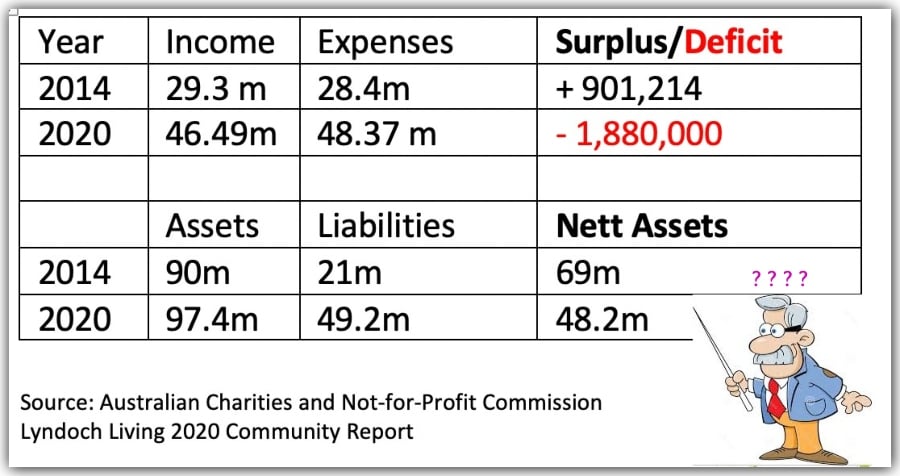
This is why tonight I am running this little chart, because it captures how Lyndoch is travelling financially.

It shows that before 2015, Lyndoch ran at a small profit/surplus or was break even.

This year, it posted its biggest loss – close to $2 million.

Lyndoch has run at a loss for five of the past six years. From my research, this is unprecedented in recent times.

At the same time, its assets have gone up, but so have expenses – they have more than doubled.

This has meant a $20m cut to its net assets in just six years.

Is this visionary? It is sustainable? And why, when it comes to cost cutting, do we hear of cuts at the coalface, and not in the corporate?

Speaking of which, it’s worth remembering that the very first thing to happen under the $100m masterplan now being rolled out by Lyndoch was an upgrade of the corporate area.

Out with former CEO Rhys Boyle’s old wooden furniture and in with the fingerprint resistant glass table.

We still don’t know how much that corporate re-vamp cost but it was an early sign of the shifting priorities.

We still don’t know, exactly, how much the Swinton Wing re-vamp and extension cost, but estimates are it blew out by $2m to $13 million.

And coming up next is a new two-storey medical clinic to be built next to Scoborio Reserve with, it is said, radiology, pathology, acute care and educational facilities alongside up to 20 GPs.

Lyndoch will bulldoze Tomlinson Wing and its gardens to make way for more glass and cement.

How much will that all cost to build and set up? We don’t know.

Is this all necessary? Is it all sustainable?

These are the questions I would like to ask the board – our eyes and ears at the table – and I am sure you would like to ask too.

In the face of their silence, we just keep pressing.


Red zone: Lyndoch posts $1.9m deficit, assets slide by $20m

Despite a 2019 spending spree which included buying the Warrnambool Medical Clinic, Lyndoch’s overall asset base is going south.

Carol Altmann – The Terrier

Lyndoch Living last financial year recorded a $1.88 million loss – its fifth deficit in five years – and its bottom line has gone backwards by $20 million since 2015.

This, unlike what was reported in the local paper after last Tuesday’s invitation-only Annual General Meeting, is the reality behind the spin.

Here is the nub: Lyndoch is not growing, but going backwards, and we need to know why, especially as it pushes on with a $100 million masterplan funded mostly through loans.

We also need to ask why, in the face of such losses, Lyndoch continues to hire more executives on executive salaries, but more about that later.

First to the numbers, which are so easy to spin.

What Lyndoch pushed in the newspaper, and in a piece of puffery it produced for the AGM called a “Community Report”, was a measure called an “underlying profit” of $2.18m.

As has been pointed out by Deloitte, underlying profit is one measure that can be “useful” to judge financial performance, but can also be “misleading if used to mask bad news”.

And Lyndoch had some bad news.

The thing is that Lyndoch’s $2.18m “underlying profit” doesn’t take into account expenses such as interest on loans, depreciation, under-performing investments, and taxation.

These are real costs and when these costs are factored in, Lyndoch’s “profit” vanishes.

In fact these costs chewed up more than $4 million and Lyndoch ended the financial year not in surplus, but $1.88 million in the red.

This is the figure we should be looking at.

This is the  “total comprehensive income” – and it is not good news.

Even more troubling, however, is the slow and steady decline in Lyndoch’s bottom line (its net assets) over the past five years.

This has fallen by a staggering $20 million from $69m in 2015 down to $48m in 2020.

Despite Lyndoch last year buying the Warrnambool Medical Clinic, the Health Spot clinic and the May Noonan hostel in Terang for a cost of around $3.3m, its asset base has not improved, but gone backward.

As one learned accountant said to me last week, “this is a company that is diminishing, not growing”.

Again, this is not good news.

Like last year, we will have to wait until late January to see the line-by-line figures reported by Lyndoch to the Australian Charities and Not-for-Profits Commission, because these days Lyndoch provides just a simple snapshot at its AGM.

Only by seeing the line-by-line figures will we see the full picture.

Nobody asked a single question at the AGM (test: try and find the video buried on its website here), which is not surprising, given Lyndoch does not allow any outsiders to become members let alone board members.

To me, the fact Lyndoch now has a new, fast-tracked president in hairdressing salon owner Sue Cassidy, who has no experience or qualifications in health, disability or aged care, is troubling.

But the lack of any open and robust accountability around Lyndoch in real-time is frightening.

I do, however, know this: just three days after posting a $1.88m deficit, Lyndoch advertised for yet another high-paid executive to join its ever-expanding executive team.

This newly created position for a “Director of Enterprise, Research and Education” is being advertised internally only and applications close in less than two weeks, which suggests someone is already being lined up for the role.

(My tip is the Acting Director of People and Resilience, Julie Bertram, a retired director of South-West TAFE, who has been filling a maternity leave position.)

It’s a powerful role and includes acting as CEO when the CEO is on leave, which previously fell to the Director of Nursing.

Five years ago, when Lyndoch hired its new CEO Doreen Power, Lyndoch had 37 people in administration. By 2019 it had 59.

All indications are that it is now above 60.

I wonder how the nurses and personal care workers and “hands-on” staff caring for the residents across Lyndoch feel about that?

As always, I wait for the board or our local MPs to ask the hard questions on our behalf and, in the meantime, we all just keep chipping away.

If you would like to support the work of The Terrier, please consider a small monthly tip into the tip jar.

Terrier Tip Jar


Deficit: down the rabbit hole into Lyndoch Wonderland

Carol “Alice” Altmann – The Terrier

Take my hand and follow me into the strange, alternative world of Lyndoch Living Wonderland, a sparkly world with a lovely colour palette, and where a deficit is “a good result”.

Lyndoch has just posted its fourth deficit in the past five years, but according to those who sit at the big table, there is no need for concern.

(Caterpillar: I don’t know what they’re smokin’ over there in the boardroom, but I want to try it!)

What’s more, Lyndoch CEO Doreen Power, who was appointed in 2015, has announced – without so much as a twitch of an eye – that we can expect our largest, fully-booked aged care home to run at a loss for another two to three years.

This means that by 2022, Lyndoch will have run at a loss for six or possibly seven years out of the past eight.

(Cheshire Cat: keep smiling everyone, keep smiling! Oh blast, here comes Alice with her practical facts…)

In 2014, the year former CEO Rhys Boyle retired, Lyndoch was comfortably in the black and recorded a $901,214 surplus, which came on top of surpluses in 2012 and 2013.

Here are the figures since:

2015: $208,707 deficit

2016: $130,037 deficit

2017: $846,563 surplus

2018: $1,573,98 deficit 

2019: $398,356 deficit


I think this tells us pretty clearly that Lyndoch is living beyond its means – each year it is spending more than it makes – but somehow an almost $400,000 loss like last year is a “good result”.

No it isn’t. It’s a bad result.

(Mad Hatter: Oh Alice, anyone knows a good result is better than a bad result which is better than a worserer result. Pour me some tea!)
If we push aside the spin and boil it down to the absolute basics, Lyndoch has one important job to do, which is to care for our elderly and infirm, for which it receives money from the Federal Government, the State Government, live-in residents, clients and its own investments.

From all these things, Lyndoch last year received a total income of $38.9 million.

It spent $39.3 million, in other words, it went over its budget…again.

On top of this, Lyndoch also confirmed a slightly awkward piece of news, which The Terrier flagged back in October, which was $11.3 million was wiped off its assets after certain, unnamed buildings were re-valued using a different method that, from what I can see, used market prices.

This is like owning a house you thought was worth $12 million, only to be told it is actually worth $1 million.

(Mad Hatter: Oh who cares? $1 million, $12 million, it’s only on paper! Tear it up and start over! More tea?)
Have a big sip of whatever you are drinking, because now we wade deeper into the forest of figures in search of the bottom line.

In 2015, Lyndoch had total assets of $96.5 million – this is whole shopping cart: the properties, the cash, the residential bond money, the investments, the cups and saucers, cutlery and cars.

At the same time, it had expenses, or liabilities, of $27.7 million, leaving it with a bottom line of $68.7 million.

By 2019, Lyndoch had total assets of $98.9 million – (White Rabbit: clap, clap, wonderful, magnificent! Well done!) – but….it also had liabilities of $47.7 million, leaving it with a bottom line of $51.1m.

This means Lyndoch’s overall bottom line has fallen from $68.7 million to $51.1 million in just five years.

(White Rabbit: Oh. But the cash, dear Alice, what about the cash?)

Lyndoch has plenty of cash: $48.7 million in cash and other investments, except they can’t touch most of it – around $30 million from my reckoning – because it is tied up in residents’ bonds.

(White Rabbit: So I can’t spend it on a shiny new pocket watch? Damn.)

As we know, other things have changed dramatically in the past five years too, including just about every member of the executive team being replaced, from the Director of Nursing, to the Chief Financial Officer, to the Human Resources head, with more than 80 staff having gone elsewhere.

I have since been told by a strong source that my figures are wrong and it’s closer to 120 staff, but I can’t verify this.

(Queen of Hearts: At last, at last, my walk on part…Off with their heads, I say! Off with their heads! Strike up the trumpets!)

No wonder the board wasn’t keen to trumpet all of this news at the annual general meeting last October, where written questions from the public were ignored, because they were not members of Lyndoch.

Anyone who has since tried to become a member has been rejected.

(Queen of Hearts: Close the gates! Don’t let the rabble in!)

And the crazy making thing is that despite these worrying figures, Lyndoch is not tightening its belt, but going on a spending spree: a $100 million masterplan that includes buying two medical clinics for a cost of $1.6 million, including $1.3 million for the Warrnambool Medical Clinic, so it can move them to a medical clinic that it will build.

(Mad Hatter: And don’t forget the horse race! We want to go to the races, so we bought the race! Giddyup Dormouse!)

I am worried, dear citizens, that we who own Lyndoch are being dragged deep into this wonderland and we won’t be able to find our way out, which is why we have to keep going.

(Caterpillar: Ah, chill baby and pass me the pipe.)
If you would like to support the Terrier, you can throw something in the tip jar below. 

The Tip Jar