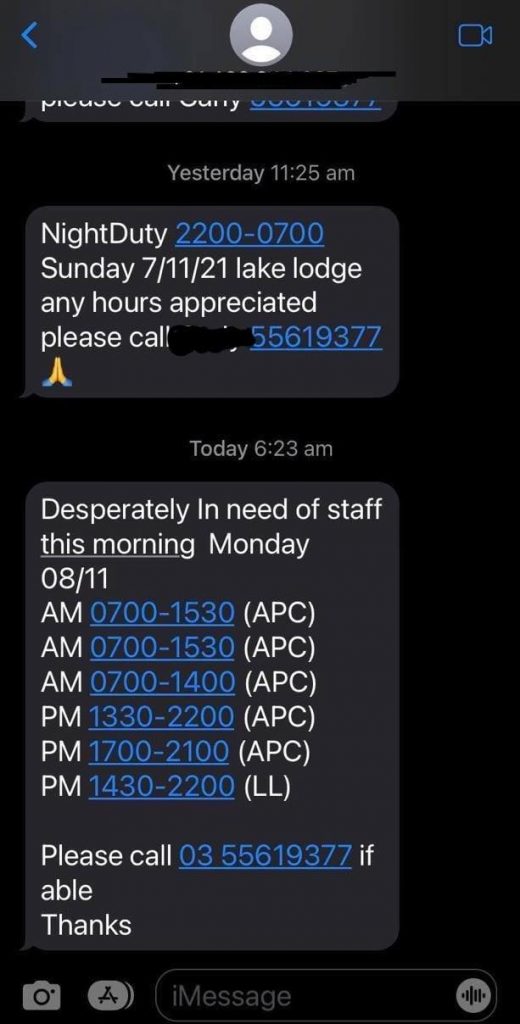
Before breaking that story yesterday, I had planned to post these roster shortages for the Audrey Prider Centre and Lake Lodge – the two, high-care areas that make up what is called the “nursing home”.
These are the very same areas that were the focus of yesterday’s bombshell that Lyndoch had failed four more national standards of care.
These are the areas that were found by the Aged Care Quality and Safety Commission to be under stress from severe staff shortages.
That was based on the commission looking closely at Lyndoch in September.
September.
Yet here we are, and nothing has changed. These are the shift shortages for the past couple of days: it is dire.
So if things were grim in September, I can only imagine what the commission would report if it turned up now.
And I hope they do turn up, unannounced, very soon because this cannot wait until the reaccreditation at the end of February. The commission has the power to do this. It can apply sanctions at any time.
Roster call-outs reveal chronic shortages in the high-care areas of Lyndoch Living.
Our local Federal member Dan Tehan gave a statement to the local paper today which says the commission is still deciding what to do in response to the latest failings.
I hope they intervene, because these rosters show that we cannot hope that things will miraculously improve. They won’t.
This has nothing to do with national staff shortages, Covid, or the Royal Commission. It has everything to do with the Lyndoch culture and priorities.
We know it, the staff know it, and surely the commission is starting to catch on.
Yet while the walls crumble around them, Lyndoch once again shows no contrition or remorse for these failings. It once again tells the paper that it has “an action plan”. It said the same thing earlier this year.
Clearly, that action plan is not working and Lyndoch is going backwards, from failing one standard, to now failing four.
My hope is the commission does not wait for it to deteriorate even further before taking action, because at the centre of all this are real people, elderly, vulnerable people, beautiful people from our local community, who are not able to smile and laugh for the Lyndoch Facebook page, but who are instead in need of our help. We are there for them, and those who care for them.
Thankyou to every single one of you who is prepared to stay the course and fight this fight.
Crisis point: Lyndoch Living again fails aged care standards
The Lyndoch Living nursing home in Warrnambool has failed a second time this year to meet aged care standards.
Exclusive
Carol Altmann – The Terrier
The Lyndoch Living nursing home has again failed a string of care standards set down by the national aged care watchdog.
In another damning report released online today by the Aged Care Quality and Safety Commission (ACQSC), the nursing home has again failed to meet key measures in personal care and clinical care, staffing, and also governance. [Download the report here.]
The nursing home area is made up the two high-care units: the Audrey Prider Centre, for dementia residents, and Lake Lodge.
An ACQSC audit from September 8 to 15 revealed poor wound management, poor pain management, a lack of monitoring and documentation after resident falls, and inadequate staffing, with unfilled rosters, and remaining staff being unable to cope with the workload.
The extent and impact of understaffing at Lyndoch is graphically highlighted by the report.
It found the nursing home is unable to demonstrate that its current mix and qualifications of its workforce could deliver and manage safe and quality care and services.
“Rosters evidence that not all care shifts are filled when staff are deployed elsewhere within the service or when staff call in sick,” the report says.
“Personal care staff interviewed advised they do not always complete all tasks allocated to them.”
The report says Lyndoch management described how they are in the process of recruiting more nursing and care staff to cover current vacancies, but this has done little to address the concerns of residents and their families.
“Whilst the service was able to evidence improvements, four out of five consumer representatives expressed ongoing dissatisfaction with staffing levels within the service,” the report says.
Short staffing was also raised in regard to poor wound and pain management.
“(Lyndoch) did not demonstrate best practice clinical care in relation to wound and pain management,” the report says.
In particular, the commission found:
– Wound management plans did not always reflect wound reviews including dressing changes, photography and measurements.
– Inconsistent wound photographs and wound measurements are taken and recorded.
– The healing progress of each wound is not clearly demonstrated.
Nursing staff told the commission that staff shortages limited the ability of staff to attend to wounds as required, and to reposition residents to reduce pressure.
“Clinical staff described how wound care is impacted by staff shortages including delayed dressing and repositioning of consumers,” the report says.
The report also outlines failings in monitoring residents who had suffered falls.
Unwitnessed falls were not always documented in reports and a sample found that three out of four residents who had fallen were not effectively monitored afterward, including neurological observations and pain monitoring.
Not surprisingly, the nursing home also failed on risk management.
“The service did not demonstrate systems are in place to prevent harm from high impact or high prevalence risks such as falls,” the report says.
Despite hiring an adviser to help with its governance activities, the service “has not demonstrated current systems and processes are adequate in identifying and managing high impact or high prevalence risks”.
The ACQSC is the peak federal body for assessing and accrediting aged care homes.
I will seek comment from Lyndoch this afternoon and update this story if or when a comment is received. In the meantime, I stand with the care staff and the poor residents.
Lyndoch Living failings in care didn’t get better, but worse
Lyndoch Living says it plans to fix failings identified by the national aged care watchdog, without publicly detailing how.
Carol Altmann – The Terrier
Lyndoch Living’s failure to care for the elderly and frail was kept under wraps for more than a year, during which things didn’t improve – but got worse.
That little bombshell was wrapped up in MP Dan Tehan’s media statement issued in response to The Terrier exclusive on Tuesday night.
Mr Tehan said the nation’s top aged care watchdog visited Lyndoch in response to a complaint way back in February LAST year.
As a result, the Aged Care Quality and Safety Commission slapped Lyndoch with a non-compliance order for Personal and Clinical Care (aka, the very reason an aged care home exists).
Never fear, Lyndoch assured the commission at the time, they had a plan!
Fast forward 12 months to January 2021 and the commission re-visited Lyndoch to find the situation was not better, but far worse.
How is that allowed to happen?
As revealed exclusively here on Tuesday night, Lyndoch failed not one, but three out of four standards, including using chemical restraint without consent, and failing to appropriately monitor residents after serious falls.
And when it came to staffing, the commission could not have been more blunt: “(Lyndoch had) not ensured the delivery of safe care and services”.
If Lyndoch can’t get this right, what is it there for? To sponsor golf and horse racing?
Lyndoch’s three-year accreditation comes around again in August.
Lyndoch told the paper (it doesn’t respond to The Terrier) that it has an “action plan”, none of which has been detailed or publicly costed.
There is no mention of it on its website.
Once again, we are kept in the dark by a board and Lyndoch executive who are failing to deliver Lyndoch’s core business.
If The Terrier had not been tipped off about this latest report, nobody would know a thing about any of this.
“This” is the neglect that follows as a natural consequence of our nursing home not having enough staff, not having enough qualified staff, getting rid of experienced staff, and staff quitting because they are physically and emotionally exhausted.
At least 120 people have left Lyndoch in recent years, from very experienced and senior operators, down to those who only lasted a year or two.
These are the ever-growing band of alumni dismissed by Lyndoch as “disgruntled workers”, when in fact they are soldiers returned from the battlefield with warnings of what lies over the horizon.
“This” is a consequence of changing priorities where Lyndoch will overload itself with executives, but can’t fix the nurse call-bell system that is still unreliable.
“This” is a culture that will happily see Lyndoch go into massive debt for a new $24 million medical clinic based on an invisible business plan, rather than hiring more hands and hearts on the ground.
This is not the fault of the nursing and care staff: the moral collapse starts with the executive and board who set Lyndoch’s vision and priorities.
Don’t just take my word for it.
Take it from former Lyndoch Director of Nursing Penny Iddon who wrote this on the Terrier Facebook page after the breaking story:
“Poor standards of care are a direct result of poor and inadequate management oversight.
“The Board, the CEO and the senior nursing staff must take responsibility for this appalling result. The Board can no longer bury their heads in the sand and the CEO can’t keep passing the buck.
“After all, what the Auditors reported on regarding poor and outdated care practices has been allowed to continue under their watch which indicates a clear breakdown of systems, protocols and values.”
We have now seen in stark detail this week how Lyndoch is breaking down.
It has broken down in its duty of care.
And there are fears if the medical clinic goes ahead at the scale which is planned, it will break down financially.
How ironic, then, to see the Lyndoch CEO listed among the guest speakers jetting off to at an aged care forum next month in Sydney.
The topic?
Attracting and retaining new talent to revitalise your workforce.
Residents’ suffering exposed in report on Lyndoch Living
A performance report from earlier this year reveals Lyndoch Living has failed to meet 3 out of 4 quality standards set by the Aged Care Quality and Safety Commission.
Exclusive
Carol Altmann – The Terrier
A string of failings at Lyndoch Living has been exposed in a damning report by the national aged care watchdog.
A report released by the Aged Care Quality and Safety Commission in March – but which I was alerted to only today – lays out a shocking series of inadequacies recorded after a two-day visit by the commission to Lyndoch in January.
The commission is the peak federal body for assessing and accrediting aged care homes and for handling complaints.
Its assessment team found Lyndoch was non-compliant in three out of four key measures for resident care and staffing.
A separate report released at the same time shows the Lyndoch Hostel section passed on all measures, but an 11-page report into other, unidentified, sections of Lyndoch reveals a story of wounds, falls, pain, lack of consent, outdated records and crying out for help.
The report focusses on five specific residents, and it makes for heart-breaking reading.
Here are some of its findings:
Resident one, who was living with severe dementia, experienced “breakthrough” pain levels daily for three weeks without receiving any further pain medication, pain assessment, monitoring or evaluation;
A pain assessment plan set out by a specialist team was not followed;
The specialist’s recommendation that a pain medication patch be increased was not followed;
This same resident also had several wounds which were not adequately overseen by staff;
In regard to one of the wounds, all four management plans failed to record if the wound was getting better or worse, with boxes on wound size either unchanged or left blank;
Another resident was being given antipsychotic drugs “as required” – which is defined as chemical restraint – with no proof of consent:
“The representative of the [resident] told the Assessment Team that they had not provided consent and were unaware of any potential side effects of the use of the medication,” the report says.
A third resident had a fall and was hospitalised overnight with a significant laceration but, upon returning to Lyndoch the next day, was not reviewed for pain or possible brain injury:
“The Assessment Team found that staff did not undertake a timely review of the consumer’s pain on return from hospital and did not undertake neurological observations.”
This same resident later developed shoulder pain, but an order for stronger pain relief was not processed until two days later, with a GP review three days later.
A fourth resident, who lives with dementia, had an unwitnessed fall, but was not assessed for pain or a possible head injury.
Two days later, the same resident had two more falls which “qualifies” for a CT scan, that occurred.
The report says Lyndoch refuted the assessment team’s statements about this incident and also questioned the accuracy of its findings.
The team, however, stood by its report.
It says “the key points were timeliness of pain review following a fall and whether staff undertook neurological observations. Particularly …. for unwitnessed falls where the consumer could have hit their head…”
A review of records of a fifth resident, who was on psychotropic medication, found the medication records were out of date.
As a result of these incidents, Lyndoch was found to be non-compliant in standards for Personal Care and Clinical Care.
It was also found to be non-compliant in Human Resources and had “not ensured the delivery of safe care and services”.
The assessment team said it witnessed staff rushing tasks and staff walking past a resident who was calling out for help without stopping to offer support or assistance.
A review of the roster across a two-week period found some shifts were unfilled.
It also found failings in infection prevention and control, including:
poor use of personal protective equipment by some staff;
social distancing not always being adhered to by some staff and;
not taking all reasonable steps to prevent visitors who do not meet entry requirements from entering the facility.
Staff shortages and a lack of suitably qualified staff also came under fire:
“the skills of the current mix of staff delivering the care are inadequate and are not meeting the current needs of (residents).”
So there it is in black and white: Lyndoch is failing in its core business of caring for our elderly and frail.
It is failing some of the most vulnerable people in our community and yet there are still those within Lyndoch who will deny, deflect and head to the May Races.
This is not the fault of the exhausted Lyndoch staff.
The buck does not stop with them: it stops with those who decide the priorities of Lyndoch.
Right now, the number one priority for Lyndoch is building a $24 million, 3000sq/m medical clinic with no clear benefit to the residents.
This is how disgracefully lop-sided things have become and how far Lyndoch has drifted from its core purpose.
And so we have reports of wounds, falls, pain, missing records, soreness, sadness and crying out for help.
This is not happening in a private aged care home deep in the outskirts of Melbourne: it is happening in Warrnambool, in a place owned by us, the community.
Why has Lyndoch not told us about this report, apologised for its failings and pledged to do better?
Do we simply shrug our shoulders and say “that’s how it is in aged care” and turn away?
I can’t turn away and I know you can’t too.
We have to be the voice of the voiceless and refuse to accept silence as a solution.
[The commission has set down seven areas in which Lyndoch must improve to avoid any risk to its accreditation. You can read those here. It should be noted the commission says Lyndoch has challenged or refuted many of its findings. You can download the full report here.]
Red zone: Lyndoch posts $1.9m deficit, assets slide by $20m
Despite a 2019 spending spree which included buying the Warrnambool Medical Clinic, Lyndoch’s overall asset base is going south.
Carol Altmann – The Terrier
Lyndoch Living last financial year recorded a $1.88 million loss – its fifth deficit in five years – and its bottom line has gone backwards by $20 million since 2015.
Here is the nub: Lyndoch is not growing, but going backwards, and we need to know why, especially as it pushes on with a $100 million masterplan funded mostly through loans.
We also need to ask why, in the face of such losses, Lyndoch continues to hire more executives on executive salaries, but more about that later.
First to the numbers, which are so easy to spin.
What Lyndoch pushed in the newspaper, and in a piece of puffery it produced for the AGM called a “Community Report”, was a measure called an “underlying profit” of $2.18m.
As has been pointed out by Deloitte, underlying profit is one measure that can be “useful” to judge financial performance, but can also be “misleading if used to mask bad news”.
And Lyndoch had some bad news.
The thing is that Lyndoch’s $2.18m “underlying profit” doesn’t take into account expenses such as interest on loans, depreciation, under-performing investments, and taxation.
These are real costs and when these costs are factored in, Lyndoch’s “profit” vanishes.
In fact these costs chewed up more than $4 million and Lyndoch ended the financial year not in surplus, but $1.88 million in the red.
This is the figure we should be looking at.
This is the “total comprehensive income” – and it is not good news.
Even more troubling, however, is the slow and steady decline in Lyndoch’s bottom line (its net assets) over the past five years.
This has fallen by a staggering $20 million from $69m in 2015 down to $48m in 2020.
Despite Lyndoch last year buying the Warrnambool Medical Clinic, the Health Spot clinic and the May Noonan hostel in Terang for a cost of around $3.3m, its asset base has not improved, but gone backward.
As one learned accountant said to me last week, “this is a company that is diminishing, not growing”.
To me, the fact Lyndoch now has a new, fast-tracked president in hairdressing salon owner Sue Cassidy, who has no experience or qualifications in health, disability or aged care, is troubling.
But the lack of any open and robust accountability around Lyndoch in real-time is frightening.
I do, however, know this: just three days after posting a $1.88m deficit, Lyndoch advertised for yet another high-paid executive to join its ever-expanding executive team.
This newly created position for a “Director of Enterprise, Research and Education” is being advertised internally only and applications close in less than two weeks, which suggests someone is already being lined up for the role.
(My tip is the Acting Director of People and Resilience, Julie Bertram, a retired director of South-West TAFE, who has been filling a maternity leave position.)
It’s a powerful role and includes acting as CEO when the CEO is on leave, which previously fell to the Director of Nursing.
Five years ago, when Lyndoch hired its new CEO Doreen Power, Lyndoch had 37 people in administration. By 2019 it had 59.
All indications are that it is now above 60.
I wonder how the nurses and personal care workers and “hands-on” staff caring for the residents across Lyndoch feel about that?
As always, I wait for the board or our local MPs to ask the hard questions on our behalf and, in the meantime, we all just keep chipping away.
If you would like to support the work of The Terrier, please consider a small monthly tip into the tip jar.