Red zone: Lyndoch posts $1.9m deficit, assets slide by $20m
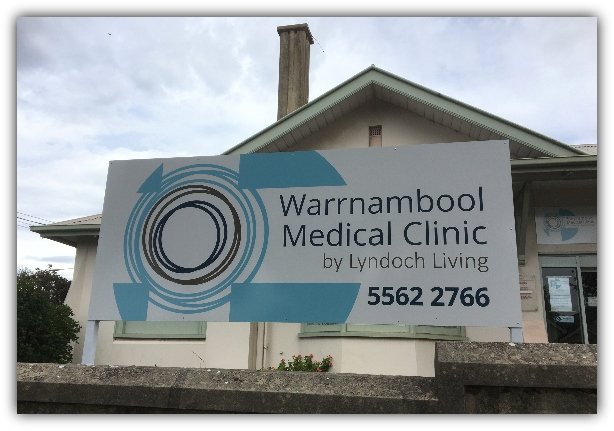
Despite a 2019 spending spree which included buying the Warrnambool Medical Clinic, Lyndoch’s overall asset base is going south.

Carol Altmann – The Terrier

Lyndoch Living last financial year recorded a $1.88 million loss – its fifth deficit in five years – and its bottom line has gone backwards by $20 million since 2015.

This, unlike what was reported in the local paper after last Tuesday’s invitation-only Annual General Meeting, is the reality behind the spin.

Here is the nub: Lyndoch is not growing, but going backwards, and we need to know why, especially as it pushes on with a $100 million masterplan funded mostly through loans.

We also need to ask why, in the face of such losses, Lyndoch continues to hire more executives on executive salaries, but more about that later.

First to the numbers, which are so easy to spin.

What Lyndoch pushed in the newspaper, and in a piece of puffery it produced for the AGM called a “Community Report”, was a measure called an “underlying profit” of $2.18m.

As has been pointed out by Deloitte, underlying profit is one measure that can be “useful” to judge financial performance, but can also be “misleading if used to mask bad news”.

And Lyndoch had some bad news.

The thing is that Lyndoch’s $2.18m “underlying profit” doesn’t take into account expenses such as interest on loans, depreciation, under-performing investments, and taxation.

These are real costs and when these costs are factored in, Lyndoch’s “profit” vanishes.

In fact these costs chewed up more than $4 million and Lyndoch ended the financial year not in surplus, but $1.88 million in the red.

This is the figure we should be looking at.

This is the  “total comprehensive income” – and it is not good news.

Even more troubling, however, is the slow and steady decline in Lyndoch’s bottom line (its net assets) over the past five years.

This has fallen by a staggering $20 million from $69m in 2015 down to $48m in 2020.

Despite Lyndoch last year buying the Warrnambool Medical Clinic, the Health Spot clinic and the May Noonan hostel in Terang for a cost of around $3.3m, its asset base has not improved, but gone backward.

As one learned accountant said to me last week, “this is a company that is diminishing, not growing”.

Again, this is not good news.
Like last year, we will have to wait until late January to see the line-by-line figures reported by Lyndoch to the Australian Charities and Not-for-Profits Commission, because these days Lyndoch provides just a simple snapshot at its AGM.

Only by seeing the line-by-line figures will we see the full picture.

Nobody asked a single question at the AGM (test: try and find the video buried on its website here), which is not surprising, given Lyndoch does not allow any outsiders to become members let alone board members.

To me, the fact Lyndoch now has a new, fast-tracked president in hairdressing salon owner Sue Cassidy, who has no experience or qualifications in health, disability or aged care, is troubling.

But the lack of any open and robust accountability around Lyndoch in real-time is frightening.

I do, however, know this: just three days after posting a $1.88m deficit, Lyndoch advertised for yet another high-paid executive to join its ever-expanding executive team.

This newly created position for a “Director of Enterprise, Research and Education” is being advertised internally only and applications close in less than two weeks, which suggests someone is already being lined up for the role.

(My tip is the Acting Director of People and Resilience, Julie Bertram, a retired director of South-West TAFE, who has been filling a maternity leave position.)

It’s a powerful role and includes acting as CEO when the CEO is on leave, which previously fell to the Director of Nursing.

Five years ago, when Lyndoch hired its new CEO Doreen Power, Lyndoch had 37 people in administration. By 2019 it had 59.

All indications are that it is now above 60.

I wonder how the nurses and personal care workers and “hands-on” staff caring for the residents across Lyndoch feel about that?

As always, I wait for the board or our local MPs to ask the hard questions on our behalf and, in the meantime, we all just keep chipping away.

If you would like to support the work of The Terrier, please consider a small monthly tip into the tip jar.

Terrier Tip Jar


Lyndoch: more spent on lawyers and consultants than food

Would you like a lawyer with that? Figures reveal Lyndoch has spent less on food in the past two years than on expert advice. Image: Shutterstock

Carol Altmann – The Terrier

In the past two years, Lyndoch Living spent more on lawyers, consultants and accountants than it did on food for residents.

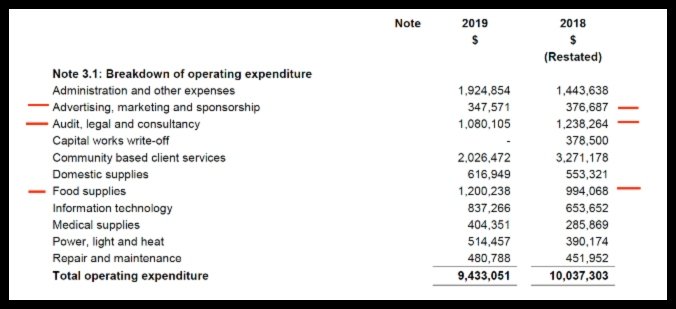
In 2018 and 2019, Lyndoch shelled out an astonishing $2.318 million on accountants, lawyers and consultants, while it spent $2.194 million on food supplies.

In 2018, the gap between the two was especially stark, with less than $1 million spent on food supplies – $994,068 – compared with $1.238 million on accountants, lawyers and consultants.

Chew on that for a moment and I suspect you will feel the same sense of indigestion that came over me.

These unpalatable facts are among the many that fall out when you take a close look at Lyndoch’s financial statements – and a lot of terriers are now taking a good, hard look at the figures, both old and new.

This is how we know that in 2013 the food bill was $992,516, which is not that far off the $994,068 that was spent five years’ later.

Did I miss something? Has the cost of groceries gone down?

I can tell you that what residents pay to live in a nursing home has certainly not gone down nor stayed the same for the past five years.

If you are going to cut costs, surely as an aged care home you don’t start with the food bill?


Judging by the 2019 financials, there is plenty of fat to trim elsewhere, starting with administration costs and the ever-growing number of staff  in the corporate area (59 and counting).

Not surprisingly, the cost of food vs lawyers/consultants/auditors was not mentioned at the Lyndoch Living annual general meeting last October and we can only make the comparison now because of two things:

The full figures have finally been released via the Australian Charities and Not-for-Profits Commission, and, for the first time, legal fees and consultants’ fees have been published in the audited statements.

Lyndoch Living bought the Warrnambool Medical Centre business for $1.3 million and plans to relocate it to a new building at Lyndoch.

Speaking of auditors, wow, has that bill shot through the roof.

Last year, Lyndoch’s auditing costs tripled from $13,950 in 2018 to $48,500 in 2019, which is five times what Lyndoch paid for auditing in 2013 ($9800).

Lyndoch changed auditors from local firm McLaren Hunt (which used to be Coffey Hunt) and replaced them with RSM Australia.

Perhaps a stack more number crunching needed to be done because Lyndoch decided to become a company limited by guarantee, buy two medical centres and also the May Noonan nursing home in Terang (I will write more about the medical centres soon).

But even the auditors were paid small beans compared with the $2.25 million spent on lawyers and consultants in the past two years.

$2.25 million.

Oh my goodness, I really am in the wrong business.


This $2.25 million would include hiring consultants for the $100 million masterplan and to write the (secret) business plan for the new medical centre that Lyndoch intends to start building soon, even though it’s still not sure how much money it needs to borrow to pay for it.

The lawyers, I assume, would also have been hired to guide the masterplan, to set up Lyndoch Healthcare Pty Ltd, and to oversee how Lyndoch now operates as a company limited by guarantee.


There are also the less obvious fees, such as the solicitor “retained” to provide advice to the company secretary, who doesn’t have legal or accounting qualifications.

All of this – millions of dollars in consulting, legal, accounting and administration bills – is such a long, long way from where Lyndoch started as a much-loved, community owned facility for our aged to see out their final years in comfort.

Back in the beginning, people donated their time and their own money to make sure Lyndoch found its feet and this is why there remains such a strong, emotional connection between Warrnambool and our iconic aged care home.

The board needs to get that.

Lyndoch has to grow and keep up with the times, we all get that, but how it is growing – and at what cost – remains at the heart of this investigation and we will keep going.

More soon.

If you would like to see The Terrier keep digging, click on the link below to throw something in the tip jar.