What impact will Wannon Water upgrade have on Lady Bay?
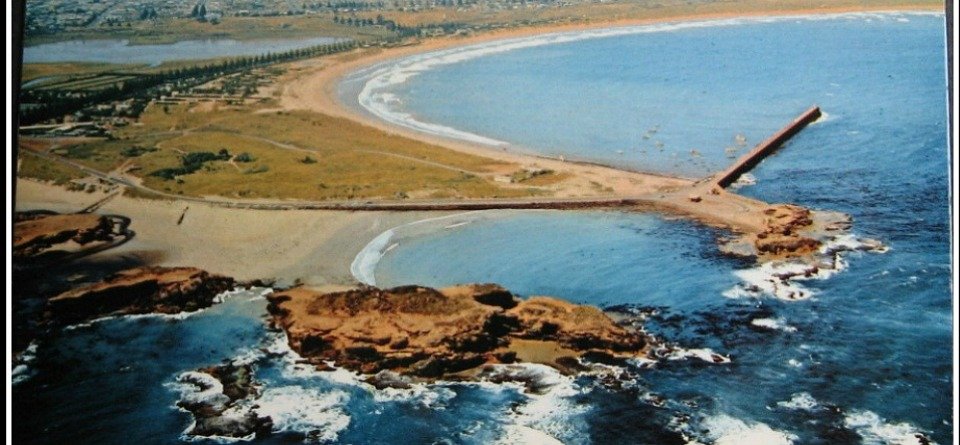
One of the many unanswered questions about the Wannon Water treatment plant is its impact on water quality at Stingray Bay and Lady Bay. Image: WCC.

By Associate Professor Laurie Laurenson

[Dr Laurenson is a retired Deakin University academic with research expertise in fish and fisheries biology. He has published more than 70 scientific research papers since the 1980s on various aspects of shark biology, fish biology and remote sensing.]

I wanted to get a better understanding of where Wannon Water got its idea that discharging partially treated water into Thunder Point was a good idea.

So I did a search on the internet and found the “Wannon Water Warrnambool STP Upgrade Mixing Zone Modelling And Outfall Assessment” document.

It’s really quite a long document but essentially looks at what biological (E. coli, Enterococci) and chemical (forms of phosphorus and nitrogen) contaminants are being discharged into the ocean and whether Wannon Water is following the rules, and will they be able into the future.

The report says “all is good” and that EPA regulations which stipulate that the contaminants should disperse within 300m of the outfall will be met.

I thought, “well that’s good” and I expected to see the three critical things that would influence dispersal of contaminants nicely organised and documented in the report. The three things being swell, winds and currents. Well, one of them was there!

I’ll digress here, because this is important.
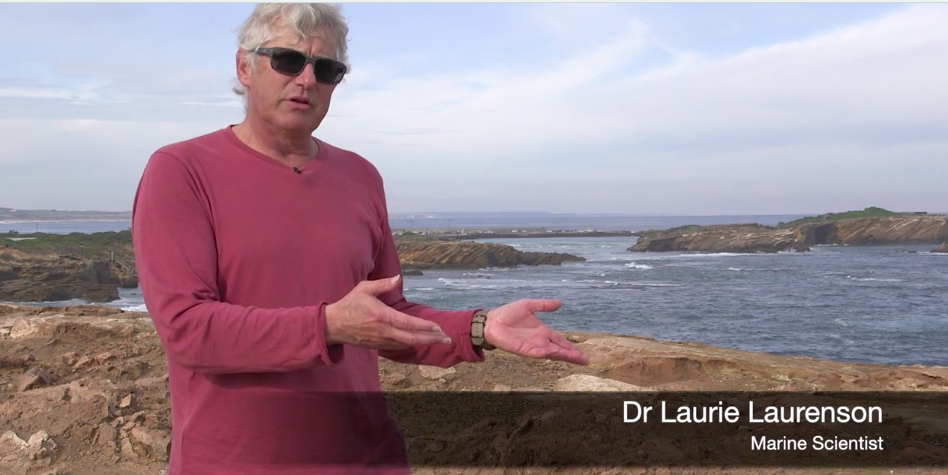
Dr Laurenson is part of a community video that outlines the objections to the proposed upgrade. Screenshot: Good Will Nurdle Hunting.

Winds are the main driver of swell and have an extremely well documented history of inducing currents.

We all know the effect that a few days of SE winds have on the water temperature in Warrnambool (it’s freezing!). This is caused by wind-induced currents travelling from the SE to the NW and then the Coreolis Effect turning the current left, and offshore, and cold water coming up from the bottom.

Now when we have winds coming from the other directions (NW to SE) the reverse happens, currents follow the wind and the surface water turns in towards the coast, so it stays warm.

Back to the report…

The mixing of contaminants in the report relies on a circular (300m specified by the EPA) radius to disperse contaminants to acceptable levels (50 per cent of the time) based entirely on the capacity of oceanic swells to achieve the dispersal – not wind and currents.

A cursory look at where Warrnambool’s wind comes from across the year shows that they come from the SW quadrant 50 per cent or more of the time across each year.

This means discharge at Shelly Beach will be blown towards the Warrnambool beaches at least one out of every two days.

The impact assessment report says that this is okay, since the closest high use beach in the area is the Flume roughly 3km away.

In fact the closest beach is Stingray Bay which is 1300m.

So here’s the problem.

On page 69 of the Wannon Water Report, it provides an “adopted minimum dilution rate” graphic which tells us how far the contaminants can spread.

This graphic is based on samples collected at a distance from the outfall of 400m (and less) with just a single sample taken at 750m.

Their predictions are based on three samples (presumably a few days in 2009, 2015 and 2016) that are assumed to be representative of the weather conditions across the entire year.

Their predictions are highly extrapolated outside their data range and based on simple linear regressions which are unlikely to be statistically significant (the significance has not been tested).

The science is poor at best.

The problem is that the degree of dispersal of contaminants beyond the 300m radius of the Wannon Water outfall has not been addressed in any meaningful way in that it excludes wind and currents, and further, the data that they have collected extrapolates well beyond the bounds of existing data.

It means that the report simply does not address the impact of the pollutants released from the outfall on the main recreational beaches of Warrnambool.

To be fair, the report states that it essentially focuses on the EPA stipulated boundary of 300m and that the pollutants do not exceed critical levels specified by the EPA for 50 per cent of the time.

However, the pollutant levels really need to be assessed at Stingray Bay and Lady Bay during wind and current conditions that will result in them being transported into these high use areas.

Given the prevailing wind conditions, this will happen at least every second day across every year.

And it’s not just the chemical and biological contaminants that will disperse in this way, it’s also the plastics that have repeatedly been released by the facility over many years.

You can find out more about the proposed treatment plant upgrade here and sign up for the online forum this Wednesday August 5 at 7pm.


Zero support for Wannon Water sewage treatment plans

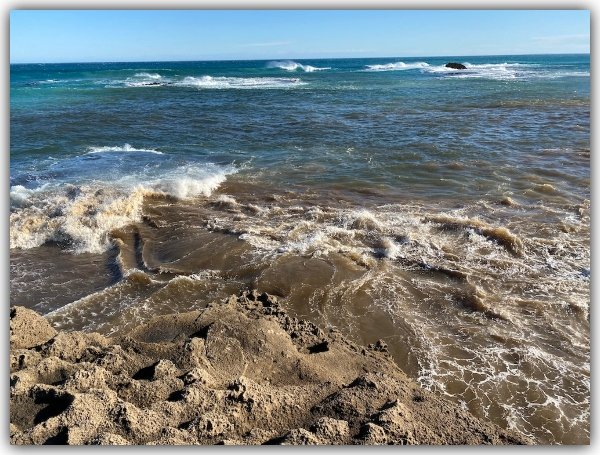
A “dirty dump” of effluent from the Wannon Water treatment plant released off Thunder Point last month. Image: Good Will Nurdle Hunting.

Carol Altmann – The Terrier

Let’s end the week on a high note!

It turns out lots of people really do care about the treated sewage being pumped into the sea off Thunder Point by Wannon Water, with an incredible 83 submissions to the EPA about plans to keep doing more of the same for the next 20 years.

83!

Wow! This is fabulous! The overwhelming majority of responses were AGAINST the proposed plant upgrade that will double the capacity of the plant, using the same technology and methods which are already considered out of date.

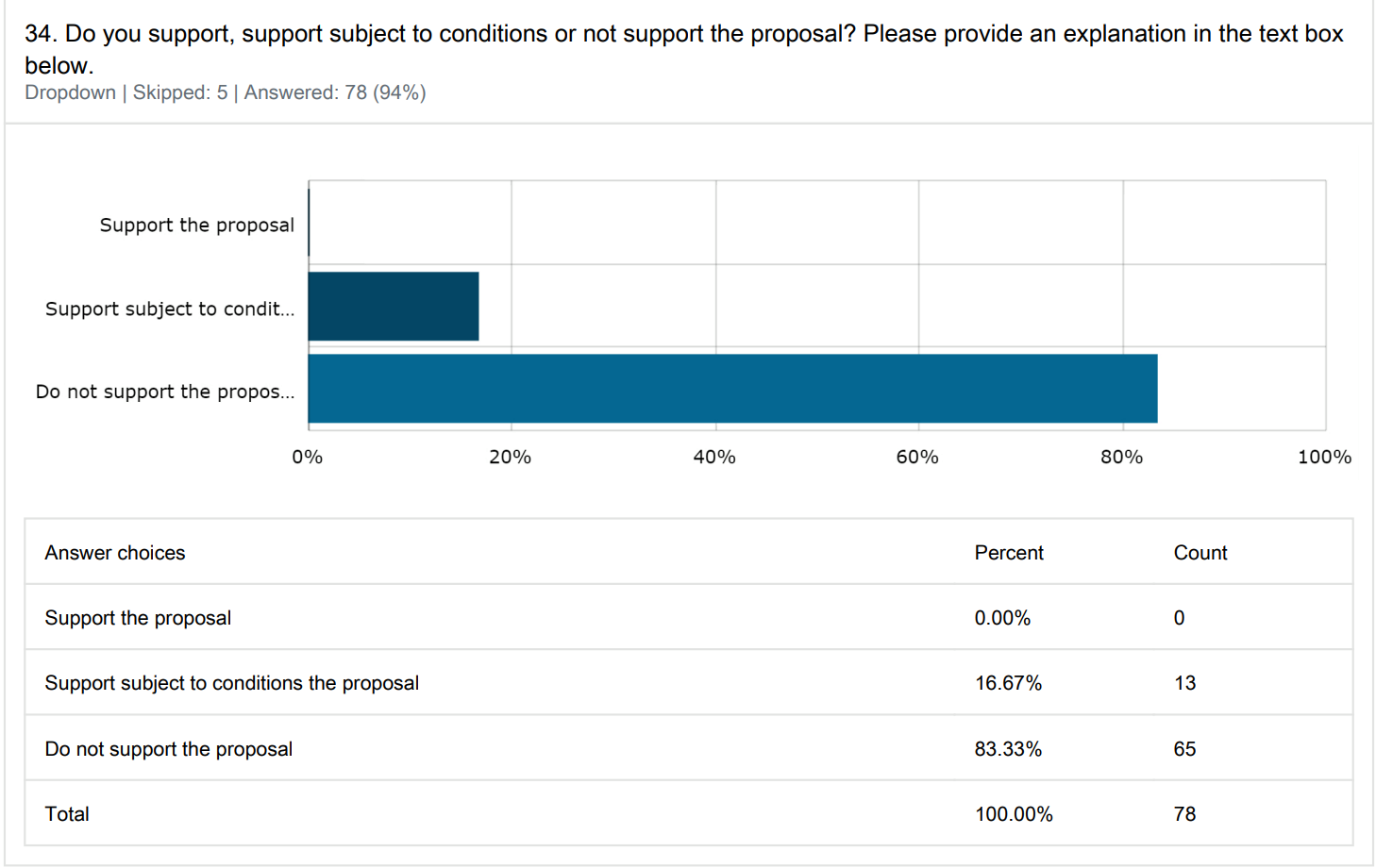
In fact of the 78 people who answered the question of whether they support the plan as is, not one person said yes.

Thirteen said they would support it with changes and 65 were firmly against.

The people have spoken – now the question is whether Wannon Water will listen.

Because there were so many responses, the EPA will hold an online conference to hear more about the community concerns and ways they may be resolved.



(Details on when this will be held are yet to be announced.)

In the meantime, you can read all the submissions and a summary here: https://engage.vic.gov.au/epa-works-approvals/wannon-water

Thankyou to Colleen Hughson and all of the Good Will Nurdle Hunting team, the Beach Patrol 3280 team and the Clean Ocean Foundation for helping us to get our %#%@! together and have a say.


Wannon Water upgrade issues: The Terrier cheat sheet

Carol Altmann – The Terrier

The sexy Wannon Water sequel: Meet Dr Sam, the West Highland Water Scientist.

Dr Sam is here to help us have a say on the Warrnambool sewage treatment plant $40m upgrade which is actually not sexy, but boy, it’s important.

What happens next at that plant sets up what will happen off Thunder Point for the next 20 years.

It’s a big ask for us humble citizens to get our heads around the full proposal.

How can we possibly know whether it’s the best we can do for our beautiful ocean?

But we have until 1 July to express an opinion, no matter how humble.

In digesting this WW plan, Dr Sam and I have been able to take a bit of a short cut – and you can too.

I have been able to tap into scientific and environmental experts who are helping the Clean Ocean Foundation with its response.

They have shared some of their thoughts with me, to pass on to you.

This means that if you want to make a comment, you don’t have to feel overwhelmed and have some handy starting points.

What follows is a top 10 list of some of the very detailed concerns being compiled by the COF. At the end is a link to an extended mix of these tips.

We are giving the simple version here, but the message is clear: we need to invest in new ways of doing things, not just do more of the same for the next 20 years.

This is our chance to stand up for the sea.

Here is your Terrier 10-point cheat sheet:

1. Where does the sewage go if the treatment plant fails, or partially fails?

2. Risks to human health from exposure to the effluent both inside and outside the mixing zone via fishing, diving, snorkelling and rock pooling.

3. The phosphorus concentrations – largely from Warrnambool Cheese and Butter – are about 10 times higher than for a similar plant. This can lead to algal blooms.

4. Micro-plastics will still be able to make it through the screening process and into the sea.

5. There is no plan for effluent disinfection. Physical, or chemical disinfection will provide a much safer marine environment.

6. The amount of effluent discharged each day will grow from 16 megalitres to 26 mgl a day, which means more pollutants will also be discharged.

7. The upgrade doesn’t take into account ‘new’ pollutants and how these will be handled, such as micro plastics, organo-chlorines and pesticides.

8. There is no deep exploration of ways to reuse/recycle the wastewater or reduce the energy consumption of the upgraded plant.

9. There must be an upgrade of technology, not just an expansion of the existing systems.

10. Industries that create the vast majority of the waste should be paying more toward the plant upgrade to make it best practice and future proof.

Click here for the extended mix.


Wannon Water sewage plant upgrade must reach for the stars

Betty Boop has nothing to do with Wannon Water and its treatment plant, but I am rolling out some stars to make sewage sexy.

Carol Altmann – The Terrier

Tonight I am rolling out the red carpet to make sewage sexy and effluent exotic, because we need to talk about the planned upgrade of the Wannon Water treatment plant.

This upgrade will service Warrnambool for the next 20 years.

I want to explain, as best I can, why before 1 July (when the chance for public comment closes) we need to ask for better from Wannon Water, to aim higher, and to stop using our beautiful ocean like a giant Maytag washing machine.

As it stands, Wannon Water plans to spend $40 million expanding the treatment works at the end of Elliot St, so it can double its capacity to eventually handle around 30 million litres of sewage a day by 2040.

This Wannon Water production should be a blockbuster starring the Brad Pitt of shit and the Betty Boop of poop and the Scarlett Johansson of industrial trade waste, except it isn’t even close.

It’s more of a B-grade movie starring faded stars of yesteryear.

That’s because the $40 million plan is the cheapest option and will not change the way our sewage is treated in the future from how it is treated now.

The ‘mixed liquor’ of treated sewage that entered the ocean off Thunder Point last month due to problems at the Wannon Water plant. Image: Beach Patrol 3280.

This means, in 2040, we will still be pouring millions of gallons of treated sewage/effluent into the ocean off Thunder Point using exactly the same treatment system as in 2020.

And that system, according to wise minds like the Clean Ocean Foundation (COF), is already behind the times by about 20 years.

The COF is lobbying to have all waste water discharged to the ocean at a Class A+ standard by 2030 to reduce ocean pollution.

Warrnambool is not even at Class A now, and won’t be at Class A after the upgrade, let alone at A+.

Worse, our system often doesn’t work, as can been seen by what is called the “mixed liquor” (which sounds sexy, but is the revolting foamy brown stuff) which still turns up off Thunder Point.

What we should be aiming for by 2040 is clean, treated effluent that can be recycled and reused and doesn’t have to go into the ocean at all, but if it does, at least make sure it is not full of pollutants like phosphorous.

Right, how do I make phosphorous sexy?

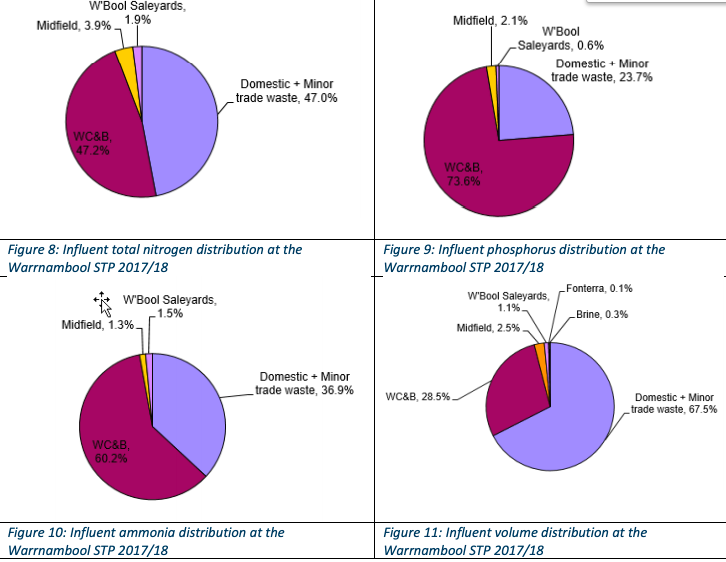
Well, here is a photo of a very sexy Brad Pitt, followed by a sexy Wannon Water graph that shows that Warrnambool Cheese and Butter – the burgundy colour – producing a Pitt-load of phosphorous, nitrogen and ammonia that goes into our ocean:

Warrnambool Cheese and Butter is owned by the Canadian giant, Saputo, which turns over about $11 billion a year.

Perhaps we could ask Saputo to throw a few million toward helping us make it to the Hollywood A-list by making sure our ocean had the cleanest effluent possible?

Or maybe Saputo could spend a few million dollars improving the treatment of its own waste before it makes anywhere near Wannon Water and into the ocean?

Another of the problems from this dairy trade waste is it’s extremely salty, which means the effluent water cannot be reused easily without burning everything along the way.

I found it astonishing that of the millions of litres of waste water produced by the Warrnambool treatment plant – 15 million litres a day – only 60 million litres a year is reused, and only at the plant itself.

In the scheme of things, 60m litres a year is an eye dropper full and the rest goes into the sea to swirl around in nature’s Maytag: not a drop is recycled or reused outside of the Elliot St treatment plant.

Wannon Water says it has investigated reuse projects and also tried to find customers for recycled water, but without success, no doubt because of the high salt content among other things.

So we have a treatment plant within walking distance of the Warrnambool Golf Course* and the new Younger St housing estate, yet no recycled waste water from the treatment plant is being used at either. (*Clarification: water was diverted from Fonterra, before it reached the plant, for use on the golf course. Please see comment from Dave at the end of this story).

Good grief.

If this is “green” Warrnambool under the Warrnambool City Council 2040 plan, then we have a long, long way to go.

Of course it all comes down to dollars and who pays.

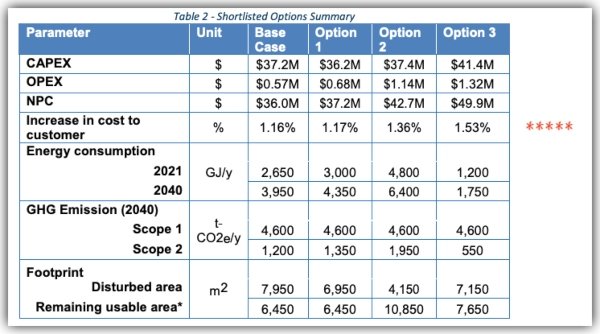
People, naturally, become nervous when Wannon Water talks about higher customer bills to cover the cost, but here is a photo of a beautiful Scarlett Johansson, under which we can see a beautiful graph showing the costs.

You will see that between the various options, it is really not that different – a range of 1.16% to 1.53%.

Is Wannon Water really that strapped for cash or ways to find it?

How bizarre that Lyndoch Living – a not-for-profit, community owned aged care home – can roll out out a $100 million masterplan, yet Wannon Water can only come up with $40 million for a major treatment plant expansion to service our city for the next 20 years.

Water treatment is complex, but I know we can do better than this, our kids deserve to inherit something better than this, and the Clean Ocean Foundation is right behind Warrnambool in its quest to ask for more.

The COF will appear in the blockbuster sequel to this story tomorrow night, offering us non-science-minded folk some starting tips for our submissions.

In the meantime, you can find out more about Wannon Water’s plans via its website here.

Good night, credits roll, lights dim.

I am tip toeing back into the Tip Jar. If you would like to see The Terrier keep digging, please throw what is affordable into the tip jar below. 

The Tip Jar


Demolishing more of our precious history is a bridge too far

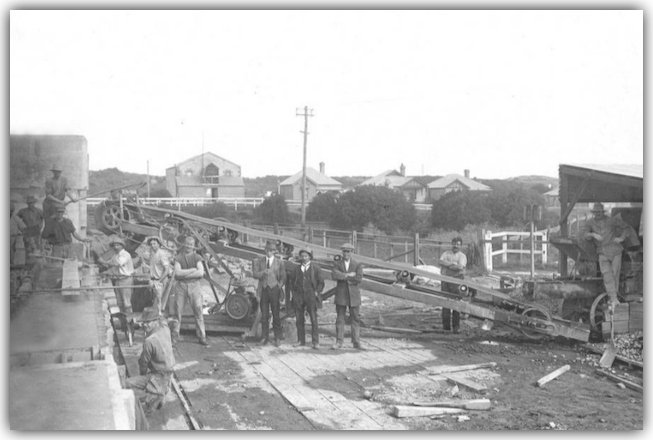
The Stanley St bridge can be seen in the backdrop of this photo taken in 1890, showing workers at a railway reserve unloading huge concrete blocks that would be used to build the breakwater. Image: Warrnambool Historical Society.

Carol Altmann – The Terrier

Will one of Warrnambool’s oldest original bridges survive the wrecking ball? Oh, I hope so.

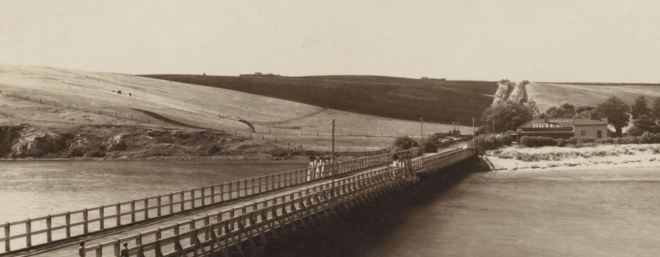
The Warrnambool City Council will soon decide what to do about the failing Stanley St bridge/Edward’s Bridge that crosses the Merri River near the pastel monstrosity formerly known as the Lady Bay Hotel, and which has been in service for 130 years.

Demolition is an option, such is the Warrnambool way.

Just three years ago –  in 2017 – the council spent tens of thousands of dollars fixing this very bridge and strengthening the piles that hold it up.

Apart from the piles, the bridge was in “generally good condition” the WCC’s then-infrastructure manager said in a media release.

Even better, the end result of spending these tens of thousands of dollars on repairs was that “the historic bridge will be serviceable for decades to come”.

Decades? Not quite.

Here we are, just three years later, and Stanley St bridge is not only in need of major repairs – another $80,000 will be spent straight away – but is under threat of demolition.

How can this be?

And has the council demanded a refund for the works that failed to extend the life of the bridge for five years, let alone decades to come?

I asked the council spokesman these questions on 20 May and also for a figure on how much the 2017 bridge works cost: there has been no response.

Oddly, these 2017 works didn’t rate a mention in the report to the council meeting on 4 May when councillors talked about how much money they would need to borrow to either knock the old bridge down, repair it, or keep it and build a brand new bridge alongside.

Nobody put up their hand and said, hang on, didn’t we just spend a bucketload of public money a couple of years ago to fix this bridge?

Like the Merri River in flood, so much public money just swishes through and is never seen or heard of again.

The original Hopkins River bridge was built in 1895 and was completely replaced in 2000. It is now in need of major repairs to prevent a catastrophic failure. Image: State Library Victoria.

The same could be said for the Hopkins River bridge which is also in need of major repairs, despite being completely replaced just 20 years ago.

It will soon have $460,000 spent on it to prevent “catastrophic failure” caused by defective concrete and other work that, obviously, couldn’t handle the harsh conditions.

Here’s part of the shopping list for Pontings, according to the tender:

Concrete patch repairs to pre-stressed beams;

Concrete patch repairs to pier headstocks and pier piles;

Crack injection to pier piles;

Silane treatment to pre-stressed beams;

Silane treatment to pier headstocks;

Silane treatment to pier headstocks; and

Protective paint system for pedestrian walkway galvanised beams & plates/cleats.


Cripes, that is some list.

The Stanley St bridge will cost around $2.6m to replace, or $1.2m to repair, with the council to cover half the cost and the remainder from a grant.

Perhaps if we had got it right the first time, we wouldn’t be facing the loss of another piece of our precious history.

My hope is the new bridge, if it must be built, runs alongside the old….and we push for a decent warranty.

Any other option should not be an option at all.