Lyndoch staffing slides backwards in wake of audit failings
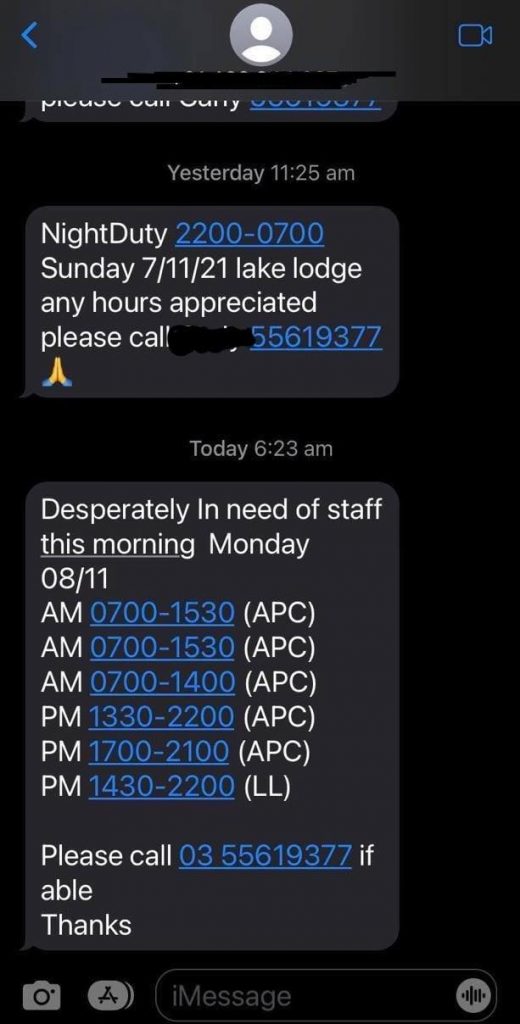
Two months after being audited by the national watchdog, staff shortages at Lyndoch are reaching crisis point.

Carol Altmann – The Terrier

I know we are all still digesting the distressing fact that Lyndoch Living has slipped further in its duty of care to look after the elderly, but this is important:

Before breaking that story yesterday, I had planned to post these roster shortages for the Audrey Prider Centre and Lake Lodge – the two, high-care areas that make up what is called the “nursing home”.

These are the very same areas that were the focus of yesterday’s bombshell that Lyndoch had failed four more national standards of care.

These are the areas that were found by the Aged Care Quality and Safety Commission to be under stress from severe staff shortages.

That was based on the commission looking closely at Lyndoch in September.

September.

Yet here we are, and nothing has changed. These are the shift shortages for the past couple of days: it is dire.

So if things were grim in September, I can only imagine what the commission would report if it turned up now.

And I hope they do turn up, unannounced, very soon because this cannot wait until the reaccreditation at the end of February. The commission has the power to do this. It can apply sanctions at any time.
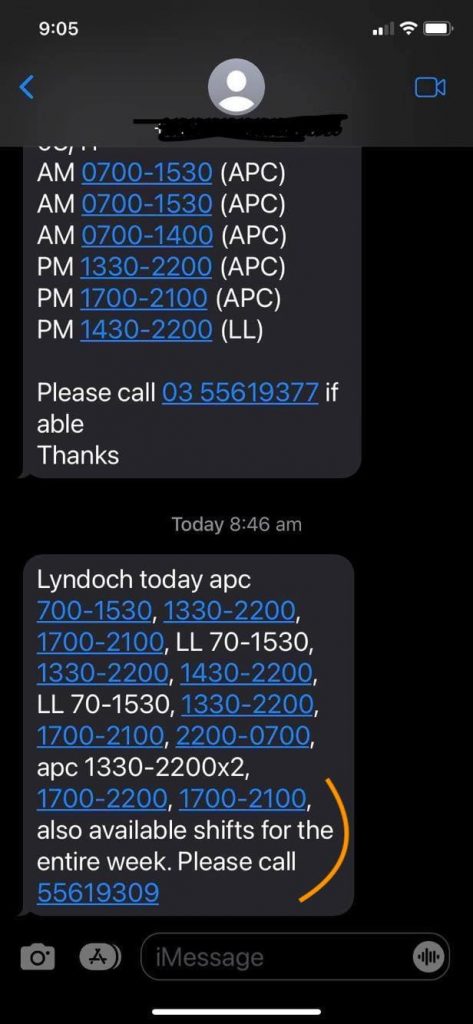
Roster call-outs reveal chronic shortages in the high-care areas of Lyndoch Living.

Our local Federal member Dan Tehan gave a statement to the local paper today which says the commission is still deciding what to do in response to the latest failings.

I hope they intervene, because these rosters show that we cannot hope that things will miraculously improve. They won’t.

A stream of experienced staff have gone on sick leave, stress leave or resigned since the commission’s last audit in September. They want to work at Lyndoch, but they can no longer tolerate what is going on.

This has nothing to do with national staff shortages, Covid, or the Royal Commission. It has everything to do with the Lyndoch culture and priorities.

We know it, the staff know it, and surely the commission is starting to catch on.

Yet while the walls crumble around them, Lyndoch once again shows no contrition or remorse for these failings. It once again tells the paper that it has “an action plan”. It said the same thing earlier this year.

Clearly, that action plan is not working and Lyndoch is going backwards, from failing one standard, to now failing four.

My hope is the commission does not wait for it to deteriorate even further before taking action, because at the centre of all this are real people, elderly, vulnerable people, beautiful people from our local community, who are not able to smile and laugh for the Lyndoch Facebook page, but who are instead in need of our help. We are there for them, and those who care for them.

Thankyou to every single one of you who is prepared to stay the course and fight this fight.



Crisis point: Lyndoch Living again fails aged care standards

The Lyndoch Living nursing home in Warrnambool has failed a second time this year to meet aged care standards.

Exclusive

Carol Altmann – The Terrier

The Lyndoch Living nursing home has again failed a string of care standards set down by the national aged care watchdog.

In another damning report released online today by the Aged Care Quality and Safety Commission (ACQSC), the nursing home has again failed to meet key measures in personal care and clinical care, staffing, and also governance. [Download the report here.]

The nursing home area is made up the two high-care units: the Audrey Prider Centre, for dementia residents, and Lake Lodge.

An ACQSC audit from September 8 to 15 revealed poor wound management, poor pain management, a lack of monitoring and documentation after resident falls, and inadequate staffing, with unfilled rosters, and remaining staff being unable to cope with the workload.

The extent and impact of understaffing at Lyndoch is graphically highlighted by the report.

It found the nursing home is unable to demonstrate that its current mix and qualifications of its workforce could deliver and manage safe and quality care and services.

“Rosters evidence that not all care shifts are filled when staff are deployed elsewhere within the service or when staff call in sick,” the report says.

“Personal care staff interviewed advised they do not always complete all tasks allocated to them.”

The report says Lyndoch management described how they are in the process of recruiting more nursing and care staff to cover current vacancies, but this has done little to address the concerns of residents and their families.

“Whilst the service was able to evidence improvements, four out of five consumer representatives expressed ongoing dissatisfaction with staffing levels within the service,” the report says.

Short staffing was also raised in regard to poor wound and pain management.

“(Lyndoch) did not demonstrate best practice clinical care in relation to wound and pain management,” the report says.

In particular, the commission found:

– Wound management plans did not always reflect wound reviews including dressing changes, photography and measurements.

– Inconsistent wound photographs and wound measurements are taken and recorded.

– The healing progress of each wound is not clearly demonstrated.

Nursing staff told the commission that staff shortages limited the ability of staff to attend to wounds as required, and to reposition residents to reduce pressure.

“Clinical staff described how wound care is impacted by staff shortages including delayed dressing and repositioning of consumers,” the report says.

The report also outlines failings in monitoring residents who had suffered falls.

Unwitnessed falls were not always documented in reports and a sample found that three out of four residents who had fallen were not effectively monitored afterward, including neurological observations and pain monitoring.

Not surprisingly, the nursing home also failed on risk management.

“The service did not demonstrate systems are in place to prevent harm from high impact or high prevalence risks such as falls,” the report says.

Despite hiring an adviser to help with its governance activities, the service “has not demonstrated current systems and processes are adequate in identifying and managing high impact or high prevalence risks”.

It is the second time this year that the Lyndoch nursing home has failed a ACQSC audit.

In July this year May Noonan Hostel in Terang, bought by Lyndoch in 2018, also failed seven out of the eight aged care standards.

The ACQSC is the peak federal body for assessing and accrediting aged care homes.

I will seek comment from Lyndoch this afternoon and update this story if or when a comment is received. In the meantime, I stand with the care staff and the poor residents.


Why WCC Mayor Neoh should step aside

michael neoh_5

Comment – Carol Altmann

It is a question that has been swirling around Warrnambool for a fortnight – now that Mayor Michael Neoh has been preselected to run for the National Party, why is he still Mayor?

It is more than two weeks since Mr Neoh switched parties from the Liberals to the Nationals so that he had a clear run at the October 31 by-election for South West Coast without having to endure a potentially bruising preselection battle inside the Liberal Party.

In that one move Mr Neoh revealed many things, not least that – like any politician in the making – he will use whatever political advantage he can to boost his chances of election, even if it means swapping parties.


His refusal to step aside from his role as Mayor is another such move.

For no matter how you look at it, staying in the mayoral role for as long as possible is all about gaining a political advantage.

By wearing both hats, as a mayor and as a National’s candidate, Michael Neoh doubles his public profile.

Sometimes he is out and about as the Mayor, other times he out and about as the candidate for the Nationals, and sometimes he swings between both and – for the average person – it can be hard to tell the difference.

It also means Mr Neoh – as Mayor – has access to opportunities and information that would not be available to him as just a member of the public.

I am not suggesting Michael Neoh has improperly used these opportunities for his own political gain, but the fact is that when he now attends any public event, he is seen as both the mayor (not the former mayor) and the Nationals candidate.

It also means when he reads any council documents, attends any briefings, or receives any other information as Mayor, he has to be disciplined enough not to let it have any influence on his election campaign.

Again, I am not suggesting Michael Neoh has been anything but disciplined in this regard, but the potential conflict of interest looms large.

michael neoh blog

No wonder the Municipal Association of Victoria (MAV) describes the “politicisation” of local councils from councillors running for state or federal parliament as a “contentious” issue.

When Mr Neoh was first nominated by the Nationals on Sept 10, he said he would take leave when the election date was set (the issuing of the writ).

The election date was announced 10 days later on Sept 17, but, in the meantime, it appears Mr Neoh ran a magnifying glass over the rules and found he could stretch his time in the chair even longer.

The MAV says, as a minimum (not a maximum), a councillor running for Parliament should take leave when the electoral commission is formally notified of their candidacy. The last date for this to happen is October 2.

Again, in a smart political move, Mr Neoh is applying the bare minimum of what is required and will stay on for as long as possible to gain maximum exposure during the by-election campaign.

We did ask Mr Neoh, via email, if he was using any of his mayoral time, allowance, car or mobile phone for his campaigning. We also asked about the potential conflicts of interest as outlined above.

This was his response:

“I have a campaign car that I use and also non council equipment.

I am following the MAV policy in regards to taking leave of absence and I do not use mayoral invited functions to campaign.

If I meet with stakeholders outside of Council duties and as a candidate I make it very clear that I am an election candidate and are not representing council.”

The boundaries, in Mr Neoh’s eyes, are very clear. But I know they are far less clear to the general public, many of whom are asking why he has not “done the right thing” and stepped aside.

Guidelines are just that – guidelines – and it is up to the individual to decide whether they wish to follow them to the letter, or embrace the spirit of their intent.

Bluestone also asked Mr Neoh, straight up, why he was staying on as mayor until the final hour.

We have not yet received an answer.