Inquiry into aged care a chance to break the fear and silence
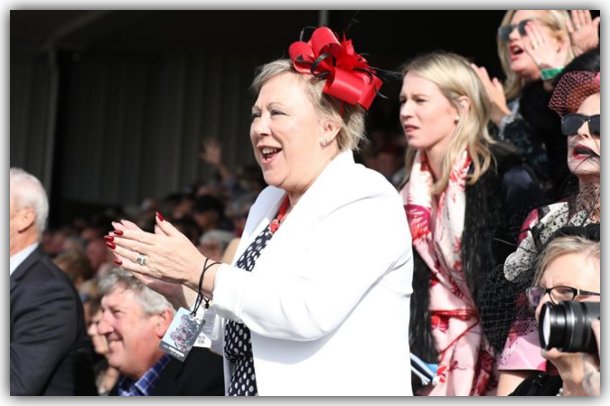
Lyndoch Living CEO Doreen Power cheering on from the stands during the 2019 May Racing Carnival. Image: Lyndoch Living/ Racing Victoria.
Carol Altmann – The Terrier
This week will be a reckoning for aged care across Australia and I can hope it blows the lid right off what is a national disgrace.
We only have to look at our own neck of the woods to see how little official outrage there is to what should be unacceptable.
It’s more than two months since The Terrier revealed an outbreak of scabies within Lyndoch Living, our much-loved, community-owned aged care home in Warrnambool.
When whistleblowers revealed scabies in a Whyalla nursing home last November, A Current Affair and a South Australian MP were on the doorstep demanding answers.
It’s also more than a year since I wrote about staff tearing up sheets and towels to use as facewashers, and more money being spent on consultants and lawyers than on food for residents.
More than a year has passed since I revealed a family member of a resident was sleeping on the floor next to her mother for seven days because her mother had had a series of falls and there was not enough staff to keep an eye on her.
At the same time, Lyndoch senior staff, right up to the CEO, and senior board members, were attending the May Races.
It’s well over a year since I first wrote about the steady stream of staff who were leaving Lyndoch, sometimes after decades of service, because of alleged bullying, being “targeted”, or given little option to resign and – if they are lucky – given a payout to sweeten the blow. I call it “keep quiet” money.
Is that sort of thing still happening? Yes.Yes, it is.
It’s eight months since we learned two architects from Melbourne were visiting Lyndoch Living despite the “ring of steel” Covid-19 lockdown in that city.
It’s 18 months since we learned that the community was no longer welcome to become members of Lyndoch: every single membership application from the general community has been rejected, including that of our now Mayor Vicki Jellie.
Board member positions are no longer advertised.
The annual general meeting is no longer advertised.
Has there been an outcry from the board at this lack of inclusion? No.
Regardless, we have still unpicked the fact that Lyndoch has recorded a series of deficits these past five years and will borrow money from residential bonds (as the current laws allow it to do), to fund its $100 million masterplan.
We also recently learned, thanks to two former Lyndoch workers who peeled back the lid, that Lyndoch was gobbling up to 44 per cent in management fees for home care packages.(Again, the laws currently allow these fees.)
And this still doesn’t touch on what I haven’t been able to publish, because Lyndoch is litigious and I have to pick my way through a minefield to report even this much.
Our local political leaders know about most – if not all – of the above. Some of them have even met personally with those directly affected.
And yet, perhaps despite the best of intentions, nothing has come of it.
That may change after this week.
This week will see the public release of the findings of the Royal Commission into Aged Care and the federal government’s initial responses.
The sad and infuriating story of what people are expected to “put up with” – as aged care residents, aged care staff, the residents families and the wider community – will be laid bare.
It will no doubt emphasise the need for better staffing ratios, better pay, better training and working conditions, better scrutiny of those in positions of responsibility, greater transparency around funding and fees, and why aged care residents should never been seen as “customers”.
But I also hope this inquiry exposes why so many people connected to aged care feel disempowered from speaking up and out about what they know, because they fear the repercussions.
I can tell you that fear and silence around Lyndoch Living is very real, even if not everyone is touched by it.
I know it, several GPs around Warrnambool know it, several lawyers around Warrnambool know it. Our local MPs know it. The families and friends of those directly affected know it.
The release of the Royal Commission findings is our chance as a whole community to speak up for those who can’t do so themselves.
This was the promise the community made to Lyndoch when it was first built more than 60 years ago: first and foremost it would protect and care for the elderly and frail, and those who look after them.
A one-day inquest hearing has been held into the disappearance of former WCC engineer Barry Collins more than 30 years ago. Image: Shutterstock.
Carol Altmann – The Terrier
I have just learned that an inquest opened today into the disappearance of Barry Collins, a former executive of the Warrnambool City Council, who went missing 30 years ago. This is big news.
Mr Collins, an engineer, disappeared after being accused of a misappropriation of council resources and funds. I remember this terrible story, as I was a wide-eyed cadet at the Warrnambool Standard at the time.
Mr Collins’ disappearance sent shockwaves through Warrnambool. It was terrible.
There has never been a full explanation as to what happened, or the full back story to the allegations. His family, no doubt, have continued to seek those answers.
Now, 30 years after this tragedy, an inquest has opened in the Coroner’s Court in Melbourne, before Coroner Paresa Spanos.
I will follow this up tomorrow, but for tonight, I am just putting this on the public record and hope that it may finally lead to some answers for Mr Collins’ family and for the wider community.
Update: The ABC’s Matt Neal has written a comprehensive piece on this case, which is set to officially clear Mr Collins of any wrongdoing. You can read Matt’s story here.
Ombudsman urges WCC to address disunity and dischord
Carol Altmann – The Terrier
A final post on the Ombudsman’s report: the story does not end here.
One of the things picked up by the Ombudsman’s investigation was a strong sense of disunity and discord within the W’bool city Council, both among councillors and council officers.
A number of “concerns” about senior management’s handling of misconduct were raised with the Ombudsman during the investigation into the credit cards, but some were unfounded, some lacked substance and some were beyond the scope of this particular investigation.
These concerns may, however, still point to a broader problem that was most recently played out by the sacking of Peter Schneider (which rates a mention).
The Ombudsman, Deborah Glass, writes:
“While we did not find evidence of systemic abuse by Council officers or systemic failings by senior management…we did not deal with every allegation aired publicly or privately, and which continued during the investigation.
“Their prevalence and persistence suggest a disunity within Council which this investigation does not purport to deal with, but for the sake of ratepayers and the community must be addressed.
“Communities rely on their council to practice unified and strong civic leadership.”
No truer words have been spoken and none more timely.
I am now off to have a lie down, but before I do, I just want to say this:
Thankyou to all of the brave souls who have helped to bring the truth to the surface today, despite the denials, excuses and dismissals that go on from enablers, even as we speak.
I remember the day these brave souls came to me about the busted culture at the WCC, because they had nowhere else to go. They had tried the “internal systems” and they got nowhere. They had approached councillors for help, and they got nowhere.
Nobody would listen. But they are listening now.
It has been a long, slow and exhausting road but here we are. Change has come and change is coming.
On. We. Go.
Ombudsman reveals changes to WCC credit card rules
The W’bool City Council has made significant changes to its credit card policy following an external review in response to the scandal around misuse and largesse.
Carol Altmann – The Terrier
Update: The Ombudsman’s report reveals the 10 recommendations from the external auditor that were adopted by the council in March this year.
Why, oh why, were these rules around credit cards not in place in the first place? They seem so straight forward.
Here is the summary of the changes:
1. Provide fraud and corruption control training to all Council staff including reporting of actual or suspected fraud and corruption.
2. Review and update Fraud and Corruption Control Plan and Procedure to include fraud incident reporting protocols to the Council.
3. Establish a criterion to determine the need for a credit card by a staff member.
4. Review and update the existing Corporate Credit Card Procedures, including to stipulate the roles and responsibilities of an authoriser, create list of risk factors for authorisers to be aware and create guidelines on ‘taking face value explanations’ versus ‘appropriate inquiry’.
5. Provide training to authorisers with respect to approval of monthly credit card expenses.
6. Review and update the existing Fraud and Corruption Controls Procedure to include specific trigger points when an independent auditor should be brought in (i.e. the period after unusual/misuse has been identified to when possible fraud is suspected).
7. Implement a process wherein pre-approvals (except CEO) shall be required for expenses such as (but not limited to):
a. Business travel
b. Accommodation
c. Conferences
d. Seminars
8. Implement an approval process which aligns with the practice recommended by the Victorian Auditor General. The Council’s Chief Financial Officer or Director Corporate Strategies, shall approve CEO’s credit card expenditure, and table the full transaction history to the Audit and Risk Committee.
9. Implement ongoing reporting and monitoring processes that fosters continuous improvement of credit card processes (with suggested areas for improvements including implementing Breach reports and Repeat Offenders report)
10. Incorporate a process wherein Statutory Declarations are witnessed by one of the many people authorised to do so (outside the Council).
Ombudsman report reveals poor actions of WCC officials
WCC City Growth Manager Andrew Paton, former CEO Bruce Anson and recently sacked CEO Peter Schneider, who, between them, capture misplaced trust, poor decision making and being kept in the dark.
Carol Altmann – The Terrier
More on the Ombudsman’s report – some key names:
Former WCC tourism chief David McMahon: found by the Ombudsman to have clearly misused his credit card and has recommended the council investigate further and consider police action.
The council accepts this recommendation.
Mr McMahon, the report says, has since expressed remorse, regret and shame and admitted he had openly betrayed his manager, Andrew Paton.
—-
City Growth Manager, Andrew Paton: the report says Mr Paton felt deceived by Mr McMahon, whom he trusted.
Given Mr McMahon adjusted some of his receipts and invoices, Mr Paton “could be excused for some of his errors” in approving this spending and failing to pick up other excessive spending “was due to his own inadvertence”.
The report says Mr Paton was considered by former CEOs Bruce Anson and Peter Schneider to be “of the highest level of professionalism and integrity and that he accepted his mistakes”.
Even so, the report says, once Mr McMahon’s spending was first exposed in November 2018 (after the Cape Schanck function), a “more structured approach to addressing the problem should have been instituted … including revisiting credit card oversight processes”.
—–
Former CEO Bruce Anson: took Mr McMahon’s explanations at face value and considered a first and final warning to be an appropriate response after Mr McMahon repaid some of his spending in November 2018.
At that time, based on Mr McMahon’s explanations, Mr Anson did not believe Mr McMahon’s conduct was criminal or corrupt and did not report it to IBAC.
Given this was Mr Anson’s belief, the Ombudsman accepts Mr Anson was not legally required to report the matter to IBAC.
He should, however, have reported it to the council’s Internal Auditor for further investigation, the report says.
Mr Anson “acknowledged in retrospect there should have been an independent audit of David McMahon’s credit card transactions in accordance with Council policy.”
—- Former CEO Peter Schneider: was not aware of Mr McMahon’s credit card misuse – or the first and final warning in Nov 2018 – until inquiries by the media (The Terrier) in mid last year.
Mr Schneider met with Mr McMahon in early July last year and asked if there was anything else he should be aware of.
Mr McMahon said no.
After stories began to appear in The Terrier, Mr Schneider began his own inquiries on 8 July. Mr McMahon resigned on 16 July 2019, having repaid a further $3071.
Mr Schneider referred the matter to IBAC on 15 July, under mandatory notification. The council later hired an external auditor to assess the council’s credit card policies and make changes.
A memorable line from Mr Schneider in the report: “When asked by the investigation what a reasonable meal purchase under Council’s policies would be, Peter Schneider noted that a meal might be a ham and cheese sandwich, not ‘a T-bone steak washed down with a bottle of Grange”.


 Carol Altmann – The Terrier