New figures confirm Flagstaff Hill is done and dusted

The new advertising campaign has failed to produce any major increase in visitor numbers.

By Carol Altmann

New, full-year figures for Flagstaff Hill Maritime Village confirm that despite a $3 million upgrade, the village is in a death spiral.

As I wrote a couple of weeks ago, the reality is a lot worse than the pumped up picture given by adding free visitor numbers to the totals.

Earlier this week Warrnambool City councillors were told that only 50,000 people paid to visit the site or attend the revamped sound and light show in 2017-18. (Just for comparison, Sovereign Hill averages more than 450,000 visitors a year).

I can almost hear their jaws hitting the table.

Another 8500 people, roughly, turned up for free events in 2017-18 and while that might make us feel good, it is not helping to pay the bills. In fact it adds to them.

To be super clear, 50,000 paying visitors is not sustainable. The village needs at least 80,000 to break even, and more if it is ever – ever – to turn a profit like it used to back in the 70s and 80s.


As it stands, the council is paying more than $500,000 a year to keep the village afloat. This financial year and next, it expects to spend a total of $1.1 million.

What an absolute waste of money and what really grates my wick is that all of this was so utterly predictable.

The council knew, tourism experts knew, and even Blind Freddy Down The Street was on top of it, that sticking a $3 million BandAid on top of a weeping wound is not going to fix it.
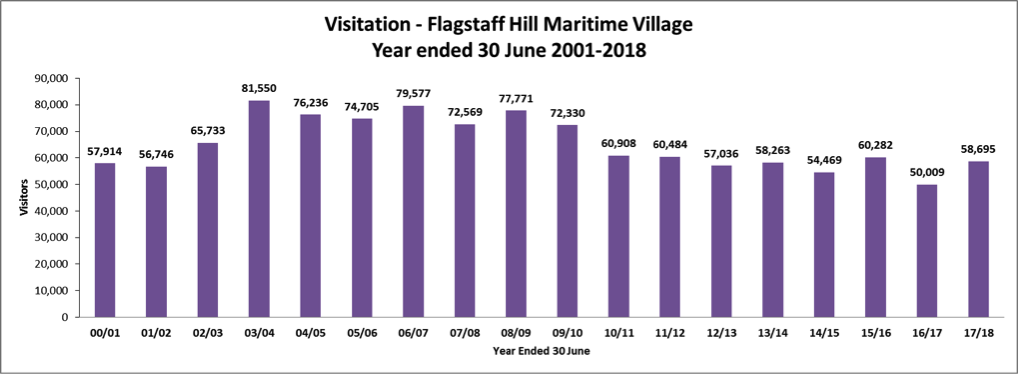
Yearly figures released to the Warrnambool City councillors this week. They include free entries that average 7000 a year. The village was closed for six weeks in 2016-17.

Four years ago, Flagstaff Hill was seriously weeping.

An expensive masterplan commissioned by the council concluded that to make any real difference, to actually turn the place around and give it a whole new lease of life, it would have to spend close to $15 million.

We didn’t have $15 million to spend.

So what do you do? Like a home renovator who has run out of money, do you keep trying to patch the house up, or do you cut your losses and move on?

Our council decided to keep patching: Maremma dogs, Oddball, a new light and sound show about hunting whales, hologram characters instead of real people, a new entrance, stuffed toys…patch, patch, patch.

And meanwhile the poor volunteers – without them we would be in even deeper trouble – and the exhausted council staff just kept trying their best while avoiding the bleeding obvious that the cobblestoned pathways weaving through the village were mostly empty.
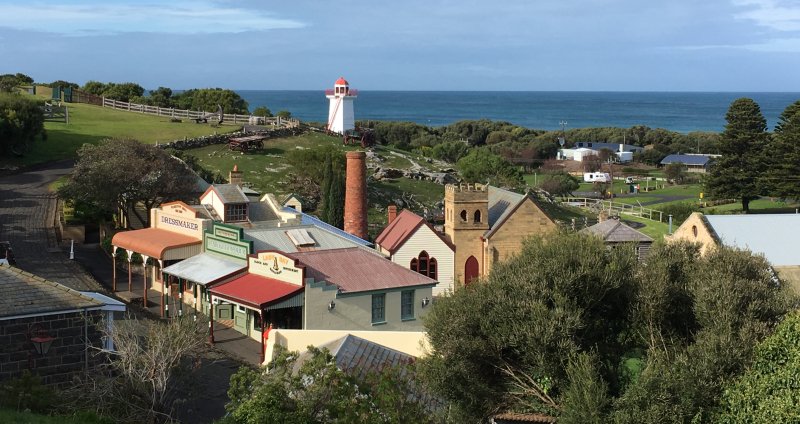
Flagstaff Hill is a site with huge potential, but the conversation on its future needs to start now.

Ratepayers and taxpayers have every right to be outraged by this waste of money.

We have been let down by our leaders and decision makers and fed a steady, fatty diet of bullshit and spin and now, here we are, with no plan for the future of Flagstaff Hill.

That clear-eyed planning should have started at least five years ago, when the numbers began to slide and the writing was on the wall that Flagstaff Hill has had its day.

It is not Sovereign Hill – which operates under an entirely different structure and system – and it is not IMAX. It was great, once, but times have changed…dramatically.

Now we know the truth, we need to ask our council to set out a new vision for the Flagstaff Hill site.

What does it have in mind? What are the possibilities? What are the limitations? (Being on Crown land is one of them).

The Flagstaff Hill site is magnificent. The views are spectacular and the lighthouse section is authentic, historic and already showing its appeal as accommodation. What’s next?


Whatever happens, we can’t do it on our own. It will need partnerships or investors or entrepreneurs to not only help set the course, but to fund it.

We only have to look across at the revitalised Fletcher Jones site, currently being transformed into The Warrnambool Motor Museum, to see what is possible. A decade ago, that site was almost given up for dead.

The same can happen with Flagstaff Hill, but we need to ring the bell and start turning away from the rocks now, or the greatest shipwreck of all will be itself.

If you would like to support local, independent journalism, please make a small contribution below.

Donate


Huge changes afoot as Midfield Meats makes it move

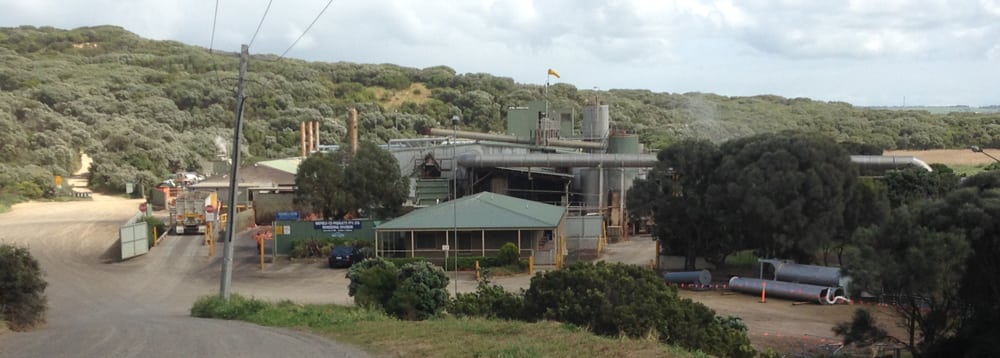
The Midfield Meat rendering plant at Levy’s Point will be shut down and its operations moved to Scott St, Merrivale, under plans officially released today. Image: B&R Enclosures.

By Carol Altmann

Midfield Meats is again shaking the earth around Merrivale and beyond with plans – officially released today (29/8/18) – to shut its rendering plant at Levy’s Point and build a new, $18 million plant next to its abattoir in Scott St.

This is a momentous move, with implications all round.

On the upside, if the relocation is approved by the EPA and Warrnambool City Council, it will free up the Levy’s Point land for the first time in 53 years and shut down what is one of the greatest assaults to the senses ever encountered by cyclists innocently peddling along the rail trail.

The place stinks and when the big gate is open, it is a horror show.

It was only three years ago that Midfield fought and won a long battle to remain at Levy’s Point, but the conditions around that approval – it seems – will cost more in the long run than moving to a new, purpose-built, super-dooper plant at 24 Scott St.

Except…

24 Scott St is near houses – the residential zone is just 250m away.

And 24 Scott St is near a primary school – just 400m away.

These are the two things that Merrivaleans, and others, pointed out when Midfield decided in 2014 that it wanted to build a powdered milk factory in Scott St.

After a huge battle, that project was also approved, but has not yet been built.

Merrivaleans must be exhausted from fight after fight, but it is not only those who live there who need to get their heads around this plan, it is all of us, because it signals a major and permanent change to a part of Warrnambool that is a lot closer to town that Levy’s.

You can read the whole 27-page plan here but here’s a quick summary from the EPA:

– two processing lines, processing up to 400 tonnes a day;

– operating hours will be between 7pm-12am weekdays and 1–5pm on Saturdays, but it will have the capacity to operate 24 hours a day, seven days a week

–  a new, purpose built bio-filter;

– processing carried out in an enclosed building;

– wastewater from the plant and abattoir will be combined and pretreated at the recently upgraded onsite wastewater treatment facility before discharging to the sewer;

– improved energy efficiency, less transport movements and water consumption and eliminate amenity impacts when compared with the existing facility;

– key environmental issues are odour emission control and Q-fever risk management;

– other issues are stormwater management and noise controls.


Nobody can argue against building a better plant, but just like the milk powder factory before it, the concern is not only with what is being built, but where it is being built.

The best rendering plant in the world is still a rendering plant, and I am not sure if that is what we want a stone’s throw from houses, a school and less than 2km from the Warrnambool Base Hospital.

While Scott St is an industrial zone, Warrnambool’s growth has caught up with it. What was once on the edge of town is now within it.

There is no doubt Midfield is an important player in Warrnambool but it has changed too: it now operates on a global scale and, in 2017, was ranked number 769 out of the top 2000 companies in Australia.

According to IbisWorld, Midfield Meat International generated a total revenue of $510,270,000 in 2017. That’s not all profit, of course, but not a bad turnover for just one year.


Given the huge success of Midfield, perhaps it is time to ask why it can’t invest in moving its entire operations right out of town, away from wetlands and houses and schools and our ever-expanding suburbs.

Surely this would provide a solution that works not just for the next 10 or 20 years, but for the next 100, and both Midfield – and Merrivale – could rest easier.

A public information session on the plan will be held from 4pm-6pm, 18 September, Archie Graham Centre, Timor St, Warrnambool.


If you would like to support local, independent journalism, please make a small contribution below.

Donate


10 good reasons why we must say no to horses and dogs

By Carol Altmann

Why horses and dogs don’t belong in the conservation and conservation/recreation zones that will stretch from Killarney Beach to Warrnambool:

1. At least 54 species of “conservation significance’ live there, including five listed as critically endangered, particularly the Orange Bellied Parrot, 10 listed as endangered, 20 as vulnerable, and 16 listed as threatened. (draft report p86-87)

2. There WILL be a negative impact on these species. Not “perhaps” or “maybe”: there WILL be a negative impact that reduces their chances of thriving or even surviving. (p29, p33, p34-35)

3. The traditional owners of this country have made it very clear that they do not support racehorse training in the reserve. (p22, p64)

4. Racehorse training at Levy’s Beach WILL cause damage to Aboriginal Cultural Heritage in this area and any artefacts will have to be removed and stored before it begins*. (p64)

5. Horse training WILL cause erosion**. Not perhaps or maybe: it WILL.

6. Every coastal plan for this area in the past 40 years has emphasised the need for MORE protection, not less. This includes the W’Bool City Council’s own Warrnambool Coastal Management Plan, signed off just four years ago.

7. It ignores the Land Conservation Council framework set down for this area in 1978, knowing it would come under increased pressures. As a result of the LCC, the majority of public land in the area was officially set aside in 1979 as a conservation reserve. The LCC emphasises low-impact recreation, conservation and protection. (p83)

8. There are no numbers on exactly how many racehorses would use the most sensitive areas of Levy’s Point, Golfies and Rutledge’s Cutting. (p63-64)

9. Monitoring this area is already difficult because of its isolation.
The area already suffers erosion and damage caused by illegal activities. (p61)
How will the WCC, Vic Police and Parks Vic have the time and resources to monitor it in the future?

10. The bottom line? Commercial racehorse training is not recreation and it is not conservation. This is not anti-horseracing, it is just fact.

Please have your say on the draft management plan for Belfast Coastal Reserve, by March 16, here: www.engage.vic.gov.au/belfast

* The full extent of Indigenous artefacts and cultural sites in this area is not known due to either out-dated or insufficient data. The plan says more studies need to be done.

** There also needs to be more studies into the full impact of horses on beaches, but two referred to in the draft report (p80-81) confirm that horses cause erosion. Here is part of the summary from a 2001 study of horse riding in D’Entrecasteaux National Park, WA:

“Horse riding altered plant species composition, increased the area of bare ground and decreased height and cover of vegetation. Significant impacts occurred after only low levels of horse use. The findings indicate the need for a database on horse riding impact in Australia so that, where horse riding is allowed, impacts can be properly assessed and effectively managed.”

http://www.publish.csiro.au/pc/PC020256