A one-day inquest hearing has been held into the disappearance of former WCC engineer Barry Collins more than 30 years ago. Image: Shutterstock.
Carol Altmann – The Terrier
I have just learned that an inquest opened today into the disappearance of Barry Collins, a former executive of the Warrnambool City Council, who went missing 30 years ago. This is big news.
Mr Collins, an engineer, disappeared after being accused of a misappropriation of council resources and funds. I remember this terrible story, as I was a wide-eyed cadet at the Warrnambool Standard at the time.
Mr Collins’ disappearance sent shockwaves through Warrnambool. It was terrible.
There has never been a full explanation as to what happened, or the full back story to the allegations. His family, no doubt, have continued to seek those answers.
Now, 30 years after this tragedy, an inquest has opened in the Coroner’s Court in Melbourne, before Coroner Paresa Spanos.
I will follow this up tomorrow, but for tonight, I am just putting this on the public record and hope that it may finally lead to some answers for Mr Collins’ family and for the wider community.
Update: The ABC’s Matt Neal has written a comprehensive piece on this case, which is set to officially clear Mr Collins of any wrongdoing. You can read Matt’s story here.
“Undesirable” result was the exact opposite: Jim Burke
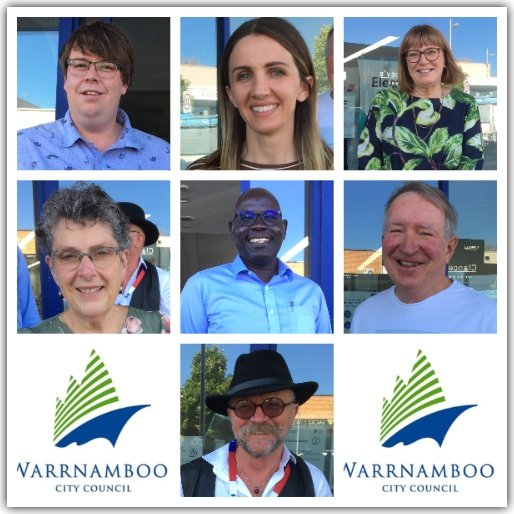
The seven new Warrnambool City Councillors elected in a clean sweep in 2020: Ben Blain, Angie Paspaliaris, Debbie Arnott, Vicki Jellie, Otha Akoch, Max Taylor and Richard Ziegeler.
Terrier guest writer – Jim Burke*
This week the local newspaper reported that three former councillors thought that the outcome of the recent council election was “undesirable” and that a ward system with three councillors in each ward would prevent “undesirable” results in the future.
Really! Well let’s unpack that.
Firstly, just how was this election result “undesirable”?
The election was a well-run, open, democratic process conducted independently by the Victorian Electoral Commission. The candidates all campaigned in good will and the community seemed to be fully engaged.
The election results were overwhelming, the community wanted a clean sweep: that is what they voted for and that is what they achieved.
It seems clear that the voters understood that they could likely end up with seven councillors who would come to the job with no previous experience.
Is that what happened? Well, actually, no.
The seven new councillors bring a wealth of skills and experience to the table and they have had the benefit of observing their predecessors and an understanding of just what is at stake.
The result of this election was not “undesirable”: it was the exact opposite. It was clearly the result the community desired.
Now, would a system of three wards, electing three councillors each, have changed the election results?
In the case of the 2020 election, I doubt that a ward system would have changed the outcome. There was a strong mood for change, and this can be seen in the voter turnout.
More were enrolled to vote in 2020 than in 2016, and of these, more people actually voted in 2020 as a proportion of those enrolled than was the case in 2016.
The proportion of informal votes also went down, not up, as implied by the former councillors in the newspaper article.
If we had three wards electing three councillors each in 2020, the outcome may have been different, if only because it might have caused a different range of candidates to nominate.
For instance, all of the sitting councillors who sought re-election in 2020 lived and/or worked within a short walk of Liebig Street; do you think that any of them would have been accepted in a ward that included, say, Allansford?
We had no candidate running from Allansford (or Woodford) in 2020, so perhaps under a system of wards, we would see such a candidate.
I would argue that such was the mood for change, the outcome would have been much the same, whether it was a single electorate, or an electorate divided into wards.
The retired councillors also made some further observations that I would like to challenge:
First, that a ward system would have reduced the informal vote from nine per cent to two per cent.
I am not sure what they base this on, or how they arrived at the figure of two per cent, but in any case the assertion is misleading.
If the 2020 election had been held over three wards, the informal vote (nine per cent) divided among three wards would have been three per cent per ward.
Perhaps with fewer candidates per ward, then the informal vote may have been lower. But a whole percentage point?
Secondly, these retired councillors harked back 30 years when there was a ward system, elections were held annually, and one third of the councillors retired each year. The idea being that this would have avoided the “undesirable” outcome of the 2020 election, by reverting to an enforced system of “old and new faces” at the council table.
This is a bogus argument that needs to be debunked right now.
Whatever the merits of the idea, it will not happen now or ever. We would have to endure three months of election activity every year, and the costs to candidates and councils – in cash and personal and professional disruption – would be unacceptable.
In any case, no State Government would ever commit the resources or pay the huge cost of an election in all 79 councils in Victoria every year. It just will not happen.
But change is in the air for the next election in 2024, with Warrnambool set to return to wards in response to a State Government review.
How many wards, their boundaries, names and the total number of councillors (the review recommended nine), will be decided in the coming months.
For now, however, all eyes are on this new council and the fresh start that Warrnambool desired and achieved.
*Jim Burke, a retired naval officer, ran for the WCC election for the first time and finished 11th after preferences. He is a regular fixture in the public gallery at council meetings and continues to run a Facebook page with commentary on civic affairs.
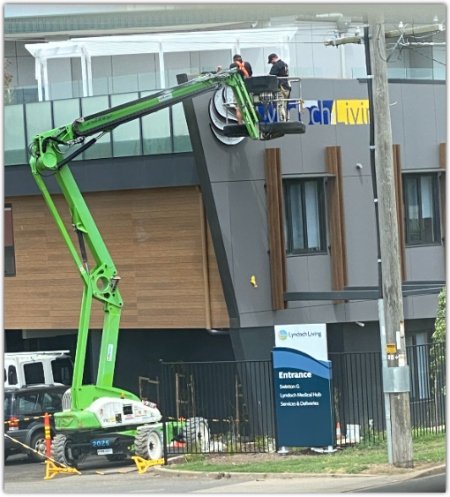
Cherry picker on the job at Lyndoch, as gardening staff cut
The Cassign team installing new signage today on the Swinton Wing expansion at Lyndoch Living.
Carol Altmann – The Terrier
Well blow me down if the Cassign team was not back at Lyndoch Living today installing a huge, illuminated sign on the front of the new Swinton Wing.
I wonder if Lyndoch put this latest slice of non-essential corporate branding out to tender, because this sign is not a little A-frame at risk of blowing over in the Warrnambool wind – it needed a cherry picker and three guys to install.
We will most likely never know, because Lyndoch no longer tells the community such things.
But what I can confirm is, as flagged last night, the Lyndoch at-home gardening team is being dismissed as of late January because they are costing Lyndoch money.
These are the hard-working men and women who visit people’s homes to mow lawns, whipper snip, and edge garden beds with a skilful eye well beyond my own.
They are now dispensable to Lyndoch, even if they were indispensable to those who used the service.
The home gardening team costs Lyndoch around $100,000 a year, and so they are out.
Be gone ye faithful gardeners, Lyndoch has snazzy signs to install via a cherry picker!
I was thinking we could offer some suggestions as to where Lyndoch could whipper-snip its costs to save the gardeners, and we could start with the number of executives.
As I wrote last night, a brand new executive position has just been filled and, as it turns out, another two will be advertised in January:
– Operations Manager: Organisational Development
– Organisational Development Consultant
Good grief.
An organisational consultant to assist the organisational manager who reports to another manager, who reports to the CEO…
At last count, Lyndoch had around 60 administrative staff.
The good people of Seymour know all about top-heavy administration, which unfolded at their hospital some years ago, and was one of several upsets challenged by the local community that led to a complete upheaval in 2012.
The CEO of Lyndoch was the CEO of Seymour Health at the time.
Lyndoch also sponsors the Grand Annual Steeplechase horse race, which was ostensibly in the hope that such advertising would help sell the waterfront apartments.
It didn’t work.
The last of these apartments was flogged off recently in a fire sale for $100,000 less than the listed price in 2014.
Lyndoch also hosts a corporate marquee for three days at the May Racing Carnival – at a cost of around $40,000 – and would have done so again this year had it not been for Covid-19.
And yet the gardening staff are being cut.
We see what is happening here. We all see it. And we are not looking away.
If you are reading this and would like to support The Terrier, please throw something in the tip jar below.
Lyndoch: potential conflicts of interest, and a new exec
Former TAFE executive Julie Bertram, now a permanent part of the Lyndoch Living executive, and former W’bool City Councillor Sue Cassidy, now Lyndoch chair.
Carol Altmann – The Terrier
Oh, the tangled web. Warrnambool can be a very, very small place when it comes to who knows who, and who ends up where, how, and why.
Which is why I asked Lyndoch Living this week how it manages the potential conflicts of interest around Lyndoch board member and now Lyndoch chair, Sue Cassidy.
I asked this because Ms Cassidy, who joined the Lyndoch board in 2017, is married to David Cassidy who operates Cassign: a very successful signage company that has operated in Warrnambool since 1983.
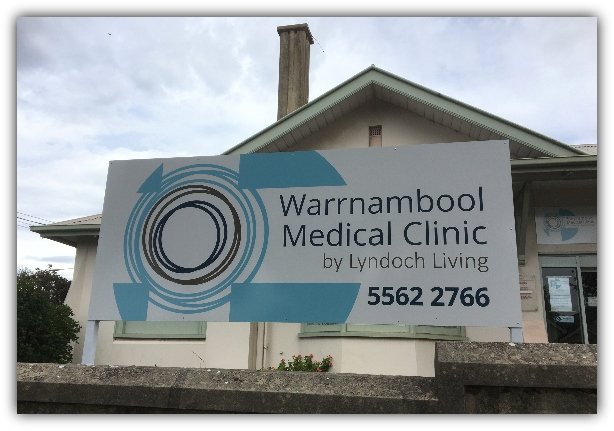
Cassign has done a lot of signage for Lyndoch Living these past few years, including the Lyndoch bus and the new signage at the Warrnambool Medical Clinic that, last year, was bought by Lyndoch Living for $1.3 million.
Cassign also provided the installation work for the swish flat-screen TV that now sits at the drive-through entrance to Lyndoch Living.
Most recently, as I understand it, Cassign replaced old signage outside the new Swinton Wing with a sparkling new sign that, among other things, directs people to the “Lyndoch Medical Hub”.
I know more than I probably need to know about Cassign, because I have raised the issue of potential conflict of interest before, when Ms Cassidy was a Warrnambool City Councillor and voted on issues to do with racehorse training on our local beaches.
At that time, I questioned how Ms Cassidy could be part of any such discussions when Cassign sponsored horse races in Warrnambool.
In response, Mr Cassidy sent me a series of long and passionate emails setting out why – in essence – my stories were all a crock and there was no potential conflict of interest and his wife was a modern woman who ran her own business, while he ran his.
I saw it differently – and I still do. Which brings me back to Lyndoch Living.
This week I asked Lyndoch Living (and Ms Cassidy) whether Lyndoch put out a tender for its signage work and, given Cassign has done at least some of this work to date, how it managed any perceived conflicts of interest.
The answer, as always, was no answer.
We shall have to make up our own minds.
In the meantime, you may recall that a couple of weeks ago I wrote a piece about Lyndoch looking for yet another senior executive to add to its ballooning executive team which has grown from 37 in 2017 to almost 60 in 2019.
This newly created position – Director of Research, Enterprise and Education – was worth more than $100k a year, was advertised only internally and for only around 10 days, leading me to speculate that someone was already lined up for the job.
That someone, I took a punt, was Julie Bertram, a retired director from South-West TAFE, who this year has been filling a maternity leave position in the Lyndoch executive.
Lo and behold, guess who today was announced as the winning candidate for the job? Ms Bertram.
While Ms Bertram is no doubt perfect for the role, the bigger question is why Lyndoch’s executive team seems to have an ever-increasing number of new staff in roles that, between them, must cost a fortune.
For what purpose and for what return to Lyndoch and its residents?
This latest position comes on the heels of Lyndoch recording a $1.9 million deficit – its fifth deficit in five years.
It also comes amid unconfirmed reports that Lyndoch’s at-home gardening staff will soon be dismissed because they are costing Lyndoch money.
And it comes as we start the countdown to Lyndoch’s full financial figures for 2020 being released in January through the Australian Charities and Not for Profit Commission.
I wonder if the food bill for Lyndoch will have increased from the paltry average of $13 per resident, per day, in 2019?
The silence from Lyndoch is always deafening when it comes to my questions, but rest assured that I will keep asking.
As always, if you would like to support the work of The Terrier, please visit the tip jar.
Harbour plan needs cool heads and caution: Peter Ronald
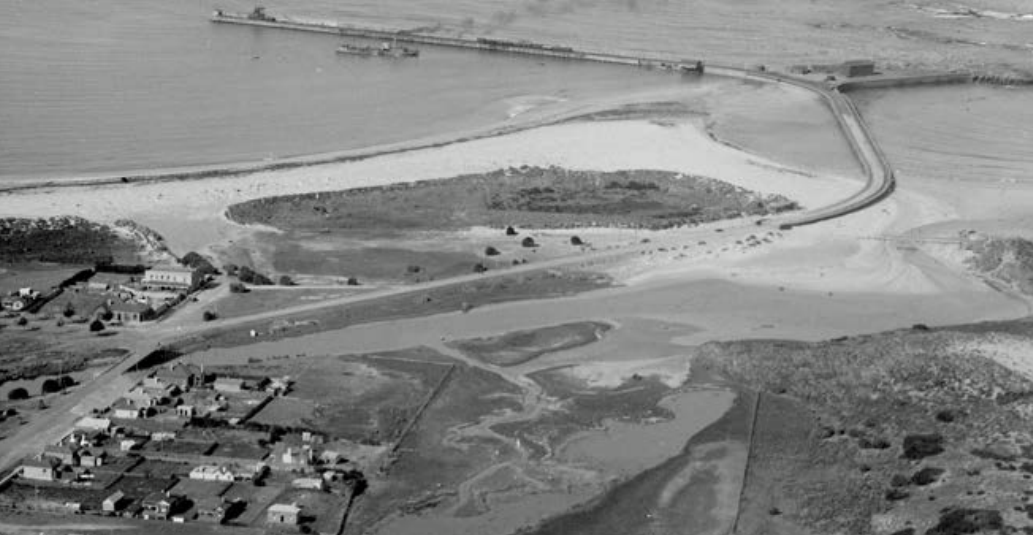
Lady Bay and the mouth of the Merri River, circa 1920s, when the viaduct was open between Stingray Bay and Lady Bay. Image: Lost Warrnambool/State Library.
Terrier guest writer – Peter Ronald*
The future of Warrnambool’s harbour has attracted growing interest recently and that is good to see, but it’s important that raw enthusiasm does not drown out sound judgement.
Good decision making on the harbours’s future will depend upon cool heads, questioning popular assumptions, and proceeding with great caution.
In the historical context, Lady Bay was never a great location for a port. The fact that European settlement occurred first in Portland, followed by Port Fairy then Warrnambool, is not accidental.
That chronology simply follows the relative suitability of each location as a serviceable port.
The lack of depth and associated siltation problems of Lady Bay were observed in the earliest days (well before the breakwater was constructed) and dredging was always going to be a necessary function. A greater limitation though, was/is Warrnambool’s exposure to the extremes of the Southern ocean.
Conditions beyond the breakwater can be, and frequently are, simply horrendous for boating.
In the days of coastal steamers, Warrnambool’s Harbour Master had the authority to close the port to all shipping movements, not because of conditions within the harbour, but because conditions across the open-ocean approach were too dangerous.
In spite of these things, it should be remembered that the breakwater has actually served its purpose.
The huge tonnage of cargo through the port was only possible through the construction of the breakwater and through the essential dredging within its lee. Nothing has changed. The depth and location of the entrance channel remain the same, sea conditions have the same degree of variability, the breakwater stands as it always has.
The key variable at play in the functionality of the port has been the extent and frequency of dredging.
The late Tom Wicking used to joke that when the old steam dredge would to go well out to sea to dump its spoil, the sand would make it back in before the dredge did!
A humorous exaggeration of course, but it served to emphasise the ongoing need for maintenance dredging. Maintenance is the operative word; the port continued to serve the needs of quite large ships for as long as the maintenance dredging was carried out.
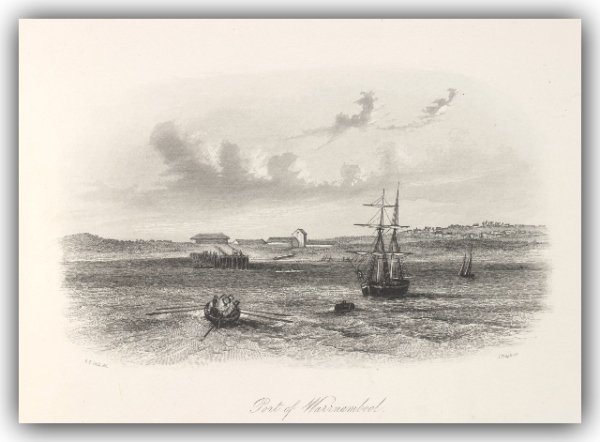
Port of Warrnambool, engraved picture by J. Tingle. Published by Sands & Kenny 1857. Image via State Library Victoria.
Just as we paint houses and mow lawns, we don’t shy away from these tasks just because they will need to be done again. The key point is this; no matter what level of port infrastructure we might like to add or subtract from Lady Bay, some level of maintenance dredging will still be needed.
As the late Edmund Gill explained; turbulent water carries sand and silt, but when that water is calmed the “cargo” is simply dropped. This truth is unalterable.
The primary interest in the port these days is for recreational boating via the boat ramp. I have about 50 years practical experience in boat launch and retrieval from Lady Bay and I refute the claim that the existing launch facility is unacceptably dangerous.
I have successfully launched a wide variety of craft over the years and never encountered a problem that was not of my own making. I have no doubt that the inexperienced, the bold and the stupid, will encounter difficulties!
This is particularly true when trying to launch in unsuitable conditions (as the inexperienced the bold and the stupid are prone to do). Given the frequently dangerous conditions beyond the breakwater, the key to safe seamanship around Lady Bay is simply knowing when to stay at home. It is not just a matter of inconvenience, the dangers are very real.
No other boat ramp facility in Victoria offers such immediate access to life threatening conditions. The total loss of life (drownings) within a 2km radius of the breakwater is probably unequalled anywhere in Australia.
In poor sea conditions it is true that the existing launch facilities are very difficult and risky. I would argue however, that this actually protects people from themselves.
The creation of an all-weather launch facility in Lady Bay would inevitably result in loss of life, simply by enabling people to put to sea when they shouldn’t.
This should not be interpreted as an argument to do nothing, but rather to illustrate the importance of fully exploring the consequences of any action.
There seems to be a popular view that, if only the launching and harbour facilities were improved, Warrnambool would become some sort of mecca for recreational (and even commercial) fishers. This is frankly a pipe dream.
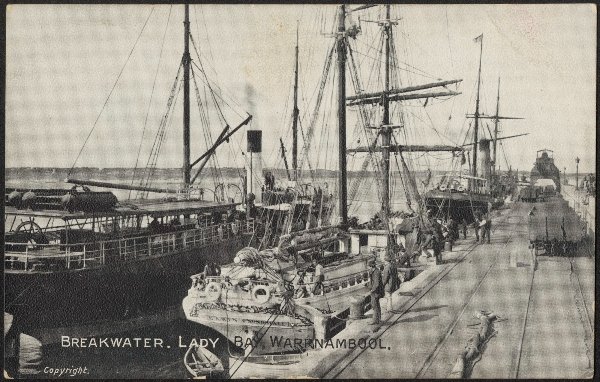
The Warrnambool breakwater in its heyday, circa 1907, when tall ships and steamers would frequent the port. Image: State Library Victoria.
Warrnambool’s true limitation in this regard remains the exposure to the elements beyond the breakwater, not inside it.
Given the comparatively tranquil waters in the lee at Portland and Port Fairy, Warrnambool will never be as attractive to recreational fishers as these other locations, no matter what launch facilities are on offer.
It is true that there is a large group of itinerant anglers eager to access blue fin tuna if and when that species comes within reach. It is also true, that a massive infrastructure overhaul of Lady Bay might just induce some of these anglers too choose to launch at Warrnambool. The question is at what cost?
Not just the budget necessary to completely overhaul our port, but also the cost to the people of Warrnambool through, for example, the aesthetic change that a fully enclosed harbour might bring, not to mention the potential of further traffic congestion and parking overflow.
Given the uncertain hope of attracting some short term visitors to spend a few days of the year in Warrnambool chasing tuna, the true cost/benefit of that endeavour requires some VERY close scrutiny.
Concerns have been expressed about the potential loss of our Lady Bay and its beaches through recent erosion and sand movement.
Certainly there are climate change considerations to be alert to, but it would be unwise to jump to conclusions just based on recent storm events. There are two things of note from the historical record.
Firstly, as previously mentioned, the navigational channel (found by aligning the two lighthouses at Flagstaff Hill) has remained unchanged in both depth and location since the 1840s. This confirms that whatever is occurring inside the breakwater and around the perimeter of the bay is having no impact on the vast bulk of Lady Bay.
Secondly, the beach shoreline has changed over the past 180 years through a cycle of erosion and deposition. Again however, from the historical record, we can see that the cumulative result has been a very substantial net gain.
The most recent erosion is exposing some interesting dating evidence; aluminium beer cans deep in the cut for example. This identifies very recent deposition of sand and dune formation.
No, we are not in imminent danger of losing our precious beach and no-one should panic, yet.
So, where to from here? Like everyone else, I have some ideas, but I don’t pretend to know the answers.
At a minimum, the ramps and associated boating facilities should be maintained, refined, and modernised where appropriate. The new fish cleaning station is a good example of what can and should be done.
In relation to dredging, surely there is room for some creative thought. A market for the dredged material, or even just a practical use for it, could help the cost benefit analysis considerably. Using the breakwater as the platform for dredging operations can significantly reduce costs and down time.
This was actually trialed once but the limitation was the reach of the equipment used. Perhaps some thinking outside the square might find some solutions to that.
If there is a problem of siltation in the immediate vicinity of the ramps, this could be easily dealt by prop blasting (using a boats propellor as an underwater “leaf blower”). It is a very simple technique and has been successfully used in maritime archaeology and harbour maintenance for decades.
The technique is sometimes overlooked because of its simplicity but it works a treat; the bigger the boat(s) the more sand can be shifted, and very quickly.
In the final analysis, maybe some form of modest additional sea barrier will be appropriate.
In any case, however, the most important thing is to proceed with caution; unbridled enthusiasm can be a dangerous thing in relation to boating in general, and also in relation to harbour improvements in particular.
* Peter Ronald is a former director of Flagstaff Hill and a diver who specialised in shipwrecks.

 If we had three wards electing three councillors each in 2020, the outcome may have been different, if only because it might have caused a different range of candidates to nominate.

 In response, Mr Cassidy sent me a series of long and passionate emails setting out why – in essence – my stories were all a crock and there was no potential conflict of interest and his wife was a modern woman who ran her own business, while he ran his.