WCC leasing deals: a wall of silence…and a shiny new shed
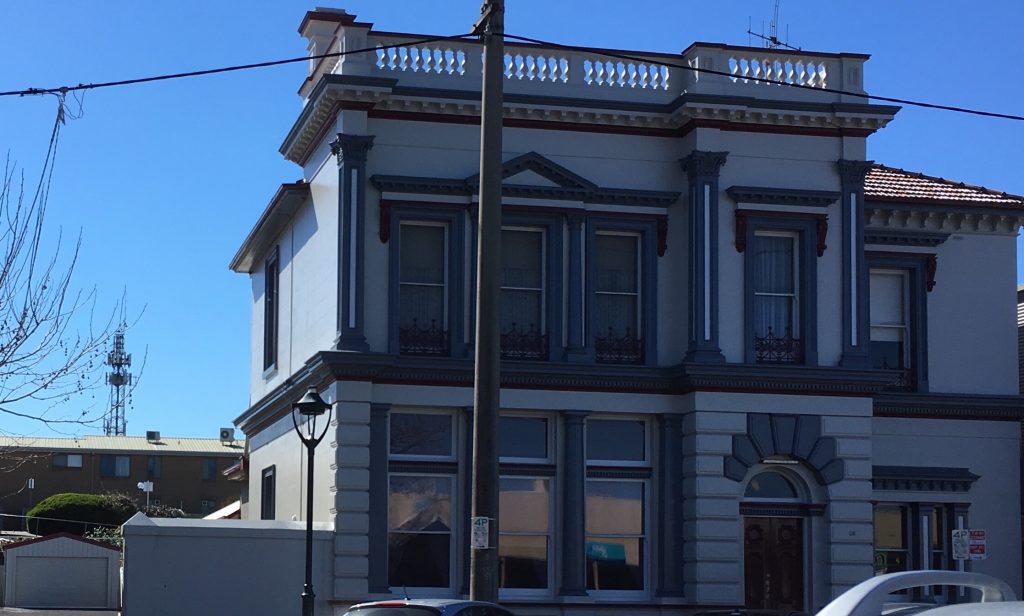
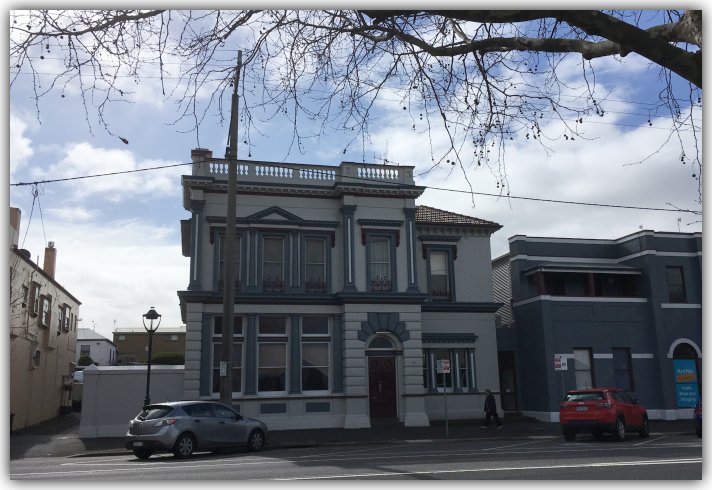
The council-owned residence at the Archie Graham Centre is part of a former bank building.

By Carol Altmann

The Warrnambool City Council has pulled down the shutters on its leasing rules that have allowed a senior staff member to rent a council-owned apartment for more than 30 years.

It is two weeks since the story broke about a senior staff member renting a central apartment at the Archie Graham Centre for 31 years (@ $190 per week) and another staff member renting a beachside house for 14 years (@ $221 per week), with no end date for either lease.

Despite an enormous response to the story from people wanting to know more, the person in charge of such things, Revenue and Property Manager Glendon Dickinson, has declined to be interviewed.

A whole series of questions I sent to both him and the WCC media manager, Nick Higgins, have been left hanging.

These questions include basic things like who sets the rent? How often is the lease renewed? How were the tenants selected? How is the rent paid? Does the rent include utility bills?

After several days, the only comment forthcoming was this:

“Our leases are guided by State legislation including the Residential Tenancies Act.”

Do you find that answer satisfying? I find it insulting: not to me, but to all WCC ratepayers, who actually own these buildings.

The public service has very different rules around transparency, compared to a private company, but what we are seeing at WCC is not transparency, but secrecy.

One thing that is impossible for the WCC to ignore, however, is the new garage and sealed driveway that has appeared behind the apartment in question at the Archie Graham complex and has cost ratepayers $43,000.

The single garage was built by council to replace a dilapidated three-bay garage (two bays of which were used to store council junk) that was demolished to make way for new works at Heatherlie homes.

I understand the single garage was budgeted at $12,000. The project came in “around” $43,000.

Mr Higgins said the final cost included the garage ($11,638), rebuilding a collapsed retaining wall, restoring a garden bed and “the sealing of a previously gravel laneway”.

This laneway, which is the expensive part, is not used by Archie Graham clients, but, according to Mr Higgins, only “used by neighbouring tenants and the residential tenant at Archie Graham”.

The $43,ooo was pulled from the capital works budget for the Archie Graham Centre, the managers of which must be either scratching their heads, or beating it against a wall, at such an expense.

In explaining the cost, Mr Higgins said the council had received more rent from the “flat” over the years than it had spent on maintaining it.

You would hope so.

The rental income from the “flat” had also helped subsidise the maintenance of Archie Graham, he said.

Again, you would hope so. Paying rent, after all, is part of the deal when leasing a property.

But both of these things, really, are beside the point.

The point is that we still don’t know the full details of this lease agreement and how it came about.

The WCC – unlike dozens of councils I have looked at – does not have a property leasing policy which is designed to keep things transparent.

The only way WCC ratepayers would know these leases exist is to visit the council offices and ask for a physical document that very few people know is there.

So why does any of this matter? What is the public interest?

Well, first, the properties are owned by Warrnambool ratepayers. They are the “landlords” here and I think they deserve to know what is going on.

Second, these two leases are unlike any of the WCC’s other residential leases. Every other WCC residential lease either provides public housing for disadvantaged tenants, or short-term accommodation for new staff.

Thirdly, the leases are not part of a salary package and are not required as part of a job description, such as a caretaker at a caravan park.

So, combining all of these factors, the crux of this issue is twofold:

  1. How did two council staff, out of more than 350 staff, manage to secure leases in prime-location, council-owned and maintained houses, that have lasted for decades?

  2. Do these arrangements breach the Local Government Act?

I still don’t know the answer to #1 and I may never know.

But I do know that under the Local Government Act, if a council lease is to be for more than 10 years, the details must be publicly advertised. This is to allow people to a) know about it and b) have a say.

So how does an ongoing lease of 30-plus years slip under the radar?

Simple.

Break the lease into, say, five year lots – and keep renewing that lease each time. Presto, you have a lease that stretches for decades, with very few people knowing about it, and nobody having a say.

Something doesn’t add up here and until it does, we need to keep asking the questions, no matter how uncomfortable. And this is what I plan to do.

If you would like to support local investigative journalism, please make a small contribution below.

Donate


New figures confirm Flagstaff Hill is done and dusted

The new advertising campaign has failed to produce any major increase in visitor numbers.

By Carol Altmann

New, full-year figures for Flagstaff Hill Maritime Village confirm that despite a $3 million upgrade, the village is in a death spiral.

As I wrote a couple of weeks ago, the reality is a lot worse than the pumped up picture given by adding free visitor numbers to the totals.

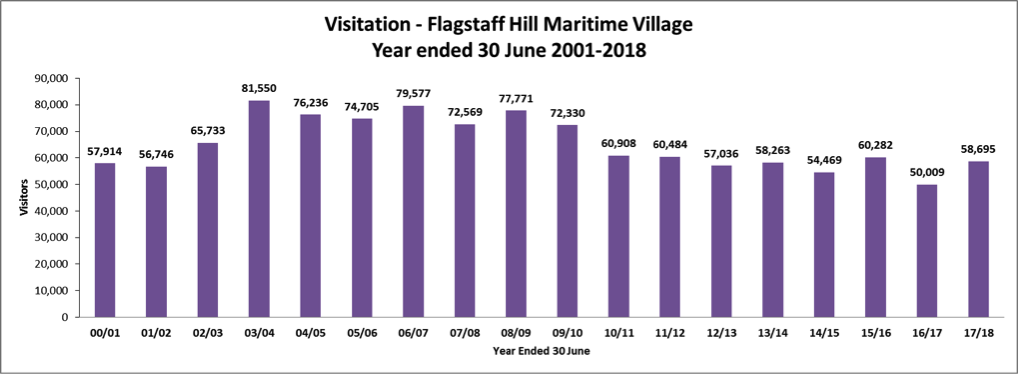
Earlier this week Warrnambool City councillors were told that only 50,000 people paid to visit the site or attend the revamped sound and light show in 2017-18. (Just for comparison, Sovereign Hill averages more than 450,000 visitors a year).

I can almost hear their jaws hitting the table.

Another 8500 people, roughly, turned up for free events in 2017-18 and while that might make us feel good, it is not helping to pay the bills. In fact it adds to them.

To be super clear, 50,000 paying visitors is not sustainable. The village needs at least 80,000 to break even, and more if it is ever – ever – to turn a profit like it used to back in the 70s and 80s.


As it stands, the council is paying more than $500,000 a year to keep the village afloat. This financial year and next, it expects to spend a total of $1.1 million.

What an absolute waste of money and what really grates my wick is that all of this was so utterly predictable.

The council knew, tourism experts knew, and even Blind Freddy Down The Street was on top of it, that sticking a $3 million BandAid on top of a weeping wound is not going to fix it.

Yearly figures released to the Warrnambool City councillors this week. They include free entries that average 7000 a year. The village was closed for six weeks in 2016-17.

Four years ago, Flagstaff Hill was seriously weeping.

An expensive masterplan commissioned by the council concluded that to make any real difference, to actually turn the place around and give it a whole new lease of life, it would have to spend close to $15 million.

We didn’t have $15 million to spend.

So what do you do? Like a home renovator who has run out of money, do you keep trying to patch the house up, or do you cut your losses and move on?

Our council decided to keep patching: Maremma dogs, Oddball, a new light and sound show about hunting whales, hologram characters instead of real people, a new entrance, stuffed toys…patch, patch, patch.

And meanwhile the poor volunteers – without them we would be in even deeper trouble – and the exhausted council staff just kept trying their best while avoiding the bleeding obvious that the cobblestoned pathways weaving through the village were mostly empty.

Flagstaff Hill is a site with huge potential, but the conversation on its future needs to start now.

Ratepayers and taxpayers have every right to be outraged by this waste of money.

We have been let down by our leaders and decision makers and fed a steady, fatty diet of bullshit and spin and now, here we are, with no plan for the future of Flagstaff Hill.

That clear-eyed planning should have started at least five years ago, when the numbers began to slide and the writing was on the wall that Flagstaff Hill has had its day.

It is not Sovereign Hill – which operates under an entirely different structure and system – and it is not IMAX. It was great, once, but times have changed…dramatically.

Now we know the truth, we need to ask our council to set out a new vision for the Flagstaff Hill site.

What does it have in mind? What are the possibilities? What are the limitations? (Being on Crown land is one of them).

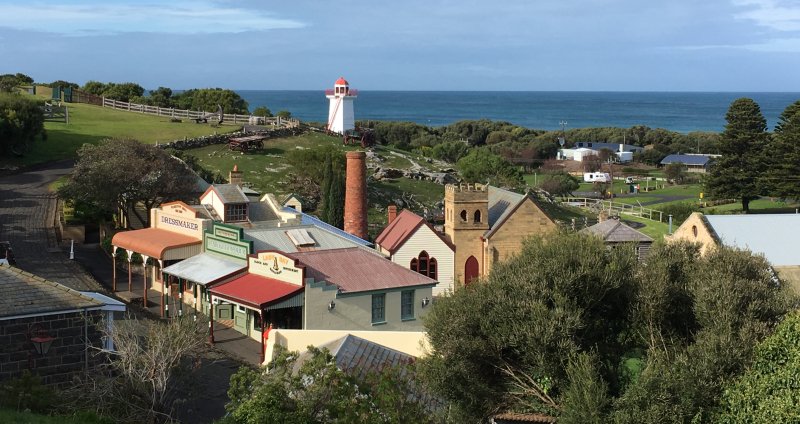
The Flagstaff Hill site is magnificent. The views are spectacular and the lighthouse section is authentic, historic and already showing its appeal as accommodation. What’s next?


Whatever happens, we can’t do it on our own. It will need partnerships or investors or entrepreneurs to not only help set the course, but to fund it.

We only have to look across at the revitalised Fletcher Jones site, currently being transformed into The Warrnambool Motor Museum, to see what is possible. A decade ago, that site was almost given up for dead.

The same can happen with Flagstaff Hill, but we need to ring the bell and start turning away from the rocks now, or the greatest shipwreck of all will be itself.

If you would like to support local, independent journalism, please make a small contribution below.

Donate


Huge changes afoot as Midfield Meats makes it move

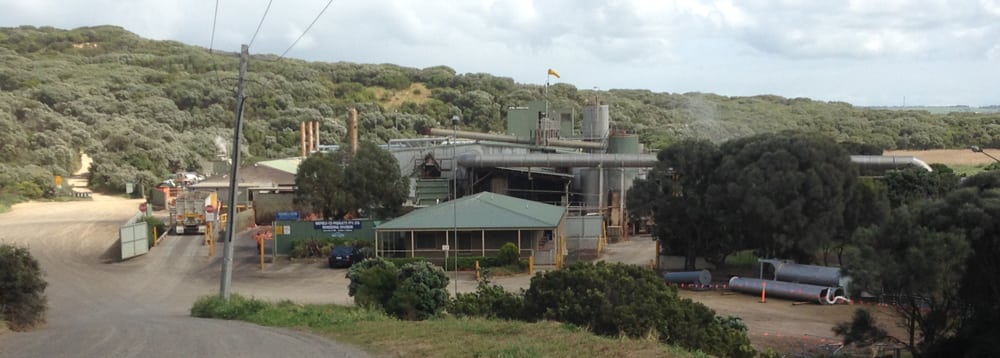
The Midfield Meat rendering plant at Levy’s Point will be shut down and its operations moved to Scott St, Merrivale, under plans officially released today. Image: B&R Enclosures.

By Carol Altmann

Midfield Meats is again shaking the earth around Merrivale and beyond with plans – officially released today (29/8/18) – to shut its rendering plant at Levy’s Point and build a new, $18 million plant next to its abattoir in Scott St.

This is a momentous move, with implications all round.

On the upside, if the relocation is approved by the EPA and Warrnambool City Council, it will free up the Levy’s Point land for the first time in 53 years and shut down what is one of the greatest assaults to the senses ever encountered by cyclists innocently peddling along the rail trail.

The place stinks and when the big gate is open, it is a horror show.

It was only three years ago that Midfield fought and won a long battle to remain at Levy’s Point, but the conditions around that approval – it seems – will cost more in the long run than moving to a new, purpose-built, super-dooper plant at 24 Scott St.

Except…

24 Scott St is near houses – the residential zone is just 250m away.

And 24 Scott St is near a primary school – just 400m away.

These are the two things that Merrivaleans, and others, pointed out when Midfield decided in 2014 that it wanted to build a powdered milk factory in Scott St.

After a huge battle, that project was also approved, but has not yet been built.

Merrivaleans must be exhausted from fight after fight, but it is not only those who live there who need to get their heads around this plan, it is all of us, because it signals a major and permanent change to a part of Warrnambool that is a lot closer to town that Levy’s.

You can read the whole 27-page plan here but here’s a quick summary from the EPA:

– two processing lines, processing up to 400 tonnes a day;

– operating hours will be between 7pm-12am weekdays and 1–5pm on Saturdays, but it will have the capacity to operate 24 hours a day, seven days a week

–  a new, purpose built bio-filter;

– processing carried out in an enclosed building;

– wastewater from the plant and abattoir will be combined and pretreated at the recently upgraded onsite wastewater treatment facility before discharging to the sewer;

– improved energy efficiency, less transport movements and water consumption and eliminate amenity impacts when compared with the existing facility;

– key environmental issues are odour emission control and Q-fever risk management;

– other issues are stormwater management and noise controls.


Nobody can argue against building a better plant, but just like the milk powder factory before it, the concern is not only with what is being built, but where it is being built.

The best rendering plant in the world is still a rendering plant, and I am not sure if that is what we want a stone’s throw from houses, a school and less than 2km from the Warrnambool Base Hospital.

While Scott St is an industrial zone, Warrnambool’s growth has caught up with it. What was once on the edge of town is now within it.

There is no doubt Midfield is an important player in Warrnambool but it has changed too: it now operates on a global scale and, in 2017, was ranked number 769 out of the top 2000 companies in Australia.

According to IbisWorld, Midfield Meat International generated a total revenue of $510,270,000 in 2017. That’s not all profit, of course, but not a bad turnover for just one year.


Given the huge success of Midfield, perhaps it is time to ask why it can’t invest in moving its entire operations right out of town, away from wetlands and houses and schools and our ever-expanding suburbs.

Surely this would provide a solution that works not just for the next 10 or 20 years, but for the next 100, and both Midfield – and Merrivale – could rest easier.

A public information session on the plan will be held from 4pm-6pm, 18 September, Archie Graham Centre, Timor St, Warrnambool.


If you would like to support local, independent journalism, please make a small contribution below.

Donate


Lifting the lid on 30-year-rent deal for WCC staff member

The Timor St building that is owned by Warrnambool City Council and includes a subsidised apartment that has been occupied by a senior council staff member for more than 30 years.

By Carol Altmann

Did you know that a senior member of Warrnambool City Council staff has lived in a subsidised, council-owned apartment in a prime location for more than 30 years?

I didn’t believe it, but it is true.

The council lease register confirms that the same staff member has rented the top floor of a prime property at 130 Timor St since 1987.

The grand old bank building is part of the Archie Graham complex owned by the council and is a two-minute walk from the council offices.

According to the council’s lease register, the current annual rent being charged on 130 Timor St is just $9900, or $190 a week, which is low for Warrnambool.

I had a quick look at realestate.com.au and the rent for a decent two-bedroom property in Warrnambool is usually at least $250 and that is for a place in the suburbs.

According to the WCC enterprise agreement, the salary for this staff member is estimated to be somewhere between $76,000 and $83,000 plus super.

Strangely, the lease between the council and the tenant is also classed as “on-going”, which means it has no renewal or end date.

What the….?

And for the past 31 years since the lease began, the council – meaning ratepayers – has paid for maintenance, repairs and other improvements to the property.

What the…?

The senior staff member is one of two council staff members on a long-term residential lease, although the 31-year-lease is by far the longest tenancy.

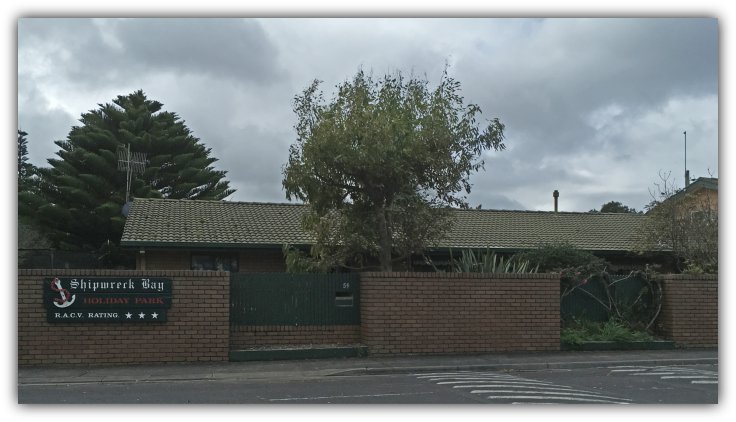
The former caretaker’s residence at the Warrnambool foreshore that has also been under a long-term, on-going lease.

The second property operating under a similar, on-going lease to a WCC staff member is the former caretaker’s house within the Shipwreck Bay caravan park at Pertobe Rd.

This foreshore property has been leased by the staff member for the past 14 years.

The current annual rent on that property, however, is closer to market rates at $11,532, or $221 a week.

Having spent a lot of time looking at what other councils do around property rentals, I can tell you that these two residential leases are highly unusual.

I have to stress at this point that I would not normally write about the affairs of a private tenant, but in this case the tenants are public servants, leasing publicly owned houses and the lease arrangements are therefore of public interest. This is why councils have to keep a lease register in the first place, even if very few people look at it. Despite this, I have chosen not to name the individuals involved. Both were contacted for comment, but declined.


I also need to be clear that many councils, including Warrnambool, own a number of houses that are made available to people who can’t afford the rental market or who are vulnerable, like the elderly.

It is also quite normal for a council to offer short-term housing to new staff who have relocated from elsewhere.

Council-owned houses in Koroit St and the Warrnambool Botanic Gardens are used for this purpose.

Some councils, like Moyne Shire, also offer a house as part of the salary package for specific jobs such as caretakers of caravan parks who need to, obviously, live onsite.

That is all absolutely normal and – usually – transparent. (I was able to get a copy of the salary package for the caretaker position at Gardens Caravan Park in Port Fairy via one call to Moyne Shire.)

But what is happening here with Timor St and Pertobe Rd is highly unusual.

So what is going on and who is making the decisions?

I think ratepayers deserve to know who sets up such lease agreements, are they part of a salary package, who sets the rents and how often they are reviewed, does the rent include power and water, and are other people ever given the chance to apply for the same property?

Most councils have some form of property leasing policy that could help answer most of these questions.

The WCC doesn’t have such a policy, or not one that they could produce.

So, I asked WCC media manager Nick Higgins for answers.

Who sets the rents?

“Rents for Council properties are set at market rates based on independent valuations,” Mr Higgins wrote in an email.

These “rental values are reviewed annually as part of Budget preparations”, he added.

Yes, but who makes the final decision? A panel? The CEO Bruce Anson? Another senior officer? The councillors?

And where does the “independent valuation” come from?

“…a private company,” Mr Higgins wrote.

Which private company, I asked?

No answer.

Okay, what about the leases? Who writes and renews the leases? And are these renewed leases advertised, as per the Local Government Act?

“Leases are renewed where there is agreement between Council and tenants,” Mr Higgins wrote.

Really? The tenant and council can agree to just keep renewing a lease on a prime CBD property for 30-plus years?

Wow, that is some deal if you can get it.

I pressed on and asked Mr Higgins, in a nutshell, if this sort of  “ongoing” lease ever actually expired.

“A fair landlord does not evict tenants or fail to renew leases if the tenants have acted in accordance with a lease agreement,” he replied.

So if a residential tenant sticks to the initial lease agreement with the WCC, they can pretty much stay on forever, it seems.

“Can you send me a copy of the lease agreement,” I asked Mr Higgins by return email.

“And, again, can I ask the name of the private company that reviews the rents in accordance with market values. I am not sure why the name of the company is being withheld.”

The response is below:

Hello Carol,

We have nothing further to add.

Regards,

Nick


Well, in my humble view, there is plenty further to add and that process starts with a Freedom of Information application for the lease agreements.

Thanks to those people who have donated to help keep these investigative stories coming, I lodged that FOI application yesterday.

I think this story is only beginning.

If you would like to support local  investigative journalism, please make a small contribution below.
Donate


Are we being told the truth about Flagstaff Hill?

By Carol Altmann

I have been looking at visitor numbers for Flagstaff Hill and, I have to tell you, there are worrying signs.

Before I go any further, I need to say three things:

The figures are from Sept 2017 to Feb 2018. The media unit at the Warrnambool City Council will not give me more recent ones. I don’t know why. It also refuses to answer any questions about the figures that have been released.

In the past 15 years, at least $15 million of public money has been poured into Flagstaff Hill to keep it alive. Most recently, $3 million was spent on a new light/sound show and other improvements that opened in June last year. A year on, I think we need to know how things are travelling.

None of what follows is a reflection of the hard work done by the volunteers and many WCC staff who, in recent years, have busted their guts for Flagstaff Hill.

So how are things going?

The expectation was that once the $3 million upgrade was launched in June 2017, visitor numbers would boom.

As the council CEO Bruce Anson said himself, the colonial village needed at least 80,000 paying visitors a year to break even. This would stop the WCC having to spend $500,000, $600,000 or $700,000 a year to help it cover costs.

It was a big ask. Three years ago, paid visitor numbers were below 55,000.

The head of WCC’s tourism arm, David McMahon, who two years ago was handed the whip to flog Phar Lap, remained optimistic. In June last year he told The Standard:

A 30% jump by January was a lofty goal, but here is an awful, ugly, unadulterated fact: the overall visitor numbers at Flagstaff Hill are going backwards.

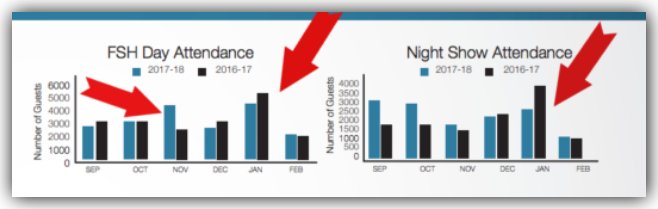
I have checked and re-checked the numbers and you can look at them yourself right here:

Let me take you through the red arrows:

  • In December and January of 2018 – our peak summer holiday season – less people went to Flagstaff Hill than the summer before.
  • The same applies to people who saw the new $2 million night show. After an initial spike in the months after the show opened, many more people actually went to the OLD show, in the summer of 2016-17, than they did in the summer just gone.
  • In February, when the weather was still warm, less than 2000 people showed up for the whole month, about the same as last February.

This is a shock.

Maybe the person who drew this graph for the council got their colours mixed up, but I don’t think so, because you can see a clear ‘spike’ around November last year.

Why was there a spike? I suspect because Flagstaff Hill had a free open weekend to celebrate its $3 million upgrade.

Did you see the word FREE in that sentence? This brings me to another very important point: how many have people actually paid to get in or paid for tickets to the night show since last Sept?

I don’t know. It’s one of the questions that those who have access to these figures – David McMahon, Flagstaff Hill manager Paul Pinkerton and WCC media head Nick Higgins – won’t answer.

But this question is critical to whether these figures are being fudged. Are these numbers a true reflection of what is going on, or is it even worse?

Free entries do not help the bottom line and if free entries are being included in these numbers, then we are being duped and that, to me, is very serious.

We have been here before, with Fun4Kids.

After many successful years as an annual winter event, Fun4Kids started to bleed money. Then it started to haemorrhage.

Here is David McMahon again being quoted by the paper during last year’s Fun4Kids:

Seven months later, the WCC dumped Fun4Kids.

The cut came without warning, without any fallback plan, without any replacement and, it must be said, without giving the scaled-back F4K festival a chance to see if it could do better than the big-budget stuff of years before.

This is not how we should be planning our future as a prime tourist destination.

We need honest, transparent conversations about how we are tracking, what we can expect and what, if anything, we need to change.

I have written many times before that a fake colonial village that opened in the 70s and still flies the Union Jack high above its premises is no longer appropriate to where Warrnambool is going today.

What could replace it is a topic I will wade into later, but for now we deserve to be told the full story.

If you would like to keep seeing more pieces like this about local issues, please make a small contribution below.
Donate