

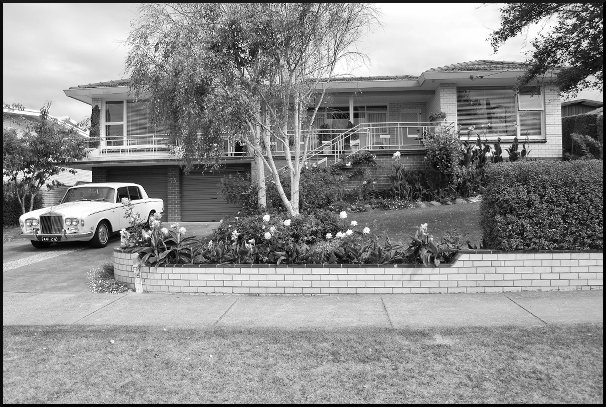
 75 Verdon street – one of a number of mid century ‘Dream Homes’ built for the booming aspirational post war generation. Harry Droste’s classic Rolls Royce looks right at home in the driveway. Image: Clinton Krause architect.
Bluestone columnist and architect CLINTON KRAUSE previously worked in Daylesford before relocating his business to Warrnambool. Clinton explores the architectural styles that gives our region so much character.
I had the great pleasure this month of taking my research out on the road accompanied by local motoring enthusiast Harry Droste. Harry has a large collection of classic and vintage vehicles and our tour around town was all the more enjoyable travelling in some of his appropriate-era cars.
As we set off, it also became clear that Harry is a valuable repository of information about mid-century architecture: he and his father set up a joinery workshop in the early 50’s and worked in conjunction with architect Tag Walter on many of the gems we set out to find.
Harry recalls Tag as a generous and helpful man, who offered Harry his first workshop to provide the bespoke cabinets that Tag designed for all his developments.
Our first stop was a Tag design, set within a street of iconic houses in East Warrnambool.
Verdon Street is unique in that nearly all the houses are superb examples of the mid-century ‘ Dream Home ’ – a style that saw aspirational Australian home owners looking towards American trends for new and exciting ideas. Houses became more expansive with walls of glazing, deep generous eave lines and patios and terraces to extend the living spaces outside.
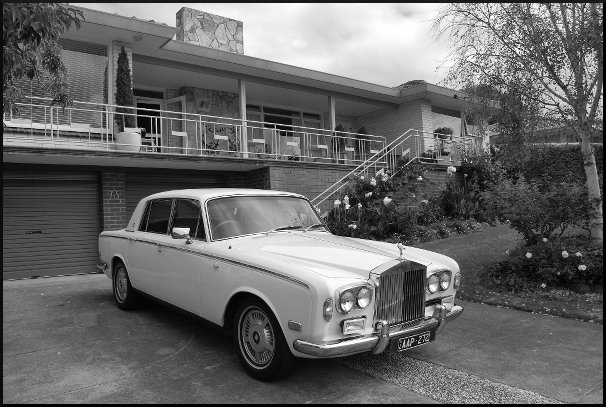 The Rolls Royce silver shadow saloon looking quite at home. Image: Clinton Krause architect.
75 Verdon Street is one such house owned by David and Cheryl Ryan and built by David’s parents in the late 1950’s.
The house has remained in the Ryan family and as such is remarkably original and intact. Harry was delighted to see the original kitchen still in use and was able to demonstrate a quirky design detail – a bank of drawers runs around the whole kitchen, sloping outward to add visual interest. One of the drawers even slides in two directions, providing access to cutlery from both sides of the island bench.
David and Cheryl enjoy the passive solar heating afforded by the expanses of north facing glass – the open fire is the only source of heating and is reserved for use only on the coldest of winter days.
Apart from a minor bathroom renovation, the home retains the original features and continues to provide a comfortable home for the Ryan’s and visiting family members.
The front garden complements the home wonderfully with its ‘ English Gardenesque ’ plantings of colourful perennial beds and groupings of deciduous specimen trees. The overall effect is one of a suburban idyll and indeed the pride and dedication to these period homes is prevalent in the entire Verdon streetscape of great early-modern houses.
As we farewelled the Ryan’s with a wave from our salubrious Rolls Royce Silver Shadow, I asked Harry if he knew of an intriguing house I had discovered some time back near the Botanic Gardens.
 48 Botanic road: a carefully balanced composition of roof lines, windows and materials. Image: Clinton Krause architect.
The house in Botanic Road is modest in size but has been designed with great care and boasts a stunning street façade redolent with details of the best of mid-century design.
The form of the home makes good use of the wide street frontage and the illusion of an expansive structure is reinforced by a graceful sloping gable roof that extends across the whole house from boundary to boundary.
The windows are placed in the façade with attention to balance and symmetry. The framing pattern of openable sashes is repeated across the façade and emulated in the panelling to the two garage doors.
The entry porch is embellished with a whole grab bag of tricks: a raised brick planter box clad in crazy stone paving; an open roof section with exposed framing to form a pergola and ensure natural light accesses an adjacent wall of glazing; a wide swath of crazy paving to both the terrace and the chimney breast (to be admired by guests approaching the front door ), and, to top it all off – a slender steel pipe column supports the verandah porch and is set at an oblique angle for visual interest.
As with many houses of this era, the wow factor is all reserved for the street and glimpses of the sides and rear of the building reveal a more pedestrian approach to roof forms, glazing and detailing.
 A 1950s vision of suburban pride and achievement which has again become highly sought after. Image: Clinton Kruase.
The house serves as a perfect setting for Harry’s 1957 Zephyr and our photo shoot encapsulates the ideals of emerging working class affluence along with the newfound freedom to travel.
Harry is unfamiliar with the origins of this home and its designer, so I have further research to undertake for a later feature.
We set off toward our next destination – a house in Walter Crescent: a street dedicated to the great man himself. More on that in my next column…
Special thanks to Harry Droste for providing and driving the classic vehicles for the grand tour.
Next week: The Tour continues with a visit to the Hobbit house.