


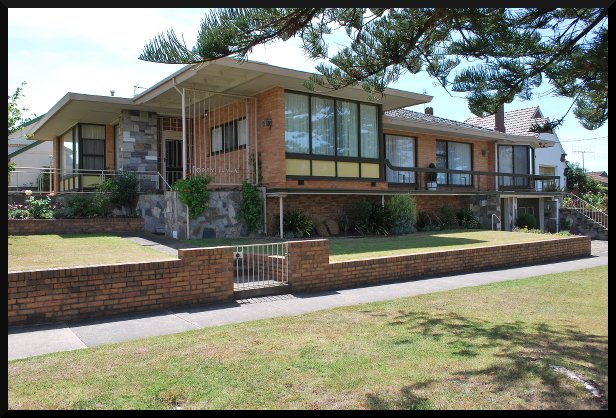
 The former Walter family home at 47 Henna St, Warrnambool, which still looks as good as they day it was built in the mid 1950s. Tag Walter also designed and built the home next door, where he started his business.
Bluestone columnist and architect CLINTON KRAUSE previously worked in Daylesford before relocating his business to Warrnambool. Clinton explores the mid-century architecture that gives our city so much character, but about which most of us know very little.
If there is one architect that has made a culturally significant and architecturally definitive contribution to our built landscape here in Warrnambool it would have to be Tag Walter.
William John Taggart Walter – or ‘Tag’ as he was always known – was born in 1909 the son of a builder/developer and one of 5 children. Tag started practice from his own home that he designed and built in 1934 at 49 Henna Street.
This house, a modest pre-war English style bungalow, still stands, but it is the later family home next door at 47 Henna that displays many of the mid-century design elements that the practice was to embrace and become renowned for.
Built in the mid-1950s, this house was a crossover-hybrid of the prevailing tiled hipped roof forms and stepped back ‘waterfall’ room layout, but also played with exciting new design trends.
Oversized eaves, large geometrically partitioned walls of windows, and cantilevered balconies lend the home a slightly ‘Japanese pavilion’ aesthetic. Abstract wrought iron balustrades and panels of crazy stone cladding further enhance the modern signature of the building.
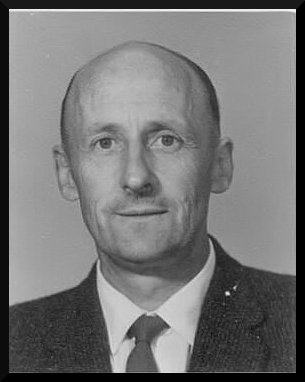 William John Taggart ‘Tag’ Walter: his designs remain highly sought after. Image courtesy of Robyn Poynton.
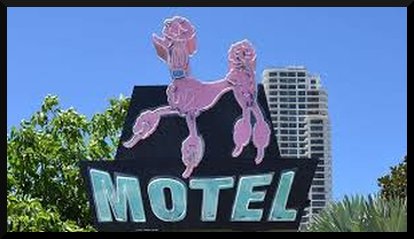 The Pink Poodle motel was one of the most famous on the Gold Coast, but unfortunately only it’s neon sign remains.
Tag brought Bruce Auty into the practice in 1951 and it is surprising how prolific this partnership became.
The pair brought wonderful examples of American 50’s/60’s ‘Googie Style’ to the district – a futuristic design movement redolent of America’s infatuation with the space age, streamlining and car culture. Surviving examples of this distinctive style can still be seen around town in the facades of Mack’s Snacks, Kermonds and Prontos on Raglan Parade – originally designed as a slick, eye-catching car showroom.
Walter and Auty’s work extended throughout the Western District and projects included hospitals, churches, community halls and ongoing development of the iconic Fletcher Jones factory site: masterplanning of the original buildings and gardens having been designed by Tag back in 1948.
A notable interstate commission was the famous Pink Poodle resort on the Gold Coast – a hedonistic motel complex complete with swingin’ bars, bistro, pool and of course a giant, neon, poodle street sign. It was a favourite destination for honeymooners, but while the poodle sign has been preserved, the original building was demolished in 2004.
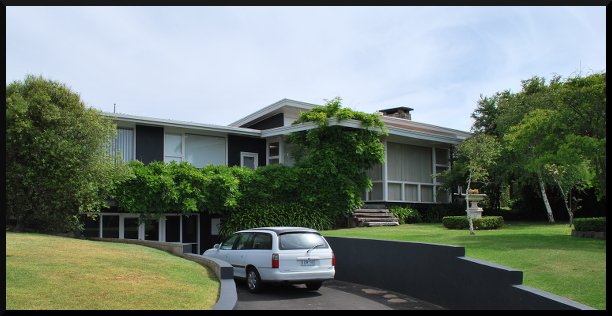 A classic ‘Tag’ design: The former family home of David Jones (son of Fletcher), Verdon St, Warrnambool.
The Walters also found time to raise three daughters who fondly remember their father as an affectionate, kind, generous and meticulous man.
Robyn Poynton recalls that “Dad was always taking me in the car to visit building sites around the district,” and that the family would often attend “opening ceremonies amongst revered dignitaries such as the Premier Henry Bolte”.
Robyn also warmly remembers her sister Joan “doing a training year in Dad’s office on the drawing board, where she would assist with water colour rendering of the perspective drawings”.
Tag worked throughout the sixties, before handing the reigns over to Bruce in 1969. A freak boating accident in 1973 cut short the life of Bruce and brought the practice to a close (but that’s another story…).
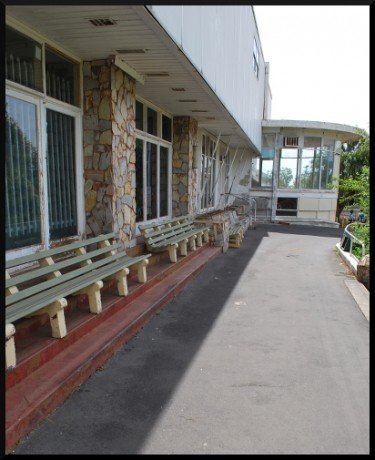 Building details, Fletcher Jones factory complex, Warrnambool.
After retirement, Tag remained registered as an architect and continued to undertake a number of development projects with family members and giving of his time generously to the community right up until his death in 1987.
Walter and Auty were the sole architectural firm in Warrnambool during the 1950’s and 60’s and were leading exponents of Modernism throughout Western Victoria.
Further examples of the firm’s work will be explored in greater detail in later features.
References/acknowledgements: Builtheritage Pty Ltd (Simon Reeves); Warrnambool and District Historical Society; Ms Robyn Poynton (daughter of Tag Walter).
Next Month: A Christmas treat – One with the Lot!

My auntie, Gwen McKellar was a neighbor of the Walters family. When I stayed with her for school holidays I used to play with Robyn Walters. I well remember their new house being built, (although would have thought it was later than the mid 50’s, memory is a strange thing) and Tag taking us through. I remember being enthralled with the built in dressing tables and built in robes. Super modern.
This article is limited information. Do you know that Walter Crescent in Warrnambool was named after him because he designed most of the houses. How do I know because I’m living in one.
In addition on the corner of Liebig and Lava Street there is a large brick building called Walter’s Building. This building was used as an Architect’s office in the second floor.
Do you realise Warrnambool’s first and only underground cafe was called Piccadilly Cafe was in the basement of that building. This basement became the main venue for the Warrnambool theatre group and later used as a photograph studio. Tag Walter’s house in Henna Street on of the first flat roof houses in Warrnambool.
Thanks for your interest John , I am aware of the other developments of Tags around Warrnambool although I do not proclaim to be an authority on his work.
Whilst I had a lot of factual material and anecdotes kindly offered up by Robyn , his daughter, the column length in Bluestone is restricted to around 800 – 1000 words and I think it is important for the objective of these articles to spark an interest, acknowledge local innovators and provide the readership with general interest stories on local architecture.
Who knows depending on feedback from subscribers and my stamina levels, we will definitely try to cover as many wonderful examples of Tags’ and other designers and builders as we can!
Correction: Tag Walter’s house in Henna Street is one of the first flat roof houses in Warrnambool. Sorry about the typing mistake.
that house has always been a favourite of mine …..
More info on Tag Walter is available here:
http://www.builtheritage.com.au/dua_walter.html