Titbits: spending up, trees down and doin’ the Sharp shimmy

Carol Altmann – The Terrier

There are so many wasteful decisions being made in our city at the moment that I’m going to throw it all into one big bowl for you and call it a dog’s breakfast.

First, the Warrnambool City Council has just advertised three new senior management positions at around $100,000 a year that will add, roughly, at least another $300,000 a year to its wage bill.

This comes, of course, as the council awaits to hear whether it is allowed to raise rates above the 2.5% cap to 4.5% for the next three years because it needs to save $700,000 a year.

Hiring more senior staff…while trying to save money. I can’t work that one out.
The three new positions include not one, but two management positions to work on developing Reid Oval so that it can host AFL practice matches, even though council-operated childcare and home care services may have to be cut and the art gallery (still) gets just $15,000 a year to spend on buying new art.

Welcome to the spending priorities in the city of WooBoo.

The third position is a project officer who will help develop the new joint library with TAFE.

All three positions run until 2022, which means a total salary bill of at least $300,000 x three years = $900,000.


This comes on top of the current contingent of senior council staff already earning over $100,000 and any consultants that, no doubt, will also be brought into the mix.

In 2016, the council had 21 staff earning a total salary package of more than $120,000 and, last year, it spent $900,000 on consultants. Let’s not forget the CEO position also attracts a salary of more than $310,000.

My eyeballs are watering.

Any day now the Essential Services Commission will rule whether the council has done enough to cut its discretionary spending, which brings us to the Sharp shimmy…

As we know, Sharp Airlines is shimmying off stage and ending its passenger service from Warrnambool to Essendon.

This is not a shock. In fact, it was entirely predictable, given the airline planned to close the route in January, but was offered $300,000 of public funds to try and turn things around by May: an almost impossible task.

Should Sharp have taken the money? Should it have just said “no thanks, we’re closing and that’s it”?

That is up for debate, but the bigger question is why did our council – our financially strapped council – provide $78,000 of that money? Why?

Sharp didn’t ask for it, but the council – apparently via former CEO Bruce Anson – handed it over anyway.

It is this sort of waste that makes ratepayers’ hair stand on end. Which brings us to chopping down trees for more bitumen.
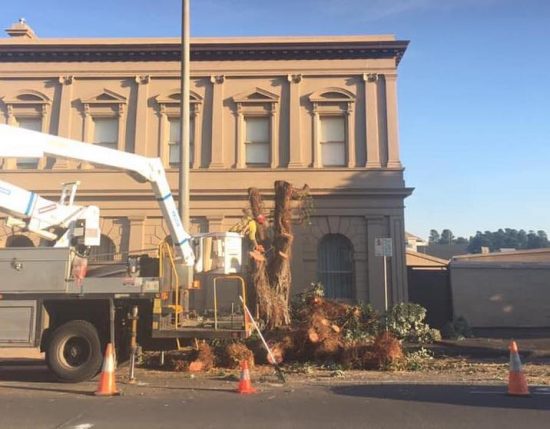
Paving paradise: an old New Zealand Christmas tree is chainsawed to make way for a new footpath in Kepler St. Image: supplied.

As we know, the council recently and reluctantly saved two 115-year-old Moreton Bay fig trees from being axed to make way for a new footpath, only to last Friday cut down an 80-plus-year-old New Zealand Christmas tree in Kepler St…to make way for a new footpath.

It did so without consultation or notification, which means its tree policy is not worth the paper it is written on.

A council spokesman told the newspaper (I didn’t get any answers to my questions on this topic) that the tree had to go because the public was baying for a high-quality roundabout at the corner of Timor and Kepler streets.

Did you hear any baying? I didn’t.

Did you see any petition with hundreds of signatures saying please build us a high-quality roundabout on Kepler St? I haven’t.

What I have heard is person after person saying please stop wasting our hard-earned ratepayer and taxpayer dollars.


What I have also heard is people saying please stop turning our CBD into an urban wasteland of cement and concrete and pavers, where trees are seen as a problem, not part of the solution.
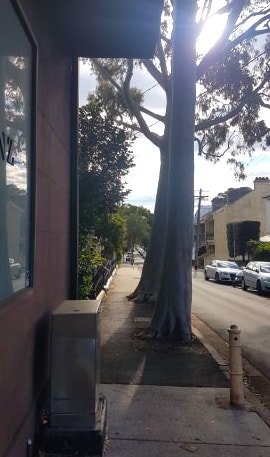
Meanwhile, in Paddington, the trees and pavement and pedestrians get along just fine. Image: supplied.

Other cities, truly cosmopolitan cities like Hobart and Sydney, value their trees.

In Hobart, they put rubber matting over the roots to protect the pavement and the tree.

In Paddington, Sydney, they let the trees grow right up through the pavement and people go around them or use the path across the street. Radical, hey?


The revitalisation of the CBD started out as a reason for celebration, but after a $3 million cost blowout and an ongoing obsession with building enormous pedestrian crossings and new roundabouts, it has turned into a financial nightmare.

We can only hope that we all wake up soon.

If you would like to support local, independent journalism, please consider making a contribution below. Thankyou to everyone who has given a tip!
Terrier Tip Jar


WCC ignores public opinion and pushes to break rate cap

The Terrier – Carol Altmann

LAST DRINKS: Tonight (25/2/19) the W’Bool City Council voted 5/2 to try and raise rates above the cap because we are apparently in deep financial do-do.

It is just three months since W’bool City Council CEO Bruce Anson retired – he spent 11 years at the helm, passing each performance review with flying colours, and earning a salary package that toward the end was close to $320,000 a year.

You earn this kind of money for a reason – to keep the ship in shape.

We are now being told we can’t afford to renew our infrastructure, basic things like bridges and footpaths. We are being told we might need to cut services, because we are ‘aspirational’ and want things like a new library and a better sports oval.

There has been so, so much waste and it has happened on Mr Anson’s watch.

Loud applause to Cr Peter Hulin and Mayor Tony Herbert for voting against this rate rise, in favour of a forensic audit of council spending and costs.

An audit is so long overdue.

I hope the Essential Services Commission – which has to approve the rate rise above the cap – sends this strong message to the council too: you can’t keep asking ratepayers for more, when you have wasted so much along the way.

The time for reckoning has come.

The Terrier is taking a closer look at how we went from budget stability to a budget emergency. It is a slog through some pretty dry data, but worth it. Stay tuned for updates.


Can W’bool break its coffee cup habit?

The environmental message is clear: we need to ditch paper cups, even recyclable ones. Image: Responsible Cafes.

By Shane Wilson*

Walk down Liebig Street from 8.30am on every weekday, and come to think of it weekends, and you will see the hastened step of the army of coffee addicts. Head down, almost caressing the plastic lid of their disposable coffee cup, infused by caffeine.

I will be clear, this piece is not about bagging out coffee lovers. That would be hypocritical, as I love my morning and lunch time coffee from my favourite café. There’s plenty of vices out there and if yours happens to be coffee, then there is no argument from this corner.

But, and I think this a big BUT, coffee drinkers are becoming an environmental scourge, the equivalent of those despicable nicotine addicts who think it is their right to flick butts on to the footpath and by stubbing it out with their foot, it will disappear.

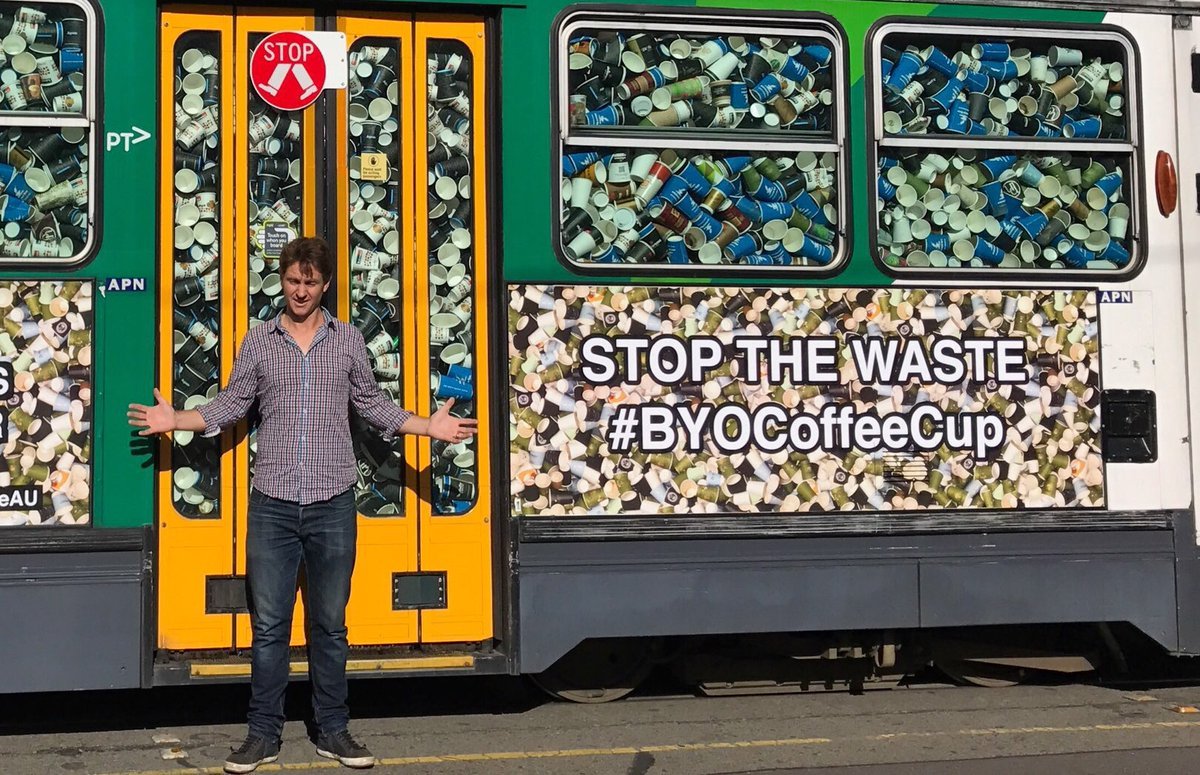
Former Chaser rascal Craig Reucassel reports in his recent ABC documentary War on Waste that it takes 50,000 coffee cups to fill a Melbourne tram. An interesting stat, but even more so when he makes the point that this is the number of coffee cups Aussies dispose of each half hour.

The cups are typically plastic lined and not bio-degradable: 50,000 every 30 minutes, one billion a year, destined for landfill.

Activist and comedian Craig Reucassel made a strong visual point by filling a Melbourne tram with the number of coffee cups thrown away every half hour in Australia. Image @craigreucassel, Twitter.

[dropcap style=”font-size: 45px; color: #8cc7d0;”] T [/dropcap]his coffee-sipping generation has been hammered in one ear about global warming and in the other about living and eating clean and green.

It’s not as if the environmental message is not being delivered. It’s just that it is not being heard. Or perhaps, Generation Now would rather promote their own immediate needs – a craving for caffeine – over a little bit of social responsibility.

But does it have to be this way.

Our town with a little good fortune (a regular, cleansing sea breeze and frequent rains) presents as a clean tidy green village.

We can build on this.

So let’s all support the push by the Leadership Great South Coast (LGSC) to completely phase out non-reusable coffee cups.

The LGSC has been urging local cafes to join the national Responsible Cafes campaign that goes further than recycling cups.

The campaign suggests, and I agree, that single-use cups be banned altogether and we bring our own, reusable cup.

If this sounds unachievable, just think for a moment on how we now all carry our own shopping bags (unless I leave them in the car!) to reduce the use of plastic bags.

As a city, we can all get behind the byo coffee cup campaign: promote it on the banners at roundabouts in the town. Bang the message out on Facebook. Talk to the schoolkids and let them know why the adults are doing this. For once, our generation can lead by example!

In our town, with leadership and meaningful discussion with our cafes, I am sure we can succeed.

The war on one-use coffee cups is going global – and Warrnambool could lead the way. Image: Beevoz

[dropcap style=”font-size: 45px; color: #8cc7d0;”] S [/dropcap]ome Warrnambool cafes, including Country Life cafe, Brightbird Espresso and Piccolo Coffee Roasters, are already taking on the environmental message by offering bio-degradable cups, selling re-usable cups and offering discounts to those who remember to bring their cup.

Warrnambool City Council is also one of the few councils which recycle coffee cups.

But recycling is not the only answer.

Unless coffee cups are disposed into recycle bins and are then appropriately recycled, it all counts for nought.

Bio-pak, which makes bio-degradable cups, state that if their cups go into landfill, they do not break down. Oxygen is required and unless the cups go into the right bins and the council ensures that the cups are correctly recycled, it’s all just more landfill.

In this day and age, with issues such as Adani’s Carmichael coal mine, the degradation of the Great Barrier Reef, and the enormity of climate change generally, people tune out.

It’s all too hard and such issues are typically outside an individual’s field of influence. On this issue, however, Warrnambool can make a difference and be an example for other towns to aspire to and in the process do good.

Yes, it’s difficult, but let’s cut to the nub of this challenge: no more single-use coffee cups in Warrnambool.

Next time you buy a coffee at your local café, take it with a teaspoon of social responsibility and I bet it will taste even better.

[author] [author_image timthumb=’on’]http://www.the-terrier.com.au/wp-content/uploads/2017/07/wilson.jpg[/author_image] [author_info]Shane Wilson is a Warrnambool solicitor, a cyclist, an activist and a coffee nut. He will write occasionally on local issues that stir discussion.[/author_info] [/author]