From serious science to one cool cat

day kitty_19
Sisters Victoria (front) and Elizabeth Carey are the smiling faces behind the wonderfully named Day Kitty cafe in the former Flaherty’s Chocolate Shop, Warrnambool.

[dropcap style=”color: #a5cecd;”] A [/dropcap]mid all the gloom of shops closing in Warrnambool, the city’s burgeoning cafe scene is stepping up to the plate to show how funky places can not only survive, but thrive.

The wonderfully named Day Kitty cafe is among the newcomers, having taken over the former – and famous – Flaherty’s Chocolate Shop building in Kepler St, right next door to the Capitol Cinema.

Since opening six months ago, the cafe with a striking black-and-white decor has carved out a niche market with its emphasis on organic that includes home-made, artisan milkshakes and icecreams, fresh-pressed juices, light meals, salads and hot drinks.

It is like a soda fountain, meets a coffee shop, meets a gourmet salad-and-juice bar – and it works.

day kitty kids
The sisters (Victoria in the middle, Elizabeth, right) were always close and have ended up working side by side after initial careers as scientists. They are pictured here with their eldest sister, Anastasia.

[dropcap style=”color: #a5cecd;”] W [/dropcap]arrnambool sisters Victoria and Elizabeth Carey are behind the venture, although Elizabeth insists she is simply “helping out” Victoria, who created the dream and has pulled all of the pieces together.

Both are former scientists who, after 10 years in their respective fields (the sisters were born two years apart), decided they wanted to do something completely different with their lives.

Victoria worked in dairying manufacturing at Murray Goulburn, in Koroit, where she gained all of the experience necessary to break out into making artisan icecreams that would use only organic ingredients.

The waffle cones, which are hand-made by Elizabeth, use the egg whites leftover from the icecream.

The cafe’s icecream and milkshake bar harks back to the hey-day of Flaherty’s, who were known not only for their extraordinary array of chocolates – particularly at Easter – but for the entire Flaherty family each taking a turn at serving icecreams and milkshakes to cinema goers.

“I knew exactly the sort of cafe I wanted to have, and I knew it had to be here, in this building,” Victoria says.

“We have had different members of the Flaherty family drop in to see how it looks, and that has been really lovely,” she adds.


day kitty_22
Victoria hand-makes all of the icecreams, using only organic ingredients, while Elizabeth makes the waffle cones using the leftover egg whites.

[dropcap style=”color: #a5cecd;”] B [/dropcap]efore joining her big sister at Day Kitty, Elizabeth specialised in the remediation of contaminated land so it is not surprising that she, too, has a strong commitment to sustainability.

“We try and recycle and reuse as much as we can. Our food scraps are composted and all of the cardboard is taken away and recycled,” she explains.

Even the cutlery and drinking straws are made from recycled bamboo – rather than plastic – although it did take a bit of trial and error to find the right straws.

“We started with some paper ones, but they fell apart before the drink was finished,” Victoria says, laughing.

Day Kitty is now “about 95 per cent organic”, according to Victoria, with a particular style of coffee bean proving to be the final, 5 per cent hurdle.

As for the name, it was chosen simply because it sounded good and is easy to remember.

“It was going to be Day Kitty-Night Owl, because we had planned to eventually open in the evening and offer cheese platters with a nice glass of wine,” Victoria says.

That may still happen, but for now the pair is happy to keep growing the business during daylight hours. The next chapter is about to unfold, with the hiring of a chef so that they can expand their lunch and breakfast menu.

“One day I would really like to also run an organic fruit and vege store, but that is a little further down the track,” Victoria says.


day kitty_26
These vintage scoops were found in secondhand stores around Warrnambool and may have even been used by Flaherty’s….who knows?

[box type=”bio”] Day Kitty, 53 Kepler St, Warrnambool is open Mon to Fri 8.30 to 5.30 and Sat 9-5. Ph: 5561 6921[/box]

[button link=”http://the-terrier.com.au/subscribe-2/” type=”icon” icon=”heart” newwindow=”yes”] Did you enjoy this story? Please subscribe here to help Bluestone thrive.[/button]

Stones Smile newsletter Read about other great cafes in our area…


A cafe that feels like coming home: Tea Tree Gallery, Portland

Timboon Railway Shed Distillery

New path leads to Lozzar’s, W’bool

The Farmer’s Wife, Port Fairy

The right place for a Good Room, W’bool

Snout in the Trough: Camperdown

Rocksalt rocks on in Port Fairy

Cafe Bagdad pops up in Penshurst


Warrnambool’s own Laverne and Shirley

shirley-bronwyn


[dropcap style=”font-size: 60px; color: #A5CECD;”] S [/dropcap]hirley Handley and Brownyn Greene are two Warrnambool friends who are rarely seen apart when it comes to spreading a little joy in people’s lives.

The pair, who met through their local church, volunteer to visit people who may be sick, lonely or just in need of some company for an afternoon, be they in hospital, in an aged care home, or in their own home.

Their cheerful, smiling personalities are infectious and it is rare day when Shirley, in particular, is not armed with a quick joke or a funny one liner.

Between them, they bring light to the lives of those who are often forgotten, isolated or finding it hard to cope with daily life, including people struggling with addictions, and they never judge, or try to change anyone: they are just there to listen.

Philosopher Alain de Botton, on his recent tour of Australia, talked about how the mainstream news media has an obsession with the wrong sort of celebrities and that ordinary people who do good, simple deeds should instead be celebrated.

So, using Alain’s approach, we celebrate Shirley and Bronwyn as our Quiet Heroes: in our eyes, they are the “Laverne and Shirley” of Warrnambool who bring much-needed good humour and fun to every day lives.

[box] Shirley and Bronwyn will receive a coffee and cake vouchers from Lozzars Lounge Cafe, in Warrnambool. Thankyou Lozzar’s for supporting our quiet heroes.[/box]


Lozzar's Logo

Stones Smile newsletter Meet more of our Quiet Heroes…


Giving voice to the Portland community: Hilary Endacott

Helping mend broken family ties: Jenny Fawcett

Lost history finds loyal following: Lost Warrnambool

Australia Day awards – did we forget someone? Vicki Jellie

Oh Possum, you’re a hero in the heat: Nalini Scarfe


We still have jumps racing? Can’t get over it

the age
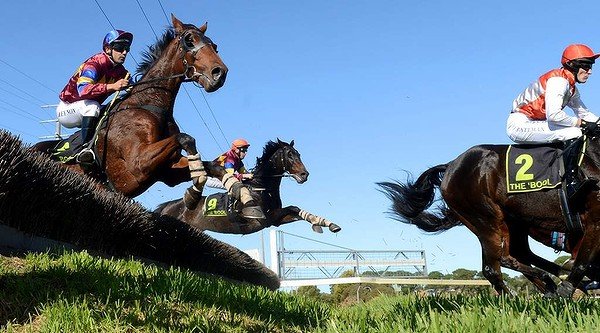
Regardless of the spectacle, the harsh reality is racehorses are continuing to die as a result of jumps racing in Victoria.  Image courtesy of The Age.

As Victoria continues to buck the trend on placing a ban on jumps racing, we ask if steeplechasing really is integral to the success of the Warrnambool May Racing Carnival.

OPINION – Carol Altmann

Here we are at that awkward time of year again in Warrnambool when the city’s biggest local sporting event – the May Racing Carnival featuring the Grand Annual Steeplechase – is also the most difficult to embrace.

For no matter how we dress it up, the reality is that jumps racing is on the nose and has been for many years.

Despite this, the powerful figures that surround the “sport” continue to tell us that horses love jumping, that the local economy would wilt without the jumps races, and that those campaigning to have jumps racing stopped are just a bunch of lefty loopies without a sense of fun.

One of the most vocal “lefty loopies” is, of course, that highly radical and subversive organisation, the RSPCA, which has an ongoing campaign against the practice on the grounds of animal cruelty.

It appears that the RSPCA is welcome to tackle battery hens, sow stalls, duck shooting, puppy farms and run the cheerful Million Paws Walk, but if it dares to go near the sanctity of the steeplechase, it is accused of being “grandstanding hypocrites,” guilty of euthanasing thousands of unwanted cats and dogs each year.

That is how the former head of the Australian Jumps Racing Association, Rodney Rae, described the RSPCA president Dr Hugh Wirth in 2011, disregarding the fact that the RSPCA is the group that mops up the sad mess left behind by irresponsible pet owners around Australia.


grand national
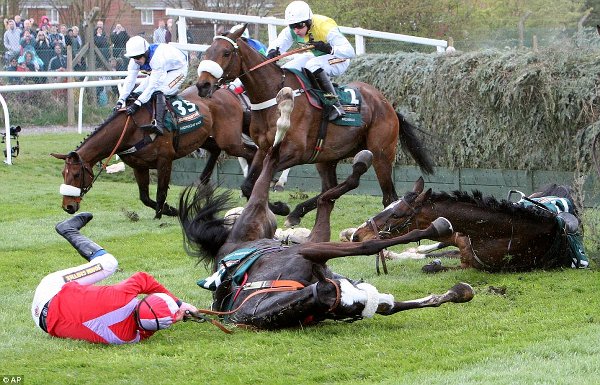
The Grand National Steeplechase in the United Kingdom remains one of the most controversial races in the world due to a high number of horse fatalities. Image courtesy of The Huffington Post.


But let’s return to jumps racing.

As most people know, this is a sport that no longer exists in any other states except for Victoria and South Australia. Jumps racing finished in Queensland more than 100 years ago. It stopped in WA in 1941 and in NSW in 1997. Tasmania joined their ranks in 2007.

A Senate committee in 1991 suggested it be phased out across Australia over a three-year period and, in 2010, this is exactly where things were headed for Victoria – until the state election prompted local MP Dr Denis Napthine to pledge $2 million to assist the racing industry if the Coalition won office.

The Coalition won and Dr Napthine, who part-owns a racehorse with local Federal MP Dan Tehan*, would be not only the Minister for Racing but also, eventually, Premier. Talk about friends in high places.

Despite the $2 million having surely being spent by now, horses still die in jumps racing.

It is a nasty, unavoidable truth of the “sport”, even if we try and disguise it behind the green curtain that is hastily erected around the broken horses before they are euthanased on the track.

According to the RSPCA, four horses died in jumps racing last year and there is no doubt that this week, many punters will be watching the three main jumps events at Warrnambool with their hearts in their mouths, hoping all the horses (and riders) make it home, while feeling a deep sense of unease that the horses are being made to perform this way in the first place.


spinthebottle
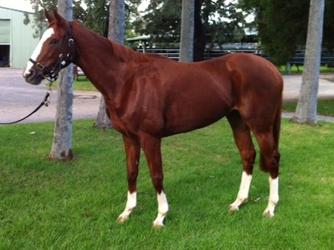
Spin the Bottle, part-owned by Premier Dr Denis Napthine and local Federal MP Dan Tehan. He is not a jumps racer.


The Warrnambool Grand Annual Steeplechase is 5.5 kilometres long – the Melbourne Cup is 2km shorter – and includes 33 jumps: the most of any steeplechase event anywhere in the world. That is a lot of running and a heck of a lot of jumping, even for a horse that “enjoys” it.

And for all of their Herculean efforts, hardly anyone remembers who wins. Can you name one winner of the Grand Annual Steeplechase? Or the Brierly Steeplechase? Or the Galleywood Hurdle?

At the end of the day, it all seems so cruel and so unnecessary, especially when such a small group of people has any significant investment in jumps racing and its immediate spoils.

The average punter, I believe, would be just as happy to go along to a three-day racing carnival at the beautiful Warrnambool racecourse and not see horses jump.

Some of the most popular – and charming – race carnivals in Victoria (think Dunkeld, Hanging Rock) attract thousands of people not because of the actual racing, but because of the atmosphere, and the chance to dress up and drink champagne for brunch.

Given the increasing awareness and activism around animal rights, especially among young people, it is only a matter of time until jumps racing is banned across Australia.

So why not cancel the jumps at Warrnambool, just for a year? Or maybe for three years, as happened during World War II when the Grand Annual Steeplechase was suspended because of more pressing matters than horse racing.

Then will we know whether the May Racing Carnival can truly stand on its own two legs, rather than relying on horses to stand on all four: despite all that is thrown at them.

*Since writing this piece, The Age has questioned the connections between Dr Napthine and Midfield Meats managing director Colin McKenna, another part-owner of Spin the Bottle.


royal ascot
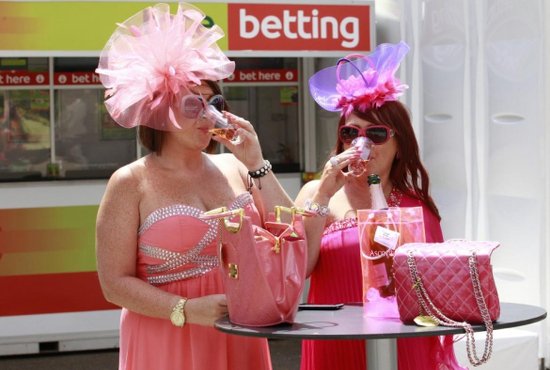
Wouldn’t punters be just as happy wearing fancy clothes and sipping champagne trackside without the need for jumps racing?


Abb, art and the immigrant journey

abb painter_8
Abb Marzouk at home in his Warranambool studio from where he still sells his sculptures. Art has remained a defining and comforting force in his life.


[dropcap style=”font-size: 60px; color: #DC943C;”] A[/dropcap]rtist Abb Marzouk represents all of the mental, physical and emotional challenges that face people who come to Australia in the hope of building a better life.

Not that 81-year-old Abb, of Warrnambool, intends to be a spokesman for the immigrant experience, far from it: he would prefer to talk about his art.

But the two cannot be separated – the art and the experience – and when Abb sits down to talk about his sculptures and paintings, he finds himself talking about growing up in Egypt, where he was an outsider, and emigrating to Australia in the 1950s, where he was even more of an outsider.

It is a painful and difficult story that pours out of him and, even after more than 50 years in Australia, Abb still struggles with finding a firm sense of identity and belonging.


abb painter_17
Abb prides himself on his highly detailed animal sculptures like this armadillo.


[dropcap style=”font-size: 60px; color: #DC943C;”] A [/dropcap]bb is a third-generation Egyptian, but he came from European ancestors who moved to Egypt when it was under colonial rule, so Egyptians of Arab descent considered his family to be Europeans.

“It didn’t matter that we had three generations born in Egypt, we were classed as European. But we weren’t considered by Europe to be European, so my family was stateless,” Abb explains.

Because of his heritage, Abb suffered constant bullying as a child, but it was as an adult, with a fine art degree under his belt and running his own tapestry design business, that the ground shifted under him.

The Egyptian revolution in 1952 saw Egypt shift from a monarchy to a republic and Abb’s status as an “outsider” was confirmed as the new government introduced crippling new laws that froze bank accounts and made it almost impossible for “Europeans” like Abb to make a living.

“I had a visa to go to America, but the Ku Klux Klan was on the rise there and I didn’t want to go to such a racist country. I decided to try Australia instead,” Abb said.


abb painter_11
Althought he has lived in Australia for more than 50 years, Abb’s Egyptian roots continue to provide inspiration for his sculptural work.


[dropcap style=”font-size: 60px; color: #DC943C;”] I [/dropcap]t took more than two years to secure an Australian visa, but Abb and his wife Sylvia arrived in Sydney with hopes of Abb using his fine art degree to teach, as his immigration officer had suggested.

Instead, he found himself in a country that was openly hostile to “wogs” and the only jobs he could find were cleaning and labouring.

“I would cry all the time. The discrimination was terrible. I wrote 63 letters trying to get work and there was nothing, so I took whatever I could just to make money,” Abb said.

It wasn’t until many years later that Abb, who has two sons, finally secured a teaching position as an art teacher, but the subtle and not-so-subtle discrimination and bullying continued. An angry jibe by a colleague about Abb being paid more than he finally sent him over the edge.

“I had a complete breakdown. I had to leave the education department after 25 years, without my super, without any of those things,” he said.

“It took me four years to come out of that depression and I still suffer from depression occasionally now.”

Abb never worked again, but found solace in his art. His intricate animal sculptures are exquisite, as are his mosaics. And in 2011, he was awarded the Warrnambool Art Society’s Judith Watson Trophy for best painting, for a Truck Full of Refugees.

The painting depicts a group of African refugees fleeing with whatever possessions they can carry.

On first glance, they look like a mound of rubbish, but on closer inspection, their faces emerge: staring out into an unknown future with a heart full of hope. And that, of course, is the message.

abb painter_33
Truck full of Refugees: the painting that took out the top prize in 2011 at the Warrnambool Artists Society annual exhibition.

[box type=”bio”] If you are interested in visiting Abb’s studio, please contact him on (03) 5561 2131.[/box]


newsletter Why Not Stones You may also enjoy… 


No shying away from social commentary: Megan Cheyne 

Smooth lines inspired by the ocean: Damian McDonald

Broken link prompts a fresh start: Jenny Altmann

The quiet contemplation of still life: Jan Allan

Art springs from the heart of Seaview: Heather Wood 


Where is Alf Altmann’s kayak now?

alf boat
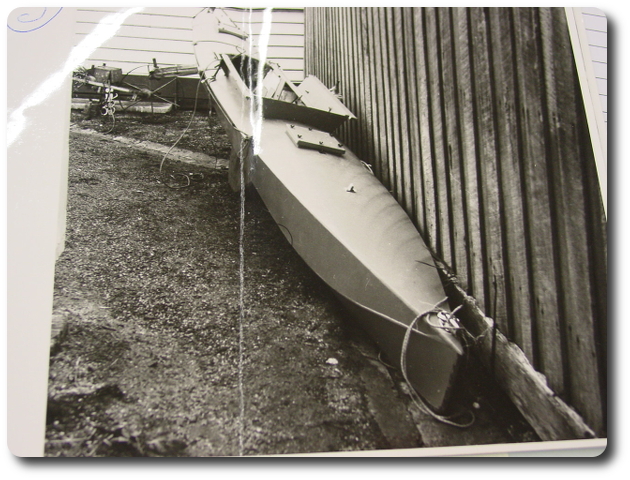
Alf Altmann’s kayak shortly after it was retrieved from the sea on March 6, 1970, following his fateful attempt to cross Bass Strait. The kayak was in pristine condition, proving Alf’s theory that it was unsinkable.

By Carol Altmann

In revisiting Alf Altmann’s fateful effort to cross Bass Strait solo in his home-made kayak, one question inevitably arose: where is the boat now?

After Alf’s death, it is understood that the kayak was stored first at the Warrnambool Ski Club and later at Alf’s brother’s property in Warrnambool before Alf’s widow, Isobel, offered it to the new Flagstaff Hill Maritime Village (it opened in 1974).

Unfortunately, however, the kayak at that time was not considered historic enough for inclusion in the museum: after all, it had only been a few years since the Bass Strait crossing attempt.

Instead, the kayak apparently ended up on display at the now defunct Lancaster’s marine, on Raglan Parade, before being donated to the Warrnambool City Council in the early 1980s, where it was stored at the council depot.

And that was pretty much the last anybody heard or saw of it…until now.

alf altmann_42
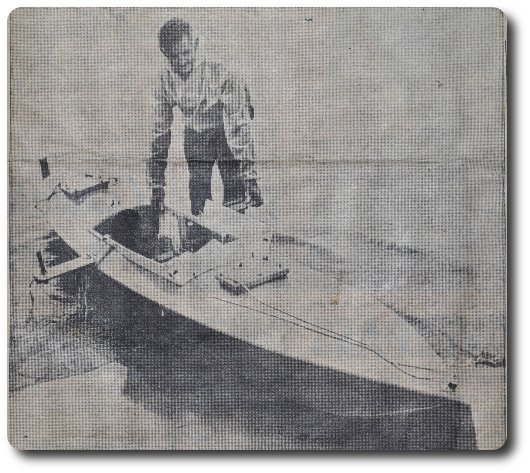
Alf Altmann during a test run with his home-made kayak, prior to setting off from Tasmania on February 25, 1970.


After being contacted by Bluestone, the WCC’s communications manager, Nick Higgins, established that the kayak was no longer at the depot and may have been donated to the Warrnambool Triton Woodworkers club, housed in the old Fletcher Jones factory.

Bluestone called Triton club secretary Louis Seater, who used the opportunity of a club afternoon tea to spread the word and see if any members knew the whereabouts of the kayak. Despite his enthusiastic efforts, nobody did.

Just as the trail was about to run cold, Nick Higgins popped up again – not only with news, but a grainy photo of what looked like the kayak in storage at Flagstaff Hill.

And it was.

alf kayak_1
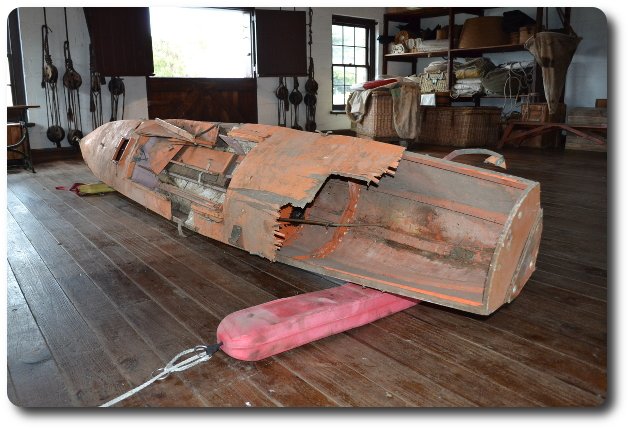
Showing the ravages of time: Alf Altmann’s kayak as it is today.

Flagstaff Hill manager Peter Abbott kindly organised for the kayak to be taken out of storage for us to confirm its heritage and to photograph it. Peter believes the kayak has been with the museum for at least the past 22 years, mainly for safekeeping, but that not a lot was known about its history.

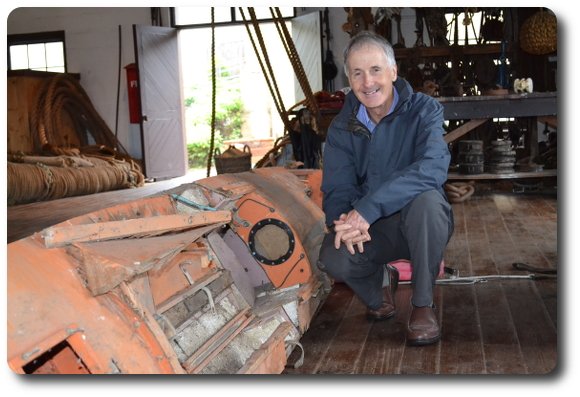
Alf’s second youngest son, Alan, joined us to see the kayak for the first time in at least 30 years and even though there are no immediate plans to put it on display (due to space), he was thrilled to know that at least something of his father’s kayak remained.

The boat is in poor condition, probably due to being moved so much in those early days, with some pieces missing and others falling apart, but it remains a very visual and emotional reminder of Alf’s extraordinary journey.

Perhaps the 50th anniversary of Alf’s voyage –  in 2020 – would be the perfect time to again reveal the “unsinkable” kayak and its story to the public.

For now, however, it is wonderful to know that what remains of the kayak is in safe hands.

alf kayak_6
Alan Altmann with his father’s kayak that he had not seen for more than 30 years before it was traced to a store room in Flagstaff Hill Maritime Museum.