Racing offers $267k sweetener for early access to Levy’s Beach
Warrnambool Racing Club has offered a nice little sweetener to the Warrnambool City Council as part of discussions to get racehorses back on Levy’s Beach by December. Image: Love Backyards.
By Carol Altmann
There is an update to this story: the council is now seeking $400k from the WRC for the carpark in exchange for approval to run horses on Levy’s and Lady Bay. It is now listed for a decision at next Monday’s council meeting (1/10/18). You can read the full documents from page 335 onward here.
——
The W’bool Racing Club is offering the W’bool City Council a big lump of sugar as part of its push to have racehorses back at Levy’s Beach by December: a $267,000 “bespoke” carpark at Lady Bay, no less.
Under a proposal put forward by the WRC, it will pay for a $267,000 upgrade to build the “bespoke” carpark at the Lady Bay breakwater, next to the existing carpark at the Pavilion cafe, specifically for use by horse trainers.
A specialist horse training carpark with proper wash-down facilities was part of the masterplan prepared for the breakwater.
It is understood the WRC hopes the State Government will chip in at least some of the $267,000 for the carpark but, if not, the racing industry will fund the carpark anyway.
The sweetener comes as the WRC seeks to have some horse training back on to Levy’s Beach in time for the all-important Spring racing carnival that includes the Melbourne Cup on November 6.
A temporary training arrangement at Levy’s Beach ended on September 14, pending the full implementation of the new Belfast Coastal Reserve Management Plan.
Under the controversial management plan, up to 120 racehorses a day will be allowed to train on the beach and up to 40 a day in the dunes.
The new, temporary arrangement, however, would allow up to 6o horses a day on Levy’s Beach and 40 a day in the dunes between now and December.
For the arrangement to go ahead, the WRC must get the approval of council, Parks Victoria and the Dept of Environment, Land, Water and Planning.
As such, gaining the Warrnambool City Council’s approval is an important step.
Another part of the deal is a reduction in the number of racehorses training on Lady Bay beach.
As the council knows, people are less enthusiastic about the damage done to the foreshore from hundreds of hooves, than they are about watching the horses swimming.
Under the new proposal, the number of horses along Lady Bay beach would be almost halved – from a maximum of 96 to 50 per day – and up to 116 per day swimming, with a combined total of no more than 116 horses either on sand or in the water.
The council is expected to make a decision on all of the proposals shortly, but given its previous support (the vote was 6/1) for racehorses training at Levy’s Beach, it is unlikely to turn such a deal down.
If you would like to keep seeing more pieces like this about local issues, please consider making a small contribution below.
Milking it: how Crs Neoh and Gaston can be councillors AND wanna-be MPs
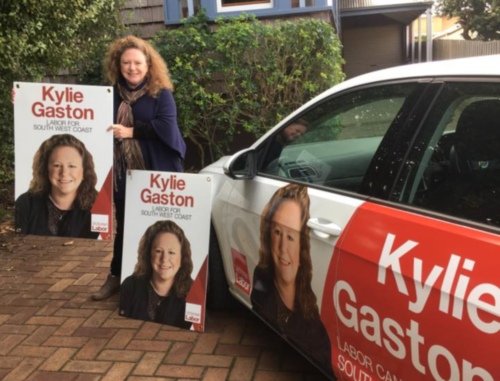
Former Warrnambool mayor, Warrnambool City Council and ALP candidate Kylie Gaston in full campaign mode. Image: Kylie Gaston ALP for South West Facebook page.
By Carol Altmann
Here is a legal loophole that is so big, you could drive a truck through it: you can be a local councillor AND run for parliament at the same time.
That is, of course, unless your council draws up a policy that says you can’t.
The Warrnambool City Council has no such policy.
This is why former Warrnambool mayor Kylie Gaston could announce way back in May that she was running for Labor at the next state election on November 24 which, at that time, was still six whole months away.
And it is why former Warrnambool mayor Michael Neoh could announce this week that he will run as an LiberalNational Independent at the same election, which is still two months away.
Neither he nor Cr Gaston have to step aside.
In fact, technically, they don’t have to step aside until nominations for the state election close on November 8. (Independent nominations close on November 9, so Cr Neoh gets an extra day).
That is another six weeks away.
Having attempted Liberal preselection in 2015, then running as a National candidate, Cr Michael Neoh is now running as an independent in the 2018 state election.
The current Local Government Act allows this, largely because it still hasn’t caught up with the modern way of doing things, where loads of wanna-be MPs are launching their political careers via the grassroots of local councils.
There is nothing wrong with a person running for local council with a view to bigger things – that’s called ambition – but there is a massive conflict of interest when you decide to run for a state election and hold on to your council spot.
When are you speaking to the media as a councillor? When are you speaking as a candidate? Do the public spot the difference? (I doubt it).
And how can your council profile, all of the free publicity and the behind-the-scenes-access to council business not be anything but a massive boost in an election campaign?
Michael Neoh has been in this territory before, back in 2015, when he ran as an IndependentLiberal National candidate while still Mayor of Warrnambool.
The council didn’t ask him to step aside, so he didn’t.
Here is what Cr Neoh said to me in an email at the time:
“I have a campaign car that I use and also non-council equipment.
I am following the MAV policy in regards to taking leave of absence and I do not use mayoral invited functions to campaign.
If I meet with stakeholders outside of Council duties and as a candidate, I make it very clear that I am an election candidate and are not representing council.”
Having seen Cr Neoh get away with it, Cr Gaston has since been following the same map, with her Labor-Party-emblazoned car parked in the WCC carpark while she performs, as Cr Neoh did in 2015, her council duties.
Again, neither Cr Gaston nor Cr Neoh are breaking any rules or laws, they are simply doing what they are allowed to get away with.
Like any savvy politician, they are milking every opportunity to maintain their public profiles, and the council is a perfect platform.
The Victorian Local Government Association is on to this.
It put out eight guidelines for councils, asking that they develop their own rules to manage councillors who run for state or federal parliament.
The guideline that nails it is this: “The taking of leave of absence immediately after nominating as a candidate until the conclusion of the election campaign”.
Simple, huh?
Don’t expect the councillors themselves to suggest the Warrnambool City Council write such a policy. Two of our seven already benefit from not having such a thing in place.
It is up to ratepayers – again – to say this is not good enough, that we are not interested in subsidising councillors’ political aspirations and that we want their mind firmly on the job of running our council, not how they can move on from it.
If you would like to support local, independent journalism, please consider making a contribution below. Thankyou to all of you who have already done so.
Is W’bool City Council a bloated boys’ club? The sums say yes.
Despite rate capping and a growing staff salary bill, life at the top of the Warrnambool City Council remains lucrative.
By Carol Altmann
Some time ago, a young Warrnambool lawyer who likes to crunch the numbers told me that our council was big, fat and bloated with an unsustainable salary bill for a city this size.
More recently, there has been a steady stream of people, all women, contacting me to say the council had turned into a dispiriting boys’ club, despite more women on the ground.
Having taken a closer look, I believe they are both right.
Let’s start with the bloat.
There are 731 people working at Warrnambool City Council (full time, part time and casual) and last financial year the cost to ratepayers was $31.5 million.
At the same time, the council collected $31.05 million in rates (not counting the $4.7 million waste management fee, which goes directly to providing a garbage service).
Look closely at those two figures again and you will see that every single dollar collected in rates – $31.05 million – is equivalent to the amount needed to cover the cost of the staffing bill of $31.5 million.
This financial year, the gap will widen.
WCC staff costs will jump by another couple of million to $33.2 million and rates, meanwhile, will bring in $31.97 million, which would actually notcover the bill.
With a cap on rates, something needs to give, and perhaps the first place to look is in the upper deck, where the salary packages are lucrative compared to those working at the grassroots.
According to figures given by the council to a parliamentary inquiry into rate capping, in 2016 the council had 21 senior officers each earning a total salary package of more than $120,000 a year – that equates to more than $2300 a week (before tax and including super, etc).
This figure, by the way, doesn’t include the CEO, Bruce Anson, who has a package currently between $310,000 – $320,000.
When I asked the council if it still had 21 senior officers earning a total salary package of more than $120,000 a year, it was hard to get a straight answer.
Instead, it provided a convoluted response about the intricacies of the Local Government Act and a list that shows only seven senior council staff now earn a package of more than $130,000 a year, including the CEO and someone who does not report directly to the CEO, but who earns a sweet package of $145,000. (Who could that be?)
I am not sure where the other 15 staff have disappeared to, but I suspect they are still earning more than $120,000, and I suspect they are among the 22 senior people listed in the council’s “organisational structure” on its website, although I don’t know this for sure.
I can confidently say, however, that the vast majority of these big earners are not women, which brings us to the second point about the council becoming a boys’ club.
Leaving aside broader and worrying allegations that I have been receiving about how the boys’ club operates – I will save that for another day – I am going to focus simply on the numbers.
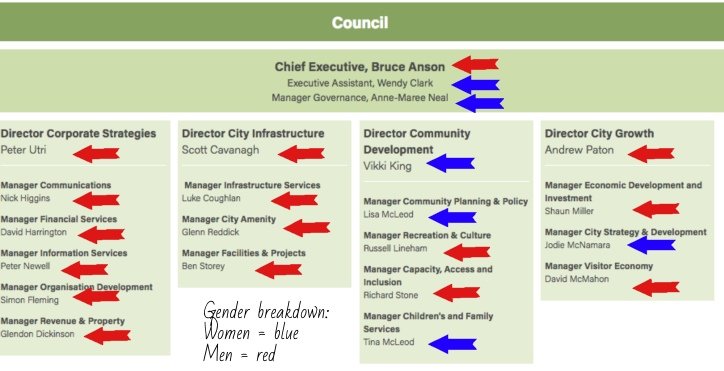
Check out the chart below:
As you can see, there are only six women in the council upper ranks, and only one, Community Development head Vikki King, holds a director position.
Two departments – Corporate Strategies and City Infrastructure – don’t have any senior women at all and City Growth has just one.
But wait, the council will say, we have more women than men on staff, which is absolutely true. There are 497 women, but only 227 full-time equivalent (45%), which means the majority are casual and part-time.
By contrast, there are 234 men, of which 163.8 are full-time equivalent – this is 70%.
As we all know by now, just having women around doesn’t make a place gender equal.
What really matters is what the women do, the positions they hold, and the influence they can wield (just ask the Federal Liberal Party) and, on this score, our council is seriously lacking.
If you are interested in transparency within government, visit The Guardian’s new The Transparency Project, which is exactly what journalism used to be about and can continue to be, thanks to donations, crowdfunding and partnerships rather than paywalls.
If you would like to support local, independent journalism, please consider making a contribution below. Thankyou to all of you who have already done so.
WCC leasing deals: a wall of silence…and a shiny new shed
The council-owned residence at the Archie Graham Centre is part of a former bank building.
By Carol Altmann
The Warrnambool City Council has pulled down the shutters on its leasing rules that have allowed a senior staff member to rent a council-owned apartment for more than 30 years.
It is two weeks since the story broke about a senior staff member renting a central apartment at the Archie Graham Centre for 31 years (@ $190 per week) and another staff member renting a beachside house for 14 years (@ $221 per week), with no end date for either lease.
Despite an enormous response to the story from people wanting to know more, the person in charge of such things, Revenue and Property Manager Glendon Dickinson, has declined to be interviewed.
A whole series of questions I sent to both him and the WCC media manager, Nick Higgins, have been left hanging.
These questions include basic things like who sets the rent? How often is the lease renewed? How were the tenants selected? How is the rent paid? Does the rent include utility bills?
After several days, the only comment forthcoming was this:
“Our leases are guided by State legislation including the Residential Tenancies Act.”
Do you find that answer satisfying? I find it insulting: not to me, but to all WCC ratepayers, who actually own these buildings.
The public service has very different rules around transparency, compared to a private company, but what we are seeing at WCC is not transparency, but secrecy.
One thing that is impossible for the WCC to ignore, however, is the new garage and sealed driveway that has appeared behind the apartment in question at the Archie Graham complex and has cost ratepayers $43,000.
The single garage was built by council to replace a dilapidated three-bay garage (two bays of which were used to store council junk) that was demolished to make way for new works at Heatherlie homes.
I understand the single garage was budgeted at $12,000. The project came in “around” $43,000.
Mr Higgins said the final cost included the garage ($11,638), rebuilding a collapsed retaining wall, restoring a garden bed and “the sealing of a previously gravel laneway”.
This laneway, which is the expensive part, is not used by Archie Graham clients, but, according to Mr Higgins, only “used by neighbouring tenants and the residential tenant at Archie Graham”.
The $43,ooo was pulled from the capital works budget for the Archie Graham Centre, the managers of which must be either scratching their heads, or beating it against a wall, at such an expense.
In explaining the cost, Mr Higgins said the council had received more rent from the “flat” over the years than it had spent on maintaining it.
You would hope so.
The rental income from the “flat” had also helped subsidise the maintenance of Archie Graham, he said.
Again, you would hope so. Paying rent, after all, is part of the deal when leasing a property.
But both of these things, really, are beside the point.
The point is that we still don’t know the full details of this lease agreement and how it came about.
The WCC – unlike dozens of councils I have looked at – does not have a property leasing policy which is designed to keep things transparent.
The only way WCC ratepayers would know these leases exist is to visit the council offices and ask for a physical document that very few people know is there.
So why does any of this matter? What is the public interest?
Well, first, the properties are owned by Warrnambool ratepayers. They are the “landlords” here and I think they deserve to know what is going on.
Second, these two leases are unlike any of the WCC’s other residential leases. Every other WCC residential lease either provides public housing for disadvantaged tenants, or short-term accommodation for new staff.
Thirdly, the leases are not part of a salary package and are not required as part of a job description, such as a caretaker at a caravan park.
So, combining all of these factors, the crux of this issue is twofold:
How did two council staff, out of more than 350 staff, manage to secure leases in prime-location, council-owned and maintained houses, that have lasted for decades?
Do these arrangements breach the Local Government Act?
I still don’t know the answer to #1 and I may never know.
But I do know that under the Local Government Act, if a council lease is to be for more than 10 years, the details must be publicly advertised. This is to allow people to a) know about it and b) have a say.
So how does an ongoing lease of 30-plus years slip under the radar?
Simple.
Break the lease into, say, five year lots – and keep renewing that lease each time. Presto, you have a lease that stretches for decades, with very few people knowing about it, and nobody having a say.
Something doesn’t add up here and until it does, we need to keep asking the questions, no matter how uncomfortable. And this is what I plan to do.
If you would like to support local investigative journalism, please make a small contribution below.
Lifting the lid on 30-year-rent deal for WCC staff member
The Timor St building that is owned by Warrnambool City Council and includes a subsidised apartment that has been occupied by a senior council staff member for more than 30 years.
By Carol Altmann
Did you know that a senior member of Warrnambool City Council staff has lived in a subsidised, council-owned apartment in a prime location for more than 30 years?
I didn’t believe it, but it is true.
The council lease register confirms that the same staff member has rented the top floor of a prime property at 130 Timor St since 1987.
The grand old bank building is part of the Archie Graham complex owned by the council and is a two-minute walk from the council offices.
According to the council’s lease register, the current annual rent being charged on 130 Timor St is just $9900, or $190 a week, which is low for Warrnambool.
I had a quick look at realestate.com.au and the rent for a decent two-bedroom property in Warrnambool is usually at least $250 and that is for a place in the suburbs.
According to the WCC enterprise agreement, the salary for this staff member is estimated to be somewhere between $76,000 and $83,000 plus super.
Strangely, the lease between the council and the tenant is also classed as “on-going”, which means it has no renewal or end date.
What the….?
And for the past 31 years since the lease began, the council – meaning ratepayers – has paid for maintenance, repairs and other improvements to the property.
What the…?
The senior staff member is one of two council staff members on a long-term residential lease, although the 31-year-lease is by far the longest tenancy.
The former caretaker’s residence at the Warrnambool foreshore that has also been under a long-term, on-going lease.
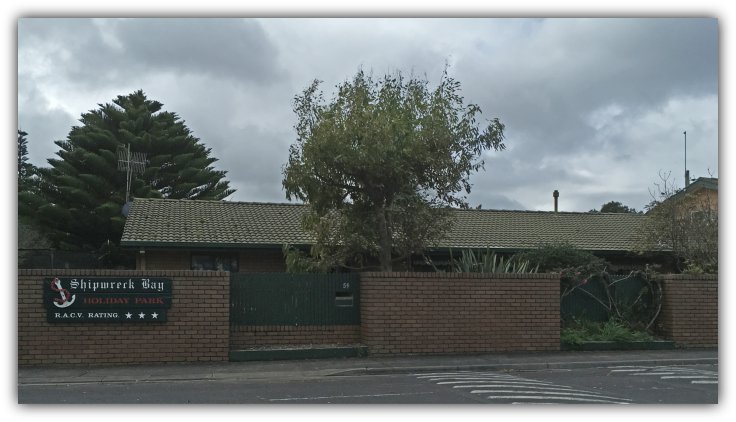
The second property operating under a similar, on-going lease to a WCC staff member is the former caretaker’s house within the Shipwreck Bay caravan park at Pertobe Rd.
This foreshore property has been leased by the staff member for the past 14 years.
The current annual rent on that property, however, is closer to market rates at $11,532, or $221 a week.
Having spent a lot of time looking at what other councils do around property rentals, I can tell you that these two residential leases are highly unusual.
I have to stress at this point that I would not normally write about the affairs of a private tenant, but in this case the tenants are public servants, leasing publicly owned houses and the lease arrangements are therefore of public interest. This is why councils have to keep a lease register in the first place, even if very few people look at it. Despite this, I have chosen not to name the individuals involved. Both were contacted for comment, but declined.
I also need to be clear that many councils, including Warrnambool, own a number of houses that are made available to people who can’t afford the rental market or who are vulnerable, like the elderly.
It is also quite normal for a council to offer short-term housing to new staff who have relocated from elsewhere.
Council-owned houses in Koroit St and the Warrnambool Botanic Gardens are used for this purpose.
Some councils, like Moyne Shire, also offer a house as part of the salary package for specific jobs such as caretakers of caravan parks who need to, obviously, live onsite.
That is all absolutely normal and – usually – transparent. (I was able to get a copy of the salary package for the caretaker position at Gardens Caravan Park in Port Fairy via one call to Moyne Shire.)
But what is happening here with Timor St and Pertobe Rd is highly unusual.
So what is going on and who is making the decisions?
I think ratepayers deserve to know who sets up such lease agreements, are they part of a salary package, who sets the rents and how often they are reviewed, does the rent include power and water, and are other people ever given the chance to apply for the same property?
Most councils have some form of property leasing policy that could help answer most of these questions.
The WCC doesn’t have such a policy, or not one that they could produce.
So, I asked WCC media manager Nick Higgins for answers.
Who sets the rents?
“Rents for Council properties are set at market rates based on independent valuations,” Mr Higgins wrote in an email.
These “rental values are reviewed annually as part of Budget preparations”, he added.
Yes, but who makes the final decision? A panel? The CEO Bruce Anson? Another senior officer? The councillors?
And where does the “independent valuation” come from?
“…a private company,” Mr Higgins wrote.
Which private company, I asked?
No answer.
Okay, what about the leases? Who writes and renews the leases? And are these renewed leases advertised, as per the Local Government Act?
“Leases are renewed where there is agreement between Council and tenants,” Mr Higgins wrote.
Really? The tenant and council can agree to just keep renewing a lease on a prime CBD property for 30-plus years?
Wow, that is some deal if you can get it.
I pressed on and asked Mr Higgins, in a nutshell, if this sort of “ongoing” lease ever actually expired.
“A fair landlord does not evict tenants or fail to renew leases if the tenants have acted in accordance with a lease agreement,” he replied.
So if a residential tenant sticks to the initial lease agreement with the WCC, they can pretty much stay on forever, it seems.
“Can you send me a copy of the lease agreement,” I asked Mr Higgins by return email.
“And, again, can I ask the name of the private company that reviews the rents in accordance with market values. I am not sure why the name of the company is being withheld.”
The response is below:
Hello Carol,
We have nothing further to add.
Regards,
Nick
Well, in my humble view, there is plenty further to add and that process starts with a Freedom of Information application for the lease agreements.
Thanks to those people who have donated to help keep these investigative stories coming, I lodged that FOI application yesterday.
I think this story is only beginning.
If you would like to support local investigative journalism, please make a small contribution below.