Power shutdowns allow long-overdue work on shop tops
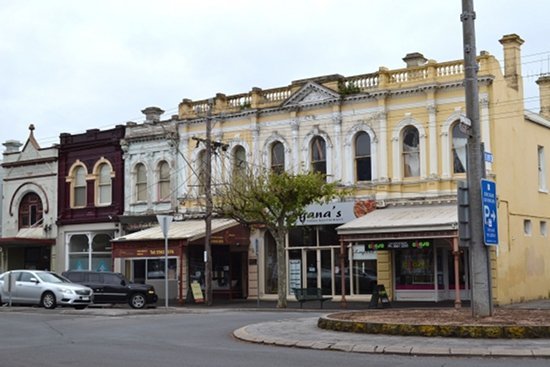
File photo: some of the dilapidated shop tops along central Timor St, Warrnambool.
Carol Altmann – The Terrier
JUST IN: A couple of weeks ago I called Powercor to see whether plans were still going ahead to briefly turn off power lines along central Timor St which would allow long overdue painting works on some of the most magnificent shop tops in Warrnambool.
The good news is that – YES! – it is still going ahead and a series of brief power shut downs will start as of tomorrow, 31 March, and extend on and off over the next 90 days.
This means property owners along the stretch between Kepler and Liebig St can finally get painters up there safely, without them risking a tight perm or far worse, and paint around the power connection points to each building.
With the help of the Warrnambool City Council, property owners can apply for $ for $ funding up to $3000 to help cover the cost of the works which – in my humble view – will transform the street.
It’s been a feat of logistics to get this all organised since it was announced by former Mayor Tony Herbert mid last year, but Powercor, the WCC and property owners have now come up with a workable solution.
Let’s hope all of the property owners grab this golden opportunity.
In a statement today, Powercor Major Client Manager Richard Scholten said Powercor knew “how important this restoration work is for shop owners in Timor Street, so we are pleased that we have been able to support this facelift to be completed safely.
“The final solution is one that not only achieves the desired restoration of each building, but does so in a way that keeps power on for these businesses and the surrounding community.”
Mayor Vicki Jellie said the plan resolved what was a major obstacle for shop owners:
“We know that many have been wanting to carry out maintenance on their buildings and this collaboration with Powercor removes the obstacle that prevented this from happening,” Cr Jellie said.
“Importantly, pedestrian access to businesses will be maintained while the work is carried out.”
You can read the full Powercor media statement here: https://www.powercor.com.au/news/media-release-power-works-help-restore-warrnambool-shop-facades/
Harbour plan needs cool heads and caution: Peter Ronald
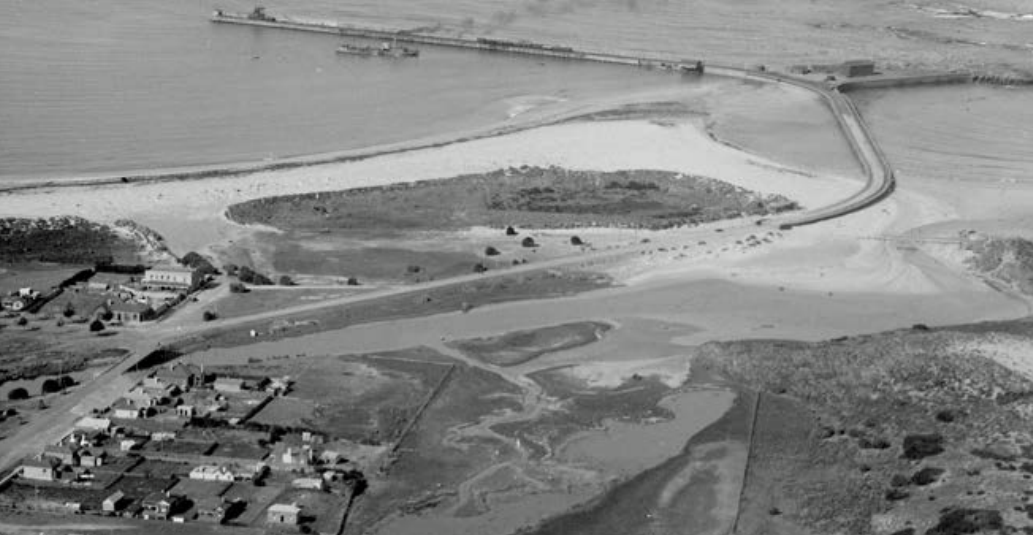
Lady Bay and the mouth of the Merri River, circa 1920s, when the viaduct was open between Stingray Bay and Lady Bay. Image: Lost Warrnambool/State Library.
Terrier guest writer – Peter Ronald*
The future of Warrnambool’s harbour has attracted growing interest recently and that is good to see, but it’s important that raw enthusiasm does not drown out sound judgement.
Good decision making on the harbours’s future will depend upon cool heads, questioning popular assumptions, and proceeding with great caution.
In the historical context, Lady Bay was never a great location for a port. The fact that European settlement occurred first in Portland, followed by Port Fairy then Warrnambool, is not accidental.
That chronology simply follows the relative suitability of each location as a serviceable port.
The lack of depth and associated siltation problems of Lady Bay were observed in the earliest days (well before the breakwater was constructed) and dredging was always going to be a necessary function. A greater limitation though, was/is Warrnambool’s exposure to the extremes of the Southern ocean.
Conditions beyond the breakwater can be, and frequently are, simply horrendous for boating.
In the days of coastal steamers, Warrnambool’s Harbour Master had the authority to close the port to all shipping movements, not because of conditions within the harbour, but because conditions across the open-ocean approach were too dangerous.
In spite of these things, it should be remembered that the breakwater has actually served its purpose.
The huge tonnage of cargo through the port was only possible through the construction of the breakwater and through the essential dredging within its lee. Nothing has changed. The depth and location of the entrance channel remain the same, sea conditions have the same degree of variability, the breakwater stands as it always has.
The key variable at play in the functionality of the port has been the extent and frequency of dredging.
The late Tom Wicking used to joke that when the old steam dredge would to go well out to sea to dump its spoil, the sand would make it back in before the dredge did!
A humorous exaggeration of course, but it served to emphasise the ongoing need for maintenance dredging. Maintenance is the operative word; the port continued to serve the needs of quite large ships for as long as the maintenance dredging was carried out.
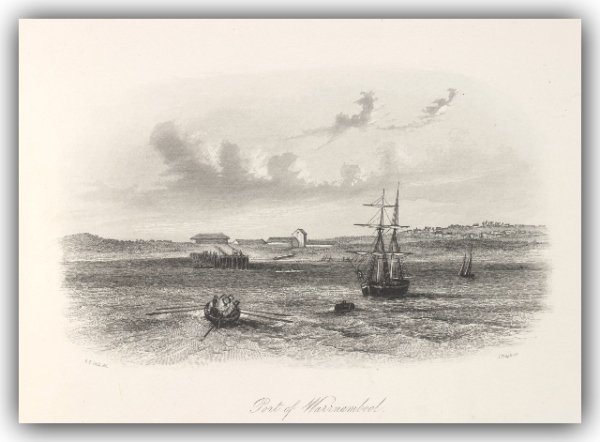
Port of Warrnambool, engraved picture by J. Tingle. Published by Sands & Kenny 1857. Image via State Library Victoria.
Just as we paint houses and mow lawns, we don’t shy away from these tasks just because they will need to be done again. The key point is this; no matter what level of port infrastructure we might like to add or subtract from Lady Bay, some level of maintenance dredging will still be needed.
As the late Edmund Gill explained; turbulent water carries sand and silt, but when that water is calmed the “cargo” is simply dropped. This truth is unalterable.
The primary interest in the port these days is for recreational boating via the boat ramp. I have about 50 years practical experience in boat launch and retrieval from Lady Bay and I refute the claim that the existing launch facility is unacceptably dangerous.
I have successfully launched a wide variety of craft over the years and never encountered a problem that was not of my own making. I have no doubt that the inexperienced, the bold and the stupid, will encounter difficulties!
This is particularly true when trying to launch in unsuitable conditions (as the inexperienced the bold and the stupid are prone to do). Given the frequently dangerous conditions beyond the breakwater, the key to safe seamanship around Lady Bay is simply knowing when to stay at home. It is not just a matter of inconvenience, the dangers are very real.
No other boat ramp facility in Victoria offers such immediate access to life threatening conditions. The total loss of life (drownings) within a 2km radius of the breakwater is probably unequalled anywhere in Australia.
In poor sea conditions it is true that the existing launch facilities are very difficult and risky. I would argue however, that this actually protects people from themselves.
The creation of an all-weather launch facility in Lady Bay would inevitably result in loss of life, simply by enabling people to put to sea when they shouldn’t.
This should not be interpreted as an argument to do nothing, but rather to illustrate the importance of fully exploring the consequences of any action.
There seems to be a popular view that, if only the launching and harbour facilities were improved, Warrnambool would become some sort of mecca for recreational (and even commercial) fishers. This is frankly a pipe dream.
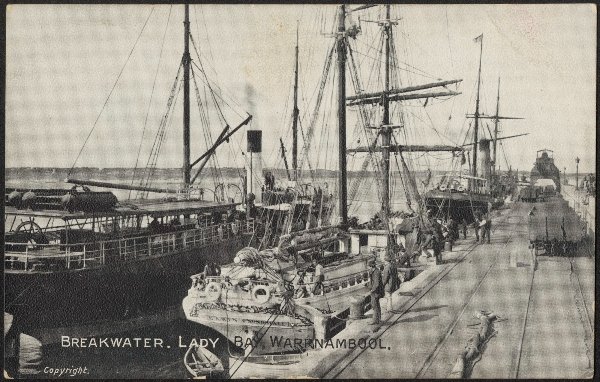
The Warrnambool breakwater in its heyday, circa 1907, when tall ships and steamers would frequent the port. Image: State Library Victoria.
Warrnambool’s true limitation in this regard remains the exposure to the elements beyond the breakwater, not inside it.
Given the comparatively tranquil waters in the lee at Portland and Port Fairy, Warrnambool will never be as attractive to recreational fishers as these other locations, no matter what launch facilities are on offer.
It is true that there is a large group of itinerant anglers eager to access blue fin tuna if and when that species comes within reach. It is also true, that a massive infrastructure overhaul of Lady Bay might just induce some of these anglers too choose to launch at Warrnambool. The question is at what cost?
Not just the budget necessary to completely overhaul our port, but also the cost to the people of Warrnambool through, for example, the aesthetic change that a fully enclosed harbour might bring, not to mention the potential of further traffic congestion and parking overflow.
Given the uncertain hope of attracting some short term visitors to spend a few days of the year in Warrnambool chasing tuna, the true cost/benefit of that endeavour requires some VERY close scrutiny.
Concerns have been expressed about the potential loss of our Lady Bay and its beaches through recent erosion and sand movement.
Certainly there are climate change considerations to be alert to, but it would be unwise to jump to conclusions just based on recent storm events. There are two things of note from the historical record.
Firstly, as previously mentioned, the navigational channel (found by aligning the two lighthouses at Flagstaff Hill) has remained unchanged in both depth and location since the 1840s. This confirms that whatever is occurring inside the breakwater and around the perimeter of the bay is having no impact on the vast bulk of Lady Bay.
Secondly, the beach shoreline has changed over the past 180 years through a cycle of erosion and deposition. Again however, from the historical record, we can see that the cumulative result has been a very substantial net gain.
The most recent erosion is exposing some interesting dating evidence; aluminium beer cans deep in the cut for example. This identifies very recent deposition of sand and dune formation.
No, we are not in imminent danger of losing our precious beach and no-one should panic, yet.
So, where to from here? Like everyone else, I have some ideas, but I don’t pretend to know the answers.
At a minimum, the ramps and associated boating facilities should be maintained, refined, and modernised where appropriate. The new fish cleaning station is a good example of what can and should be done.
In relation to dredging, surely there is room for some creative thought. A market for the dredged material, or even just a practical use for it, could help the cost benefit analysis considerably. Using the breakwater as the platform for dredging operations can significantly reduce costs and down time.
This was actually trialed once but the limitation was the reach of the equipment used. Perhaps some thinking outside the square might find some solutions to that.
If there is a problem of siltation in the immediate vicinity of the ramps, this could be easily dealt by prop blasting (using a boats propellor as an underwater “leaf blower”). It is a very simple technique and has been successfully used in maritime archaeology and harbour maintenance for decades.
The technique is sometimes overlooked because of its simplicity but it works a treat; the bigger the boat(s) the more sand can be shifted, and very quickly.
In the final analysis, maybe some form of modest additional sea barrier will be appropriate.
In any case, however, the most important thing is to proceed with caution; unbridled enthusiasm can be a dangerous thing in relation to boating in general, and also in relation to harbour improvements in particular.
* Peter Ronald is a former director of Flagstaff Hill and a diver who specialised in shipwrecks.
Lyndoch: budget blowout, a fire sale and an invite-only AGM
Carol Altmann – The Terrier
What’s happening at Lyndoch Living?
It’s been a long time since I have written about Lyndoch Living – our other high-profile public institution which, in recent years, has become an increasingly closed shop – but with its AGM next week, the time is right to dive back in.
I do so under the tight collar of yet another legal action against The Terrier by Lyndoch Living – my third in 12 months.
This one has been running for some weeks now and I can’t tell you much more than that…for legal reasons.
I often wonder how much money has been spent by Lyndoch on hiring the classy Collins St law firm, K & L Gates, to go after The Terrier?
Perhaps this could be one of the questions at the AGM next Tuesday at 4pm?
Another, more pressing question I planned to ask concerned the $2 million budget blowout for the Swinton Wing upgrade and expansion which had its online, virtual opening in September.
The upgrade was reportedly budgeted at $11 million, but came in at $13 million.
Where did the extra $2 million go?
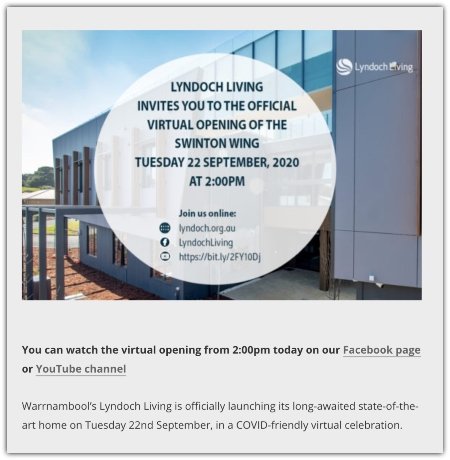
Invitation to the virtual opening of the revamped Swinton Wing, via Lyndoch Living website.
This is largely because – according to real estate watchers – those on the south side of the “Rolfanna” apartment complex were in the shade and over-priced.
In 2014, the cheapest apartment in this block was $420,000.
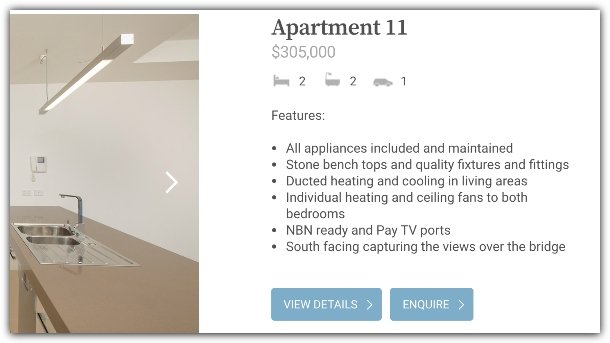
The last one is now under contract, having been listed at $305,000 – a $115,000 nose dive. Ouch.
A bunch of smaller, less salubrious residential units next to “Rolfanna” are for sale for as little as $185,000.
Advertisement for one of the Rolfanna apartments, via Lyndoch Living website.
Except I won’t be asking questions at the AGM, and neither can you.
That’s because the AGM will be online via Zoom and – unlike the virtual grand opening of Swinton Wing – is strictly invitation only and we haven’t been invited.
I have contacted several families of residents to see if they have been invited and no, they didn’t even know the date of the AGM, which once-upon-a-time was advertised widely and weeks in advance.
[I learned the date just last week, after a couple of emails to the Lyndoch media unit.]
Us mere mortals who have not been invited will have to wait for the video recording to be uploaded to the Lyndoch website, which sounds sort of reasonable….except we are still waiting for the video from the 2019 AGM to be uploaded to the Lyndoch website.
More importantly, we don’t get to ask any questions next Tuesday and – I suspect – that is the whole point.
Those who have been following this Lyndoch story from the beginning (last October), know that Lyndoch – despite being community owned and built on the generosity and support of locals – has changed to a Company Limited by Guarantee and is now a very tight shop.
At last count, it had just 16 members: nine board members, the Lyndoch executive and two life members, so every member is from within Lyndoch itself.
In this climate of litigation, frustration and obfuscation, I feel we have only one choice and that is to appoint our own Member Of Lyndoch (External) to represent us.
So meet Abbey the Airedale Terrier, also known as a Waterside Terrier (which seems fitting), a breed known for being intelligent, outgoing, alert, confident, friendly and….courageous.
Abbey is just what we need in the kennel and she will be sniffing out some important issues in the lead-up to the Lyndoch AGM that still require answers.
If you would like to support the work of The Terrier, please visit the tip jar.
Pressure mounts on Wannon Water to end ocean outfall
Dirty effluent water off Thunder Point, from the Wannon Water treatment plant. Image: Goodwill Nurdle Hunting.
Carol Altmann – The Terrier
Big news is filtering out of the EPA today which could see Wannon Water forced to lift its game so these “dirty decants” into the ocean off Thunder Point are soon a thing of the past.
The push is to produce only what is called “Class A” water which is not piped into the ocean but – wait for it – reused and recycled.
The fabulous news is that the independent consultant hired by the EPA to look at the public response to the $40m WW plant upgrade agrees!
Agrees!
The consultant is recommending that the EPA requires Wannon Water to move to a Class A/tertiary system within five years.
Five years!
Sorry for the exclamation marks, but I am genuinely excited, because this is a major breakthrough in what has been a very long battle, by some very dedicated people, to bring our city into the 21st century.
If the W’bool City Council is serious about its 2040 Plan, then it needs to demand this requirement too.
I have learned that Class A water is good for just about everything other than a refreshing drink.
It is safe for human contact.
You can wash your clothes in it, water your vegies with it, irrigate your lawn with it….
How very modern and forward thinking, given we are the driest continent on the entire frying pan of the planet.
As it sits, Wannon Water plans to spend $40m expanding the treatment plant so that it can do more of the same for the next 20 years – ie. just keep pumping effluent into the ocean.
To go for Class A will cost another $30m to $40m, which for something which will set us up for the next 20 years, sounds like a good deal to me.
Wannon Water has already put the heebies into people by saying it would also cost an extra $2m to $3m each year to run and customer bills might rise.
When I see the sort of money swishing around the big dairy and meat companies that use our treatment plant, that sounds like small change.
They can afford it and they should pay most of it.
There are 19 recommendations in the report which has dropped onto the EPA website, and I am yet to fully digest them all, but boy, this one – #7 in the 19 – is a ripper.
People power is working and that is why I love, through the Terrier, being a part of it.
By the way, thankyou SO MUCH to everyone who has tipped into the tip jar. I will have an update on all days that have a T in them…..which means, tomorrow!
EPA puts Wannon Water under the pump over ocean outfall
Carol Altman – The Terrier
Happy news: I am supposed to be taking a break…but there has been a breakthrough with the fight to stop Wannon Water’s plans to continue to pour effluent into our ocean off Thunder Point for the next 20 years.
Before this $40m, more-of-the-same project goes any further, the EPA has asked WW to provide a whole raft of extra, expert detail on, among other things:
1. Public Health Concerns, including assessing pathogens in the wastewater and the impact of humans being exposed to these bacteria and viruses in the ocean, including through seafood.
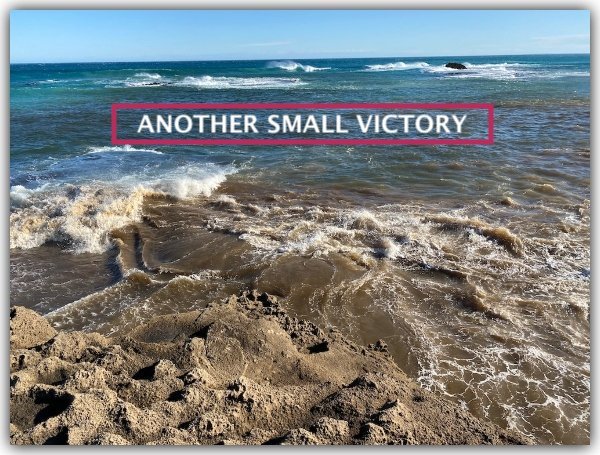
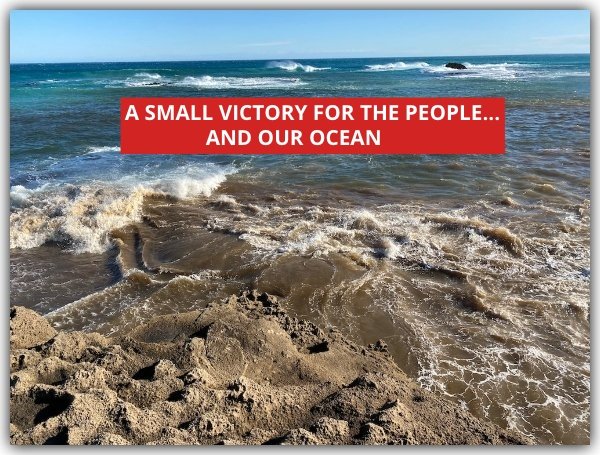
2. A health risk assessment of the ‘dirty decants’ (like that pictured) where solids and untreated waste water are released into the ocean.
3. Marine discharge concerns, including phosphorous levels.
4. Treatment process concerns, including the dirty decants that the EPA agrees have happened “multiple times in the past two years” and how these will be prevented.
5. Preventing the discharge of microplastics and;
6. Responding to each of the 83 public submissions received on this proposal, of which 78 were against the plan as it stood.
The fight is not over, but my word, this is a victory for the voices and for Colleen Hughson’s bravery in the face of immense corporate pressure, and for all of those people who took the time and effort to say ‘not good enough’ to Wannon Water.
We care about our ocean and we don’t want some cheap option that “will do” for the next 20 years.
Industry needs to sort out its own pollution and not expect to use Thunder Point as a dumping ground, or they should pay more toward making sure this is a first class/tertiary treatment plant that disposes only clean water into the sea.
Our kids and grandkids will thank us for this fight.
(If you haven’t watched the community video yet, tonight is the night. Most people have/had no idea what is happening out there near Shelly Beach, but they do now.)