WCC leasing deals: a wall of silence…and a shiny new shed
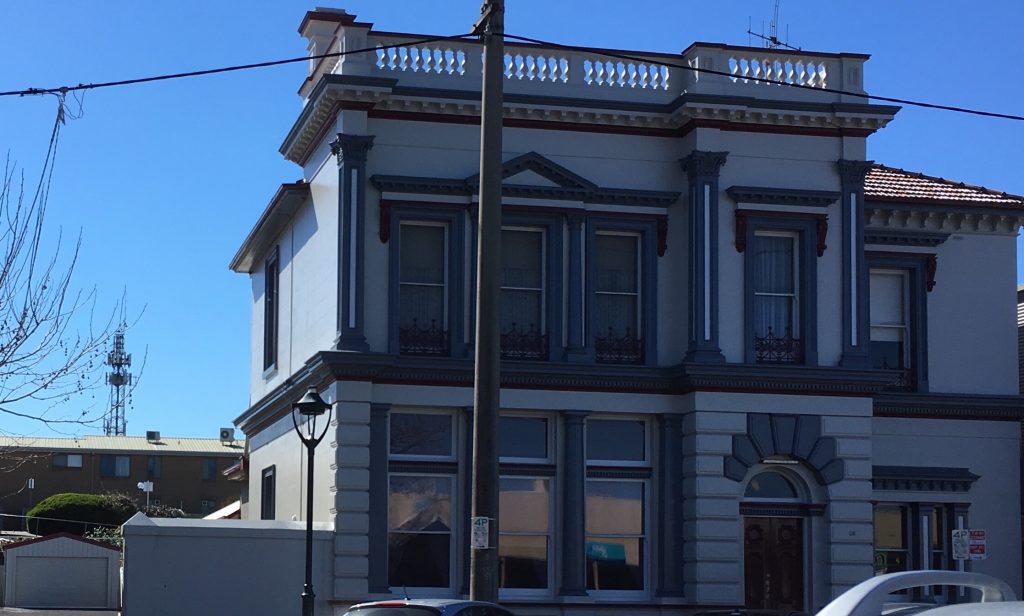
The council-owned residence at the Archie Graham Centre is part of a former bank building.

By Carol Altmann

The Warrnambool City Council has pulled down the shutters on its leasing rules that have allowed a senior staff member to rent a council-owned apartment for more than 30 years.

It is two weeks since the story broke about a senior staff member renting a central apartment at the Archie Graham Centre for 31 years (@ $190 per week) and another staff member renting a beachside house for 14 years (@ $221 per week), with no end date for either lease.

Despite an enormous response to the story from people wanting to know more, the person in charge of such things, Revenue and Property Manager Glendon Dickinson, has declined to be interviewed.

A whole series of questions I sent to both him and the WCC media manager, Nick Higgins, have been left hanging.

These questions include basic things like who sets the rent? How often is the lease renewed? How were the tenants selected? How is the rent paid? Does the rent include utility bills?

After several days, the only comment forthcoming was this:

“Our leases are guided by State legislation including the Residential Tenancies Act.”

Do you find that answer satisfying? I find it insulting: not to me, but to all WCC ratepayers, who actually own these buildings.

The public service has very different rules around transparency, compared to a private company, but what we are seeing at WCC is not transparency, but secrecy.

One thing that is impossible for the WCC to ignore, however, is the new garage and sealed driveway that has appeared behind the apartment in question at the Archie Graham complex and has cost ratepayers $43,000.

The single garage was built by council to replace a dilapidated three-bay garage (two bays of which were used to store council junk) that was demolished to make way for new works at Heatherlie homes.

I understand the single garage was budgeted at $12,000. The project came in “around” $43,000.

Mr Higgins said the final cost included the garage ($11,638), rebuilding a collapsed retaining wall, restoring a garden bed and “the sealing of a previously gravel laneway”.

This laneway, which is the expensive part, is not used by Archie Graham clients, but, according to Mr Higgins, only “used by neighbouring tenants and the residential tenant at Archie Graham”.

The $43,ooo was pulled from the capital works budget for the Archie Graham Centre, the managers of which must be either scratching their heads, or beating it against a wall, at such an expense.

In explaining the cost, Mr Higgins said the council had received more rent from the “flat” over the years than it had spent on maintaining it.

You would hope so.

The rental income from the “flat” had also helped subsidise the maintenance of Archie Graham, he said.

Again, you would hope so. Paying rent, after all, is part of the deal when leasing a property.

But both of these things, really, are beside the point.

The point is that we still don’t know the full details of this lease agreement and how it came about.

The WCC – unlike dozens of councils I have looked at – does not have a property leasing policy which is designed to keep things transparent.

The only way WCC ratepayers would know these leases exist is to visit the council offices and ask for a physical document that very few people know is there.

So why does any of this matter? What is the public interest?

Well, first, the properties are owned by Warrnambool ratepayers. They are the “landlords” here and I think they deserve to know what is going on.

Second, these two leases are unlike any of the WCC’s other residential leases. Every other WCC residential lease either provides public housing for disadvantaged tenants, or short-term accommodation for new staff.

Thirdly, the leases are not part of a salary package and are not required as part of a job description, such as a caretaker at a caravan park.

So, combining all of these factors, the crux of this issue is twofold:

  1. How did two council staff, out of more than 350 staff, manage to secure leases in prime-location, council-owned and maintained houses, that have lasted for decades?

  2. Do these arrangements breach the Local Government Act?

I still don’t know the answer to #1 and I may never know.

But I do know that under the Local Government Act, if a council lease is to be for more than 10 years, the details must be publicly advertised. This is to allow people to a) know about it and b) have a say.

So how does an ongoing lease of 30-plus years slip under the radar?

Simple.

Break the lease into, say, five year lots – and keep renewing that lease each time. Presto, you have a lease that stretches for decades, with very few people knowing about it, and nobody having a say.

Something doesn’t add up here and until it does, we need to keep asking the questions, no matter how uncomfortable. And this is what I plan to do.

If you would like to support local investigative journalism, please make a small contribution below.

Donate


The big shed shemozzle: we follow the money

porter shed
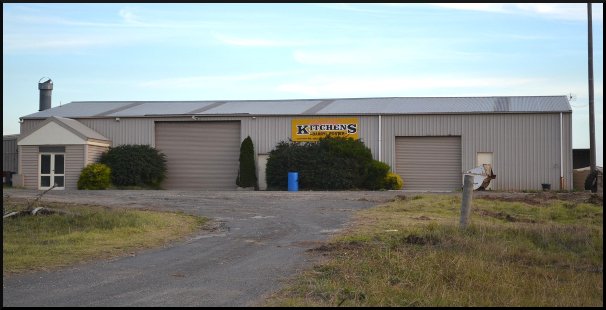
The former Porter’s shed on Wangoom Rd which is at the centre of a deepening and intriguing story about its final costs and the deals being done.

There is an old saying in journalism that you should always follow the money and that is exactly what we have done with the ongoing saga of the Warrnambool City Council’s purchase of the old Porter’s shed and it has led to an intriguing twist.

As those who have been following this story already know, the council paid local developer (and former councillor) Graeme Rodger $40,000 for the shed that sits on the edge of his new residential land project on Wangoom Rd, but shortly after tried to get rid of it via auction.

Unfortunately for the council, auctioneer Brian Hancock couldn’t attract a single bid and the shed was passed in at $20,000.

One reason for the shed’s unpopularity among bidders was the cost of dismantling, relocating, repairing and rebuilding the old shed at a new location, as the council is now discovering, and why it tried to “move it along” without success.

More recently, we have since learned, the council was told by Mr Rodger’s lawyers that the shed had to go: it was supposed to have been moved by mid this year, and each month that has passed since has been a blight on Mr Rodger’s land sales, after all, who wants to buy a block with a derelict shed next door?

In our last piece on this saga, we told you that the council had received a quote of $170,000 to move, relocate and reassemble the shed, making the $40,000 shed now costed at $210,000.

We also told you that the council rejected this quote and instead decided to pay Mr Rodger another $63,000 to dismantle and relocate (but not re-assemble) the shed, but that’s not the full story and herein lies the twist.

Mr Rodger is being paid $63,000, but, as the council is fully aware because it organised the arrangement, he is passing that money on to a third party to actually do the dismantling and relocating.

Why would the WCC want to use Mr Rodger as a go-between and not pay the third party itself?

shed corrosion
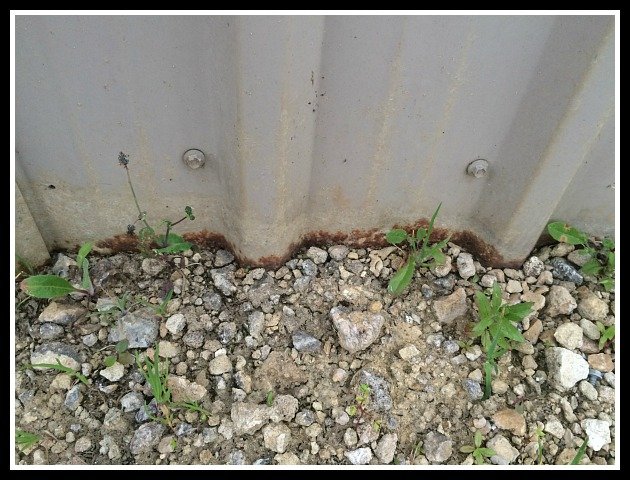
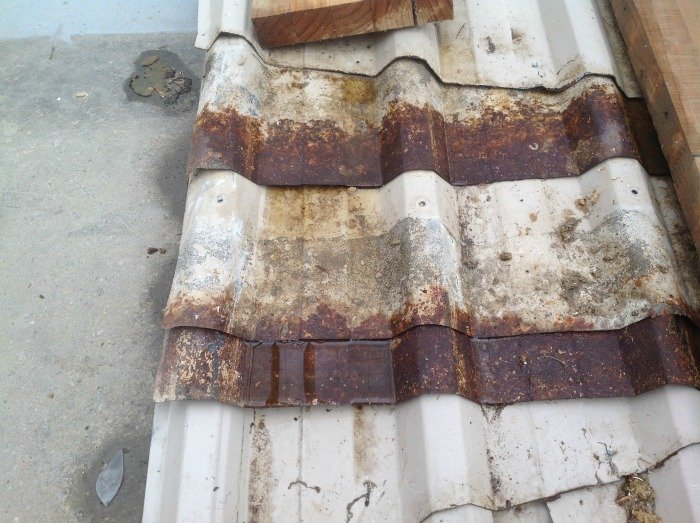
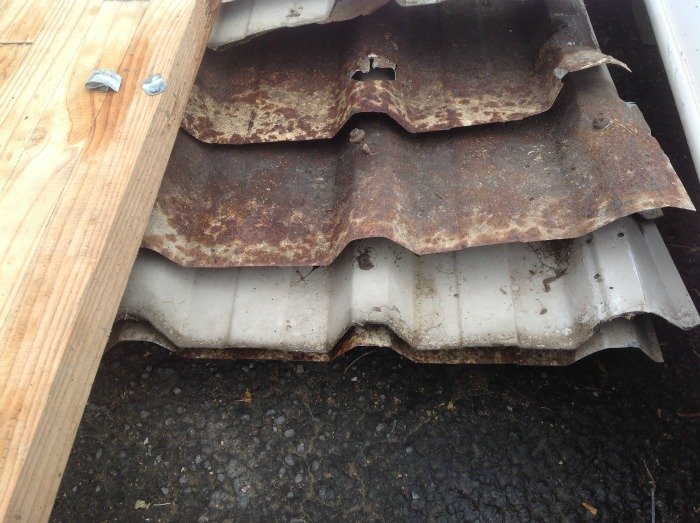
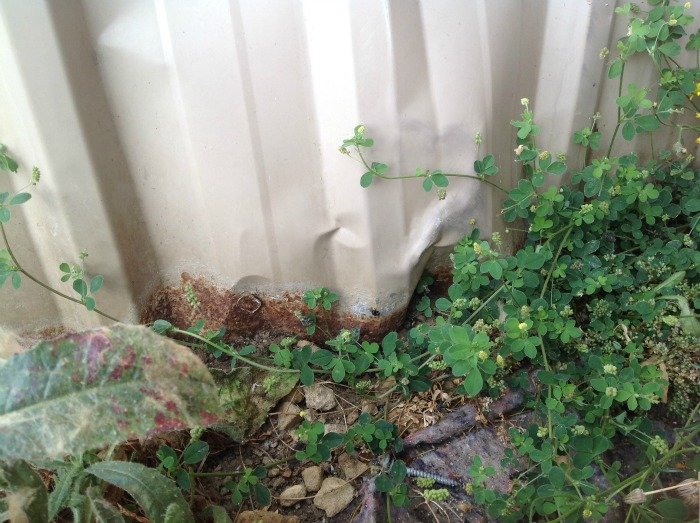
Corrosion along the bottom edge of the Colourbond sheets suggest the shed will require repairs when it is moved to Scott St.

We have pondered this question long and hard and the only possible solution we can come up with is that it is tied up with the council’s procurement policy, in other words, the rules around how it spends money.

These rules are quite complex, but include that any spending on services between $15,000 and $74,999 requires at least three written quotes. Perhaps by paying Mr Rodger for the cost of the shed AND its removal, the council could avoid this step and get the shed off the land by the new, mid-January deadline.

Also, under the rules, a council director can only authorise spending of up to $149,000 and anything above that must go to tender.

Director of Infrastructure Peter Robertson has so far spent $100,000 on the shed, but there are still major costs yet to come and that is the reassembly, re-fit and any repair costs for the corrosion. (See images below)

shed rust 2

shed rust1

shed rust3

This is almost certain to exceed $40,000, which begs the question of whether this whole mess should have gone to public tender in the first place?

Unfortunately the council’s media manager Nick Higgins is refusing to answer any of our questions on the shed, but it is indicative of a number of things, not least the secrecy surrounding these dealings and the lack of transparency around the use of ratepayers’ money.

Only three councillors – Brian Kelson, Peter Hulin and Peter Sycopoulis – have raised questions about this shed within council and tried to unravel what went wrong.

council depot
The former council depot building sold to Midfield Meats as part of a controversial land deal.

And where is this shed headed? Here comes the final twist:

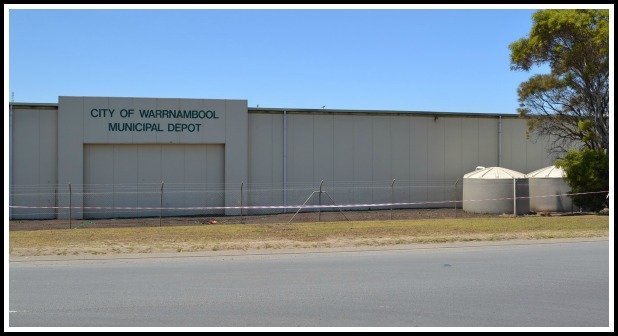
The shed is off to the council depot in Scott St where it will – alongside a brand new shed – partly replace the massive storage shed sold to Midfield Meats as part of the controversial land deal to allow the building of its milk processing plant.

That deal was supposed to give the council a $290,000 profit to invest back into the shrunken depot, but it appears that Porter’s shed alone will now soak up most of that “windfall”.


W’bool City Council’s big shed shemozzle

porter shed
All locked up with nowhere to go: the Wangoom Rd shed bought by the Warrnambool City Council that will cost up to $90,000 to relocate.

Exclusive – Carol Altmann

There is no doubt the hard-working staff within the Warrnambool City Council do many good things to keep our city ticking along, but occasionally they make financial decisions which are difficult to understand – like this shed.

Take a good close look at this shed because, if you are Warrnambool ratepayer, you now own it … and nobody else wants it.

The former premises of Daryl Porter’s cabinet making works on Wangoom Rd was sold by its new owner, developer Graeme Rodger, to the Warrnambool City Council earlier this year for a price understood to be between $40,000 and $50,000.

The sale was sealed on behalf of the council by its director of City Infrastructure, Peter Robertson, who by way of his position has the authority to make purchases up to $149,999 under the council’s procurement policy.

The idea, Bluestone has been told, was to have the shed relocated to council land in the west Warrnambool industrial estate, most likely at the council depot.

Unfortunately neither Mr Robertson or the council’s media manager will answer Bluestone’s questions about the shed, and perhaps the reason why is because it is shaping up as a major liability.

How? Because it has to be moved, and that is a very expensive exercise.

The 700m2 shed and an attached 300m2 lean-to are made of laminated timber, with a Colourbond steel roof and fully clad walls.

Bluestone has learned that the council received quotes to remove, relocate and re-assemble a shed of this type and found it would cost somewhere between $80,000 to $90,000 and this does not include the cost of a concrete slab.

So a $40,000 to $50,000 shed was now going to cost ratepayers well over $120,000.

No doubt realising that the shed was an unnecessary extravagance at a time when budgets are tight, the council recently tried to get rid of it – but nobody was interested in buying.

shed advert
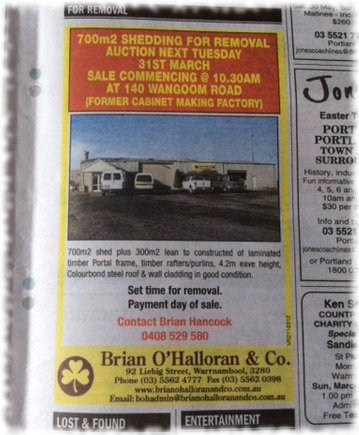
A newspaper advertisement for the shed, placed just days before the auction.

The shed was a late inclusion in an on-site auction held on Tuesday March 31, where auctioneer Brian Hancock tried his best to extract even a single bid from the crowd.

Hands stayed firmly down and the shed was passed in at $20,000.

It might not be so bad if the shed could stay where it was, and perhaps the council could rent it out to the many community and sporting groups around Warrnambool who could use the storage space, but there is a final twist.

Graeme Rodger needs the shed gone to make way for his residential subdivision later this year.

Indeed the auction advertisement reflected a sense of urgency, with bold letters stating: “Set time for removal. Payment day of sale.”

Mr Rodger told Bluestone that he was not putting any pressure on the council to move the shed, but that some time “in the next few months” would be reasonable.

The council has found itself in a checkmate and the question now is whether it spends tens of thousands of dollars on moving and re-establishing the shed, or walking away and cutting its losses.