Ombudsman urges WCC to address disunity and dischord

Carol Altmann – The Terrier

A final post on the Ombudsman’s report: the story does not end here.

One of the things picked up by the Ombudsman’s investigation was a strong sense of disunity and discord within the W’bool city Council, both among councillors and council officers.

A number of “concerns” about senior management’s handling of misconduct were raised with the Ombudsman during the investigation into the credit cards, but some were unfounded, some lacked substance and some were beyond the scope of this particular investigation.

These concerns may, however, still point to a broader problem that was most recently played out by the sacking of Peter Schneider (which rates a mention).

The Ombudsman, Deborah Glass, writes:

“While we did not find evidence of systemic abuse by Council officers or systemic failings by senior management…we did not deal with every allegation aired publicly or privately, and which continued during the investigation.

“Their prevalence and persistence suggest a disunity within Council which this investigation does not purport to deal with, but for the sake of ratepayers and the community must be addressed.

“Communities rely on their council to practice unified and strong civic leadership.”


No truer words have been spoken and none more timely.

Thankyou for hanging in here: this is a report with a lot to digest and it is worth a full read.

I am now off to have a lie down, but before I do, I just want to say this:

Thankyou to all of the brave souls who have helped to bring the truth to the surface today, despite the denials, excuses and dismissals that go on from enablers, even as we speak.

I remember the day these brave souls came to me about the busted culture at the WCC, because they had nowhere else to go. They had tried the “internal systems” and they got nowhere. They had approached councillors for help, and they got nowhere.

Nobody would listen. But they are listening now.

It has been a long, slow and exhausting road but here we are. Change has come and change is coming.

On. We. Go.



Ombudsman reveals changes to WCC credit card rules

The W’bool City Council has made significant changes to its credit card policy following an external review in response to the scandal around misuse and largesse.

Carol Altmann – The Terrier

Update: The Ombudsman’s report reveals the 10 recommendations from the external auditor that were adopted by the council in March this year.

Why, oh why, were these rules around credit cards not in place in the first place? They seem so straight forward.

Here is the summary of the changes:

1. Provide fraud and corruption control training to all Council staff including reporting of actual or suspected fraud and corruption.

2. Review and update Fraud and Corruption Control Plan and Procedure to include fraud incident reporting protocols to the Council.

3. Establish a criterion to determine the need for a credit card by a staff member.

4. Review and update the existing Corporate Credit Card Procedures, including to stipulate the roles and responsibilities of an authoriser, create list of risk factors for authorisers to be aware and create guidelines on ‘taking face value explanations’ versus ‘appropriate inquiry’.

5. Provide training to authorisers with respect to approval of monthly credit card expenses.

6. Review and update the existing Fraud and Corruption Controls Procedure to include specific trigger points when an independent auditor should be brought in (i.e. the period after unusual/misuse has been identified to when possible fraud is suspected).

7. Implement a process wherein pre-approvals (except CEO) shall be required for expenses such as (but not limited to):
a. Business travel
b. Accommodation
c. Conferences
d. Seminars

8. Implement an approval process which aligns with the practice recommended by the Victorian Auditor General. The Council’s Chief Financial Officer or Director Corporate Strategies, shall approve CEO’s credit card expenditure, and table the full transaction history to the Audit and Risk Committee.

9. Implement ongoing reporting and monitoring processes that fosters continuous improvement of credit card processes (with suggested areas for improvements including implementing Breach reports and Repeat Offenders report)

10. Incorporate a process wherein Statutory Declarations are witnessed by one of the many people authorised to do so (outside the Council).

I have one more update to come.

(You can download the full report here.)


Ombudsman report reveals poor actions of WCC officials

WCC City Growth Manager Andrew Paton, former CEO Bruce Anson and recently sacked CEO Peter Schneider, who, between them, capture misplaced trust, poor decision making and being kept in the dark.

Carol Altmann – The Terrier

More on the Ombudsman’s report – some key names:

Former WCC tourism chief David McMahon: found by the Ombudsman to have clearly misused his credit card and has recommended the council investigate further and consider police action.

The council accepts this recommendation.

Mr McMahon, the report says, has since expressed remorse, regret and shame and admitted he had openly betrayed his manager, Andrew Paton.
—-

City Growth Manager, Andrew Paton: the report says Mr Paton felt deceived by Mr McMahon, whom he trusted.

Given Mr McMahon adjusted some of his receipts and invoices, Mr Paton “could be excused for some of his errors” in approving this spending and failing to pick up other excessive spending “was due to his own inadvertence”.

The report says Mr Paton was considered by former CEOs Bruce Anson and Peter Schneider to be “of the highest level of professionalism and integrity and that he accepted his mistakes”.

Even so, the report says, once Mr McMahon’s spending was first exposed in November 2018 (after the Cape Schanck function), a “more structured approach to addressing the problem should have been instituted … including revisiting credit card oversight processes”.
—–

Former CEO Bruce Anson: took Mr McMahon’s explanations at face value and considered a first and final warning to be an appropriate response after Mr McMahon repaid some of his spending in November 2018.

At that time, based on Mr McMahon’s explanations, Mr Anson did not believe Mr McMahon’s conduct was criminal or corrupt and did not report it to IBAC.

Given this was Mr Anson’s belief, the Ombudsman accepts Mr Anson was not legally required to report the matter to IBAC.

He should, however, have reported it to the council’s Internal Auditor for further investigation, the report says.

Mr Anson “acknowledged in retrospect there should have been an independent audit of David McMahon’s credit card transactions in accordance with Council policy.”
—-
Former CEO Peter Schneider: was not aware of Mr McMahon’s credit card misuse – or the first and final warning in Nov 2018 – until inquiries by the media (The Terrier) in mid last year.

Mr Schneider met with Mr McMahon in early July last year and asked if there was anything else he should be aware of.

Mr McMahon said no.

After stories began to appear in The Terrier, Mr Schneider began his own inquiries on 8 July. Mr McMahon resigned on 16 July 2019, having repaid a further $3071.

Mr Schneider referred the matter to IBAC on 15 July, under mandatory notification. The council later hired an external auditor to assess the council’s credit card policies and make changes.

A memorable line from Mr Schneider in the report: “When asked by the investigation what a reasonable meal purchase under Council’s policies would be, Peter Schneider noted that a meal might be a ham and cheese sandwich, not ‘a T-bone steak washed down with a bottle of Grange”.

Amen to that.

The auditor’s 10 recommendations to follow.


Ombudsman report: no rules on coffees, lunches and dinners

Hundreds of ratepayer dollars spent on lunches, dinners, drinks and coffees were explained away as part of a “spend local” campaign.

Carol Altmann – The Terrier

More on the Ombudsman’s incredible report:

If ever there was an example of how loose the goose was running down at 25 Liebig St, it is this one – the “spend local” idea during the Liebig St upgrade.

A large swathe of the spending on credit cards held by managers other than David McMahon – including City Growth Manager Andrew Paton and former Economic Growth Manager Shaun Miller – is explained away by the council through its “spend local” idea.

According to the Ombudsman’s report, the council had set aside a budget of $170,000 a year for “support local” activities during the Liebig St upgrade.

Under this, “council officers were encouraged to hold work-related meetings at local cafés and restaurants, and to use their Council credit cards to pay for food and coffees”.

A noble cause, perhaps, but this is a remarkably generous eat-and-drink plan that I don’t recall ratepayers ever being told about.

More importantly, as the Ombudsman points out: “No guidance was issued by Council to assist Council officers decide what was an acceptable purchase using Council funds and what was not, other than the directives in the Procurement Policy and the Credit Card Policy.”

No guidance and a $170,000 a year budget: that’s a winning formula.

Mr Paton told the Ombudsman he was mindful of community perceptions and told his team that the “rules” were the meeting had to be business related, and involve another council officer or stakeholder.

(Call me naive, but that sounds like a recipe for pretty much anything goes.)

Here is Mr Paton’s response to the Ombudsman: “… it’s easy to look at a spreadsheet and say, ‘You spent $600 on coffees. How do you justify that?’ with no context of why that meeting occurred and why that expenditure occurred. And that’s a hard one to explain sometimes even to the people who are involved in it …

“I can see how that would look. But in terms of the context of the space we were in and the battle we were in, I’ll use that language … it was a bit of a battle to try and keep the wheels spinning because it was a day-today thing.”

I am not sure how this accounts for the after-hours work drinks on a Friday night at places like the Hairy Goat or the Warrnambool Hotel.

I am also curious as to why the “spend local” was confined to pretty much the same places: Fishtales, The Hairy Goat, Seanchai, Whaler’s, Warrnambool Hotel….

Nobody ever opted for Mack’s Snacks.

As the Ombudsman says, while this “shop local” idea may have been well-intentioned, the approach was “fundamentally unwise” and the public perception could rightly be council staff eating and drinking on the public purse, as opposed to doing “business”.

Again, this report not only reveals what was clearly misuse of a credit card by one person, but what was permissible use of a credit card by others who were simply following the “rules”.

Thankfully those rules have now changed.


Ombudsman: $700 dinner a “shock” to manager who paid

Carol Altmann – The Terrier

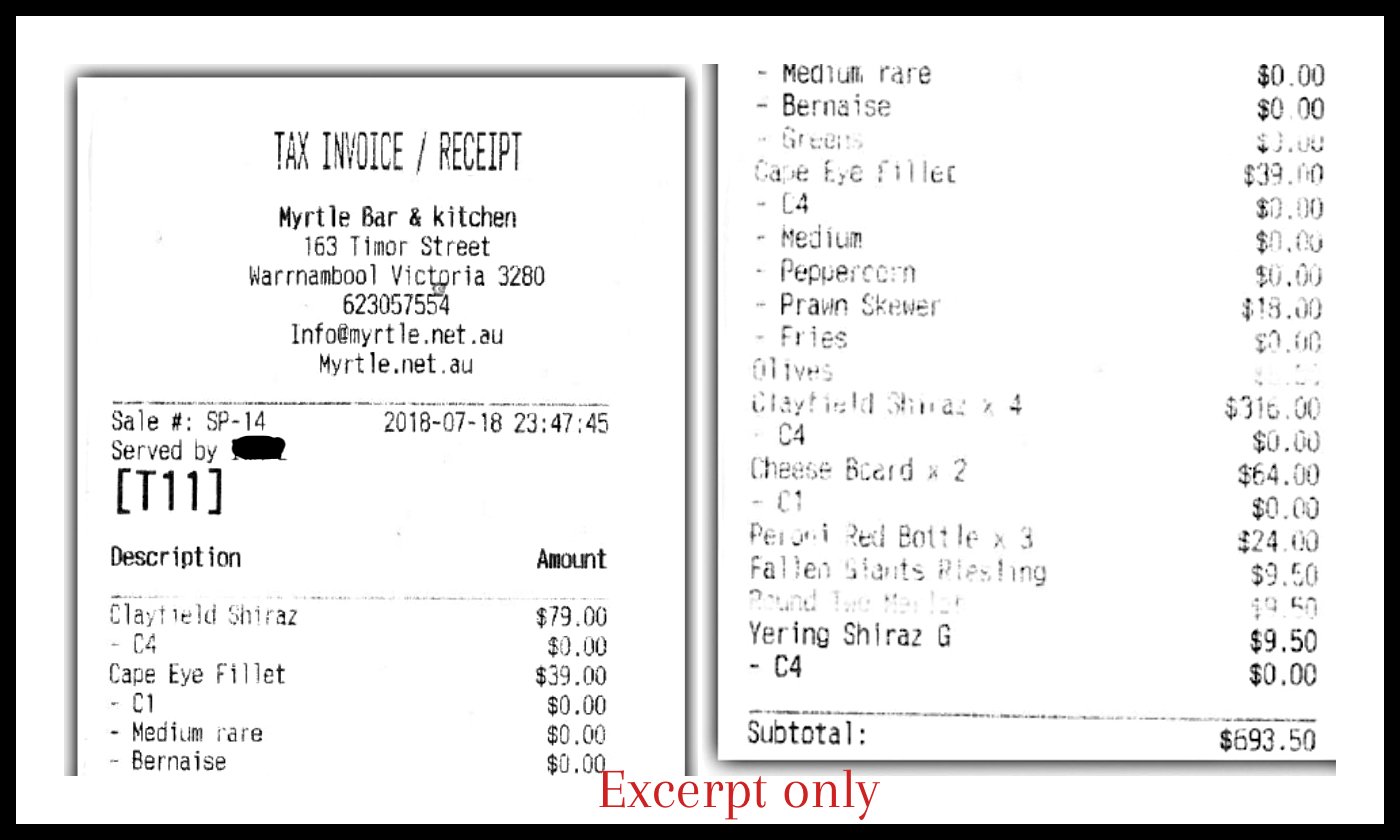
More on the Ombudsman’s report: The Myrtle Bar & Kitchen.

Readers will recall the story on The Terrier about the almost $700 dinner held at the Myrtle Bar & Kitchen and attended by City Growth Manager Andrew Paton, David McMahon, Cr Sue Cassidy and the head of the Great Ocean Road Regional Tourism authority.

This dinner was paid for on Mr Paton’s credit card and included five bottles of shiraz.

Here is what Mr Paton has told the Ombudsman by way of explanation:

“When the evening finished and we settled the bill, I looked at the bill and I was shocked by it. My initial thought was to query it, and then split the bill; and I didn’t do that, and, and I regret it.

“So I can see what that looks like, it’s about, oh we’re building a relationship with GORRT (Great Ocean Road Regional Tourism) by wining and dining them, and I get that, totally get that perception.

“But the picture for me and how I rationalised it, was the outcomes that I got from that discussion, that on balance I had good outcomes, but it didn’t meet my personal standards.

“That dinner with Great Ocean Road Regional Tourism delivered some good things, but there are some things that could have been done better that I regret.”

—-

I wonder what the “outcomes” and “good things” from this dinner were – wouldn’t it be great to see a public report!

The Ombudsman records that Cr Sue Cassidy last October voluntarily repaid $200 toward this bill after she regarded it as “excessive”. I guess that’s something.

On a similar note, the $1476 dinner held at Pippies By the Bay Restaurant in May 2018 – reported as part of this same story – has led to greater restraint on Sister City functions.

In 2018, it was “free reign in ordering”, so of course everyone went for the lobster and abalone.

As the Ombudsman reports: “(this) did not meet community expectations and it (the council) has taken steps to allocate a moderate per head allowance to these meals”.

All of which reminds me of the line I wrote in that original story:

“…this is not about catching people breaking the law…but exposing the steaming pile of inappropriate and unjustifiable spending that gives so little return to the ratepayer.

It’s this unjustifiable spending – via poor governance – that people want independently audited, cleaned up and cleaned out.”

I have to say I am feeling a little emotional as I write all this, knowing that this has now all been exposed after a true team effort, and change has come as a result.

It has been a long road.

More soon.