“Undesirable” result was the exact opposite: Jim Burke
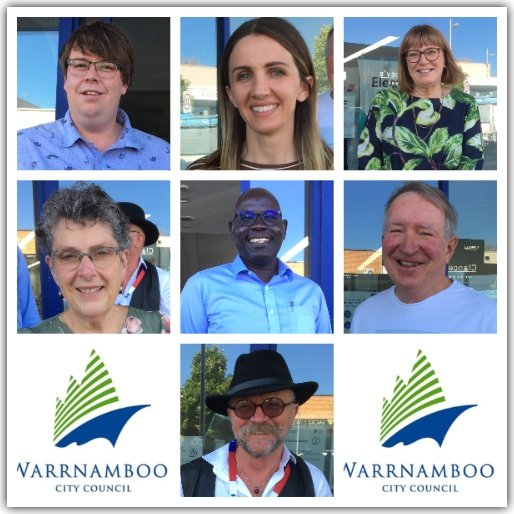
The seven new Warrnambool City Councillors elected in a clean sweep in 2020: Ben Blain, Angie Paspaliaris, Debbie Arnott, Vicki Jellie, Otha Akoch, Max Taylor and Richard Ziegeler.

Terrier guest writer – Jim Burke*

This week the local newspaper reported that three former councillors thought that the outcome of the recent council election was “undesirable” and that a ward system with three councillors in each ward would prevent “undesirable” results in the future.

Really!  Well let’s unpack that.

Firstly, just how was this election result “undesirable”?

The election was a well-run, open, democratic process conducted independently by the Victorian Electoral Commission. The candidates all campaigned in good will and the community seemed to be fully engaged.

The election results were overwhelming, the community wanted a clean sweep: that is what they voted for and that is what they achieved.

It seems clear that the voters understood that they could likely end up with seven councillors who would come to the job with no previous experience.

Is that what happened? Well, actually, no.

The seven new councillors bring a wealth of skills and experience to the table and they have had the benefit of observing their predecessors and an understanding of just what is at stake.

The result of this election was not “undesirable”: it was the exact opposite. It was clearly the result the community desired.

Now, would a system of three wards, electing three councillors each, have changed the election results?

In the case of the 2020 election, I doubt that a ward system would have changed the outcome. There was a strong mood for change, and this can be seen in the voter turnout.

More were enrolled to vote in 2020 than in 2016, and of these, more people actually voted in 2020 as a proportion of those enrolled than was the case in 2016.

The proportion of informal votes also went down, not up, as implied by the former councillors in the newspaper article.

If we had three wards electing three councillors each in 2020, the outcome may have been different, if only because it might have caused a different range of candidates to nominate.

For instance, all of the sitting councillors who sought re-election in 2020 lived and/or worked within a short walk of Liebig Street; do you think that any of them would have been accepted in a ward that included, say, Allansford?

We had no candidate running from Allansford (or Woodford) in 2020, so perhaps under a system of wards, we would see such a candidate.

I would argue that such was the mood for change, the outcome would have been much the same, whether it was a single electorate, or an electorate divided into wards.

The retired councillors also made some further observations that I would like to challenge:

First, that a ward system would have reduced the informal vote from nine per cent to two per cent.

I am not sure what they base this on, or how they arrived at the figure of two per cent, but in any case the assertion is misleading.

If the 2020 election had been held over three wards, the informal vote (nine per cent) divided among three wards would have been three per cent per ward.

Perhaps with fewer candidates per ward, then the informal vote may have been lower. But a whole percentage point?

Secondly, these retired councillors harked back 30 years when there was a ward system, elections were held annually, and one third of the councillors retired each year. The idea being that this would have avoided the “undesirable” outcome of the 2020 election, by reverting to an enforced system of “old and new faces” at the council table.

This is a bogus argument that needs to be debunked right now.

Whatever the merits of the idea, it will not happen now or ever. We would have to endure three months of election activity every year, and the costs to candidates and councils – in cash and personal and professional disruption – would be unacceptable.

In any case, no State Government would ever commit the resources or pay the huge cost of an election in all 79 councils in Victoria every year. It just will not happen.

But change is in the air for the next election in 2024, with Warrnambool set to return to wards in response to a State Government review.

How many wards, their boundaries, names and the total number of councillors (the review recommended nine), will be decided in the coming months.

For now, however, all eyes are on this new council and the fresh start that Warrnambool desired and achieved.

*Jim Burke, a retired naval officer, ran for the WCC election for the first time and finished 11th after preferences. He is a regular fixture in the public gallery at council meetings and continues to run a Facebook page with commentary on civic affairs.

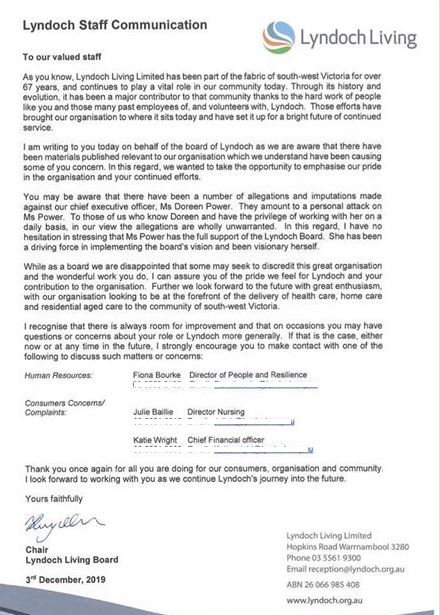


Lyndoch Living chair issues statement to staff

Lyndoch Living company secretary Lyanne Vinecombe, chair Kerry Nelson, CEO Doreen Power and Director of Nursing, Julie Baillie. Image: Lyndoch Living annual report 2018-19.

Carol Altmann – The Terrier

The chair of Lyndoch Living, Kerry Nelson, has issued a statement to staff to try and allay any concerns surrounding Lyndoch management.

You can read the statement in full below, or download it here:

Ms Nelson is yet to respond to any of my questions.


W’bool City Council opens up on 30-year lease deal to staffer

The Archie Graham building is one of two properties at the centre of long-term lease deals between the W’bool City Council and two staff members.

By Carol Altmann

It has been a bit like pulling teeth, but the Warrnambool City Council has finally released more detail about why it has rented two properties to two of its staff for – in one case – more than 30 years, and 14 years the other.

The five-page article posted on its website is a direct response to the stories that have appeared here about one senior WCC staff member living in the old bank building at 130 Timor St, part of the Archie Graham Centre, since 1987 and currently paying about $190 a week.

This property also saw about $43,000 from the Archie Graham capital works budget used to build a new garage, retaining wall, garden bed and sealed driveway in a spend that sources say incensed many of the Archie Graham staff.

The other property is a beachside former caretaker’s residence, currently rented at $221 a week.

Both are open-ended, on-going leases with no end in sight.

So, what is the council’s more fulsome explanation as to how these arrangements work and why they exist?

You can read the whole thing for yourself here – please, do – but the nub of it appears to be that these two properties are “unusual” and the council is lucky to find good tenants to rent them:

“Because of the unusual locations and nature of these properties if Council staff were not renting these properties they would not be made available for rent to the general public and Council would lose income.”


What exactly makes the properties “unusual”?

Well, according to the council’s explanation, the Archie Graham tenant is virtually a live-in security guard, turning off lights and appliances left on by the staff and centre clients, and, on occasion, even responding to attacks by vandals:

“Over a recent weekend the staff member was able to set in train urgent repairs when an intoxicated individual smashed a glass entrance door.”


Further, the tenant can only access the apartment via the main entrance to Archie Graham, which I guess when you put all of these things together, means that not all WCC staff could be entrusted with such an arrangement and they could not be guaranteed a good night’s sleep.

(Apparently councillors were also told privately in response to my stories that the tenant had to share a bathroom with the public. This does not appear in the public explanation and my sources say that such a claim is is not correct.)

The beachside house apparently has similar issues with noisy passersby:

“In the past the house at Shipwreck Coast Holiday Park has been made available to the public to rent but Council experienced difficulties in the rent being reliably paid and tenants finding the level of amenity acceptable with regard to being in close proximity to excited holiday makers.”


I will leave that image of the excited holiday makers for you to ponder.

As I say, read the full statement – it is too long to reproduce here – and I will finish with just one or two more points.

First, I recently asked the Local Government Inspectorate if these two lease deals breached the Local Government Act because, under the Act, a lease of more than 10 years must be advertised.

W’bool CEO Bruce Anson has finally released a more fulsome explanation of the two long-term lease arrangements. Image: ABC Radio

The inspectorate contacted the council CEO Bruce Anson and reported back to me that, no, the leases did not breach the Act because neither was for more than 10 years, even though one is 31-years long and the other inching toward 15 years.

I think George Orwell would be impressed.

I don’t know how frequently these leases are renewed, but the collective total for each is definitely more than 10 years. This, according to the inspectorate, is an “alleged loophole”.

Moving on.

Much of the council’s response has been about privacy and protecting people’s names and addresses:

“As a responsible landlord and to ensure the privacy and security of the tenants, Council will not broadcast the identities of the tenants in these homes.”


Some readers may also share this view.

But I have to point out that this issue is about due process, not particular individuals, which is why I have not published names.

Nothing written about the people in these two properties is not on the public record. You can visit the council offices and read the lease register, which is a public document and the reason it is public is because it deals with public property.

Of course Mr Anson, parts of the council, and probably the tenants in question, would all prefer we didn’t go poking about in lease registers and asking questions about rents and new garages and sealed driveways and forcing them to write long statements justifying their actions, but this is exactly what we need to do – and what I do on your behalf – because that, as we know, is all part of a healthy democracy.

A freedom of information application asking for copies of the two lease agreements is still being processed. Thankyou to those of you who donate $ to help me pay for these applications. If you too would like to support independent journalism, please consider making a small contribution below.

Donate