Is W’bool City Council a bloated boys’ club? The sums say yes.

Despite rate capping and a growing staff salary bill, life at the top of the Warrnambool City Council remains lucrative.

By Carol Altmann

Some time ago, a young Warrnambool lawyer who likes to crunch the numbers told me that our council was big, fat and bloated with an unsustainable salary bill for a city this size.

More recently, there has been a steady stream of people, all women, contacting me to say the council had turned into a dispiriting boys’ club, despite more women on the ground.

Having taken a closer look, I believe they are both right.

Let’s start with the bloat.

There are 731 people working at Warrnambool City Council (full time, part time and casual) and last financial year the cost to ratepayers was $31.5 million.

At the same time, the council collected $31.05 million in rates (not counting the $4.7 million waste management fee, which goes directly to providing a garbage service).

Look closely at those two figures again and you will see that every single dollar collected in rates  – $31.05 million – is equivalent to the amount needed to cover the cost of the staffing bill of $31.5 million. 


This financial year, the gap will widen.

WCC staff costs will jump by another couple of million to $33.2 million and rates, meanwhile, will bring in $31.97 million, which would actually not cover the bill.

With a cap on rates, something needs to give, and perhaps the first place to look is in the upper deck, where the salary packages are lucrative compared to those working at the grassroots.

According to figures given by the council to a parliamentary inquiry into rate capping, in 2016 the council had 21 senior officers each earning a total salary package of more than $120,000 a year – that equates to more than $2300 a week (before tax and including super, etc). 

This figure, by the way, doesn’t include the CEO, Bruce Anson, who has a package currently between $310,000 – $320,000.

When I asked the council if it still had 21 senior officers earning a total salary package of more than $120,000 a year, it was hard to get a straight answer.


Instead, it provided a convoluted response about the intricacies of the Local Government Act and a list that shows only seven senior council staff now earn a package of more than $130,000 a year, including the CEO and someone who does not report directly to the CEO, but who earns a sweet package of $145,000. (Who could that be?)

I am not sure where the other 15 staff have disappeared to, but I suspect they are still earning more than $120,000, and I suspect they are among the 22 senior people listed in the council’s “organisational structure” on its website, although I don’t know this for sure.

I can confidently say, however, that the vast majority of these big earners are not women, which brings us to the second point about the council becoming a boys’ club.

Leaving aside broader and worrying allegations that I have been receiving about how the boys’ club operates – I will save that for another day – I am going to focus simply on the numbers.


Check out the chart below:
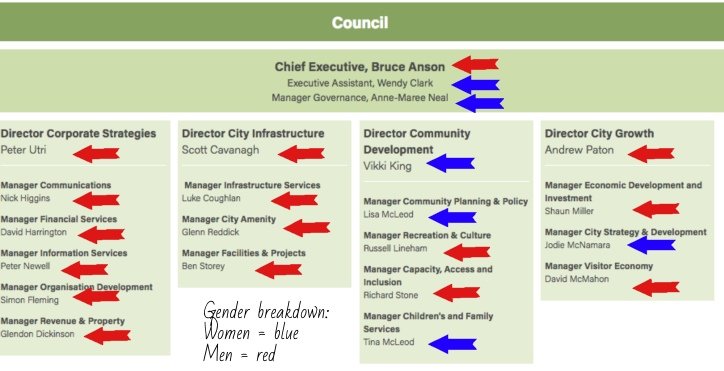
 

As you can see, there are only six women in the council upper ranks, and only one, Community Development head Vikki King, holds a director position.

Two departments – Corporate Strategies and City Infrastructure – don’t have any senior women at all and City Growth has just one.


But wait, the council will say, we have more women than men on staff, which is absolutely true. There are 497 women, but only 227 full-time equivalent (45%), which means the majority are casual and part-time.

By contrast, there are 234 men, of which 163.8 are full-time equivalent – this is 70%.

As we all know by now, just having women around doesn’t make a place gender equal.

What really matters is what the women do, the positions they hold, and the influence they can wield (just ask the Federal Liberal Party) and, on this score, our council is seriously lacking.


If you are interested in transparency within government, visit The Guardian’s new The Transparency Project, which is exactly what journalism used to be about and can continue to be, thanks to donations, crowdfunding and partnerships rather than paywalls.

If you would like to support local, independent journalism, please consider making a contribution below. Thankyou to all of you who have already done so. 
 

Donate


WCC leasing deals: a wall of silence…and a shiny new shed

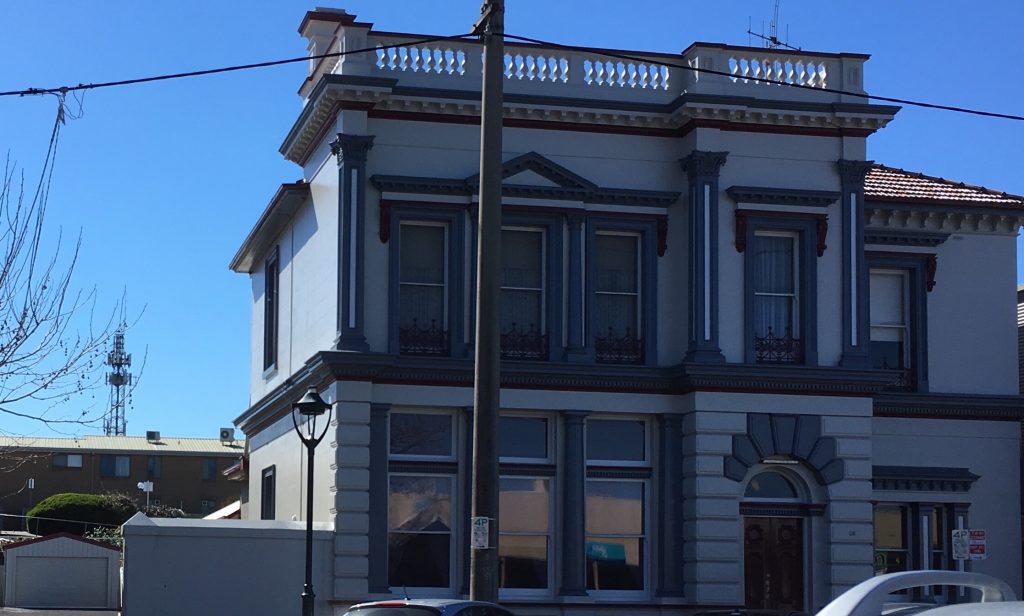
The council-owned residence at the Archie Graham Centre is part of a former bank building.

By Carol Altmann

The Warrnambool City Council has pulled down the shutters on its leasing rules that have allowed a senior staff member to rent a council-owned apartment for more than 30 years.

It is two weeks since the story broke about a senior staff member renting a central apartment at the Archie Graham Centre for 31 years (@ $190 per week) and another staff member renting a beachside house for 14 years (@ $221 per week), with no end date for either lease.

Despite an enormous response to the story from people wanting to know more, the person in charge of such things, Revenue and Property Manager Glendon Dickinson, has declined to be interviewed.

A whole series of questions I sent to both him and the WCC media manager, Nick Higgins, have been left hanging.

These questions include basic things like who sets the rent? How often is the lease renewed? How were the tenants selected? How is the rent paid? Does the rent include utility bills?

After several days, the only comment forthcoming was this:

“Our leases are guided by State legislation including the Residential Tenancies Act.”

Do you find that answer satisfying? I find it insulting: not to me, but to all WCC ratepayers, who actually own these buildings.

The public service has very different rules around transparency, compared to a private company, but what we are seeing at WCC is not transparency, but secrecy.

One thing that is impossible for the WCC to ignore, however, is the new garage and sealed driveway that has appeared behind the apartment in question at the Archie Graham complex and has cost ratepayers $43,000.

The single garage was built by council to replace a dilapidated three-bay garage (two bays of which were used to store council junk) that was demolished to make way for new works at Heatherlie homes.

I understand the single garage was budgeted at $12,000. The project came in “around” $43,000.

Mr Higgins said the final cost included the garage ($11,638), rebuilding a collapsed retaining wall, restoring a garden bed and “the sealing of a previously gravel laneway”.

This laneway, which is the expensive part, is not used by Archie Graham clients, but, according to Mr Higgins, only “used by neighbouring tenants and the residential tenant at Archie Graham”.

The $43,ooo was pulled from the capital works budget for the Archie Graham Centre, the managers of which must be either scratching their heads, or beating it against a wall, at such an expense.

In explaining the cost, Mr Higgins said the council had received more rent from the “flat” over the years than it had spent on maintaining it.

You would hope so.

The rental income from the “flat” had also helped subsidise the maintenance of Archie Graham, he said.

Again, you would hope so. Paying rent, after all, is part of the deal when leasing a property.

But both of these things, really, are beside the point.

The point is that we still don’t know the full details of this lease agreement and how it came about.

The WCC – unlike dozens of councils I have looked at – does not have a property leasing policy which is designed to keep things transparent.

The only way WCC ratepayers would know these leases exist is to visit the council offices and ask for a physical document that very few people know is there.

So why does any of this matter? What is the public interest?

Well, first, the properties are owned by Warrnambool ratepayers. They are the “landlords” here and I think they deserve to know what is going on.

Second, these two leases are unlike any of the WCC’s other residential leases. Every other WCC residential lease either provides public housing for disadvantaged tenants, or short-term accommodation for new staff.

Thirdly, the leases are not part of a salary package and are not required as part of a job description, such as a caretaker at a caravan park.

So, combining all of these factors, the crux of this issue is twofold:

  1. How did two council staff, out of more than 350 staff, manage to secure leases in prime-location, council-owned and maintained houses, that have lasted for decades?

  2. Do these arrangements breach the Local Government Act?

I still don’t know the answer to #1 and I may never know.

But I do know that under the Local Government Act, if a council lease is to be for more than 10 years, the details must be publicly advertised. This is to allow people to a) know about it and b) have a say.

So how does an ongoing lease of 30-plus years slip under the radar?

Simple.

Break the lease into, say, five year lots – and keep renewing that lease each time. Presto, you have a lease that stretches for decades, with very few people knowing about it, and nobody having a say.

Something doesn’t add up here and until it does, we need to keep asking the questions, no matter how uncomfortable. And this is what I plan to do.

If you would like to support local investigative journalism, please make a small contribution below.

Donate


Be all things or stick to the basics?

council plan
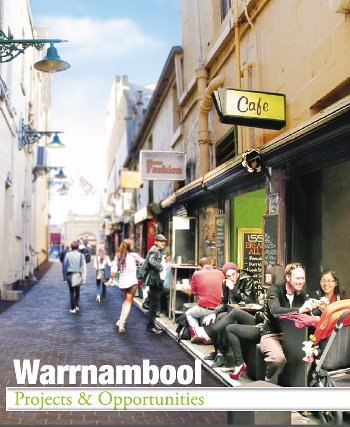
The dream: an image of bustling cafes built into the sides of Warrnambool’s laneways graces the cover of the council’s recently released priority ‘wish list’.


[dropcap style=”font-size: 60px; color: #A5CECD;”] C [/dropcap]ouncils were once primarily responsible for rates, roads and rubbish: my, how times have changed.

The 16-point list of advocacy priorities released by the Warrnambool City Council suggests that the council must now be all things to all people, fixing everything from school retention rates, to unemployment, to developing the region’s food export industry…right down to upgrading the stormwater drains. But is this what ratepayers really want or expect?

Sixteen points is a lot of priorities for a council covering only 32,000 people and they can’t possibly all be met, especially when we struggle to get the public toilets right.

I say this because as I was walking back from a media briefing on the plan last week, I wandered past the vandalised portable toilet box on Gilles St, across the road from the heritage precinct of the former police station and court house.

Having only been back in Warrnambool a relatively short time, I thought these toilets must have been installed for the comfort of the workmen repairing the former post office nearby.

A google search, however, revealed the eyesore is considered a public toilet and has been sitting there since 2011 while the council finalises its public toilet strategy.

My heart sank. If it takes more than three years to sort out the public lavatories, what hope is there of achieving the bulk of the 16 priorities that had just been outlined to the media by Mayor Michael Neoh and CEO Bruce Anson?

Moreover, do we need to have 16 priorities? What about focussing on five, securing the funding for these, and doing them really, really well? (We will list our top five later).

toilet_19
The reality: the ‘temporary’ toilet block on Gilles St indicates that making progress on some projects can take years.


[dropcap style=”font-size: 60px; color: #A5CECD;”] W [/dropcap]hile there is nothing wrong with thinking big and aiming high, we have three levels of government for the simple reason that each one looks after different levels of responsibility.

Ratepayers, I suspect, want a local council to focus on maintaining and improving their local amenities, to ensure that their city is a good looking and vibrant place where people want to live, work or visit for an unforgettable holiday.

Given this, it was heartening to hear Mr Anson list the revitalisation of the CBD as the number one priority, but there was scant detail on how this would be done, and by when. (*Since this piece was written, WCC has announced it is seeking an architect to redesign the portion of Liebig St between Koroit St and Raglan Parade).

The gradual rejuvenation of some of the city’s laneways – a wonderful council project –  is an example of what can happen, yet the F Project artists behind all of this hard work are scrimping and scraping to develop their art space down at The Artery, in Timor St.

The Artery has the potential to utterly transform what was a bland part of the CBD and to draw tourists in droves, but unfortunately this simple project has received very little council money.

At the same time, the council says in its latest document that it hopes to secure $100,000 for a “comprehensive study” into food production in south-west Victoria and potential export markets. Why? Isn’t this the domain of the State Government and, more particularly the local member, Denis Napthine? Or perhaps it is even better suited to the Federal Government, and our local member, Dan Tehan?

bluestone2_29
The Artery artists’ hub in Timor St has the potential to be a magnet for tourists and locals alike.


[dropcap style=”font-size: 60px; color: #A5CECD;”] L[/dropcap]obbying the other two tiers of government is part of what local councils do, but do we really want to secure and spend $100,000 on another study in the process?

Even a portion of this money would go a long way toward, for example, The Artery being able to open its retail space, gallery and studios – heck, they might even be able to get their signwriting done.

To be fair, the council’s priority list does contain some good, grassroots project such as upgrading the dated public swimming pool and working on a plan to improve the equally dated and tiny library, but it also contains a chunk of ‘priorities’ that have been around for so long now, most of us have forgotten when they were first announced, such as sorting out the future of the Fletcher Jones site, Flagstaff Hill and the railway station precinct.


bluestone2_25
Warrnambool will receive a longer airport runway, but the trains will still be slow, unreliable and crowded.

[dropcap style=”font-size: 60px; color: #A5CECD;”] S[/dropcap]peaking of the railway, improving the inadequate train service to Melbourne has been another, long-standing priority that has again been wish-listed by the council, yet it is the extension of the Warrnambool airport runway that is taking precedence for $4.5 million in state and federal funding.

The number of people who use this runway will be minuscule compared to the number of train commuters who already struggle to find a seat on a service that operates only three times a day and lumbers along at a Cobb-and-Co-like speed of 74 kph.

We should be outraged, especially as our compatriots in Bendigo, Ballarat and even Traralgon each have more than a dozen services a day, including a number of express trains.

A fast, reliable commuter service between Warrnambool and Melbourne is also critical to tourism, yet there is no indication that the service will receive another cent from either the state or federal governments.

The council has developed an enormous amount of strategic plans and strategies – the latest one brings the total to 32 in the past 10 years – but my fear is that it is spreading itself too thin, that it expends too much time and money reaching for the stars rather than dealing with the basics, and that, like the toilet box in Gilles St, it will ultimately struggle to be flush with success.

[box] Below are Bluestone’s five funding priorities (what are yours?):[/box]

  • Secure and save the best of the Fletcher Jones site and gardens and lobby for state funds to make it happen. This site is critical to creating a sense of ‘arrival’ to Warrnambool and has the potential to be something very special.
  • Fix the train service with more frequent, faster and reliable trains that include express services.
  • Revitalise the CBD by, for example, offering incentives to restore and repair the heritage buildings, remove the parking meters and create a true restaurant precinct.
  • Finish the sensational foreshore bike path by, as previously suggested by the council, linking it back through Lake Pertobe to the railway station. People would travel to Warrnambool (on a fast train) just to ride this path – I have already met some.
  • Upgrade the whale watching precinct into the world-class attraction that it should be.

Logo Smile newsletter More opinion pieces…


Who will step up for Fletcher Jones?

Time for a fresh start with Australia Day

Broken link for Artlink

Losing sleep over a lot of rubbish

Close Flagstaff Hill; save Fletcher Jones

When scrutiny is sub-standard, democracy suffers