Animal faeces among EPA concerns for Wannon Water plant
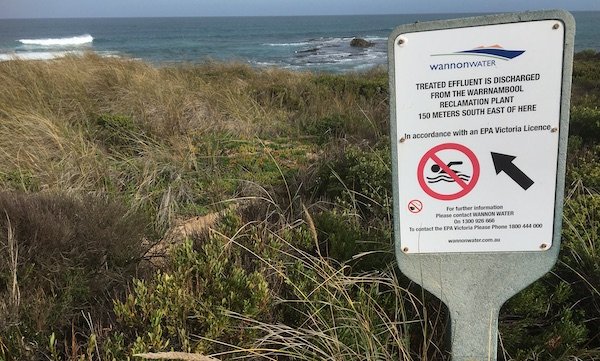
A decision on the Wannon Water treatment plant expansion has been delayed further while the EPA seeks more information on what will end up in the ocean near Thunder Point.
Carol Altmann – The Terrier
If you’re wondering what’s happening with Wannon Water’s $40 million Warrnambool treatment plant upgrade, here it is – a decision has been delayed amid concerns that waste collected from the abattoirs and saleyards contains animal faeces that could cause disease.
Charming, huh?
The Environmental Protection Authority (EPA) was due to make a decision on the controversial plant expansion by 12 March, but is now asking Wannon Water for more information.
According to the EPA notice issued on 26 February, Wannon Water denied that effluent collected from the abattoir would contain animal faeces, but the EPA was on to it:
“In contrast with what was claimed in the (Wannon Water) report, it is also to be noted that abattoir effluents do contain slurries and animal faeces”, the notice says.
The EPA sent Wannon Water back to the drawing board for a “deeper assessment of the pathogens that may be present in the wastewater” which – remember – will continue to be discharged into the ocean off Thunder Point.
This is a spot where, despite the warnings, people still fish and dive and collect shellfish, as you do, when at a beach.
The EPA is rightly worried about humans coming into contact with animal waste.
“Specifically, we believe that the report (from Wannon Water) does not consider the pathogens most likely to be present in the trade wastewater from the saleyards and the abattoirs.
“Rather than having a dilution effect, these wastewaters will add protozoa and bacterial pathogens.”
Pathogens = disease causing microbes.
Lovely.
Wannon Water no longer tests for micro-organisms such as E.coli, coliforms and enterococci within the so-called “mixing zone” off Thunder Point. As such, its planning submission quotes figures from 2018 and 2015 to estimate what levels can be expected after the upgrade.
Wannon Water must now re-evaluate these risks and, the EPA says, take into “proper account the risks posed by animal wastes” including from different types of animals.
Animal waste, however, is just one issue raised by the EPA in what is called a Section 22 notice.
The EPA has also asked Wannon Water to explain how adding an extra two processing tanks – from four to six – will cope with an almost doubling of the amount of effluent coming into the plant to 27.9 megalitres a day when it barely copes already.
As the EPA confirms and as has been captured on video by Good Will Nurdle Hunting, the plant “has failed multiple times”.
“Currently the plant is hardly rated at 16.4 megalitres a day as the plant has failed multiple times (dirty decants, failed nutrients discharge limits),” the notice says.
The EPA wants to know how much waste the expanded plant could reliably handle, and how it will cope if a tank breaks down, or is offline for repair, or – heaven forbid – both.
In that last, worse-case scenario, four tanks – the same as now – will be handling almost double the volume of sewage and trade waste.
No wonder the EPA is drilling into that detail.
In addition, the EPA wants more information on how much phosphorous and nitrogen will be coming in from (mostly) the dairy industry each year, and discharged into the ocean, and how these annual loads will be measured.
Lastly, the EPA has asked for a concise summary of exactly what Wannon Water has planned for the upgrade, given the many changes, public comments and back-and-forths that have happened since the project was first unveiled in 2017.
If the EPA is confused with the final proposal, no wonder the rest of us are.
I am, however, grateful to the EPA for making sure that Wannon Water nails all of this detail, as this upgrade is intended to last for the next 20 years.
Wannon Water had until 1 March to respond to the EPA notice but has not yet done so.
You can read all of the documentation on this upgrade and keep track of its progress through the EPA here.
Wannon Water sewage plant upgrade must reach for the stars
Betty Boop has nothing to do with Wannon Water and its treatment plant, but I am rolling out some stars to make sewage sexy.
Carol Altmann – The Terrier
Tonight I am rolling out the red carpet to make sewage sexy and effluent exotic, because we need to talk about the planned upgrade of the Wannon Water treatment plant.
This upgrade will service Warrnambool for the next 20 years.
I want to explain, as best I can, why before 1 July (when the chance for public comment closes) we need to ask for better from Wannon Water, to aim higher, and to stop using our beautiful ocean like a giant Maytag washing machine.
As it stands, Wannon Water plans to spend $40 million expanding the treatment works at the end of Elliot St, so it can double its capacity to eventually handle around 30 million litres of sewage a day by 2040.
This Wannon Water production should be a blockbuster starring the Brad Pitt of shit and the Betty Boop of poop and the Scarlett Johansson of industrial trade waste, except it isn’t even close.
It’s more of a B-grade movie starring faded stars of yesteryear.
That’s because the $40 million plan is the cheapest option and will not change the way our sewage is treated in the future from how it is treated now.
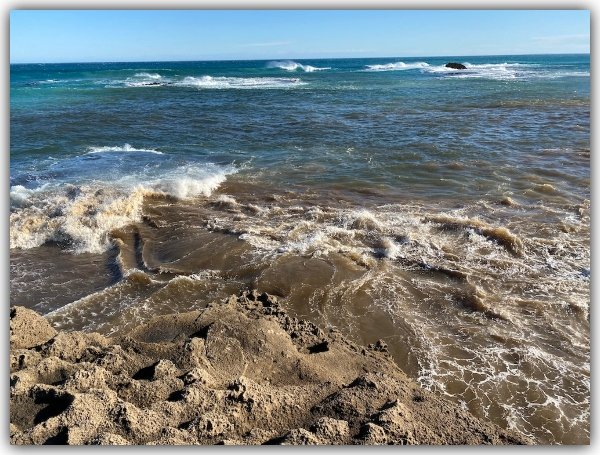
The ‘mixed liquor’ of treated sewage that entered the ocean off Thunder Point last month due to problems at the Wannon Water plant. Image: Beach Patrol 3280.
This means, in 2040, we will still be pouring millions of gallons of treated sewage/effluent into the ocean off Thunder Point using exactly the same treatment system as in 2020.
The COF is lobbying to have all waste water discharged to the ocean at a Class A+ standard by 2030 to reduce ocean pollution.
Warrnambool is not even at Class A now, and won’t be at Class A after the upgrade, let alone at A+.
Worse, our system often doesn’t work, as can been seen by what is called the “mixed liquor” (which sounds sexy, but is the revolting foamy brown stuff) which still turns up off Thunder Point.
What we should be aiming for by 2040 is clean, treated effluent that can be recycled and reused and doesn’t have to go into the ocean at all, but if it does, at least make sure it is not full of pollutants like phosphorous.
Right, how do I make phosphorous sexy?
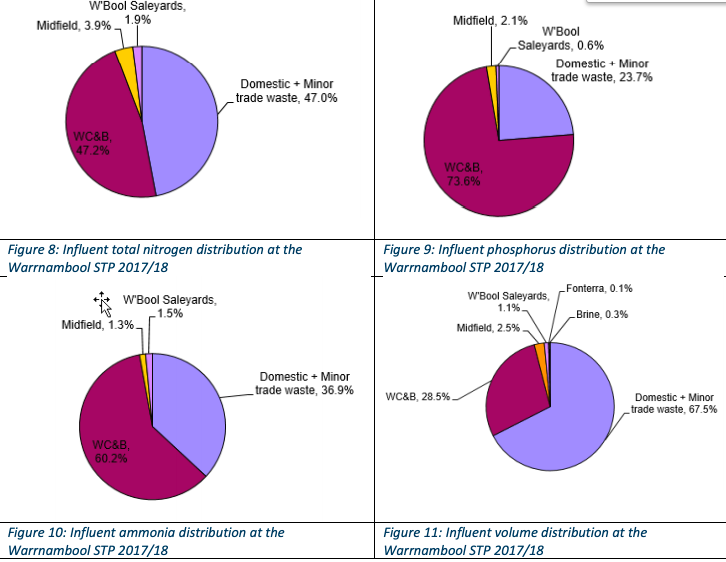
Well, here is a photo of a very sexy Brad Pitt, followed by a sexy Wannon Water graph that shows that Warrnambool Cheese and Butter – the burgundy colour – producing a Pitt-load of phosphorous, nitrogen and ammonia that goes into our ocean:
Warrnambool Cheese and Butter is owned by the Canadian giant, Saputo, which turns over about $11 billion a year.
Perhaps we could ask Saputo to throw a few million toward helping us make it to the Hollywood A-list by making sure our ocean had the cleanest effluent possible?
Or maybe Saputo could spend a few million dollars improving the treatment of its own waste before it makes anywhere near Wannon Water and into the ocean?
Another of the problems from this dairy trade waste is it’s extremely salty, which means the effluent water cannot be reused easily without burning everything along the way.
I found it astonishing that of the millions of litres of waste water produced by the Warrnambool treatment plant – 15 million litres a day – only 60 million litres a year is reused, and only at the plant itself.
In the scheme of things, 60m litres a year is an eye dropper full and the rest goes into the sea to swirl around in nature’s Maytag: not a drop is recycled or reused outside of the Elliot St treatment plant.
Wannon Water says it has investigated reuse projects and also tried to find customers for recycled water, but without success, no doubt because of the high salt content among other things.
So we have a treatment plant within walking distance of the Warrnambool Golf Course* and the new Younger St housing estate, yet no recycled waste water from the treatment plant is being used at either. (*Clarification: water was diverted from Fonterra, before it reached the plant, for use on the golf course. Please see comment from Dave at the end of this story).
Good grief.
If this is “green” Warrnambool under the Warrnambool City Council 2040 plan, then we have a long, long way to go.
Of course it all comes down to dollars and who pays.
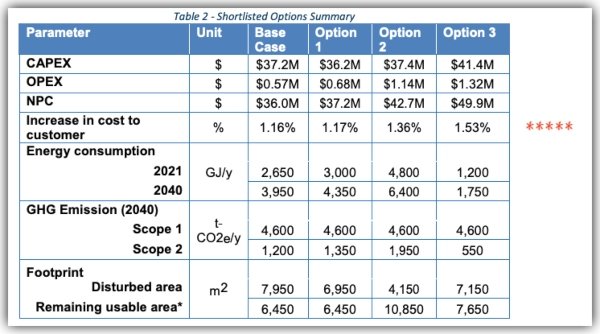
People, naturally, become nervous when Wannon Water talks about higher customer bills to cover the cost, but here is a photo of a beautiful Scarlett Johansson, under which we can see a beautiful graph showing the costs.
You will see that between the various options, it is really not that different – a range of 1.16% to 1.53%.
Is Wannon Water really that strapped for cash or ways to find it?
How bizarre that Lyndoch Living – a not-for-profit, community owned aged care home – can roll out out a $100 million masterplan, yet Wannon Water can only come up with $40 million for a major treatment plant expansion to service our city for the next 20 years.
Water treatment is complex, but I know we can do better than this, our kids deserve to inherit something better than this, and the Clean Ocean Foundation is right behind Warrnambool in its quest to ask for more.
The COF will appear in the blockbuster sequel to this story tomorrow night, offering us non-science-minded folk some starting tips for our submissions.
Flushing out the truth about Wannon Water’s fatberg failure
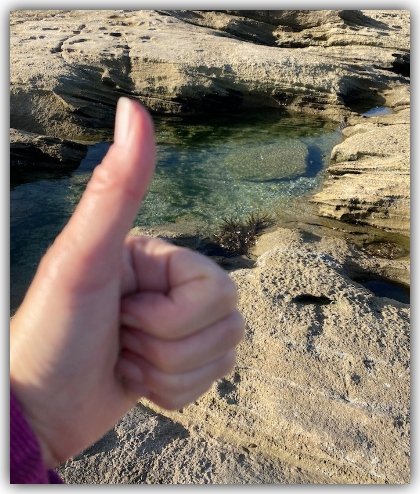
The Shelly Beach rockpools have been the cleanest they have been in years thanks to sustained pressure for better screening at the Wannon Water treatment plant. Image: Pick Up Sticks FB page.
Carol Altmann – The Terrier
That is eco-activist Colleen Hughson’s thumb and that is one very clean rock pool at Shelly Beach, near Thunder Point and both are worth a special mention tonight.
I want to acknowledge a small moral victory by Colleen, (who doesn’t know I am writing this, but who is surely one of the most determined people on this planet), and the diligent beach clean up crew who have been pushing for years for Wannon Water to clean up its act.
Ever since zillions of plastic nurdles landed in the ocean via the sewerage system in 2017 by some assbob who has never been held to account, Colleen and other like-minded souls have been pressing Wannon Water to lift its game.
This is because it wasn’t only nurdles, but a whole pile of other gunk that was making its way through the Wannon Water treatment plant and out into the ocean.
Cotton buds, tossed down the toilet by other, unthinking assbobs, are one major offender.
Another is a delightful thing called a fatberg, which is a stinky, smelly, fatty, hairy blob that forms in the scum of the Wannon Water treatment plant and – if not caught – ends up floating in the rockpools of Shelly Beach.
The Pick Up Sticks and Good Will Nurdle Hunting crew knew this stuff must have been coming via Wannon Water, but Wannon Water ducked and weaved and pretty much denied it was doing anything other than an exemplary job at catching the smelly gunk before it was flushed out to sea.
Wannon Water’s take on it was that fatbergs and any other gunk showing up at Shelly Beach must have been from elsewhere or it was “old” stuff being flushed back to shore. (Spin, rinse, repeat).
Rarely did their screening system fail, they said, when I toured the plant last October.
Except Colleen and the beach clean-up crew knew it was failing.
They could see the screens failed when they became completely blocked and overflowed (just like any sieve or kitchen drain).
And it failed every time the two screens, including a fine screen, had to each be taken out manually, scraped into a wheelbarrow or vacuumed, and put back again.
How such a clunky system involving a wheelbarrow and a vacuum cleaner was ever considered good enough in the 21st century is beyond me, but it was, for years and years.
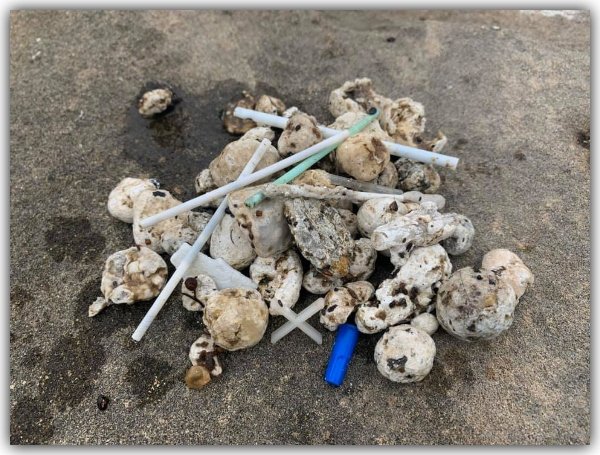
Some of the fatbergs, plastics, cotton buds and other assorted junk collected from Shelly Beach in February this year, before the new screens were added to the Wannon Water plant. Image: Pick up Sticks FB page.
After the nurdle spill in November 2017, Wannon Water announced plans to improve the screening system as part of its plant upgrade, but these changes were slow in coming.
A second, manual fine screen was finally added earlier this year, and a fully automated, $1.1 million screen was installed in April …. and no wonder.
Because what happened in between times was a big, fat pollution abatement notice was issued to Wannon Water by the EPA in February.
This notice confirmed what was always suspected: the manual screens were not always doing their job.
In fact when the EPA visited the treatment plant last November, the screens were 100% blocked and effluent, it said, may have flowed over the top.
Whats more, the EPA went back to the plant in January this year and actually saw the effluent overtopping the screens.
Not only that, the EPA visited the rock pools at Shelly Beach that same day and, guess what?
They found five fat balls and many smaller pieces of fat in just one rockpool: slam dunk proof of a failing system.
This is a story that I wanted to write two months ago, but it got bumped in the Covid 19 news whirl.
But it’s an important vindication of the hard work and pressure and activism by Colleen and the dozens of other activists who form the clean up crews: they were right all along, and now the EPA notice proved it.
The EPA notice ordered Wannon Water to fix its screening system by no later than 15 June this year, which it has done, and the Shelly Beach rockpools are the cleanest they have been in years.
There is no doubt in my mind that the sustained pressure of Colleen and the beach clean up crew has helped this to happen.
And yet, even now, Wannon Water can’t quite bring itself to say just that.
“The manual screening system, installed in November 2017, has performed extremely well and has been very effective,” managing director Andrew Jeffers said to me via email.
No, actually, it didn’t perform “extremely well” and it should have been improved years ago.
The fight to clean up our beaches from plastics and pollution goes on, but the small victories and vindications are worth celebrating and so, as Rod Stewart would say, tonight’s the night.
Terrier tidbits: rates, credit cards, shite and spending
Carol Altmann – The Terrier
Welcome to The Terrier Sunday Night Tidbits in easy-to-digest, meaty morsels:
1. Shelly beach is less stinky: the indefatigable Colleen Hughson and the whole Good Will Nurdle Hunting and Pick Up Sticks crew are reporting that the rockpools at Shelly Beach, near Thunder Point, are cleaner than they have been in years since another fine mesh screen was installed at the Wannon Water treatment plant in February.
I had almost forgotten what a crystal clear rockpool at Shelly Beach looked like, but things are set to get even better.
A fourth, fully automated, $1.1 million screen made in the US is being installed at the plant by Wannon Water as we speak.
By automated, I mean it is the first screen that will clean itself without having to be physically taken out and cleaned by WW staff, which must be a shitty job, to say the least.
If the rockpools are looking good now, hopefully they will soon be sparkling permanently.
A big, non-algae blooming bouquet to everyone involved in making this happen. I will write more about this whole water pollution saga soon.
2. Big fat rate rise on hold: The W’bool City Council has decided, because we are in very tough times, against raising rates by 4.5% again this year, which it was allowed to do after getting approval last year to break the rate cap for two years in a row.
This means rates will go up by 2%.
But before we stand and cheer, the rate pain is not over yet.
The council is still very keen to slap that 4.5% rise into place next year because, it says, it still needs the money to fix its assets.
From what I am reading, it’s going to take a couple of years at least for most businesses to get back on their feet after the crush of C19.
We have said this many times before, but surely more savings have to come from within rather than jacking up rates by 4.5% at a time when ratepayers will still be doing it very, very tough.
3. Borrowing more big bucks: Speaking of which, I see in the agenda for tomorrow night’s council meeting that the WCC plans to borrow $3 million for its share of Reid Oval, $2.5 million for its share of the new library at TAFE and another $3 million to restore and upgrade the old library space when it moves out.
What are the plans for this old library space that warrants a $3 million loan?
Please, please don’t tell me the council intends to spread out and use the old library for more office space?
If they do, then I want our old Post Office building back.
I would love to see it open to the public as an art space, communal space, cafe…anything but offices.
The fact this beautiful old building – one of the best in Warrnambool – is shut off to the public is a travesty and all you can see through the glazed windows are phone books and shadows.
4. Another resignation: Speaking of Reid Oval, the project officer for this $11 million project, Mel Starr, has resigned and taken up a job in Melbourne where – according to an email she sent to various sporting clubs – she can be closer to family.
As far as we know, nobody has been announced as a replacement, so perhaps one of the existing WCC managers will pick up the role at this crucial stage.
By the way, can anybody tell me if this Reid Oval upgrade, as it stands, will be enough to host AFL practice matches as we had hoped?
Or will more upgrades need to follow? I have been told it is the latter but haven’t been able to follow this up this weekend.
5. Cutting up the credit cards: And last but not least for tonight’s tidbits, the council agenda confirms credit card use is way down.
The number of transactions fell from 6757 in 2018-19 to 4139 so far in 2019-20.
Ombudsman Deborah Glass was on ABC statewide radio last Wednesday and said the investigation into the council’s credit card use was still ongoing. No release date for the final report has been given.
And that, terriers, is tonight’s tidbits. (The council will live stream its meeting tomorrow night at 5.45pm.)
[This is the C19 version of The Terrier : short, sharp and shiny posts straight to Facebook rather than longer, in-depth pieces to unearth where the truth bones are buried. Rest assured those pieces are simmering along behind the scenes.]
How can you dump piles of deadly plastic without detection?
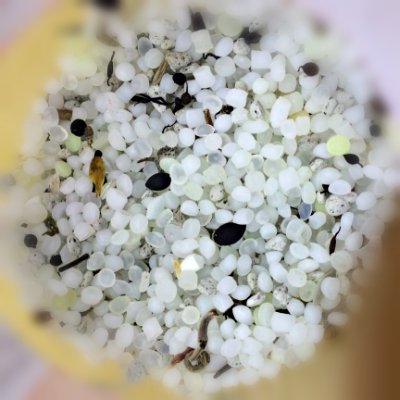
Pollution in disguise: Millions of micro plastic ‘nurdles’ were illegally dumped into the Warrnambool sewerage treatment plant last November. This image by Rosana Sialong shows how easily they can be mistaken by coastal wildlife for food. Image: Good Will Nurdle Hunting.
By Carol Altmann
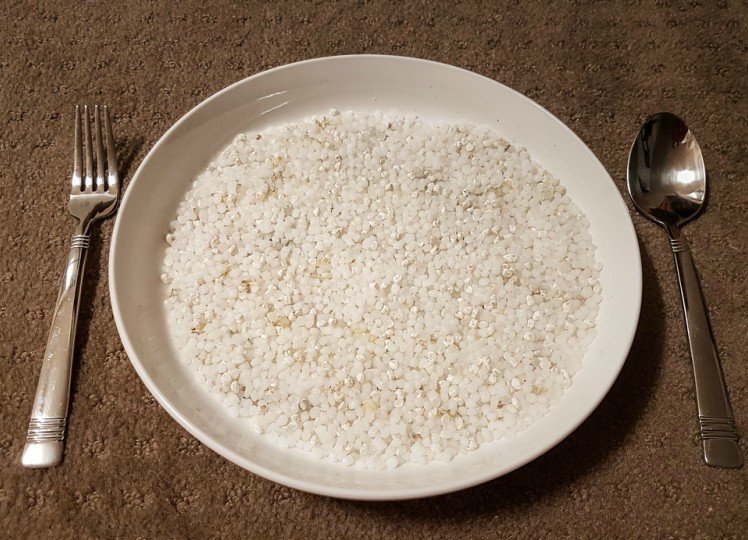
LAST November, millions of tiny plastic pellets (nurdles) were dumped illegally into Warrnambool’s sewerage treatment system – polluting our beaches all the way from Thunder Point to Yambuk – and still nobody has been found responsible.
How can this be?
This was a criminal act, but as Bob Brown said recently, crimes against the environment don’t attract police cars with their lights flashing and sirens roaring.
It was also, I suspect, one of the largest pollution spills ever recorded in Warrnambool and one from which it will take months if not years to recover.
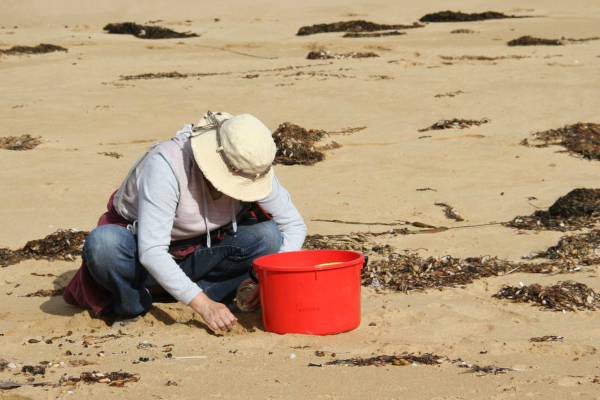
Even as I write this, the Good Will Nurdle Hunting action group – set up by film maker Colleen Hughson – and others, are still laboriously picking up thousands of nurdles to avoid them getting stuck in a seabird’s gut and killing them.
And yet five months on, Wannon Water, who is responsible for accepting and treating the waste that comes into the Warrnambool plant, appears no closer to finding a culprit.
In these days of swipe cards, security codes, security cameras, trade waste controls, random testing, checklists, computerised logistics and god knows what else, this seems inconceivable, but it is the current reality.
It is also astonishing that Wannon Water didn’t know exactly what was being poured into its treatment plant on or around November 16.
This might be a harsh assessment if we were talking about the general sewerage system that caters for tens of thousands of customers from across the south-west, including those stupid enough to flush all manner of junk down the loo.
But in this case, the search is not a needle-in-a-haystack scenario, but actually quite narrow.
Local artist Megan Nicolson collected almost 2000 nurdles in one sweep around Shelly Beach on April 17, and they just keep coming. Image: Good Will Nurdle Hunting
BEAR with me for a second while I lay this out, because it is critical as to why this spill is considered by many to have been avoidable and why so many people are still angry and demanding answers.
Wannon Water has confirmed that the plastics came into its plant through what is called a Sludge Acceptance Point (SAP). This is where authorised tankers deliver gunk collected from authorised customers. You need a key and a swipe card to get in. In other words, it is not open to just anybody.
As Wannon Water managing director Andrew Jeffers said by email, “WannonWater’s system is secure and only able to be accessed by approved customers. Volumes received at this point are only a very minor proportion of the total volume of sewage treated at the Warrnambool plant.”
Of these SAP customers, Wannon Water has identified 20 sites that were inspected as part of its investigation, including some sites that might use nurdles or raw plastic.
Yet despite nailing it down to just 20 likely sources, none of these inspections, it seems, has come to anything.
Knees down, back bent, nurdle collector Rosana Sialong is one of the many locals still trying to remove the nurdles from the Shelly Beach area. Image: Good Will Nurdle Hunting.
WANNON Water declined to list the 20 sites inspected, or to reveal much of anything about its ongoing investigation, so I asked five local, large industries directly if they had any knowledge of the spill.
Here is what they said:
Midfield Meats: “Midfield doesn’t use nurdles in any processes.”
Murray Goulburn: ‘MG does not use Wannon Water for its effluent disposal. We have our own wastewater treatment system and spray irrigate on to our farmland. In addition, MG does not use a product of this nature in any aspect of its manufacturing.’
Beach Energy: (owners and operators of the Port Campbell gas field, formerly operated by Origin Energy): “No nurdles are used in production on site.”
Fonterra: “I’ve spoken to our site environment manager and can advise that we don’t use nurdles in our production processes”.
Saputo/Warrnambool Cheese and Butter: The questions have been sent to Saputo communications in Canada – still waiting a response.
And what about two of Warrnambool’s septic and trade waste collection services, Berminghams and Sergeants? What do they know?
Sergeants: “As the records would state (we) didn’t dispose of any liquid waste at the Warrnambool facility during the months of October, November or December”.
Berminghams: “We have nothing to tell you about that.” The person said on the end of the phone before ending the call.
Lastly, I called Bartlett’s Environmental in Geelong.
Bartlett’s are contracted to clean the Wannon Water sewer pump stations and truck the sludge to the SAP, so maybe they unknowingly sucked up a load of nurdles around November 16 last year?
At first Barlett’s offered to look into it, and then, a day later, its general manager John McCoy emailed: “For all matters regarding contract work undertaken by Bartlett’s Environmental for Wannon Water, please refer all questions directly to Wannon Water.”
Mr Jeffers, who declined to be interviewed directly for this piece, said via email that Wannon Water had since ruled out the plastics coming in via sludge from a sewer pump station.
So around and around and around we go.
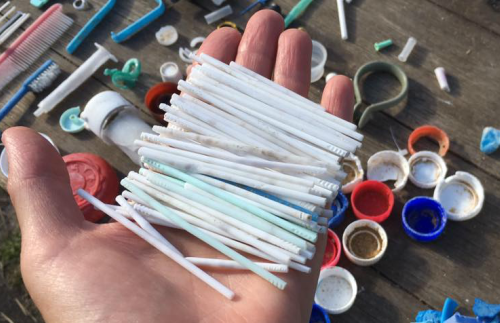
Thousands of cotton ear bud sticks, like these collected on April 20, were considered by many to be the canary in the coal mine on the pollution problem. Image: Pick Up Sticks Facebook Group.
WANNON Water appears keen to find out who has caused it such grief.
It is even using the skills of a private investigator, retired police officer Mick Fennessy, who is a big, no-bullshit kind of guy, to try and flush out the truth.
But what this spill has exposed is not only an environmental vandal in action, but a gaping hole in how the Warrnambool treatment plant has operated – quite legally – to date.
Wannon Water has now realised that its screening systems were not good enough, both before sludge was poured into its plant, and once it passed through.
What has happened since this spill is that two, finer screens have been installed at the treatment plant to catch anything larger than 1.5mm before it reaches the ocean.
Wannon Water is also “now supervising all loads coming in” to the SAP, according to Mr Jeffers.
Both of these are important changes but, some argue, they should have been made immediately when thousands of cotton bud sticks appeared at Shelly Beach en masse in 2015 and turned up in vast numbers again last August.
The slim white sticks were considered to be the canary in the coal mine, sending a highly visual warning that thousands of litres of small plastic could be passing through the Warrnambool treatment plant to the ocean.
Nothing, however, was done, despite Wannon Water being told about the pollution.
“Both the Environmental Protection Authority and Wannon Water were informed by myself and others of the sticks, but they either didn’t believe me or were unwilling to do anything about it,” said Luke Foster, a local plumber and member of Good Will Nurdle Hunting.
If the new 1.5mm screen had been installed before November 16 last year, the argument goes, very few of the millions of dumped nurdles would have made it to the ocean.
“I am happy there is now a 1.5mm screen at the end of the waste water treatment plant to capture these plastics. However, it may be a long time before we are able to remove the majority of plastics that remain in the marine environment from past pollution,” Mr Foster said.
Mr Jeffers, however, has distanced Wannon Water from any responsibility for the cotton bud sticks.
“WannonWater does not believe the cotton buds were related to the current sewage treatment plant nor the nurdle incident,” he wrote.
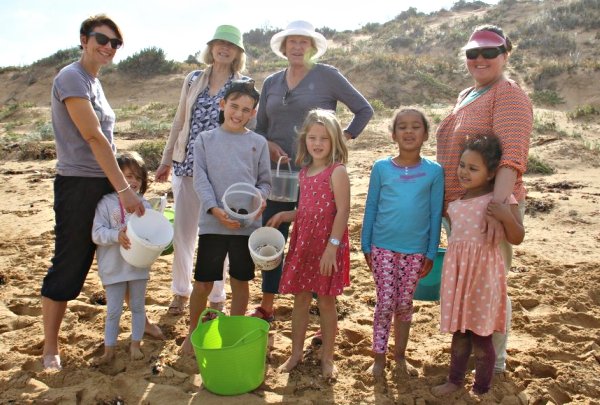
Some of the many Warrnambool locals who have joined he clean up effort at local beaches. Image: Good Will Nurdle Hunting.
THERE is a lot at stake for Wannon Water from this pollution problem, with the EPA continuing its own investigation into potential breaches of the Environment Protection Act by the treatment plant.
As EPA South West manager Carolyn Francis outlined, the maximum penalty through the courts for a breach of an EPA licence is $380,568. The EPA can also directly issue Infringement Notices of $7729.
There is also, of course, the need to reassure the public that Wannon Water is top of its game when it comes to handling pollutants: preventing them from entering the system in the first place and catching them – and the polluters – when they do.
Catching the nurdle culprit so long after the event, however, appears increasingly unlikely and yet time alone, surely, cannot be an excuse to give up the search. We deserve answers.
In the meantime, Colleen Hughson, who really got the ball rolling on the public clean-up, says she has been amazed by the community response.
“The most heartening thing about the nurdles spill is the amount of ‘good will’ the community has shown in coming together to clean the mess up.
“(It) has also highlighted the bigger issue of marine plastic pollution and many people in my community have been inspired to look into ways of curbing their own consumer habits to stop the flow of plastic waste. It’s brought about conversations, generosity and a willingness to take positive action.”
Do you know anything about the illegal dumping of the nurdles? If you do, contact me at altmanncarol@gmail.com
For information on Wannon Water’s response to the nurdle spill, including media releases, clean-up activities and ongoing updates, visit its dedicated webpage here.