Huge changes afoot as Midfield Meats makes it move
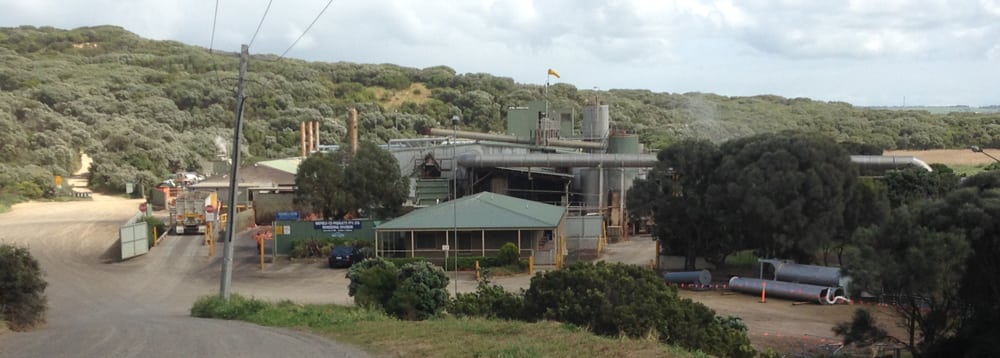
The Midfield Meat rendering plant at Levy’s Point will be shut down and its operations moved to Scott St, Merrivale, under plans officially released today. Image: B&R Enclosures.

By Carol Altmann

Midfield Meats is again shaking the earth around Merrivale and beyond with plans – officially released today (29/8/18) – to shut its rendering plant at Levy’s Point and build a new, $18 million plant next to its abattoir in Scott St.

This is a momentous move, with implications all round.

On the upside, if the relocation is approved by the EPA and Warrnambool City Council, it will free up the Levy’s Point land for the first time in 53 years and shut down what is one of the greatest assaults to the senses ever encountered by cyclists innocently peddling along the rail trail.

The place stinks and when the big gate is open, it is a horror show.

It was only three years ago that Midfield fought and won a long battle to remain at Levy’s Point, but the conditions around that approval – it seems – will cost more in the long run than moving to a new, purpose-built, super-dooper plant at 24 Scott St.

Except…

24 Scott St is near houses – the residential zone is just 250m away.

And 24 Scott St is near a primary school – just 400m away.

These are the two things that Merrivaleans, and others, pointed out when Midfield decided in 2014 that it wanted to build a powdered milk factory in Scott St.

After a huge battle, that project was also approved, but has not yet been built.

Merrivaleans must be exhausted from fight after fight, but it is not only those who live there who need to get their heads around this plan, it is all of us, because it signals a major and permanent change to a part of Warrnambool that is a lot closer to town that Levy’s.

You can read the whole 27-page plan here but here’s a quick summary from the EPA:

– two processing lines, processing up to 400 tonnes a day;

– operating hours will be between 7pm-12am weekdays and 1–5pm on Saturdays, but it will have the capacity to operate 24 hours a day, seven days a week

–  a new, purpose built bio-filter;

– processing carried out in an enclosed building;

– wastewater from the plant and abattoir will be combined and pretreated at the recently upgraded onsite wastewater treatment facility before discharging to the sewer;

– improved energy efficiency, less transport movements and water consumption and eliminate amenity impacts when compared with the existing facility;

– key environmental issues are odour emission control and Q-fever risk management;

– other issues are stormwater management and noise controls.


Nobody can argue against building a better plant, but just like the milk powder factory before it, the concern is not only with what is being built, but where it is being built.

The best rendering plant in the world is still a rendering plant, and I am not sure if that is what we want a stone’s throw from houses, a school and less than 2km from the Warrnambool Base Hospital.

While Scott St is an industrial zone, Warrnambool’s growth has caught up with it. What was once on the edge of town is now within it.

There is no doubt Midfield is an important player in Warrnambool but it has changed too: it now operates on a global scale and, in 2017, was ranked number 769 out of the top 2000 companies in Australia.

According to IbisWorld, Midfield Meat International generated a total revenue of $510,270,000 in 2017. That’s not all profit, of course, but not a bad turnover for just one year.


Given the huge success of Midfield, perhaps it is time to ask why it can’t invest in moving its entire operations right out of town, away from wetlands and houses and schools and our ever-expanding suburbs.

Surely this would provide a solution that works not just for the next 10 or 20 years, but for the next 100, and both Midfield – and Merrivale – could rest easier.

A public information session on the plan will be held from 4pm-6pm, 18 September, Archie Graham Centre, Timor St, Warrnambool.


If you would like to support local, independent journalism, please make a small contribution below.

Donate


Hot off the presses: Deakin plan

[box]This is the media release in full just issued by Deakin University:[/box]

warrnambool deakin campus
Warrnmabool Deakin Campus: Image, Deakin University.

DEAKIN WARRNAMBOOL HERE TO STAY

 Monday, 3 October 2016

[dropcap style=”color: #a5cecd;”]D[/dropcap]eakin University has today announced a proposed ongoing, long-term and more sustainable model for its Warrnambool Campus that will see it continue its role as the region’s higher education provider.

Vice-Chancellor Professor Jane den Hollander said it was not possible for Deakin to remain in Warrnambool on a business as usual basis, in the face of declining enrolments and increasing annual losses.

“If something does not change these losses are predicted to rise and the campus is increasingly unsustainable,” Professor den Hollander said.

Professor den Hollander today met with Warrnambool Campus staff and students to confirm the University’s commitment to the region and discuss proposed key changes to the current Campus model which will:

  • ensure a student experience at Warrnambool consistent with Deakin’s LIVE the future strategy and equivalent in quality to student learning outcomes at other Deakin campuses;
  • fulfil Deakin’s public purpose; and
  • address the financial losses of the Campus.

Deakin will continue to explore opportunities to grow and sustain the campus into the future, including the consideration of a new Bachelor of Agribusiness unique to the Warrnambool Campus.

Professor den Hollander said Agribusiness could be an exciting new course that plays to the region’s agricultural strengths.

“We will work with the community to explore whether there is sufficient demand to get this new Bachelor of Agribusiness up and running,” she said.

Jane-Den Hollander
Deakin Pro Vice Chancellor Jane Den Hollander. Image: Deakin University.

Deakin will continue to identify other opportunities and create strategies for new and expanded offerings at the Warrnambool Campus, including increased work integrated learning and internships, expanded use of Trimester 3, exploring the international markets, both for in-bound students and on campus international programs, potential expansion of Associate Degrees, maximisation of pathways with South-West TAFE, VCE extension studies and potential opportunities for development of Deakin’s Institute of Koorie Education programs.

“Deakin will further consult with the Victorian Government, SW TAFE and regional schools to ensure community and industry support for higher education and Deakin University in South West Victoria,” Professor den Hollander said.

“We will focus on the courses for which there is demonstrated demand and strong graduate employment outcomes,” Professor den Hollander said.

Under the proposal, Deakin will continue to offer Nursing, Midwifery, Health Sciences, Psychological Sciences, Education (Primary), Commerce, Environmental Science (Marine Biology), Law and Commerce/Law at the Warrnambool Campus. Deakin will also continue to offer the Associate Degree of Education and several PhD courses.

Professor den Hollander emphasised that all students currently enrolled in non-ongoing courses at the Warrnambool Campus will be able to complete their studies at the Campus.

”A reduction in staff numbers as a result of the proposed decreased course offering would be necessary, but this will be worked through compassionately and via a period of consultation with staff, beginning today, Professor den Hollander said.

The consultation process will help to determine how the reduction in staff numbers will occur, including the option for a voluntary separation process.

Other aspects of the proposed model include closure of the Warrnambool Corporate Centre and rezoning of parts of the Campus that the University does not require. Professor den Hollander said Deakin acknowledged the State Government for its support of the proposed rezoning.

In addition to its Warrnambool Campus, Deakin’s strong presence in the South West region will continue, including through the School of Medicine’s Clinical School at South West Healthcare, Deakin Rural Health’s integrated program of research, education, the Centre for Farmer Health and the Centre for Rural Emergency Medicine.

Professor den Hollander acknowledged the financial support promised by the Federal Government to support Deakin’s transition to the proposed new Campus model.

“Deakin appreciates the work of the Member for Wannon, the Hon Dan Tehan, who has facilitated this support,” she said.

“We look forward to the active support of local industry, education institutions and the community in general to help ensure the success of the proposed new Campus model. Support will hopefully include provision of student work placements, internships and scholarships.

We look forward to working with the community to grow a new model that better suits the current era and the growing knowledge economy. This model will include both face to face and digital learning experiences so that those who study at Warrnambool receive an education that enables them for the jobs of the future. That is our focus.”