Lyndoch and WCC fail pub test while ruining public reserve
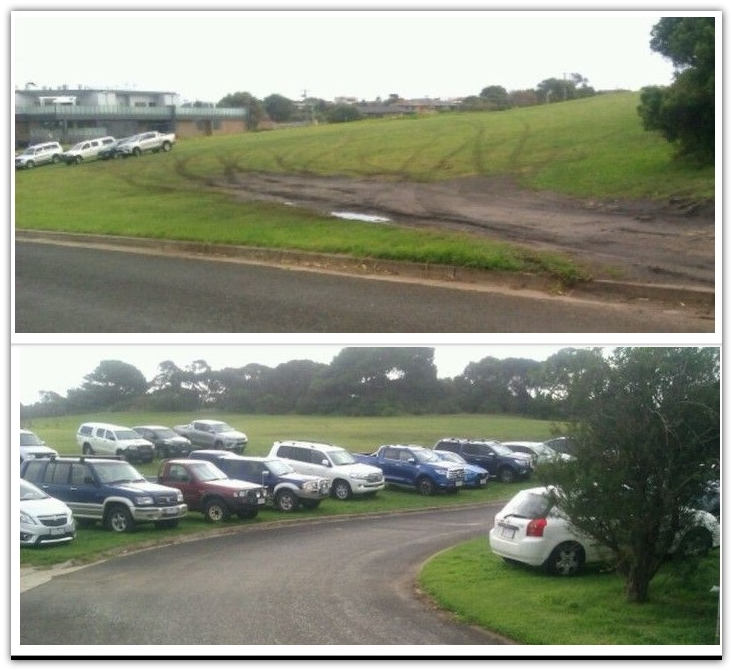
The scars of multiple Lyndoch Living staff cars parking illegally on Scoborio Reserve. The WCC is “working” with Lyndoch to find a solution.

Carol Altmann – The Terrier

Look closely, this is the slow ruination of a public reserve by Lyndoch Living through ongoing, illegal parking with impunity.

They are photos of Scoborio Reserve, a public reserve on the north side of Lyndoch and the original site of the Warrnambool botanic gardens.

It is named in honour of a head gardener, Charles Scoborio.

It’s a place where a few remnant scraps of native vegetation cling to what used to be a rich habitat along the banks of the Hopkins River as part of the Peek Whurrong lands.

Yellow-crested black cockatoos, pink-chested galahs and nesting magpies still like to hang out there.

And now, bit by bit, it’s being lost to the expansion of Lyndoch.

Lyndoch is turning the eastern end into an unofficial staff car park because it has failed to ever provide enough staff and visitor parking on its own land.

The reserve is becoming a mud bath.

What was once a handful of cars has grown to 30 or more a day.
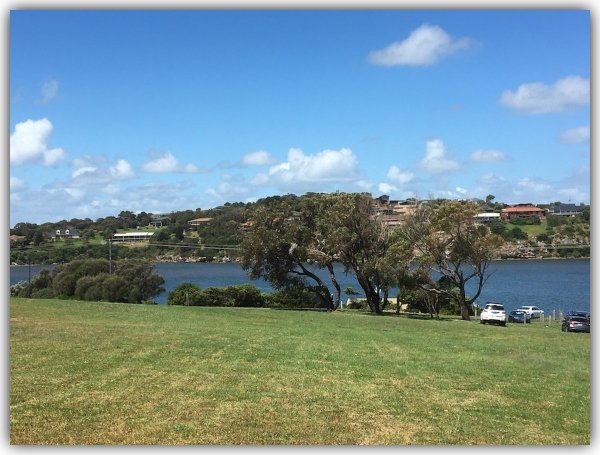
2019: the eastern side of Scoborio Reserve as it used to look, before it became an unofficial and illegal Lyndoch carpark.

That’s because the opening of a mini medical clinic at Lyndoch and demolition work for the $22 million medical clinic has pushed scarce parking on site to breaking point.

Lyndoch has even had the gall to direct staff – in writing – to park on land that it doesn’t own because it couldn’t be bothered to find its own solution.

And what have the WCC officers done about it?

They haven’t, as you might expect, told Lyndoch to stop.

In fact they haven’t moved one inch to protect the reserve from this illegal activity.

No, what they have done is actually far worse than doing nothing: they are looking at ways to let it go on.

The council officers – NOT the elected councillors* – are busily working to solve a problem that is not their problem and are offering up a piece of public land in the process.

In other words, if Lyndoch breaks the law, the council doesn’t fine them, but bends to them.

What a disgrace.

I wish I could say this was a one off.

You may recall the large corporate sign that was installed on the side of Lyndoch last November without a council permit.

Seven months on, the permit application (lodged after The Terrier story) is still being processed.

The illegal sign is still there.

Lyndoch is also, as we speak, committing an offence under the State Planning and Environment Act by ignoring the permit conditions for its mini medical clinic.

Part of the permit issued by council staff (NOT councillors*) included a clear traffic and parking plan.

This plan has been completely ignored by Lyndoch ever since the clinic opened on 4 April.

Has anything happened as a consequence? Was the clinic forced to close immediately?

No, of course not.

And here comes the pub test.

All of these breaches are happening while the WCC chief of planning, Andrew Paton, sits on the Lyndoch board.

He is also a director of the Warrnambool Medical Clinic, a commercial, private company owned by Lyndoch that is driving the $22m project.

Former WCC Acting CEO and community services manager Vikki King is also deputy chair of a board chaired by the Lyndoch CEO and managed by Lyndoch.

How is it okay for senior council managers  – a chief planner and a former Acting CEO no less – to be anywhere near an organisation that requires multiple council approvals* as part of its expansion?

(You might also recall the secret talks between Lyndoch and the WCC about 18 months ago to sell off part of Scoborio for a childcare centre before exposure by The Terrier cut that off at the pass.)

The WCC says Mr Paton has declared a conflict of interest in all planning and applications from Lyndoch* and has not been involved in any decisions.

And Mr Paton, for his part, told me both positions he holds with Lyndoch are, “to date”, voluntary.

I have no doubt Mr Paton has acted with integrity, but that is not the point.

The question is, why would he put himself in that position in the first place and why would the WCC allow it?

If Mr Paton was a board member of a building company that was rolling out $100m worth of housing on Hopkins Rd hill, eyebrows would be up.

Why is it not the case here as Lyndoch rolls out a $100m masterplan*?

This is precisely the “wheels within wheels”, “who-you-know” rubbish that the people of Warrnambool are sick of.

We are all tired of doing the right thing – applying for permits, parking within the lines, paying our fines – while others sail past in the express lane of exemption and ruin public property in the process.

Insiders and outsiders.

As I wrote after the Schneider court victory, those days are done and it’s time for the WCC to end it, regardless of who is in charge.

* Not one part of Lyndoch’s $100m masterplan so far has gone to full council for approval by the elected councillors. Each part has been signed off by delegation.


Lyndoch: red spots, black spots, cold walls and lights out

Carol Altmann – The Terrier

As the year comes to a close, I wish I could do more for those who contact me about Lyndoch Living.

Whenever I write about Lyndoch aged care, I get a stream of messages from readers, most of whom thank me for just listening, even if I can’t help.

People care about Lyndoch and its residents, including the staff who have to go to extraordinary lengths just to get a message to me, for fear of being “caught” talking to The Terrier, but also the families of residents, and friends of residents.

I find so many of these messages heartbreaking and I feel powerless, because I can’t fix it.

All I can do is tell you – the wider community – what I have learnt and what I have investigated and hope that you, like me, won’t look away.

Like this message from a reader about the new $13 million Swinton Wing extension:

“..residents from (Tomlinson) have now been moved to the second floor of the new “dementia building” (my words). This means that all ambulant dementia residents are now “trapped” upstairs with no free access to an outside area where they can feel the breeze or sun on their face, walk on a “return” path through an enclosed garden area, and see birds hopping around.

“They now have no chickens to care for and secured outside areas for unsupervised activities are now nonexistent. ….. the new building is very impressive and state of the art, but soulless and clinical.

“Whoever thought that this was an improvement to the quality of residents’ lives has no understanding of the ageing and their needs. My alarm bells are going off and I feel this needs further investigation. Please.”

Please.

This is the new Lyndoch, I have learned, where pictures are not allowed on the new walls of the new rooms and the new TV that comes with the new room is the one a resident MUST use, even if they don’t know how to work the freakin’ new remote control.

And then there are the messages about “the rash”.

I have had so many messages about a “rash” that has been coming and going through the Audrey Prider Centre at Lyndoch for six months and I can – at last – write about it because the Australian Nursing and Midwifery Federation (ANMF) has taken up the issue on behalf of their members – the nursing staff on the front line.

In a letter to Lyndoch last week, the ANMF has asked the question up front: is this rash scabies? And if it is, what is being done about it, and what has been done to support residents and staff?

The union has asked for a response by tomorrow (Dec 4).

If this rash is not scabies – I have since heard that it ISN’T – then what is it?

It is enough to have staff and family of some residents demanding more answers.

Another worry that has filtered through to The Terrier these past weeks is the mobile “black spots” within Lyndoch that means families calling after-hours to check on sick loved ones are finding the phones are either not answered (because nursing staff are in a black spot) or the call drops out.

All of those millions spent on expanding Lyndoch – and adding an IT specialist to the executive team – and the phone system is unreliable.

Perhaps instead of worrying about awards and nominations and getting its name up in fairy lights, Lyndoch needs to make sure it responds to these concerns – and I am only able to share a few of them here.

Speaking of lights, the big, new, illuminated, illegal corporate logo on Swinton Wing will be approved retrospectively by the WCC, but will not be lit up.

The lighting breaks the planning laws, but it took neighbours to tell them that.

Given the WCC head of planning is on the Lyndoch board, we can only assume that he had no idea this sign was going ahead.

I really hope Lyndoch receives a refund on the LED.

And I really hope that those who have concerns and fears and worries about Lyndoch will keep speaking up and find the strength to stand up, to light up, knowing that we – the community – has their back.

On we go.

[This is my last post for 2020. Thankyou so much to all of the terriers who have helped The Terrier to keep going in more ways than one. You are the voices behind this voice and I couldn’t do any of it without you.]


Historic trees could have been saved

Opinion/Analysis by Carol Altmann

[dropcap style=”font-size: 35px; color: #8cc7d0;”] D [/dropcap]o you remember the two giant Norfolk pines that were cut down at the Warrnambool Police Station late last year?

I do, because I couldn’t believe the Warrnambool City Council didn’t try harder to save them – but, as I have since learned, they actually ignored their own advice to let the chainsaws in.

Here is a photo of what we are talking about, taken after the limbs were cut off in preparation for their full removal last August:

The two mature Norfolk pines being prepared for removal in August 2016.

These weren’t just any old trees.

The pair had historical links to the beautiful Church of England property next door (built in 1855) and were considered so important by the council that they were specifically mentioned in the planning permit issued in 1996 for the new Warrnambool Police Station in Koroit St.

In particular, the trees were not to be “removed, destroyed or lopped” without written consent from the council.

The new station opened in 1999 but, it appears, had immediate problems with drainage and flooding which to me says more about a poor build in the first place rather than the position of the two trees.

In 2005, a member of Victoria Police – I don’t know who, because names have been redacted from the Freedom of Information documents I received from the council – sent the council an email, saying the pine trees were continuing to cause water damage to the new building and needed to go.

“All advice we have and our own observations tell us that out problems will continue whilst the trees remain in place. I seek approval to remove both of them forthwith,” he/she wrote.

Two weeks later in November 2005, a council officer wrote a detailed response on behalf of the council’s Built Environment Committee.

The most important paragraph of that letter is this:

“…the trees have a positive contribution to the streetscape, have demonstrated historical links with the church property next door, clearly the intention of the endorsed plans is to retain the trees and therefore the removal of the trees should only be considered as a last resort.” (my emphasis)

Crucially, the council also recommended the police obtain a Structural Engineer’s report on what could be done to either the building (eg. adding more gutters) or to the trees (eg. root barriers) to fix the problem.

The council even offered the police a free arborist service and access to its Heritage Advisor.

But neither happened. In fact, nothing happened.

Fast forward five years to 2010 and the police wrote to the council again and – again – asked how it could get rid of the trees.

This time, however, there was no detailed response, but a six-line letter from a different council officer to that who responded in 2005.

And this time, the historic trees were suddenly considered dispensable because they might – might – cause problems.

“Given the retention of the trees is likely to be problematic, Council does not object to their removal,” he/she wrote. (My emphasis).

It is hard to get a sense of the size of the remaining tree stumps, but you could stand on them and stretch out your arms and your fingertips. I hope that helps.

I am not sure when a written permit expires, but it took a further six years before it was used to cut down two Norfolk pines that were apparently causing so much trouble.

No wonder so many people were shocked – at no time has there been any public information or discussion about the trees, despite their significance.

Instead, a six-year-old permit, issued behind closed doors and by a different group of councillors (if they knew about it at all), was enough.

I have tried to talk to the police about why they removed the trees now, more than 10 years after they were considered a dire problem. They didn’t respond.

As such, I am unable to confirm one story doing the rounds that the space will be used for extra car parking.

Surely not.

Now some of you will be shrugging your shoulders and saying, oh, they were just trees, but to me this sequence of events reveals so much about the weakness of our planning laws, the way decisions are made in private and then how they are pitched to the public.

As custodians of our natural and built heritage, we can surely do better than this.

[box]You can see all of the Freedom of Information documents relating to this story here and here.[/box]

This is the first of three Terrier pieces that will be free to access. If you would like continued access, please become a paying supporter by clicking the box below.

Donate