Illegal sign, unfinished tavern, expose set of double standards
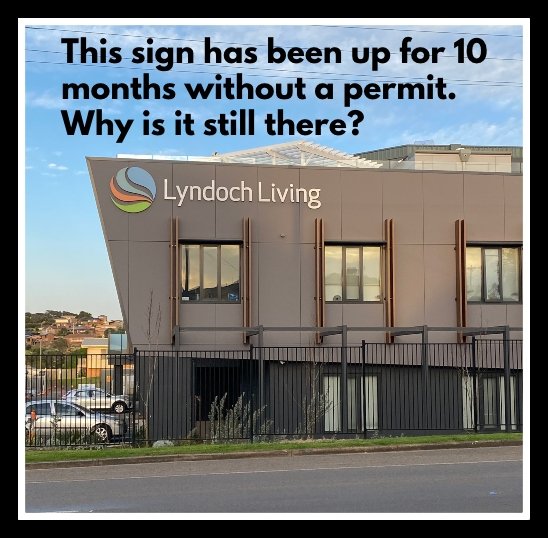
A 5m corporate sign on the side of Lyndoch Swinton Wing was installed without a permit and is still awaiting approval.

Carol Altmann – The Terrier

What does an illegal sign, a half-built tavern and being woken by trucks at 6.30am on a weekend all have in common?

They are shining examples of the failings of planning laws that are supposed to help protect the rights of Warrnambool residents.

I am sure you have examples of your own, but let me pick out three, including two I know well, because they stem from my own neighbourhood.

The first is a textbook case of “just do it, and ask later”.

It’s the 5m-long, illuminated sign that was installed on the side of Lyndoch Living last November without a permit.

You know the one – Lyndoch didn’t bother to apply for a permit, perhaps thinking nobody would notice, even when it was switched on at night.

Such an illuminated sign is illegal in a residential area, so after complaints to the Warrnambool City Council, it was switched off.

The sign, however, is still there.

It’s still awaiting a decision on a permit lodged belatedly in December.

That was nine months ago*.

“The non-compliant sign remains an open enforcement matter which Council continues to work on,” is how the WCC spokesman put it.

Why hasn’t it been taken down in the meantime? Nobody from the council staff can tell me.

And what have been the consequences for Lyndoch acting without a permit in the first place? Zero.

Just as the penalty for Lyndoch digging a road through a public reserve was zero.

And just as the penalty for Lyndoch failing to apply the parking and traffic plan for its medical hub was zero.

Laws, schmaws. Who cares? Move aside.

All of this has unfolded at Lyndoch while WCC director Andrew Paton sits on its board and former councillor Sue Cassidy is chair. Have they not noticed?

The latest battle for residents around Lyndoch is construction noise from the new medical clinic.

At least five times in the past seven weeks, nearby residents – including a 90 year old widow and a frontline shift worker  – have been woken by noise before 7am weekdays and 9am on Saturday.

This is against the noise laws.

The council, which enforces these laws, has been alerted and has in turn alerted the construction company, Nicholson, but still the breaches go on, including this morning.

Consequences so far? Nothing.

A spokesman for Nicholson said this afternoon that it “places the utmost importance in complying with all regulations including EPA and local Government.”

“We would like to re-assure all residents on Hopkins Road that (we)  take any and all complaints very seriously and would encourage any residents with concerns to engage in direct dialogue with us.

“Nicholson Construction will be contacting neighbouring residents in the coming days….”.
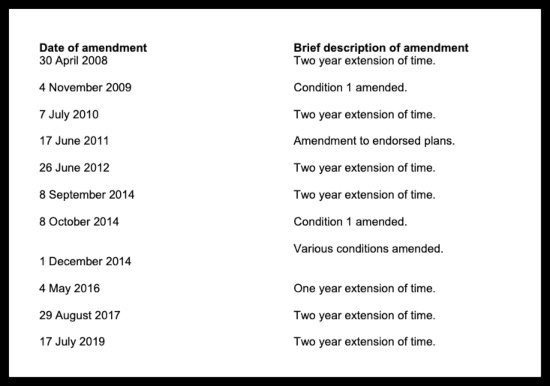
The timeline for the Northpoint tavern and its string of extensions and amendments.

Let’s shimmy across to north Warrnambool and the running sore of the Northpoint tavern/hotel on Hayley Drive which has been unfinished for 15 years.

Fifteen years – is this a record?

This half-built project has been through four councils and is about to ask for yet another extension from a fifth.

Any consequences or penalties after 15 years?

Zero.

What a complete failure of planning laws and what a complete failure to protect residents from a half-built eyesore.

Meanwhile, the average Warrnamboolian is cut no such slack for breaking the rules.

Imagine any of us trying the same arguments as above to avoid, say, an $80 parking fine:

You: “Sorry, I forgot I need to pay for parking.”

Local laws: “Okay. No problem.”

You: “Oops! I need a bit more time. Just another hour and I am on to it, promise”.

Local laws: “No stress. Chill!”

You: “Actually, something has come up, do you mind if I park my car here all day and sort it out tomorrow?”

Local laws: “Great idea. See you then!”

In your dreams.

* I was co-signatory to an objection to this sign in January. In the interests of full disclosure, you can read the objection here.
Lyndoch and WCC fail pub test while ruining public reserve

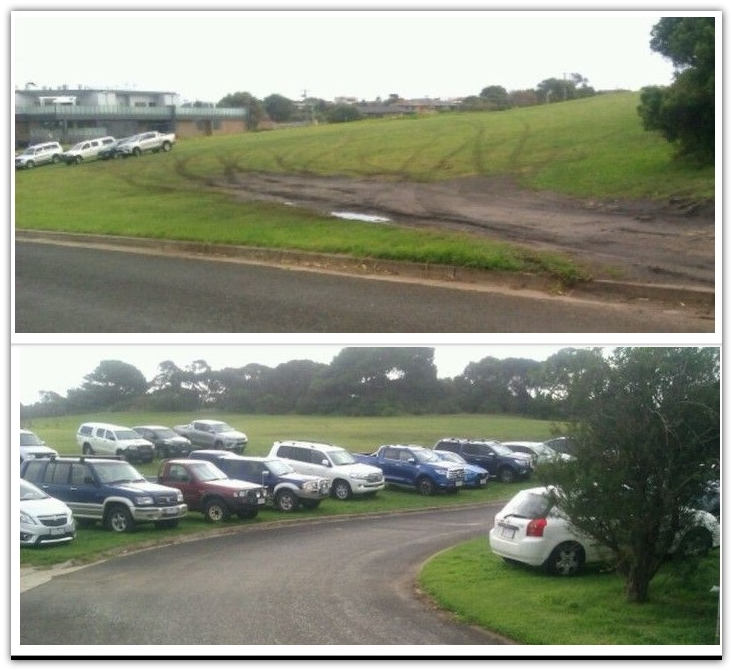
The scars of multiple Lyndoch Living staff cars parking illegally on Scoborio Reserve. The WCC is “working” with Lyndoch to find a solution.

Carol Altmann – The Terrier

Look closely, this is the slow ruination of a public reserve by Lyndoch Living through ongoing, illegal parking with impunity.

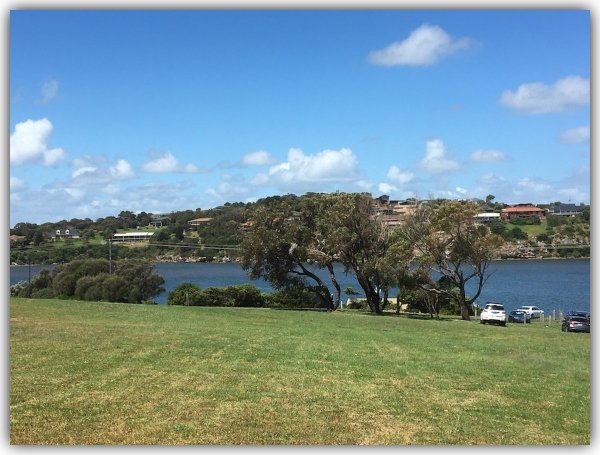
They are photos of Scoborio Reserve, a public reserve on the north side of Lyndoch and the original site of the Warrnambool botanic gardens.

It is named in honour of a head gardener, Charles Scoborio.

It’s a place where a few remnant scraps of native vegetation cling to what used to be a rich habitat along the banks of the Hopkins River as part of the Peek Whurrong lands.

Yellow-crested black cockatoos, pink-chested galahs and nesting magpies still like to hang out there.

And now, bit by bit, it’s being lost to the expansion of Lyndoch.

Lyndoch is turning the eastern end into an unofficial staff car park because it has failed to ever provide enough staff and visitor parking on its own land.

The reserve is becoming a mud bath.

What was once a handful of cars has grown to 30 or more a day.

2019: the eastern side of Scoborio Reserve as it used to look, before it became an unofficial and illegal Lyndoch carpark.

That’s because the opening of a mini medical clinic at Lyndoch and demolition work for the $22 million medical clinic has pushed scarce parking on site to breaking point.

Lyndoch has even had the gall to direct staff – in writing – to park on land that it doesn’t own because it couldn’t be bothered to find its own solution.

And what have the WCC officers done about it?

They haven’t, as you might expect, told Lyndoch to stop.

In fact they haven’t moved one inch to protect the reserve from this illegal activity.

No, what they have done is actually far worse than doing nothing: they are looking at ways to let it go on.

The council officers – NOT the elected councillors* – are busily working to solve a problem that is not their problem and are offering up a piece of public land in the process.

In other words, if Lyndoch breaks the law, the council doesn’t fine them, but bends to them.

What a disgrace.

I wish I could say this was a one off.

You may recall the large corporate sign that was installed on the side of Lyndoch last November without a council permit.

Seven months on, the permit application (lodged after The Terrier story) is still being processed.

The illegal sign is still there.

Lyndoch is also, as we speak, committing an offence under the State Planning and Environment Act by ignoring the permit conditions for its mini medical clinic.

Part of the permit issued by council staff (NOT councillors*) included a clear traffic and parking plan.

This plan has been completely ignored by Lyndoch ever since the clinic opened on 4 April.

Has anything happened as a consequence? Was the clinic forced to close immediately?

No, of course not.

And here comes the pub test.

All of these breaches are happening while the WCC chief of planning, Andrew Paton, sits on the Lyndoch board.

He is also a director of the Warrnambool Medical Clinic, a commercial, private company owned by Lyndoch that is driving the $22m project.

Former WCC Acting CEO and community services manager Vikki King is also deputy chair of a board chaired by the Lyndoch CEO and managed by Lyndoch.

How is it okay for senior council managers  – a chief planner and a former Acting CEO no less – to be anywhere near an organisation that requires multiple council approvals* as part of its expansion?

(You might also recall the secret talks between Lyndoch and the WCC about 18 months ago to sell off part of Scoborio for a childcare centre before exposure by The Terrier cut that off at the pass.)

The WCC says Mr Paton has declared a conflict of interest in all planning and applications from Lyndoch* and has not been involved in any decisions.

And Mr Paton, for his part, told me both positions he holds with Lyndoch are, “to date”, voluntary.

I have no doubt Mr Paton has acted with integrity, but that is not the point.

The question is, why would he put himself in that position in the first place and why would the WCC allow it?

If Mr Paton was a board member of a building company that was rolling out $100m worth of housing on Hopkins Rd hill, eyebrows would be up.

Why is it not the case here as Lyndoch rolls out a $100m masterplan*?

This is precisely the “wheels within wheels”, “who-you-know” rubbish that the people of Warrnambool are sick of.

We are all tired of doing the right thing – applying for permits, parking within the lines, paying our fines – while others sail past in the express lane of exemption and ruin public property in the process.

Insiders and outsiders.

As I wrote after the Schneider court victory, those days are done and it’s time for the WCC to end it, regardless of who is in charge.

* Not one part of Lyndoch’s $100m masterplan so far has gone to full council for approval by the elected councillors. Each part has been signed off by delegation.


Is the new Liebig St working, or not?

Liebig St was in desperate need of an upgrade, but is the lack of free parking killing the CBD?

Carol Altmann – The Terrier

There was no doubt that Warrnambool’s grotty, rundown old Liebig St needed a serious makeover, but is the $18 million upgrade being stuffed up by a lack of free parking?

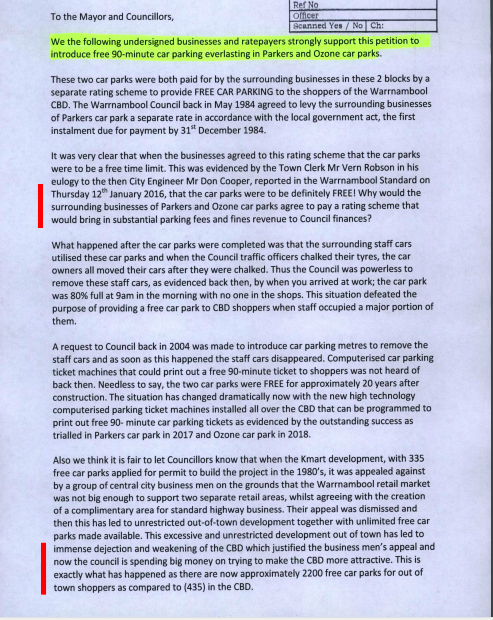
Almost 3000 people who physically signed a petition for the return of central, 90-minute free parking say it is.

The 2833 signature petition – no small number – was tabled at the Warrnambool City Council meeting last Monday but barely raised a mention because of the much bigger news story that night – racehorse training on Levy’s beach.

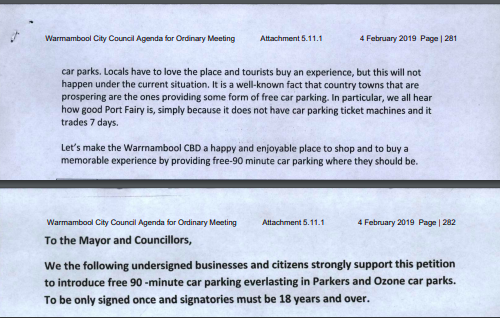
The petition is pushing for permanent, 90-minute free parking in Parker’s Carpark (behind the Commonwealth Bank) and the Ozone carpark (behind the new post office) and was gathered by long-term CBD trader Max Taylor, from Taylor’s clothing and surf store, which has been trading in Liebig St for decades.

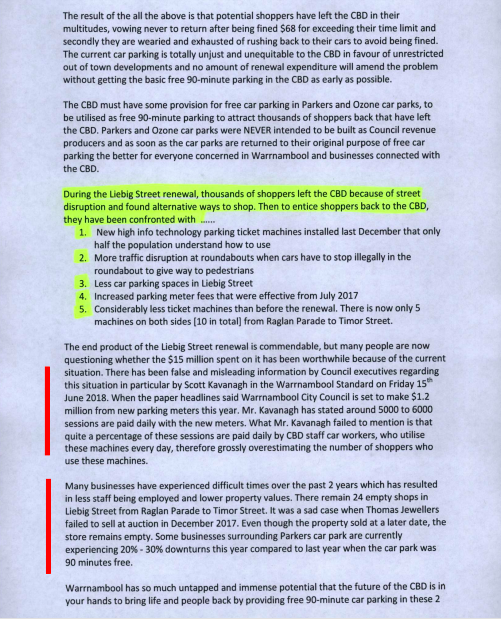
Max pulls no punches in the three page-document (see images at end of story) he added to the petition.

“Potential shoppers have left the CBD in their multitudes”, he says, because of damaging combination of expensive parking, confusing meters and lack of meters (only 10 in the whole street) that leave people worried they will be fined $68 for overstaying.


Some traders around Parker’s carpark, he says, have experienced a 20-30% loss in trade compared to when the 90-minute free carparking was in place during the street works.

And there are still 24 empty shops between Raglan Parade and Timor St (we won’t go into how many others sit empty along Lava and Timor).

Max also accuses the council Director City Infrastructure, Scott Cavanagh, of making misleading claims to the local newspaper about the number of shoppers parking in the CBD. The 5000-6000 people who parked every day included a lot of city workers, Max claims, thereby “grossly overestimating the number of shoppers”.

He also points out that local traders around the Parker and Ozone carparks paid a special levied back in 1984 to build the new FREE off-street carparks in Parker Arcade and the Ozone. Meters were added in 2004.

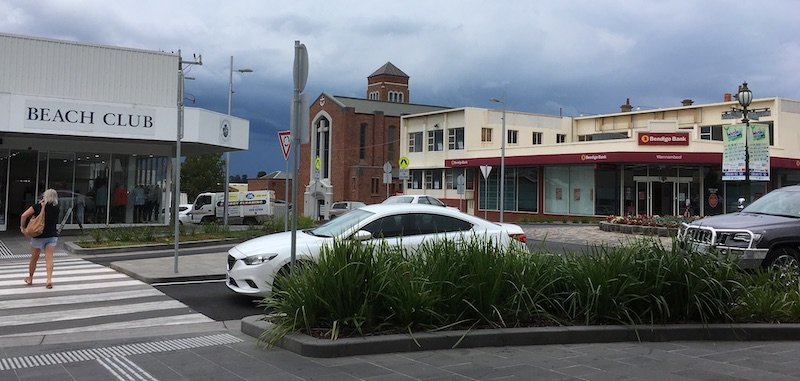
Stormy weather: navigating the roundabouts in Liebig St can mean a lot of stopping and starting.

A lot has changed since 2004. Online shopping arrived. More shopping centres have been built on the fringe of Warrnambool, offering more than 2000 free car parking spaces.

And then there are the new, pedestrian friendly crossings in and around Liebig St which are so pedestrian friendly that drivers potentially have to brake before they get to the roundabout, in the roundabout, and leaving the roundabout.

My personal favourite is driving from Liebig St down Lava St, past the Centrelink, where you give way to pedestrians coming into and leaving the roundabout, then cross an ugly road hump, give way to buses leaving the bus zone and roll up to another pedestrian crossing – all within 50 metres.

I am all for slower traffic, but that really is ridiculous…and messy.

Maybe we just need more time to get used to it. Maybe we can all download the app and pay for parking that way.

Or maybe, as Max fears, people will avoid Liebig St unless it is absolutely necessary and shop somewhere else. For our long-suffering, high rent paying traders, that would be the worst scenario.


It is worth mentioning, as Max does, Port Fairy has no parking meters and seven-day trading. The little town won yet another award for being the most popular among tourists.

They just might be on to something over there.

Max’s petition, as per standard council procedure, sits on the table for 30 days and will be discussed at the next council meeting.

If you would like to see The Terrier keep digging up, sniffing out and chewing on local issues, please make a small contribution below.

Donate


Deakin’s pay-to-park farce

deakin parking_05
A sold-out footy match? No, it is the free parking around the oval at Deakin, Warrnambool, where students would rather park and walk to avoid a $6 a day fee. It is only open in dry weather.

[dropcap style=”font-size: 60px; color: #8F9F59;”] R [/dropcap]egional universities are vital to the small communities they serve, in terms of providing quality education, but especially for the continued economic development of those regions.

They educate local people, mostly young people (and in so doing help keep them in the towns they know) and provide many jobs.

Students have to work hard (there is a huge drop off rate in the first year) and most try to balance study with part-time paid work, often difficult to secure in regional areas. Indeed, trying to encourage young people to stay and study in Warrnambool was a key topic in the recent election for Wannon.

Most students struggle financially during this time, so it seems unbelievable that a regional university would choose to make going to university any harder.

Deakin University’s Warrnambool campus, despite being on the outskirts of town, charges students the same fee to park their cars ($6 a day or by the hour rates) as students at its Melbourne and Geelong-based campuses. To make matters worse, it provides a solitary ticket machine at the Warrnambool campus which leads to long snaking queues of cars (backing up to the railway station 500m away) at peak times.

[box] There is little argument in city campuses charging for parking, as there is limited space and the public transport system is usually close at hand: there are viable and cheap options for students who do not want to pay.[/box]

deakin parking_02
Could this be South-West Victoria’s hardest working parking ticket machine?

[dropcap style=”font-size: 60px; color: #8F9F59;”] T [/dropcap]he Warrnambool campus offers free parking of a sort (when it is not raining)! It allows students and staff to park for free around the edge of its football field. It is currently closed because of wet grounds, causing another spike of complaints and a return to long lineups for the single ticket machine.

You might ask, why don’t students just use the train service?  After all, it is cheaper and better for the environment.

The $1.15m train station, built in 2006, is only useful it you want to turn up to the campus at 5.35am or 5.20pm (from west to east).  Practically useless. A bus service is scheduled to arrive at the campus from its W’bool rounds at 8.45am, but our contacts say it is often late and therefore students are reluctant to take the risk.

[box] It’s important to know that not all regional universities charge their students for the ‘privilege’ of parking a car to attend lectures or study.[/box]

[dropcap style=”font-size: 60px; color: #8F9F59;”] M [/dropcap]onash University in Gippsland, where I recently worked, did not charge students a cent to park at its regional campus in Churchill,despite there also being a bus service to the campus. Staff and students at that regional campus were provided with free and plentiful parking.

Parking has been an ongoing issue at the Deakin campus for two years. There have been protests since 2011 about the university’s money grab.

In 2011 the Vice Chancellor Professor Jane den Hollander said in an email to staff that she knew the pay to park arrangements would “upset some students and staff but subsidising car parks was costing the university’s core business”.

“I trust that you will take some time to consider these new arrangements in the light of the need to reduce Deakin’s carbon footprint, to release more funds for Deakin’s teaching and research activities, and to keep pace with other institutions who are also working hard to reduce the demand for on-site car parking,” she wrote.

[box] She said the changes also aimed to reduce demand for parking on campuses and encourage staff and students to adopt “sustainable transport alternatives” like public transport.[/box]

Clearly, that position has not changed, even though the VC would now know of the poor public transport options for the Warrnambool campus. We are not the first to call for the university to act and support it regional staff and students, and do away with its pay-to-park farce.