What impact will Wannon Water upgrade have on Lady Bay?
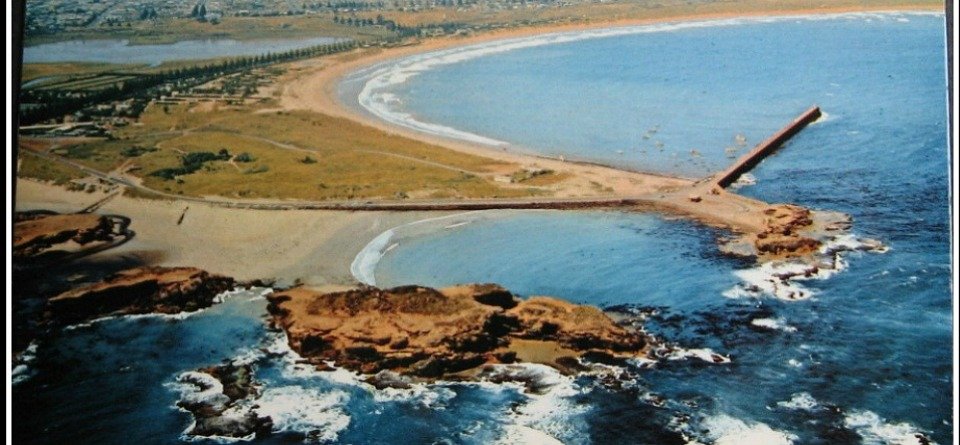
One of the many unanswered questions about the Wannon Water treatment plant is its impact on water quality at Stingray Bay and Lady Bay. Image: WCC.

By Associate Professor Laurie Laurenson

[Dr Laurenson is a retired Deakin University academic with research expertise in fish and fisheries biology. He has published more than 70 scientific research papers since the 1980s on various aspects of shark biology, fish biology and remote sensing.]

I wanted to get a better understanding of where Wannon Water got its idea that discharging partially treated water into Thunder Point was a good idea.

So I did a search on the internet and found the “Wannon Water Warrnambool STP Upgrade Mixing Zone Modelling And Outfall Assessment” document.

It’s really quite a long document but essentially looks at what biological (E. coli, Enterococci) and chemical (forms of phosphorus and nitrogen) contaminants are being discharged into the ocean and whether Wannon Water is following the rules, and will they be able into the future.

The report says “all is good” and that EPA regulations which stipulate that the contaminants should disperse within 300m of the outfall will be met.

I thought, “well that’s good” and I expected to see the three critical things that would influence dispersal of contaminants nicely organised and documented in the report. The three things being swell, winds and currents. Well, one of them was there!

I’ll digress here, because this is important.
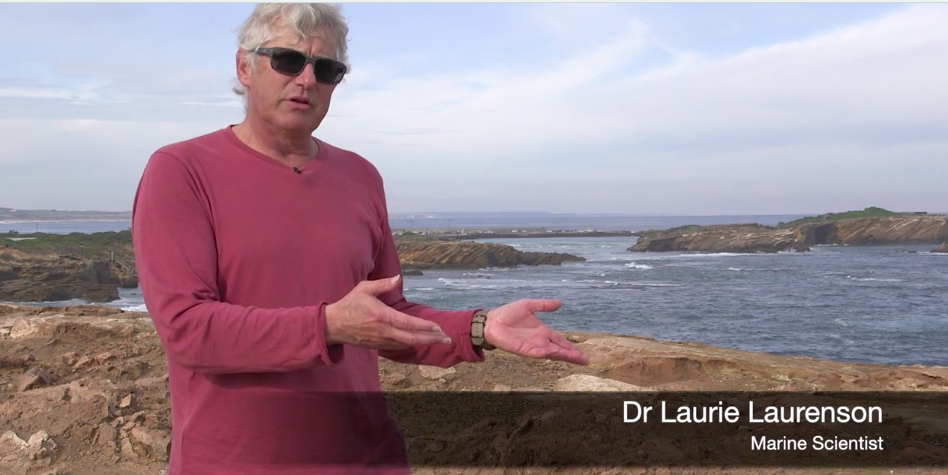
Dr Laurenson is part of a community video that outlines the objections to the proposed upgrade. Screenshot: Good Will Nurdle Hunting.

Winds are the main driver of swell and have an extremely well documented history of inducing currents.

We all know the effect that a few days of SE winds have on the water temperature in Warrnambool (it’s freezing!). This is caused by wind-induced currents travelling from the SE to the NW and then the Coreolis Effect turning the current left, and offshore, and cold water coming up from the bottom.

Now when we have winds coming from the other directions (NW to SE) the reverse happens, currents follow the wind and the surface water turns in towards the coast, so it stays warm.

Back to the report…

The mixing of contaminants in the report relies on a circular (300m specified by the EPA) radius to disperse contaminants to acceptable levels (50 per cent of the time) based entirely on the capacity of oceanic swells to achieve the dispersal – not wind and currents.

A cursory look at where Warrnambool’s wind comes from across the year shows that they come from the SW quadrant 50 per cent or more of the time across each year.

This means discharge at Shelly Beach will be blown towards the Warrnambool beaches at least one out of every two days.

The impact assessment report says that this is okay, since the closest high use beach in the area is the Flume roughly 3km away.

In fact the closest beach is Stingray Bay which is 1300m.

So here’s the problem.

On page 69 of the Wannon Water Report, it provides an “adopted minimum dilution rate” graphic which tells us how far the contaminants can spread.

This graphic is based on samples collected at a distance from the outfall of 400m (and less) with just a single sample taken at 750m.

Their predictions are based on three samples (presumably a few days in 2009, 2015 and 2016) that are assumed to be representative of the weather conditions across the entire year.

Their predictions are highly extrapolated outside their data range and based on simple linear regressions which are unlikely to be statistically significant (the significance has not been tested).

The science is poor at best.

The problem is that the degree of dispersal of contaminants beyond the 300m radius of the Wannon Water outfall has not been addressed in any meaningful way in that it excludes wind and currents, and further, the data that they have collected extrapolates well beyond the bounds of existing data.

It means that the report simply does not address the impact of the pollutants released from the outfall on the main recreational beaches of Warrnambool.

To be fair, the report states that it essentially focuses on the EPA stipulated boundary of 300m and that the pollutants do not exceed critical levels specified by the EPA for 50 per cent of the time.

However, the pollutant levels really need to be assessed at Stingray Bay and Lady Bay during wind and current conditions that will result in them being transported into these high use areas.

Given the prevailing wind conditions, this will happen at least every second day across every year.

And it’s not just the chemical and biological contaminants that will disperse in this way, it’s also the plastics that have repeatedly been released by the facility over many years.

You can find out more about the proposed treatment plant upgrade here and sign up for the online forum this Wednesday August 5 at 7pm.

Demolishing more of our precious history is a bridge too far

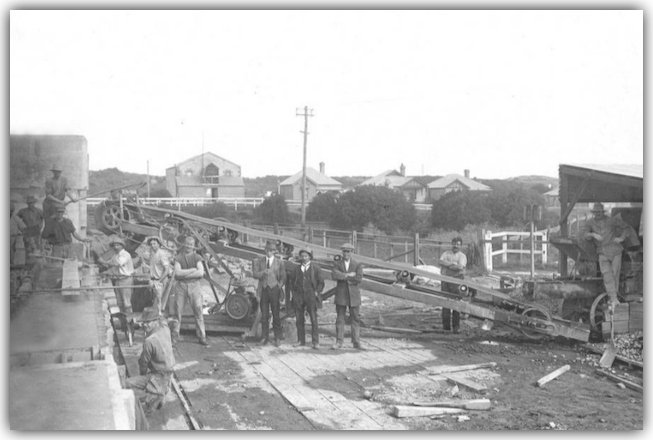
The Stanley St bridge can be seen in the backdrop of this photo taken in 1890, showing workers at a railway reserve unloading huge concrete blocks that would be used to build the breakwater. Image: Warrnambool Historical Society.

Carol Altmann – The Terrier

Will one of Warrnambool’s oldest original bridges survive the wrecking ball? Oh, I hope so.

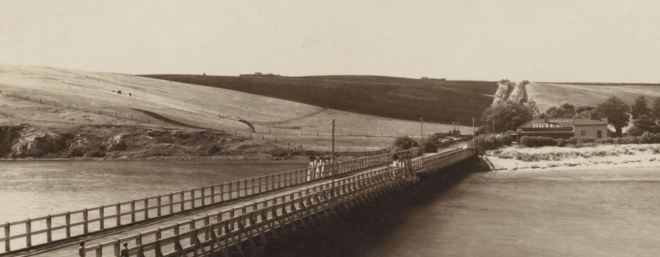
The Warrnambool City Council will soon decide what to do about the failing Stanley St bridge/Edward’s Bridge that crosses the Merri River near the pastel monstrosity formerly known as the Lady Bay Hotel, and which has been in service for 130 years.

Demolition is an option, such is the Warrnambool way.

Just three years ago –  in 2017 – the council spent tens of thousands of dollars fixing this very bridge and strengthening the piles that hold it up.

Apart from the piles, the bridge was in “generally good condition” the WCC’s then-infrastructure manager said in a media release.

Even better, the end result of spending these tens of thousands of dollars on repairs was that “the historic bridge will be serviceable for decades to come”.

Decades? Not quite.

Here we are, just three years later, and Stanley St bridge is not only in need of major repairs – another $80,000 will be spent straight away – but is under threat of demolition.

How can this be?

And has the council demanded a refund for the works that failed to extend the life of the bridge for five years, let alone decades to come?

I asked the council spokesman these questions on 20 May and also for a figure on how much the 2017 bridge works cost: there has been no response.

Oddly, these 2017 works didn’t rate a mention in the report to the council meeting on 4 May when councillors talked about how much money they would need to borrow to either knock the old bridge down, repair it, or keep it and build a brand new bridge alongside.

Nobody put up their hand and said, hang on, didn’t we just spend a bucketload of public money a couple of years ago to fix this bridge?

Like the Merri River in flood, so much public money just swishes through and is never seen or heard of again.

The original Hopkins River bridge was built in 1895 and was completely replaced in 2000. It is now in need of major repairs to prevent a catastrophic failure. Image: State Library Victoria.

The same could be said for the Hopkins River bridge which is also in need of major repairs, despite being completely replaced just 20 years ago.

It will soon have $460,000 spent on it to prevent “catastrophic failure” caused by defective concrete and other work that, obviously, couldn’t handle the harsh conditions.

Here’s part of the shopping list for Pontings, according to the tender:

Concrete patch repairs to pre-stressed beams;

Concrete patch repairs to pier headstocks and pier piles;

Crack injection to pier piles;

Silane treatment to pre-stressed beams;

Silane treatment to pier headstocks;

Silane treatment to pier headstocks; and

Protective paint system for pedestrian walkway galvanised beams & plates/cleats.


Cripes, that is some list.

The Stanley St bridge will cost around $2.6m to replace, or $1.2m to repair, with the council to cover half the cost and the remainder from a grant.

Perhaps if we had got it right the first time, we wouldn’t be facing the loss of another piece of our precious history.

My hope is the new bridge, if it must be built, runs alongside the old….and we push for a decent warranty.

Any other option should not be an option at all.


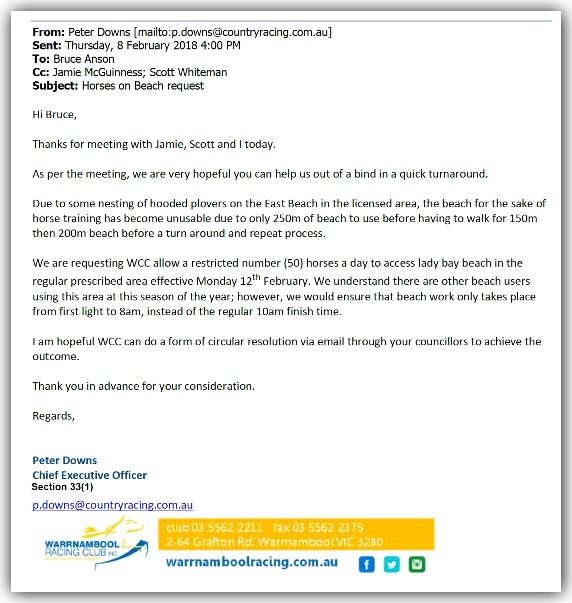
WRC to WCC: Hi Bruce, can you help us out of a bind?

Former W’bool City Council CEO Bruce Anson and former W’bool Racing Club CEO Peter Downs. (Original images via WCC and Racing.com)

Carol Altmann – The Terrier

It’s fascinating to see the conversations that go on behind the scenes between the powerful, like an exchange between the former CEO of the Warrnambool City Council, Bruce Anson, and the former CEO of the Warrnambool Racing Club, Peter Downs.

It is a brief exchange – and released only through Freedom of Information of course – but it says so much.

It reveals that Mr Downs met with Mr Anson on Thursday 8 February 2018 with a problem.

The problem was that racehorse training along a section of Port Fairy’s East Beach was no longer possible because, wait for it, those pesky Hooded Plovers had turned up and made it “unworkable” for the racehorses.

But Mr Downs had an idea, which he put to Mr Anson in writing after their catch up: what about giving permission for 50 racehorses to use Lady Bay from Monday 12 February, from dawn until 8am?

Under the council rules, racehorse training at Lady Bay did not normally start until 1 March.


There is a very good reason for this, as Mr Downs acknowledges:  “We understand that there are other beach users using this area at this season of the year”.

(That season of the year is called summer and funnily enough there are loads of “beach users” who like to use Warrnambool’s main beach in summer.)

Not only did Mr Downs think having 50 racehorses training on Lady Bay in summer was a great idea, he also hoped the council could make it happen with just four days’ turnaround from his meeting with Mr Anson.

How? Well, “a circular resolution via email” to councillors.

Excuse me?

No meeting of councillors? No discussion with the public? Not even a notice in the Saturday newspaper?

Was Mr Downs seriously suggesting the council could change the rules by flicking an email around to councillors for a “yes” or a “no”?


You would expect Mr Anson, as CEO, to have clutched his belly, laughed out loud and spluttered “Don’t be so bloody ridiculous Peter!”

But no.

Mr Anson got straight on to it, to see if it could be done.

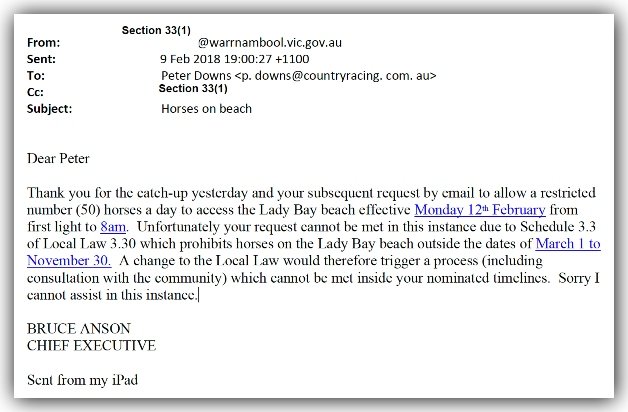
Within 24 hours Mr Anson had replied to Mr Downs, having done something that the council should have done when the WRC also wanted to access Levy’s Beach for racehorse training – he checked the council laws.

Lo and behold, it is illegal under local laws to bend the rules around racehorse training at Lady Bay without consulting the public.

Who would have thought? Fancy not being able to change a local law via Snapchat or WhatsApp, how inconvenient.

“Sorry I cannot assist in this instance,” Mr Anson wrote in his reply to Mr Downs via his ipad.

In this instance.

Ah, the power of three little words.


Mr Anson is no longer CEO, but the councillors are due to vote again on large-scale racehorse training at Levy’s Beach/Spooky’s Beach which, you may recall, was also found to be illegal under council laws and saw the Planning Minister step in to make it legal.

A sunset clause on the whole mess lapsed on 30 November last year, so each councillor will once again have to decide where they stand on the issue which continues to divide the community.

The first council meeting of the year is next Monday…and the election is in October.

Stay tuned.

The story would not have been possible without a grant from the Walkley Foundation Public Fund which supports investigative journalism.


FOI: Digging into the numbers behind the Daz and Jaz show

Former racing king pins Darren Weir and Jarrod McLean dominated the training numbers at Lady Bay. Image: Racing.com

Carol Altmann – The Terrier

Horse racing is all about numbers and here is a set that reveals just how dominant disgraced trainer Darren Weir and his suspended side-kick Jarrod McLean were in turning our beaches into racehorse training tracks.

The figures, released as part of a Freedom of Information application to the Warrnambool City Council, relate to the number of trainers and racehorses that used Lady Bay each month from the first day of Autumn to the first day of Summer in 2017 and 2018.

The numbers, collected by the Warrnambool Racing Club, show that more than 1000 racehorse workouts a month were happening up and down Lady Bay, spread out between 21 trainers.

The reality is, however, that the vast majority of horses were from the stables of just two of the 21 trainers: Weir and McLean.

Here is a snapshot:

In August 2018, when Weir was at the height of his powers in Warrnambool, 1141 racehorses ran up and down Lady Bay and 877 of these – or 76 per cent – were workouts by horses trained by Weir or McLean.

In September 2018, there were 1123 horse workouts on Lady Bay and 838 – 74 per cent – were trained by Weir or McLean.

In October, there was a whopping 1299 horse workouts, of which the pair trained 951 – 73 per cent – and in November 2018, there were 1339 horses and their share was 909 horses – 67 per cent.


Between them, Weir and McLean had almost 1000 horse workouts a month at Warrnambool’s main beach, for a mere cost of $1.50 per horse (no GST) paid to the council for the privilege.

Such was Weir’s dominance and influence that, as we know, the quivering council voted 6/1 in December 2018 to open up Levy’s Beach to racehorse training because Weir threatened to go elsewhere unless he had access to Warrnambool’s beaches 365 days a year.

The threat, of course, was that without Weir, Warrnambool’s racing industry would collapse and, without access to the beaches, all the other trainers might pack up and leave too.

Neither has happened.

Levy’s Beach has been closed to racehorse training since late 2016 and remains closed as the WRC continues to work through various approvals.

I had a look through the list of the other 19 trainers using Lady Bay and not one of them, from what I can see, has left Warrnambool because they haven’t been able to access Levy’s Beach.

(Both Weir and McLean have gone as they, between them, face a raft of serious charges for animal cruelty and other offences.)

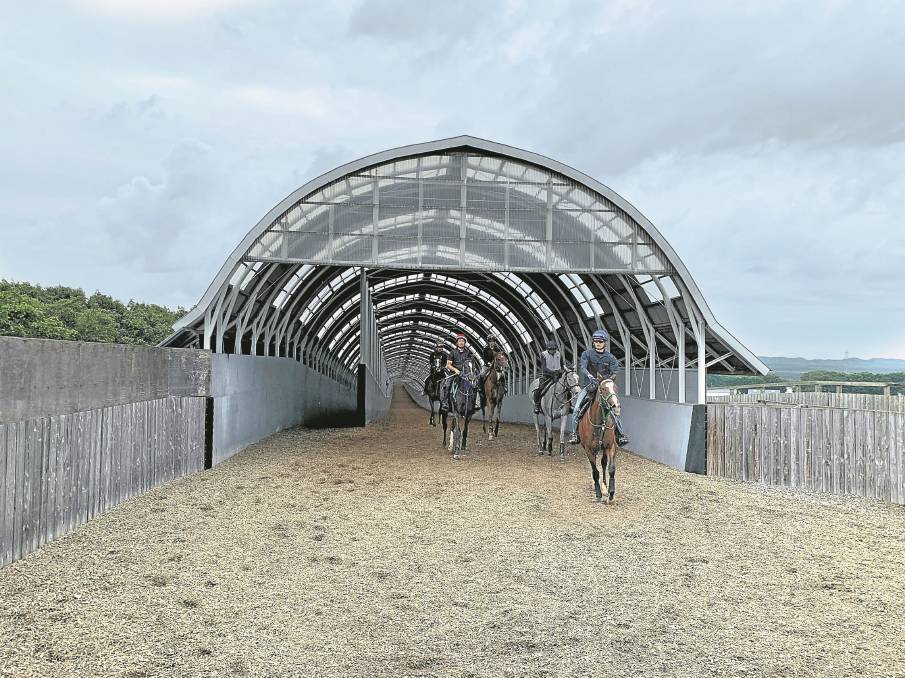
The Ballarat Turf Club is planning to build one of these: an all-weather, uphill training track based on a model used in Japan. Digitally altered image via Ballarat Courier story which you can read here.

In the meantime, the Ballarat Turf Club is forging ahead with investing millions in state-of-the-art, all-weather training facilities at its racetrack, making it a magnet to top trainers moving out of Caulfield and Flemington.

The State Government has decided both Caulfield and Flemington need to hand over more of what is actually public (Crown) land for public use.

Our public beaches, meanwhile, remain a battleground. Ah, the irony.

I will be writing more from the results of this FOI request, which sought all correspondence between the council, the Warrnambool Racing Club and Racing Victoria for the period September 1, 2016 and March 14, 2019, relating to racehorse training at Levy’s, Spooky’s Beach and Lady Bay. It took nine months and produced more than 500 pages of documents (including lots of spreadsheets) at a cost of $292.

The FOI would not have been possible without a grant from the Walkley Foundation Public Fund which supports investigative journalism.


FOI confirms WCC weakness on racehorse training breaches

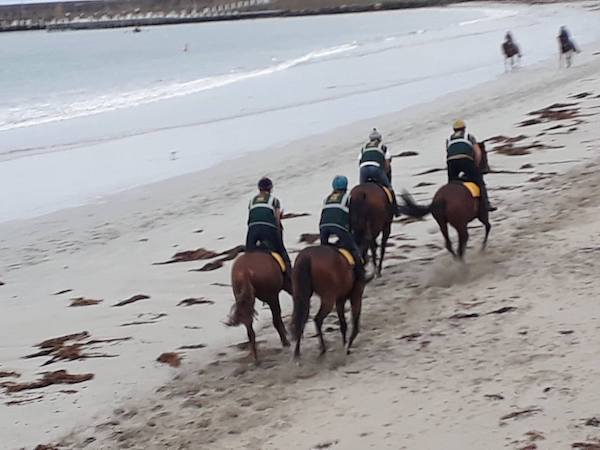
Professional racehorse training at Lady Bay continues to raise concerns around who is monitoring and reporting alleged breaches of the rules. Image supplied.

Carol Altmann – The Terrier

I always suspected it was the case, but now it’s been confirmed – for almost three years, the Warrnambool City Council did virtually nothing about racehorse trainers breaking the rules at Lady Bay.

Early last year I lodged a Freedom of Information application for all of the correspondence between the council and Warrnambool Racing Club about breaches and alleged breaches of the training rules at Lady Bay.

I asked for everything from 1 December 2016 – which is when the new rules began – right through to 14 March 2019: all letters, emails, the whole lot.

The application took nine months, with the council making me jump through multiple, mind-screwing hoops to narrow down such things as what I meant by “members” of the WRC, what email addresses they should search for, what names they should search for, what keywords they should search for….

On and on it went, at an eventual cost of $216.75 (funded, thankfully, by a grant from the Walkley Foundation Public Fund which supports investigative journalism).

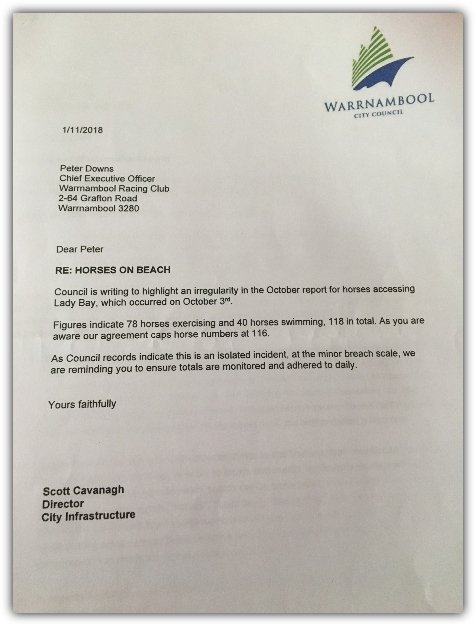
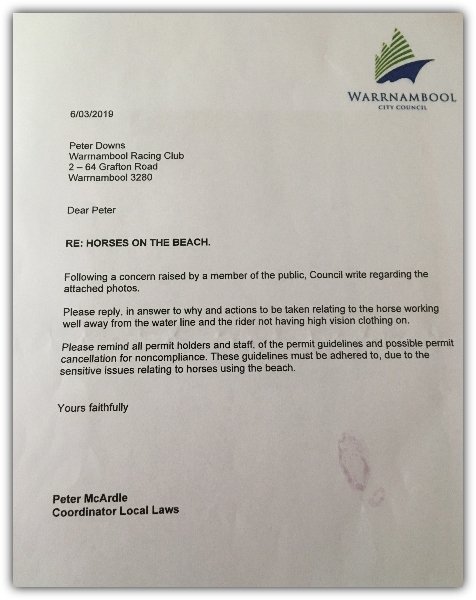
And at the end of all that searching and all that money, the result was just two letters:

Two, brief letters from the WCC to the WRC in 27 months: one written in March last year and one from November 2018.

This was the total sum of all written correspondence between those in charge, despite the steady stream of complaints (and videos and photographs) from the public during this time showing near misses, a racehorse that had thrown its rider, trainers riding fast past walkers, and numerous other safety issues. (See footage below from 2017.)

Apparently none of this warranted even a single email from the WCC to the WRC.

Perhaps they rang or texted each other, leaving no paper trail, I don’t know.

What I do know, however, is that when it comes to cracking down on errant trainers, the council has been extraordinarily weak. 

Let’s be super clear here: asking for the rules to be enforced does not mean we are instantly “anti-horse racing” or that all trainers are running amok. #notalltrainers

Instead, it’s a reminder that a public beach is just that – public –  and members of the public have every right to be asking the council what happens when things go wrong, especially when it comes to racehorses on Warrnambool’s main swimming beach.

Until last November, not one trainer had been suspended or fined.

The council says it has since cancelled the permit of one trainer for breaches, although we don’t know who, or for how long, or why, or whether – to be frank – if this actually happened, as some within the industry are unaware of it.


Professional racehorse training at Lady Bay is now the new normal and despite claims that it has “always” been this way, it hasn’t.

A second FOI, which I will write more about soon, revealed there were regularly more than 1000 horse workouts a month at Lady Bay until disgraced trainer Darren Weir fell off his perch.

This is not how it used to be, but this is what our council happily signed up for: up to 96 horses running each morning until 10am, seven days a week, from the first day of Autumn to the first day of Summer, including public holidays.

And they did this with a promise that officers would keep an eye on things – the FOI results show that they didn’t.

In fact Mayor Tony Herbert has recently taken things one step further and suggested that people who are worried by the racehorses at Lady Bay should go to another beach.

Good grief.

This is an excerpt of what Cr Herbert recently wrote in an email to one resident:

“I have spoken to many people over the past few years and some of them avoid the said beach when training of horses is occurring.  Some find that unacceptable, others find that ok.  WCC approach is trying to achieve a balanced approach.

We are so lucky in our city and region that we have a number of alternatives, if sharing the beach with horses is unacceptable to you in the mornings. During the winter months if I’m walking my dog, I choose to use other beaches and there is a number of them.”


In other words, if push comes to shove with “sharing” our main beach, it is the general public that gets shoved.

More on the results of these FOIs soon.

The FOI would not have been possible without a grant from the Walkley Foundation Public Fund which supports investigative journalism.