May Racing Carnival again has blood on its hands
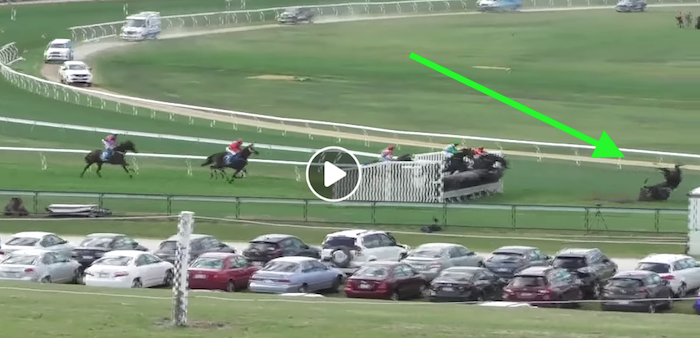
A video still showing Blues Breaker landing on its neck after a full somersault. The locally trained horse has since been euthanised. Original footage: Robyn Wylie.

Carol Altmann – The Terrier

With the death of yet another racehorse from the Warrnambool May Racing Carnival, how on earth is jumps racing still considered okay?

How does Warrnambool, as a city, continue to look away as if racehorses being killed is an unavoidable by-product of pumping money into our local economy?

It was revealed today that Blues Breaker, trained by local Symon Wilde, was killed after a truly hideous, full-roll somersault last Wednesday, and it serves as an ugly reminder that we accept horses can and will die in the name of a “sport” that hides its cruelty under hired suits, fascinators, champagne and finger food.

At the same time, our Mayor Tony Herbert bangs on about Warrnambool being “sophisticated” and “cosmopolitan” – well, jumps racing ain’t either of those, Mr Herbert, it is barbaric.


It is unquestionably brutal and the money generated for Warrnambool by this “sport” is once again smeared with blood.

For the record, Blues Breaker is the fourth horse to die at the Warrnambool May Racing Carnival since 2016 and there have been more than 50 horses die from jumps racing in Victoria in the past 10 years.

Unfortunately we have become deaf to the statistics that, in any other sport, would cause an outcry, such as the results of a 15-year-long study by the University of Melbourne which shows horses are 18 more times likely to die in jumps racing than flat racing and 121 more times likely to suffer a head, back or neck injury.

Read those numbers again and imagine, for a moment, if they applied to AFL or cycling or soccer.
While Blues Breaker has been euthanised, there are numerous other racehorses still recovering from their outing in Warrnambool last week.

You won’t hear or read about them, but you can read through the racing stewards’ reports compiled from across the three days of the May Racing Carnival to see the string of horses that stumbled, failed to finish, “knuckled upon landing”, jumped awkwardly, pulled up sore, ran out of breath, were whipped too many times, or bled from the nose after racing.

Despite all this, our city leaders wander around the racecourse, all hats and smiles, as if wearing their own personal set of blinkers: nothing to see here folks! Let’s all have fun!

It is dishonest and it is dirty, but because it brings in the big dollars, we are encouraged to stay mute and suck it up.


Indeed if you do speak up, you are accused of being a killjoy, or a rabid animal activist who lives in a sweaty little teepee, or ill-informed because, hey, don’t you know racehorses love to jump numerous hurdles for long distances while having their arses beaten with a whip? What’s wrong with you, killjoy?

If there is one rock solid argument as to why jumps racing must be maintained in Victoria, I am yet to hear it.

In the meantime, what we do hear is about the millions of taxpayer dollars being poured into the Warrnambool Racing Club and the Warrnambool Racecourse.
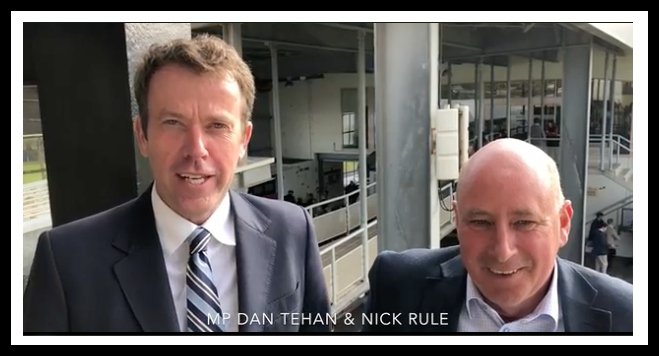
Racehorse owner and Federal Member for Wannon Dan Tehan, who shares a racehorse with the chairman of the Warrnambool Racing Club, Nick Rule, announced $1.25 million of public money would be put toward revamping the grandstand.

The State Government will throw in another cool $300,000 and the remaining $3.4 million for the project will come from the Warrnambool Racing Club which, according to Mr Herbert, has been struggling, cash-strapped, and virtually down-on-its-knees.

Former Premier Denis Napthine, another racehorse owner and now a racing commentator on 3YB, would like to see the State Government offer more prize money because, hey, that has to be a priority for us hardworking taxpayers, doesn’t it?

And we know that millions have already been spent improving training facilities at the racecourse with sand tracks and swimming pools and better drainage, yet the industry still wants to run around our wild beaches.

Enough.

Warrnambool is moving toward being a different city to what it was 20 or 30 years ago. We have a Greens’ member on council and a rainbow flag outside the council chambers – both unthinkable just a decade ago.


Our demographic is changing and we are all moving on from the days of treating the natural and animal world as if it is ours to exploit. Heavens, we even had the Swedes here recently telling us how to capture hydrogen fuel to power our cars.

This is the Warrnambool I am a proud to be a part of and so many people want to be a part of. Jumps racing – surely – no longer fits that future.

Would you like to support The Terrier? Please consider throwing something in the tip jar.
Terrier Tip Jar


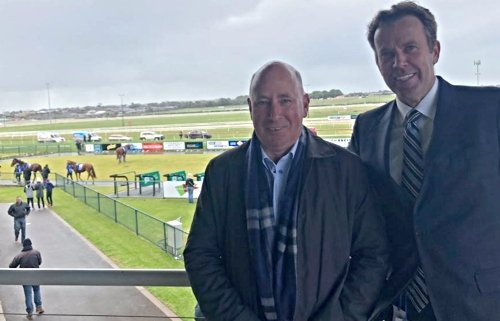
All smiles: Dan Tehan’s friends in racing

Racehorse co-owners Wannon MP Dan Tehan and Warrnambool Racing Club chairman Nick Rule at the announcement of $1.25m in funds for the WRC. Image via The Warrnambool Standard.

I have tried at least five times to stop writing about local issues so that I can focus on books that I need to write, but each time I try, some frustrated soul contacts me with a story idea or a piece of information that they know will not be investigated or published elsewhere.

So here we go.

Story number one: Dan Tehan’s friends in racing.


A week or so ago, Wannon MP Dan Tehan braved the chill winds at the Warrnambool racecourse to announce a sweet $1.25 million in funds to the Warrnambool Racing Club so it could transform, among other things, its already “first-class” eating and drinking venue into a “world-class” venue.

That little slice of pumped up Trump-speak was from WRC chairman Nick Rule, who told the local paper back in January that: “The club has the support from the Member for Wannon Dan Tehan for the project” aka, he is right behind us on this one.

Dan is a big fan of racing, but more than that, he owns shares in racehorses and, in particular, he owns shares in a racehorse – called Wells – with Nick Rule and others.

That’s right: our local Federal MP shares a horse with the chairman of the WRC and lobbies on behalf of the WRC for public money.

What I don’t understand is why this connection is never mentioned in any media reports?

And why doesn’t Dan Tehan ever mention it in any of his public remarks and Facebook posts?

And why, if it is no big deal, does his staff refuse to answer a simple “yes” when asked if Dan and Nick co-own a racehorse?

Nick Rule and Dan Tehan at the Warrnambool races. From Dan Tehan’s Facebook page on the day of the funding announcement.

It was the same story a few years ago when Dan Tehan and then Premier Denis Napthine part-owned a racehorse (Spin the Bottle) with Midfield Meats owner and multi-millionaire Colin McKenna who, at the time, was seeking state money to expand his operations in Warrnambool. (He got the money and Denis got a political headache.)

And it is the same story, as I have written about before, every time local MP James Purcell, racehorse owner and father-of-trainer-Aaron Purcell, opens his mouth about anything to do with horse racing and allowing large numbers of racehorses to train on beaches.

Let me shout it out:

THESE MPS OWN RACEHORSES!

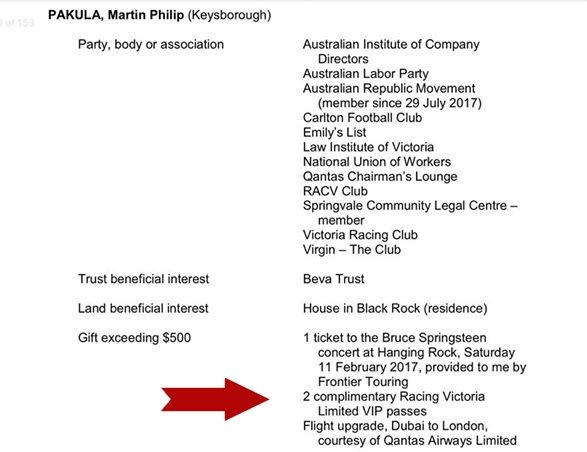
Dan Tehan and James Purcell are not alone. State ministers Lily D’Ambrosio and Martin Pakula, who are among those deciding whether commercial racehorse training should be allowed on our local beaches, have been the recipients of a free annual pass or a VIP pass to Racing Victoria.

Ah, the lure of a ringside seat at the Melbourne Cup.

I am not sure when we started to accept such potential conflicts of interest as normal.


It is difficult to think of another example where an MP would be permitted to be actively involved in any lobbying or decision making when they held such interests but, for some reason, horse racing remains exempt.

I hasten to add, before the lawyers start dictating letters, that there is no suggestion of any impropriety by any of these MPs: they are doing what we allow them to do.

If this is to change, we need to keep calling it out and to keep shining the light into the dim corners, sometimes several times over.

And that is story number one.


10 good reasons why we must say no to horses and dogs

By Carol Altmann

Why horses and dogs don’t belong in the conservation and conservation/recreation zones that will stretch from Killarney Beach to Warrnambool:

1. At least 54 species of “conservation significance’ live there, including five listed as critically endangered, particularly the Orange Bellied Parrot, 10 listed as endangered, 20 as vulnerable, and 16 listed as threatened. (draft report p86-87)

2. There WILL be a negative impact on these species. Not “perhaps” or “maybe”: there WILL be a negative impact that reduces their chances of thriving or even surviving. (p29, p33, p34-35)

3. The traditional owners of this country have made it very clear that they do not support racehorse training in the reserve. (p22, p64)

4. Racehorse training at Levy’s Beach WILL cause damage to Aboriginal Cultural Heritage in this area and any artefacts will have to be removed and stored before it begins*. (p64)

5. Horse training WILL cause erosion**. Not perhaps or maybe: it WILL.

6. Every coastal plan for this area in the past 40 years has emphasised the need for MORE protection, not less. This includes the W’Bool City Council’s own Warrnambool Coastal Management Plan, signed off just four years ago.

7. It ignores the Land Conservation Council framework set down for this area in 1978, knowing it would come under increased pressures. As a result of the LCC, the majority of public land in the area was officially set aside in 1979 as a conservation reserve. The LCC emphasises low-impact recreation, conservation and protection. (p83)

8. There are no numbers on exactly how many racehorses would use the most sensitive areas of Levy’s Point, Golfies and Rutledge’s Cutting. (p63-64)

9. Monitoring this area is already difficult because of its isolation.
The area already suffers erosion and damage caused by illegal activities. (p61)
How will the WCC, Vic Police and Parks Vic have the time and resources to monitor it in the future?

10. The bottom line? Commercial racehorse training is not recreation and it is not conservation. This is not anti-horseracing, it is just fact.

Please have your say on the draft management plan for Belfast Coastal Reserve, by March 16, here: www.engage.vic.gov.au/belfast

* The full extent of Indigenous artefacts and cultural sites in this area is not known due to either out-dated or insufficient data. The plan says more studies need to be done.

** There also needs to be more studies into the full impact of horses on beaches, but two referred to in the draft report (p80-81) confirm that horses cause erosion. Here is part of the summary from a 2001 study of horse riding in D’Entrecasteaux National Park, WA:

“Horse riding altered plant species composition, increased the area of bare ground and decreased height and cover of vegetation. Significant impacts occurred after only low levels of horse use. The findings indicate the need for a database on horse riding impact in Australia so that, where horse riding is allowed, impacts can be properly assessed and effectively managed.”

http://www.publish.csiro.au/pc/PC020256


For the love of horses

emma mclean small

[dropcap style=”font-size: 60px; color: #A5CECD;”] H [/dropcap]elping animals in distress is one of the noblest things us flawed humans can do.

While most of us are familiar with the good work of the RSPCA, Animals Australia and Wildlife Victoria, there is also a large number of individuals doing their bit by rescuing injured or neglected animals, saving broken birds, fighting to protect native habitat, or rehoming a former family pet.

Bluestone Magazine has found two such people in Emma McLean and Matt Hee, both of Allansford, who save unwanted or neglected horses.

Emma, followed more recently by Matt, is the south-west Victorian representative for Second Venture Horse Rescue, a new and still relatively unknown not-for-profit group that covers most of Victoria and into NSW.

Second Venture, as it sounds, aims to give old, injured, neglected or surrendered horses a second chance at life.

floss-small
Happy horse in a new home: Floss tries out the territory at Emma’s property.


[dropcap style=”font-size: 60px; color: #A5CECD;”] A [/dropcap]s Emma explains, the horses are usually surrendered by owners who are no longer willing or able to care for them, although others are referred to Second Venture because of concerns about neglect.

The rescued horses are picked up by the Second Venture rep, vet checked and, if required, have a visit by the dentist and farrier, all at the rep’s expense. The rep also covers the floating costs to collect the horses and provides feed, blankets and all the other necessities, including retraining and resocialisation.

When they are happy and healthy again, each horse is rehomed with a new owner who doesn’t pay for the horse, other than a $35 a year “leasing” fee. Second Venture then checks on the horse after a month, six months and a year to see that it is in good hands.

“The only horses we don’t rehouse are stallions, for obvious reasons, and we won’t let a horse go until it is safe to be around,” Emma says.

Emma has been the south-west Victorian rep for about a month and had her first surrender last week, Floss, an 18-year-old thoroughbred chestnut that she intends to keep as one of five horses she cares for.

treats-small
Now that’s roughage! Home-made horse treats are one way of raising funds.

[dropcap style=”font-size: 60px; color: #A5CECD;”] S [/dropcap]econd Venture relies entirely on donations and the goodwill of supporters who are prepared to loan a float, for example, or offer equine services at a discount rate and so it’s not surprising that much of Emma’s time is taken up with finding ways of raising funds.

When Bluestone visited, Emma was preparing horse treats made of molasses, oats and other horsey ingredients to sell to raise money for the horse sales, where Second Venture tries to buy horses that are otherwise destined for the knackery. The horse treats, thankfully, have been selling like hotcakes through orders on her Facebook page.

Shari Henderson, from Cherwood Park Equine Supplies in Warrnambool, has been one of Emma’s biggest supporters and continues to admire her dedication.

“We need more like her,” she says.

We happen to agree: Emma is our first quiet hero for 2014. You can contact Emma via her Facebook page or on 0432 625 880. Find out more about Second Venture Horse Rescue here.

[box] Emma will receive a coffee and cake voucher from The Pavilion Café in Warrnambool. Thankyou to owners Mary-Ellen and Jon Watson for supporting this week’s Quiet Hero.[/box]

Pavilion-Inverse-small

Logo Smile newsletter

 If you enjoyed this story, you might enjoy…


No bolting, just tolting for Icelandic horses

Walking with strength and purpose: Susie Alexander

On the road with the Schoolies

Tackling a hidden terror: Pat McLaren

A life-changing adventure: Schoolies with a Cause 

A winner for Woodford

United we stand – Wbool Uniting Church