Lyndoch: champagne at the races, but no sheets and towels
Carol Altmann – The Terrier

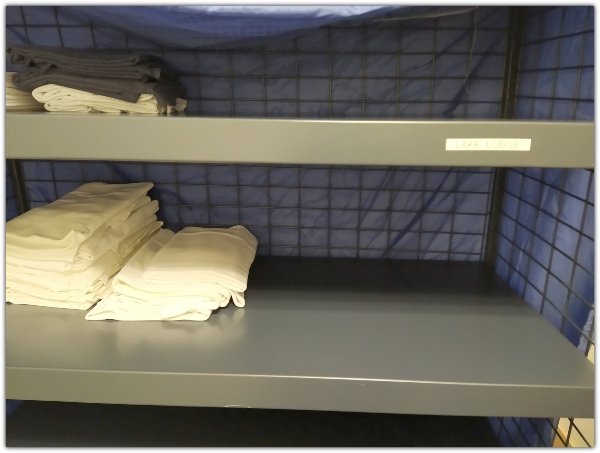
If there was ever a picture of how Lyndoch Living is losing touch with its priorities, it is this one.

This is a linen shelf that should be stacked with towels, sheets and face washers that is almost empty half way through a shift.

This is allegedly not unusual, despite Lyndoch  – a charity – getting geared up to spend millions of dollars to build a “super clinic” on its Hopkins Rd site as part of a $100 million masterplan.

Unbelievably, some nursing staff are cutting up old towels to use as flannels for showering and freshening up residents   – sorry, they are now called consumers – rather than rely on the back-up of wet wipes.

Other staff are hiding linen on Fridays so they have enough towels, sheets and face washers to get through the weekend.

Has it really come to this, you ask? Yes it has, and we need to know about it.

Lyndoch – a charity – has also just signed on to again sponsor the Grand Annual Steeplechase (at a cost of what, $70,000? $80,000?), yet a machine used to pulp cardboard urinal bottles has been out of action for months.

This means the cardboard bottles are carried by nurses across a dining room to another machine for disposal.

These are just some of the cracks that start to appear when a short-staffed system is under rising stress, and, my word, we need to know about it.
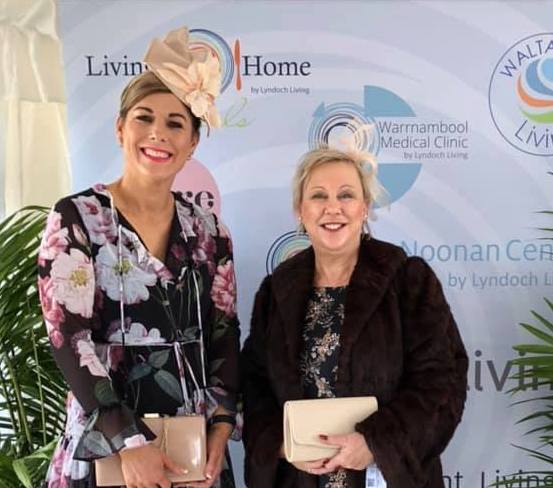
Lyndoch board member (and Warrnambool City Councillor) Sue Cassidy and Lyndoch CEO Doreen Power in the Lyndoch corporate tent at the 2019 May Races. Image: Lyndoch Living FB page.

In recent years Lyndoch has somehow lost sight of its core business, which is caring for the aged and infirm both in the nursing home and in-home care.

To most residents, this means tasty, nourishing food, having someone to talk to, and being cared for by nursing staff with the time, support and full resources to do their jobs properly.

This should be the number one and only priority for any aged care home, especially Lyndoch.

Lyndoch, we need to remember, is a not-for-profit, benevolent, charitable organisation that was set up more than 60 years ago by the Warrnambool community for the community.

We ultimately own Lyndoch, but it is run by a board on our behalf who, in turn, hire the CEO.

Lyndoch has plenty of money to fulfil its core business, receiving almost $30 million last year in government funds and another $6.1 million from client fees, with net assets worth $51.2 million.

You would think that every dollar would be directed toward the care and comfort of residents, including hiring and keeping quality nursing staff who are paid well, treated well and given all the resources they need to do their jobs well.

But no.

Instead, as I wrote last week, the staff are run off their feet and even when they do the best they can – like cut up towels for face washers – it is not enough.
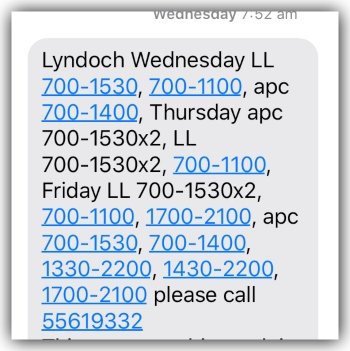
Roster shortages inside Lyndoch Living from last week.

At the same time, the Lyndoch board and CEO Doreen Power are pressing on with a $100 million masterplan, including borrowing money to build a multi-million dollar medical clinic on site for GPs, dental services and a chemist that nobody has proven is wanted or needed.

And at the same time, the number of admin staff at Lyndoch – a charity – has ballooned in the past three years from 37 to 59, with many having titles straight out of an episode of Utopia:

Director of People and Resilience; Social Inclusion and Entrepreneurial Manager; Operational Support and Improvement Manager; Project Manager Safety and Wellness.

All of those soapy titles and yet the culture is turning toxic and staff morale is sliding to rock bottom.

And then there is a revolving door of consultants who, between them, cost thousands for their expert advice.

I wish I could tell you exactly how much is being spent on consultants, but Lyndoch is yet to release its full financial figures and, given its new-found secrecy around such things, I doubt we will find the answers there.
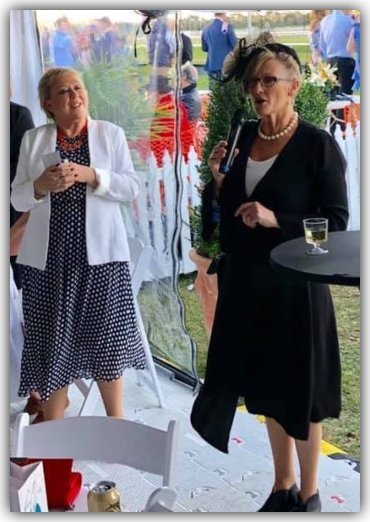
Lyndoch Living CEO Doreen Power and Lyndoch board chair Kerry Nelson in the Lyndoch corporate tent at the 2019 May Races. Image: Lyndoch Living FB page.

Lots of really wonderful people work at Lyndoch and terrific things happen there as a result of their efforts, but I also know that so many are struggling to hold it all together.

We can either hold our head in hands, or we can actually hold the Lyndoch board to account and ask “what is being done about it?”

Chair Kerry Nelson has not responded to my questions. There is silence from all the other board members: Sue Cassidy, Ron Page, Peter Downs, Lorraine Mielnik, Percy Eccles, Kane Grant and Andrew Paton.

Are they so bedazzled by Ms Power’s “big vision” that they are not asking the tough questions? Do any board members or Ms Power ever wander down to chat with nursing staff and ask how they are managing?

As I understand it, some nursing staff have never met the CEO after almost five years.

I have never met the CEO and she will not return my calls or my emails, so – again – I can’t tell you Ms Power’s response to any of the above.

This silence is familiar territory to me, but just as with the Warrnambool City Council credit card scandal, I am slowly building a picture and the questions will keep coming because the community created Lyndoch, we care for Lyndoch and we have every right to know what is really going on.

More soon.

If you would like to support the work of The Terrier, please consider throwing something in the tip jar.
Terrier Tip Jar


Staff morale slipping to rock bottom at Lyndoch Living

Carol Altmann – The Terrier

Hear that? Alarm bells are ringing and they are coming from inside Lyndoch Living.

What follows comes from talking to dozens of people who have all expressed the same fear: the Lyndoch culture is turning toxic.

Many of the staff at Lyndoch are under so much pressure from staff shortages or low morale that they are starting to crack under the strain, or have already left. Others have been allegedly pushed out.

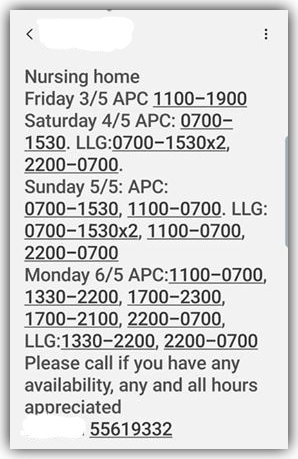
The images posted here are just a slice of the ‘please help’ messages of the past nine months, desperately asking for nursing staff to fill roster gaps.

Note that these gaps include during the week of the May Racing Carnival, where Lyndoch had a corporate tent and sponsored the Grand Annual Steeplechase (and has signed on again for 2020).

I have to tread very carefully here, because I know each word will be read forensically, but I believe this issue goes far deeper than the staff shortages suffered by many aged care homes across Australia.

What I am hearing is that since CEO Doreen Power took over in 2015, there has been a complete change in workplace culture that has brought an upheaval way beyond what you expect with a new chief.

This upheaval also goes further than nursing staff and into areas like catering, kitchen, supplies, maintenance, finance and administration. I am told that, as a result, up to 80 people have left Lyndoch in the past two years – an extraordinary number by any measure.

For many people, Lyndoch is no longer a very happy place, despite the “good news stories”, #hashtag slogans and Facebook snaps that would have you think otherwise.

The brave people who talked to me took an enormous risk because of fears of reprisals, but they have done so because they care deeply about the residents and for each other.

Tonight I am giving them a voice, because it seems nobody within the Lyndoch executive or on the Lyndoch board is listening.

This is what we need to hear:

So many long-serving Lyndoch staff are no longer there, with some devoting 15, 20, 30 years of their lives to Lyndoch, only to find that they were no longer wanted.

This was not how they imagined Lyndoch would treat them after such service, but their careers ended in ways that left them feeling either disillusioned or, in some cases, devastated.

Many other staff, including experienced nursing staff, have left because they could no longer tolerate the stress and how it was starting to affect their personal lives.

I know the methods that can be used: the unreasonable workload, the nit-picking, the micro-managing, the criticism, the sudden outsourcing of your job, the constant fear of dismissal, the slow wearing down of confidence.

In that environment, people choose to leave, rather than tolerate one more day.

This is allegedly what happened to many long-serving staff at Lyndoch, and to others who thought they had a career path ahead of them, only to have it suddenly fall away.

The stories I have been listening to revealed the same management pattern over and over again and I believe them.

People talked of certain staff allegedly having “targets on their backs” and the fear of who would be next, which is exactly the sort of terror that is designed to keep people silenced.

Others told of distressed staff crying in the carpark as they left work, or as they prepared to enter it.

The old Lyndoch culture, with more warmth, empathy and understanding, appears to have become collateral damage toward a big corporate, pumped-up dream that someone decided was where Lyndoch needed to go.

From the hours of interviews I have now done, I can say the new Lyndoch culture appears to be one infused with bullying, intimidation, gaslighting and a poisonous game of divide-and-rule where some people are looked after at the expense of others.

In this world, not all staff suffer, only some: there are the insiders and the outsiders.

This is how a toxic culture works and it crushes people.

Worse, it can all filter down to the most vulnerable in this story: the residents.

Staff shortages following the days of the 2019 May Racing Carnival, where Lyndoch had a corporate tent and sponsored the steeplechase.

So many people I talked to were wracked with a sense of guilt and “feeling that I let the residents down”, because even if they worked themselves to the point of exhaustion, they felt it was not enough.

It was always the residents they worried about most.

It was not that they wanted more pay, or that they wanted less hours: they just desperately wanted more help.

I have been told there is often just one Registered Nurse on night duty for the entire Lyndoch building – around 200 residents. This nurse is also phoned by staff at the Lyndoch May Noonan Hostel in Terang, when there is often no RN on night duty at all.

I understand that there are only two unit managers for all of Lyndoch: there used to be four.

This means each unit manager is overseeing the care of 100-120 residents – including those with high needs such as dementia, psychosis and schizophrenia – plus overseeing all of the nursing staff.

It’s an impossible task.

Things can get missed, or not followed up, and the leadership that used to be there to support the nurses and care workers – to allow proper shift handovers, guidance and so on – falls away.

To try and cover the gaps, some senior nursing staff in the past 12 months have worked shifts for no pay.

One senior Registered Nurse, who worked part-time, worked for free on weekends at least three times during her contract, because there was nobody else available and it became her problem to fix.

Lyndoch has again signed on as sponsor of the Grand Annual Steeplechase at the May Races. Former W’bool Racing Club CEO Peter Downs, who has relocated to Melbourne, remains on the Lyndoch board. Image: WRC.

Lyndoch says it is trying to hire more RNs and it is advertising a range of jobs, but word is now spreading that Lyndoch is not the place it used to be.

Highly qualified or experienced aged care staff can choose where they want to work, such is the demand for their skills, and many are not choosing Lyndoch.

They are, instead, choosing Moyne Health, or Mercy, or Southwest Healthcare.

I understand that four RNs hired by Lyndoch over the past 12 months each lasted barely more than a week before before moving on.

All of the above I have put to Ms Power, who, despite winning an award for aged care CEO of the year, refuses to talk to me about what is allegedly happening in the aged care facility she runs.

I have also asked questions of the board chair, Kerry Nelson, which have been similarly ignored.

This on top of its increasing secrecy makes me think that Ms Power and the nine-member board have forgotten that Lyndoch is a public institution, not a private company – at least not yet.

What is unfolding at Lyndoch is unfolding on our watch and we, as a community, need to be asking questions and demanding answers from Ms Power and the board.

To look away and just leave Lyndoch to it is not an option, so I am ringing the bell loudly and I am going to keep ringing it.

More soon.

If you would like to support the work of The Terrier, please consider throwing something in the tip jar.

Terrier Tip Jar


Lyndoch Living pulling down the shutters on scrutiny

Lyndoch Living can’t wait to talk about all the good stuff happening, but digging into the financials is getting harder.

Carol Altmann – The Terrier

What the heck is happening at Lyndoch?

It’s behaving more and more like a private corporation than a community owned home for our elderly and infirm.

Its unadvertised, annual general meeting held earlier this week was, by all accounts, one big self-congratulatory, PR exercise rather than a critical analysis of the last 12 months.

While it’s terrific to celebrate the good stuff, we also want to know the nitty gritty behind the growing “brand”, because Lyndoch is now very much a brand.

So where are the financials?

How are the Lyndoch board and CEO Doreen Power spending our money, be it via residents’ fees, taxpayer dollars or donations?

Was there a surplus or a deficit like the $1.77 million loss of last year?

How many staff have come and gone?

How much is being spent on food for the residents? On medical and health items? How are the public donations going?

And – I ask, one more time with feeling – where is the $100 million coming from for the eight-year masterplan?

The annual report released this week answers none of these questions, in fact, it deliberately avoids them.

The financial statements have been reduced to three, very basic graphs and about 125 words of text – that’s it – for a multi-million-dollar, publicly funded, not-for-profit organisation that is fully accountable to the public.

Well, it used to be.


Things have changed dramatically since Lyndoch changed its corporate structure late last year.

Now, trying to get any detailed information is like prising open the jaws of Barry the Bull Terrier.

I am still trying to get a copy of Lyndoch’s constitution, which it is zealously guarding like a first-edition copy of Harry Potter.

Even old annual reports that were posted on the Lyndoch website were pulled down yesterday.

Maybe this is because I actually read them and crunched the numbers and found a rather large skeleton lurking in the closest: Lyndoch last year recorded its largest deficit in recent years at $1.77m.

Thankfully I took notes and kept copies of the annual reports that could be downloaded, and took screenshots of those that couldn’t.

Good grief, when did it get this hard to find out basic information about our much-loved aged care home?

What on earth is there to hide?

Perhaps it’s because, as I believe, Lyndoch recorded another deficit in 2019, which would be its fourth deficit in the past five years.


I am not an accountant by any stretch, but using the scant details released this week, and my earlier notes, I think Lyndoch Living recorded another operating deficit, this time of around $750,000 and that’s before any other unusual items – if there were any – are added.

Please, Lyndoch, correct me if I am wrong.

The back page of the Lyndoch annual report for 2019 reflects its growing business model.

Using my same, very high-tech accounting methods, I believe its net assets also dropped by a whopping $11 million in the past year from $62.7 million down to $51.2 million.

Hmm, could that be because Lyndoch just borrowed $11 million from the bank to pay for the first stage of the masterplan?

Please, please, Lyndoch, correct me if I am wrong.

There is no question that Lyndoch needed to freshen up some spaces, try different things, move with the times, but surely when big decisions are made and millions are being spent, it must all be open to rigorous scrutiny?


As it sits, to get even close to the full story, we will have to wait until early next year for the full financial reports and all of the gritty details to be released via a government website that oversees charities.

In the meantime, this Terrier is just going to keep digging. More soon.

If you would like to support the work of The Terrier, please consider throwing something in the tip jar.
Terrier Tip Jar


Stroke of luck – surviving a killer

Last year, Lee Nicholson suffered a stroke at the age of just 47 and, through her recovery, has learnt so much more about an illness that is the second biggest killer of Australians.

By Lee Nicholson

[dropcap style=”font-size: 35px; color: #8cc7d0;”] C [/dropcap]lose your eyes for just a moment. Is everything silent?

No?

Is that inner voice chattering away, not letting you get any mental peace and quiet?

Maybe you quietly yearn for that internal voice to be silenced?

Be careful what you wish for.

It was exactly this time a year ago that the internal chatter stopped for me and everything went quiet … and it nearly killed me.

That mental silence, that inner voice shutting down, was just one symptom of Australia’s second biggest killer: strokes.

At just 47 years of age, I have suffered and survived a stroke.

A clot had formed, probably in my heart, and travelled through my arteries to my brain, got caught and starved my brain of oxygen.

I went down so quickly that I didn’t even have time to put my hands out to break my fall as I made a coffee in my kitchen.

Life, as I had known it, changed in that split second.

For people who survive a stroke in the Warrnambool district you are bound to come in contact with Pat Groot.

As South West Healthcare’s stroke liaison clinical nurse consultant, Groot is the expert who at some stage will help you trawl through your near-death experience, help you make some sense of what you have gone through and understand your new ‘normal’.

“People like to know ‘what could I have done that would have prevented this’,” Groot says.

“There’s a lot of soul searching because people would have liked to have avoided stroke altogether, perhaps never become acquainted with it, but they’re here and sometimes they’re not really sure why.”

When I was felled by an embolic stroke, I just didn’t believe it: the thought that I was “having a stroke” was inconceivable.

I was violently ill. My right side couldn’t move and I couldn’t walk. I had to drag myself to my bed and lay there amid the agony of the very worst of headaches.

As crazy as it might sound, I took 24 hours to seek help because I didn’t have the ‘classic’ signs of stroke, in other words, my face hadn’t fallen.

The area the stroke took out affected the part of the brain that controls my balance, speech and writing – all of my fine motor skills – and, of course, decision making.

On first glance, this looks like pretty good shorthand, but it is Lee’s attempt to write the alphabet the day after she suffered a stroke.

[dropcap style=”font-size: 35px; color: #8cc7d0;”] I [/dropcap]

was unable to work as a journalist and I had to resign from a job I was enjoying as a business editor in Adelaide. My life was now about trying to relearn all of the movements that I had taken for granted.

Walking, talking, balance, eating, typing, writing, drawing, driving. You name it, every action I did since I was born and was second nature, I had to learn to do again.

The fatigue. You have a stroke and it feels like someone has disconnected your batteries.

That two, three, four or five kilometres you used to be able to casually walk? Forget it.

You will be knackered just getting out of the armchair back to your bed to sleep for 20 hours.

Despite my delay in seeking treatment, I am one of the lucky ones and, fortunately, I have almost made a full recovery.

According to the latest figures from the Australian Stroke Foundation, stroke is the country’s second biggest killer and a leading cause of disability.

The financial cost of stroke in Australia is estimated to be about $5 billion each year.

Stroke kills more women than breast cancer and more men than prostate cancer.

“You see other conditions which seem to be, for want of a better word, sexier,” Groot explains.

“Stroke continually fails to attract the attention of funders.

“We know if there was money directed at it we could reduce the instance of stroke by making people aware of the risk factors.”

In 2015, funding for stroke research through the National Health and Medical Research Council represented just 4.1 per cent of the total investment in medical research.

The foundation predicts that this year there will be more than 55,000 new and recurrent strokes or 1000 strokes every week: that’s one stroke every 10 minutes somewhere in Australia.

Around a third of all stroke survivors are of working age, or under the age of 65.

This year there will be more than 470,000 people living with the effects of stroke. This is predicted to increase to 709,000 by 2032.

After a stroke, 65 per cent of survivors have to live with a disability which prevents them carrying out daily living activities unassisted.

“The number of people who die within six months of a stroke is fairly high … about 12 per cent,” Groot says.

He adds a stroke is a symptom of our 21st century lifestyle.

“The truth is we’ve become more sedentary, our diets have become worse, we perhaps drink too much and people who smoke are twice as high risk than those who don’t.”

Developed in the United Kingdom, the FAST test is an easy way to recognise and remember the signs of stroke.

FAST involves asking these simple questions:

  • Face – Check their face. Has their mouth drooped?
  • Arm – Can they lift both arms?
  • Speech – Is their speech slurred? Do they understand you?
  • Time – Time is critical. If you see any of these signs, call 000 straight away.

“When it comes down to it there is so much more we have to learn about stroke, more research that needs to be conducted for us to talk with authority,” Groot says.

Groot urges people who think that they might be having a stroke to act on the side of caution and seek medical help.

“If it turns out to be a stroke mimic, that’s not bad, that’s a good outcome. But if we’ve intervened in time … that’s a good thing.

“You could be one of those statistics that could be affected due to stroke and not everyone makes a good recovery.”

For more information on the facts and figures, click here.

[box]Victoria

Stroke Association of Victoria: (03) 9670 1117 local call 1300 434 233.

New South Wales

Stroke Recovery Association of NSW: (02) 9807 6422 local call 1300 650 594.

South Australia

Stroke SA Inc: (08) 8352 4644.

Call StrokeLine for free information and advice. 1800 STROKE (787 653)[/box]


Rising to the challenge of breast cancer

susie alexander_17
Susie Alexander (in her screenprinting shirt!) with one of the many mottos that she applies to her life since being diagnosed with breast cancer and having a double mastectomy before the age of 50.

By Carol Altmann

[dropcap style=”color: #a5cecd;”] A [/dropcap] little more than a year ago, Susie Alexander received the news that nobody wants to hear: the lump she had found in her right breast was malignant.

“I had a shower and I never really look at myself in the mirror, but this time I noticed a puckering on the right side of my breast. I felt around and felt a lump and thought, ‘oh no’. It made me feel quite nauseated, because, well…” Susie, from Warrnambool, said, her voice trailing away.

It was to be the beginning of a journey that, like only cancer can, turned Susie’s life completely upside down.

Susie, 49, was a nurse for 28 years and is married to paediatrician Dr Greg Pallas, so she wasted no time in having the lump tested the same day as she found it. That was a Friday, her step-daughter’s birthday, and the distraction of a party sleepover made the agonising wait for results over the weekend a little easier to bear.

A strong history of cancer on the matriarchal side of the family – her mother, Jan, died of lymphatic cancer last December – meant that Susie was highly conscious of the risk, but previous lumps detected in mammograms had proven to be harmless.

By the Tuesday, however, the result was confirmed as cancer and three days later Susie had the breast removed, together with 32 nodes under her armpit because of concern that they might also be cancerous.

“You have no time to think. I turned into a robot and I think I was a robot for 12 months thereafter because between Mum and myself, you just have to get on with it,” she said.

susie alexander_1
Susie at home in Warrnambool: “You can’t afford to not live your life now. I try to live in the now and so that is how I survive.”

[dropcap style=”color: #a5cecd;”] A [/dropcap] layer-by-layer inspection of the removed breast brought more devastating news.

“(My doctor) came in and gave us the results: I not only had one cancer, but two cancers in that breast. Ductal and lobular. The lobular…was in 11 different areas of my breast, but it hadn’t shown up on the scans at all, because it is so minute,” Susie said.

“I was hysterical, I have never cried so much, because even though (the cancer) wasn’t in the nodes, I was not guaranteed of anything anymore.”

Given the insidious nature of Susie’s particular cancer, she made the seemingly radical decision to have her remaining breast off, even though scans had not shown any sign of disease.

“For me, it was an easy decision. Knowing what had happened with the lobular, there was no doubt I was going to have the left breast off. I just had this feeling about it that said ‘get that breast off,”’she said.

The left breast was removed last October and post-operative tests revealed ductal cancer in situ: cancer cells that are contained, but which can become invasive.

While a double mastectomy before the age of 50 is a psychological and physical mountain in itself, it has been the reconstructive surgery since that has been an equally demanding challenge.

susie-lynne
Susie with older sister Lynne Wormald at the start of last year’s fundraising walk in December: she intends to repeat the walk again this year.

[dropcap style=”color: #a5cecd;”] S [/dropcap]usie blames nobody, but feels the decision to have reconstructive surgery was “rushed” and, in hindsight, she wishes she had taken more time to recover emotionally and physically from the mastectomies.

Not only is the pre-implant process quite painful, where an expander is fitted into the chest muscle and gradually filled with a saline solution, but Susie has no sensation in or around the implants.

Worse, she has had life-threatening sepsis three times as a result of the reconstructions and been hospitalised for up to a fortnight each time.  A year on, Susie still requires surgery to fix the complications.

Yet here she is, alive, laughing, making art, and doing what she can to raise awareness and funds for breast cancer research and support. Just like last year, Susie will again lead a fundraising walk along the Warrnambool foreshore in early December.

“It is good for me, because as a survivor of cancer I want to be able to do something to help other women. I want to be able to help.”

Given her vitality, it is a shock to hear Susie say late in our interview that she has “a sixth sense” that her cancer will return.

It does not depress her, however, but makes her more appreciative of each day of wellness.

“You can’t afford to not live your life now. I try to live in the now and so that is how I survive. I don’t look into the future too much, or the past either, just the now.”

[box] Bluestone Magazine will provide updates on Susie’s foreshore walk planned for December to raise funds for the Breast Cancer Network Australia. You can read our story on last year’s event here To find out more about the Warrnambool Social Breast Cancer Support Group contact Ann at annkrause56@gmail.com or phone 0400 800 499. [/box]

[button link=”http://the-terrier.com.au/subscribe-2/” type=”icon” icon=”heart” newwindow=”yes”] Bluestone is aiming for 500 subscribers. Please click here to become one.[/button]

Stones Smile newsletterYou might also enjoy…


Finding a way back from adversity: Lorraine O’Brien

The comfort of a hot cuppa and cake

On the road with the Schoolies

Tackling a hidden terror: Pat McLaren

United we stand – Wbool Uniting Church

Kylie Thulborn – pushing boundaries