Lyndoch posts record loss as it ploughs on with masterplan

Lyndoch Living aged care is sailing into un-charted waters with big borrowing, big spending and a sharp decline in its overall equity.

Carol Altmann – The Terrier

Lyndoch Living’s full financial figures dropped late today and here is a quick snapshot:

Lyndoch last year posted a record loss of $4.029 million – almost $2 million up on the loss of the previous year.

In 2020, it posted a loss of $2.4 million.

In 2019, it posted a loss of  $1.88 million.

In 2018, it posted a loss of $1.77 million.

In 2017, it posted a $846,000 surplus.

Er, is this supposed to be how a not-for-profit operates? Not breaking even, but running at continual losses?

More importantly, Lyndoch’s net worth has dropped to $40 million in 2021, down from $48 million in 2020 and $69 million in 2015.

This net worth/equity figure  comes from adding up all of Lyndoch’s assets (around $100m), and subtracting all of its liabilities.

Lyndoch’s assets have hovered around the $100 million mark for several years now.

What has changed are the liabilities – they keep going up, up and up.

In 2018, Lyndoch’s liabilities were $37 million

In 2020, Lyndoch’s liabilities were $47 million.

In 2021, they were up to $60 million.

All of this cuts deep into Lyndoch’s overall financial position.

Lyndoch is borrowing big, it is taking risks, it is investing in a $22 million medical centre that is due to be finished mid-year, ploughing ahead with its $100m masterplan and somewhere in all of that is a whole lot of hope – by us – that it will all work out.

Hold on to your hats, me hearties.

[The full figures are available through the Australian Charities and Not for Profits Commission. I will pull apart the figures in detail in coming days.]


Arise! Huge pre-fab clinic starts to emerge from Lyndoch

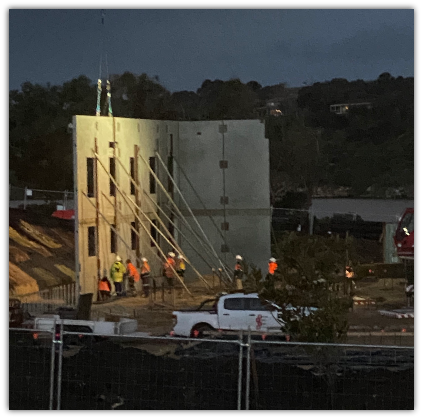
Workers are dwarfed by the pre-cast slabs for Lyndoch’s new $22m million medical clinic.

Carol Altmann – The Terrier

Up it goes.

The pre-cast concrete walls of Lyndoch Living’s $22m medical clinic are being hauled into place this week, giving the first real sense of the sheer scale of the project.

It’s far from sculptural in design (give me Tomlinson Wing any day), but it sure is big.

In fact the total footprint of the building, plus the carpark, is 3210 sq/m.

To put that into perspective, an Olympic-sized swimming pool is 1250 sq/m.

The three-storey building is intended to house up to 20 GPs, two dentist chairs, a pharmacy, pathology, radiology, cafe, education centre, wellness centre, and an acute care area, but don’t start calling it a mini hospital.

It’s a primary health care centre, being built by an aged care home.

We are still not entirely sure whose idea it was to build such an enormous and expensive project, but it has had the full support of the Lyndoch board.

We are also still not sure, exactly, how it will benefit the elderly residents of Lyndoch, or whether it is financially sound.

Lyndoch’s new Chief Operating Officer Elizabeth Green told the local paper in June that there was absolutely nothing to worry about and the project was viable.

“It’s as simple as that,” she told The Standard*.

“This has been planned for a number of years using a number of specialists.

“We have looked at every option, every worst-case scenario, every best case scenario to make sure that whatever we do will work, and it will,” Ms Green is quoted as saying.

Okie dokie, but where are the figures to back up the “it will”?

As we know, former Chief Financial Officer Allan Conway, who finished his contract in March, holds a completely different view.

Mr Conway expressed his grave concerns in writing to his boss, the Lyndoch CEO, in the final days of his contract and said he could not support the clinic “in its current form”.

In other words, Mr Conway believes the clinic is far too big, and will leave Lyndoch exposed if it can’t fill it.

Both Ms Green and Mr Conway can’t be right.

Perhaps one was privy to information that the other was not, but why do we have two chief financial officers with two very different opinions?

(A good question for the October AGM).

Either way, the construction of the pre-fab clinic is going gangbusters in order to meet Lyndoch’s deadline of April next year.

In the meantime, the deadline for a decision on whether Lyndoch will be accredited for another three years has been delayed until February because of Covid19.

A decision was due this month, just five months after the national aged care watchdog found a string of serious failings within the nursing home.

Have these failings been turned around? How did they happen in the first place?

(Another good question for the October AGM).

In another update, I am also waiting to hear from the Warrnambool City Council on whether the corporate sign installed on the side of Lyndoch illegally last November has been given a permit.

Why is it taking so long and, given the sign was installed illegally, what is it still doing there? (Yet another good question for the AGM).

Lastly, I have learned from the WCC staff that the road gouged illegally through Scoborio Reserve to access the medical centre construction site is being reinstated, but there will be no fine.

No fine….

Til next time,

Terrier.

* I have to quote The Standard, as Lyndoch has never responded to The Terrier’s questions.


Sod turns on Lyndoch med clinic while nurse call system fails

Lyndoch held a sod turning ceremony on its new $22m medical clinic today, while 100m away nurses are dealing with an unreliable call system. Image: Stockblock.

Carol Altmann – The Terrier

Lyndoch Living today held a ceremony to celebrate the turning of the first sod on its $22 million medical clinic on Hopkins Rd.

Red rope and gold pillars, like those you see outside nightclubs, marked the VIP area on the razed Tomlinson site that remains littered with a pile of unanswered questions, like how will this benefit the residents?

There didn’t appear to be any VIPs other than the board who turned up today, and there was no sign of any residents.

Neither was there any care staff who, 100m away from the sod, are still battling with an unreliable nurse call system.

These staff must wonder, surely, how Lyndoch can afford to spend $22 million on a medical clinic while such basics as the call system remain dodgy.

This is the mobile system that connects care workers as they move from wing to wing and floor to floor.

It’s the spinal cord of the communications system and yet is not 100 per cent reliable and plagued by black spots.

This means calls between care staff can drop out, which, in an emergency, is a bit like us dialing 000 and nobody answers.

Lyndoch has known about these system failings for more than a year and yet, for whatever reason, it still hasn’t been fixed.

In that time, there has been at least one serious incident involving an emergency with a resident and the call system breaking down.

How such lop-sided priorities within Lyndoch remain acceptable is beyond me and I can only ponder, as the board lines up for photo opportunities with a shiny spade, if they are aware.

They are now.

[Once again, I am sorry, but I have comments turned off on this post until a current legal action involving Lyndoch is sorted.]


Demolishing more of our precious history is a bridge too far

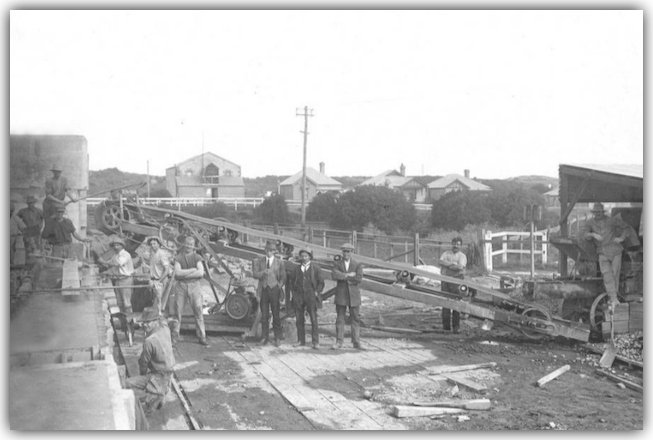
The Stanley St bridge can be seen in the backdrop of this photo taken in 1890, showing workers at a railway reserve unloading huge concrete blocks that would be used to build the breakwater. Image: Warrnambool Historical Society.

Carol Altmann – The Terrier

Will one of Warrnambool’s oldest original bridges survive the wrecking ball? Oh, I hope so.

The Warrnambool City Council will soon decide what to do about the failing Stanley St bridge/Edward’s Bridge that crosses the Merri River near the pastel monstrosity formerly known as the Lady Bay Hotel, and which has been in service for 130 years.

Demolition is an option, such is the Warrnambool way.

Just three years ago –  in 2017 – the council spent tens of thousands of dollars fixing this very bridge and strengthening the piles that hold it up.

Apart from the piles, the bridge was in “generally good condition” the WCC’s then-infrastructure manager said in a media release.

Even better, the end result of spending these tens of thousands of dollars on repairs was that “the historic bridge will be serviceable for decades to come”.

Decades? Not quite.

Here we are, just three years later, and Stanley St bridge is not only in need of major repairs – another $80,000 will be spent straight away – but is under threat of demolition.

How can this be?

And has the council demanded a refund for the works that failed to extend the life of the bridge for five years, let alone decades to come?

I asked the council spokesman these questions on 20 May and also for a figure on how much the 2017 bridge works cost: there has been no response.

Oddly, these 2017 works didn’t rate a mention in the report to the council meeting on 4 May when councillors talked about how much money they would need to borrow to either knock the old bridge down, repair it, or keep it and build a brand new bridge alongside.

Nobody put up their hand and said, hang on, didn’t we just spend a bucketload of public money a couple of years ago to fix this bridge?

Like the Merri River in flood, so much public money just swishes through and is never seen or heard of again.

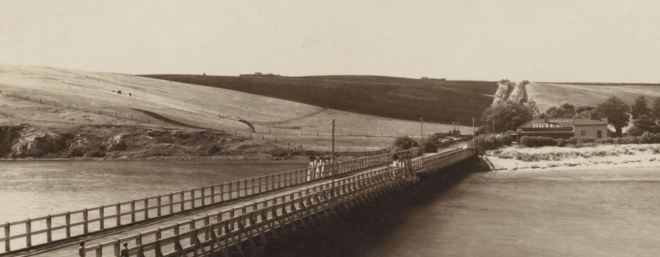
The original Hopkins River bridge was built in 1895 and was completely replaced in 2000. It is now in need of major repairs to prevent a catastrophic failure. Image: State Library Victoria.

The same could be said for the Hopkins River bridge which is also in need of major repairs, despite being completely replaced just 20 years ago.

It will soon have $460,000 spent on it to prevent “catastrophic failure” caused by defective concrete and other work that, obviously, couldn’t handle the harsh conditions.

Here’s part of the shopping list for Pontings, according to the tender:

Concrete patch repairs to pre-stressed beams;

Concrete patch repairs to pier headstocks and pier piles;

Crack injection to pier piles;

Silane treatment to pre-stressed beams;

Silane treatment to pier headstocks;

Silane treatment to pier headstocks; and

Protective paint system for pedestrian walkway galvanised beams & plates/cleats.


Cripes, that is some list.

The Stanley St bridge will cost around $2.6m to replace, or $1.2m to repair, with the council to cover half the cost and the remainder from a grant.

Perhaps if we had got it right the first time, we wouldn’t be facing the loss of another piece of our precious history.

My hope is the new bridge, if it must be built, runs alongside the old….and we push for a decent warranty.

Any other option should not be an option at all.


Deficit: down the rabbit hole into Lyndoch Wonderland

Carol “Alice” Altmann – The Terrier

Take my hand and follow me into the strange, alternative world of Lyndoch Living Wonderland, a sparkly world with a lovely colour palette, and where a deficit is “a good result”.

Lyndoch has just posted its fourth deficit in the past five years, but according to those who sit at the big table, there is no need for concern.

(Caterpillar: I don’t know what they’re smokin’ over there in the boardroom, but I want to try it!)

What’s more, Lyndoch CEO Doreen Power, who was appointed in 2015, has announced – without so much as a twitch of an eye – that we can expect our largest, fully-booked aged care home to run at a loss for another two to three years.

This means that by 2022, Lyndoch will have run at a loss for six or possibly seven years out of the past eight.

(Cheshire Cat: keep smiling everyone, keep smiling! Oh blast, here comes Alice with her practical facts…)

In 2014, the year former CEO Rhys Boyle retired, Lyndoch was comfortably in the black and recorded a $901,214 surplus, which came on top of surpluses in 2012 and 2013.

Here are the figures since:

2015: $208,707 deficit

2016: $130,037 deficit

2017: $846,563 surplus

2018: $1,573,98 deficit 

2019: $398,356 deficit


I think this tells us pretty clearly that Lyndoch is living beyond its means – each year it is spending more than it makes – but somehow an almost $400,000 loss like last year is a “good result”.

No it isn’t. It’s a bad result.

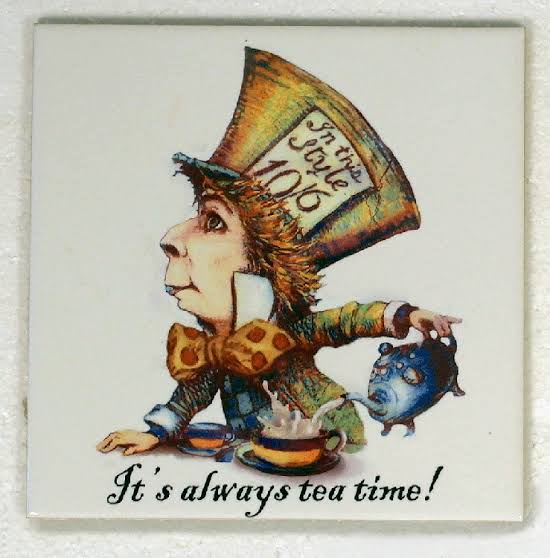
(Mad Hatter: Oh Alice, anyone knows a good result is better than a bad result which is better than a worserer result. Pour me some tea!)

If we push aside the spin and boil it down to the absolute basics, Lyndoch has one important job to do, which is to care for our elderly and infirm, for which it receives money from the Federal Government, the State Government, live-in residents, clients and its own investments.

From all these things, Lyndoch last year received a total income of $38.9 million.

It spent $39.3 million, in other words, it went over its budget…again.

On top of this, Lyndoch also confirmed a slightly awkward piece of news, which The Terrier flagged back in October, which was $11.3 million was wiped off its assets after certain, unnamed buildings were re-valued using a different method that, from what I can see, used market prices.

This is like owning a house you thought was worth $12 million, only to be told it is actually worth $1 million.

(Mad Hatter: Oh who cares? $1 million, $12 million, it’s only on paper! Tear it up and start over! More tea?)
Have a big sip of whatever you are drinking, because now we wade deeper into the forest of figures in search of the bottom line.

In 2015, Lyndoch had total assets of $96.5 million – this is whole shopping cart: the properties, the cash, the residential bond money, the investments, the cups and saucers, cutlery and cars.

At the same time, it had expenses, or liabilities, of $27.7 million, leaving it with a bottom line of $68.7 million.

By 2019, Lyndoch had total assets of $98.9 million – (White Rabbit: clap, clap, wonderful, magnificent! Well done!) – but….it also had liabilities of $47.7 million, leaving it with a bottom line of $51.1m.

This means Lyndoch’s overall bottom line has fallen from $68.7 million to $51.1 million in just five years.

(White Rabbit: Oh. But the cash, dear Alice, what about the cash?)

Lyndoch has plenty of cash: $48.7 million in cash and other investments, except they can’t touch most of it – around $30 million from my reckoning – because it is tied up in residents’ bonds.

(White Rabbit: So I can’t spend it on a shiny new pocket watch? Damn.)

As we know, other things have changed dramatically in the past five years too, including just about every member of the executive team being replaced, from the Director of Nursing, to the Chief Financial Officer, to the Human Resources head, with more than 80 staff having gone elsewhere.

I have since been told by a strong source that my figures are wrong and it’s closer to 120 staff, but I can’t verify this.

(Queen of Hearts: At last, at last, my walk on part…Off with their heads, I say! Off with their heads! Strike up the trumpets!)

No wonder the board wasn’t keen to trumpet all of this news at the annual general meeting last October, where written questions from the public were ignored, because they were not members of Lyndoch.

Anyone who has since tried to become a member has been rejected.

(Queen of Hearts: Close the gates! Don’t let the rabble in!)

And the crazy making thing is that despite these worrying figures, Lyndoch is not tightening its belt, but going on a spending spree: a $100 million masterplan that includes buying two medical clinics for a cost of $1.6 million, including $1.3 million for the Warrnambool Medical Clinic, so it can move them to a medical clinic that it will build.

(Mad Hatter: And don’t forget the horse race! We want to go to the races, so we bought the race! Giddyup Dormouse!)

I am worried, dear citizens, that we who own Lyndoch are being dragged deep into this wonderland and we won’t be able to find our way out, which is why we have to keep going.

(Caterpillar: Ah, chill baby and pass me the pipe.)

If you would like to support the Terrier, you can throw something in the tip jar below. 

The Tip Jar