Two years on, Levy’s Beach dunes are still being trashed
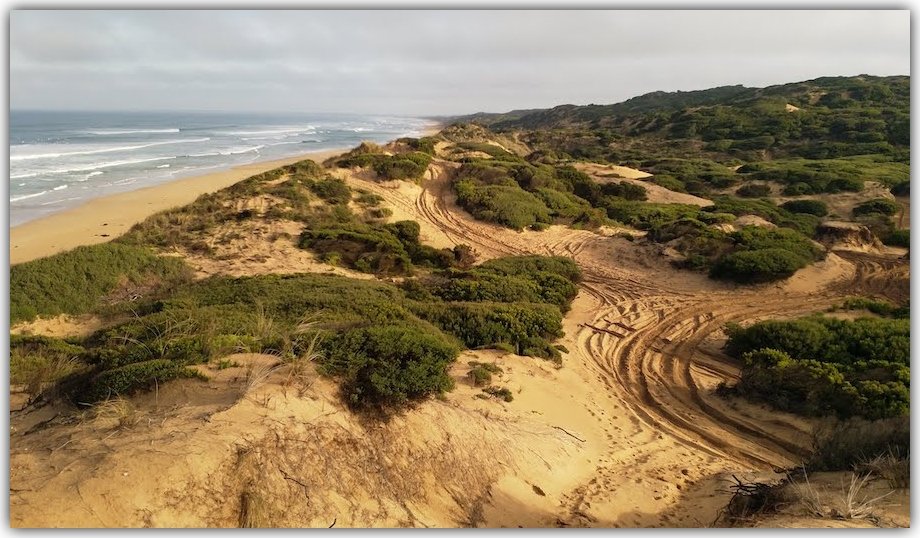
The scars of illegal four-wheel drives across the landscape at Levy’s Beach. Picture supplied.

Carol Altmann – The Terrier

We call ourselves Australia’s most liveable city, but this is still happening to our coast.

Two years after a long, expensive and detailed plan was put in place to look after the wild terrain of Levy’s Beach, it’s still being trashed.

The illegal four wheel-driving still goes on.

Illegal rubbish dumping still goes on.

The illegal trail bike riding still goes on.

And there is still no answer from the Warrnambool City Council as to whether racehorse training will be allowed, because most councillors are paralysed with fear of making this an issue at the next election and more importantly, pissing off the powerful Warrnambool Racing Club.

Tip: it already is an election issue.

Another tip: with Weir and McLean now pre-occupied preparing their defence for serious charges of animal cruelty against racehorses, the other 99 per cent of the trainers have moved on and are content with Lady Bay.

When it comes to Levy’s beach and our part of the Belfast Coastal Reserve, the council is incapable of making a decision and it is incapable of managing the area.

It has utterly failed and, this time, it cannot claim it didn’t know what was happening “out there”.

They know what is happening and the best they can do is launch yet another bloody survey.

Another survey, for another plan.
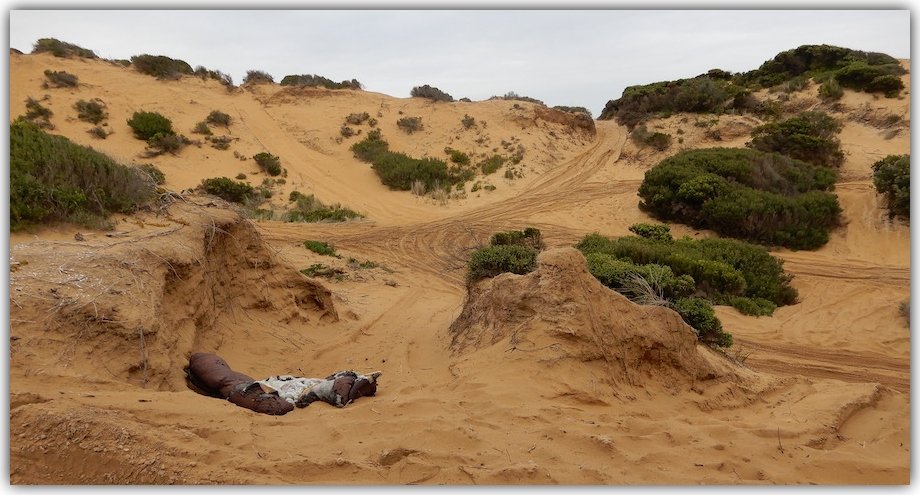
Illegal rubbish dumping and illegal four-wheel driving tracks at Levy’s Beach. Image supplied.

Please, not another plan.

We already have a Warrnambool Coastal Management Plan 2013, a Green Warrnambool 2018 plan, a Warrnambool Coastal Vegetation Management Plan 2012, a Management Plan for the Levy’s Point Coastal Reserve from 1998, a Marine and Coastal Policy 2020, and – as mentioned above – the Belfast Coastal Reserve Management Plan from just two years ago.

Now we are being asked to fill out this new survey by 10 July and say what you REALLY, REALLY, think should happen at Levy’s Beach…

Bloody hell. It’s exhausting, particularly when some of us are still putting our eyeballs back in from telling the EPA what we think about the Wannon Water treatment plant upgrade that will pour industrial effluent into this same stretch of coast.

I am starting to think the WCC is secretly developing a form of psychological torture where they survey citizens into submission, call it consultation, ignore the results, do nothing, and then survey us all over again.

It’s called surveyconsultationitis and is designed to cause temporary insanity and physical exhaustion as we scroll through yet another Survey Monkey and click on the multiple choice.

By the end of it all, we will be gibbering like chimpanzees and that, I suspect, is the whole point.

While we are distracted by all of this “busy work” – as musician and activist John Schumann once described it – our coast continues to suffer.

It continues to be raped and pillaged by those who really don’t give a stuff, and they do so with impunity.

They don’t care: it’s all a bit of a laugh to go up there in your Toyota Hilux and shred the dunes for half an hour, because nobody’s watching and nobody is issuing any fines. More people are fined for parking too long in Liebig St.
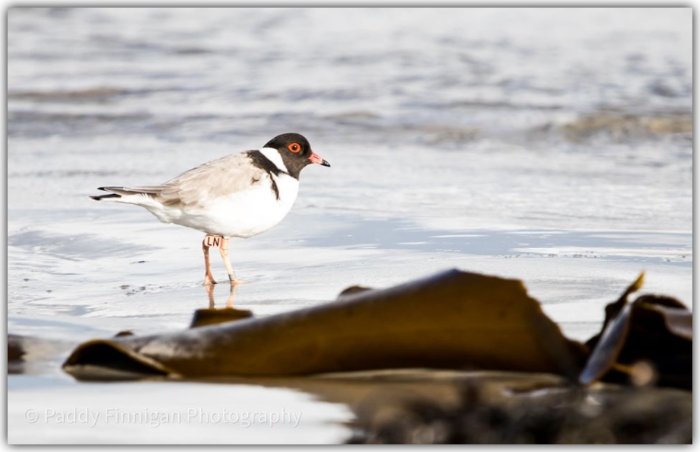
The Belfast Coastal Reserve is home to myriad bird species including the protected Hooded Plover. Image: Paddy Finnigan Photography.

The Belfast Coastal Reserve Management Plan promised this would change.

It promised that the council, Parks Victoria and various state bodies would all work together to protect this precious, wild coastline that is a victim of its isolation.

But the only thing that ever captured the immediate attention of all these bodies was the racehorse training: it was a top priority.

The council moved so fast in late 2018, it was almost as if it had a jigger on its arse: special meetings were held, Ministers were called, planning amendments were rushed through to make the illegal racehorse training that had been going on, legal…

Ah, the power of money.

We don’t need to fill out another survey because we have already spoken, many times: protect this area from any more degradation.

The council knows what it has to do.

Just do it.



Wannon Water sewage plant upgrade must reach for the stars

Betty Boop has nothing to do with Wannon Water and its treatment plant, but I am rolling out some stars to make sewage sexy.

Carol Altmann – The Terrier

Tonight I am rolling out the red carpet to make sewage sexy and effluent exotic, because we need to talk about the planned upgrade of the Wannon Water treatment plant.

This upgrade will service Warrnambool for the next 20 years.

I want to explain, as best I can, why before 1 July (when the chance for public comment closes) we need to ask for better from Wannon Water, to aim higher, and to stop using our beautiful ocean like a giant Maytag washing machine.

As it stands, Wannon Water plans to spend $40 million expanding the treatment works at the end of Elliot St, so it can double its capacity to eventually handle around 30 million litres of sewage a day by 2040.

This Wannon Water production should be a blockbuster starring the Brad Pitt of shit and the Betty Boop of poop and the Scarlett Johansson of industrial trade waste, except it isn’t even close.

It’s more of a B-grade movie starring faded stars of yesteryear.

That’s because the $40 million plan is the cheapest option and will not change the way our sewage is treated in the future from how it is treated now.

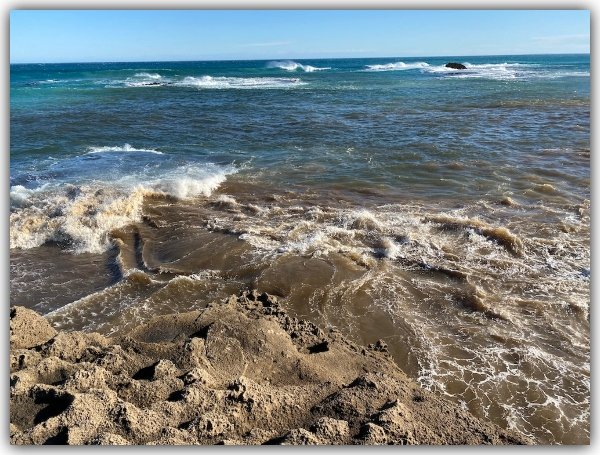
The ‘mixed liquor’ of treated sewage that entered the ocean off Thunder Point last month due to problems at the Wannon Water plant. Image: Beach Patrol 3280.

This means, in 2040, we will still be pouring millions of gallons of treated sewage/effluent into the ocean off Thunder Point using exactly the same treatment system as in 2020.

And that system, according to wise minds like the Clean Ocean Foundation (COF), is already behind the times by about 20 years.

The COF is lobbying to have all waste water discharged to the ocean at a Class A+ standard by 2030 to reduce ocean pollution.

Warrnambool is not even at Class A now, and won’t be at Class A after the upgrade, let alone at A+.

Worse, our system often doesn’t work, as can been seen by what is called the “mixed liquor” (which sounds sexy, but is the revolting foamy brown stuff) which still turns up off Thunder Point.

What we should be aiming for by 2040 is clean, treated effluent that can be recycled and reused and doesn’t have to go into the ocean at all, but if it does, at least make sure it is not full of pollutants like phosphorous.

Right, how do I make phosphorous sexy?

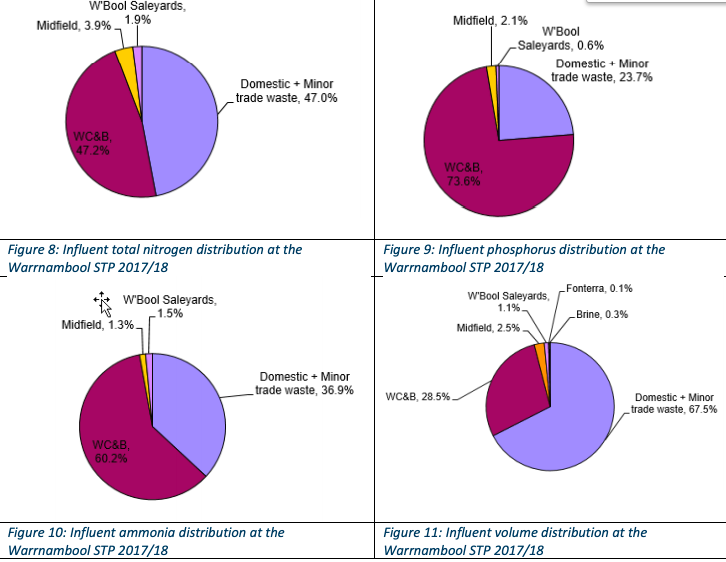
Well, here is a photo of a very sexy Brad Pitt, followed by a sexy Wannon Water graph that shows that Warrnambool Cheese and Butter – the burgundy colour – producing a Pitt-load of phosphorous, nitrogen and ammonia that goes into our ocean:

Warrnambool Cheese and Butter is owned by the Canadian giant, Saputo, which turns over about $11 billion a year.

Perhaps we could ask Saputo to throw a few million toward helping us make it to the Hollywood A-list by making sure our ocean had the cleanest effluent possible?

Or maybe Saputo could spend a few million dollars improving the treatment of its own waste before it makes anywhere near Wannon Water and into the ocean?

Another of the problems from this dairy trade waste is it’s extremely salty, which means the effluent water cannot be reused easily without burning everything along the way.

I found it astonishing that of the millions of litres of waste water produced by the Warrnambool treatment plant – 15 million litres a day – only 60 million litres a year is reused, and only at the plant itself.

In the scheme of things, 60m litres a year is an eye dropper full and the rest goes into the sea to swirl around in nature’s Maytag: not a drop is recycled or reused outside of the Elliot St treatment plant.

Wannon Water says it has investigated reuse projects and also tried to find customers for recycled water, but without success, no doubt because of the high salt content among other things.

So we have a treatment plant within walking distance of the Warrnambool Golf Course* and the new Younger St housing estate, yet no recycled waste water from the treatment plant is being used at either. (*Clarification: water was diverted from Fonterra, before it reached the plant, for use on the golf course. Please see comment from Dave at the end of this story).

Good grief.

If this is “green” Warrnambool under the Warrnambool City Council 2040 plan, then we have a long, long way to go.

Of course it all comes down to dollars and who pays.

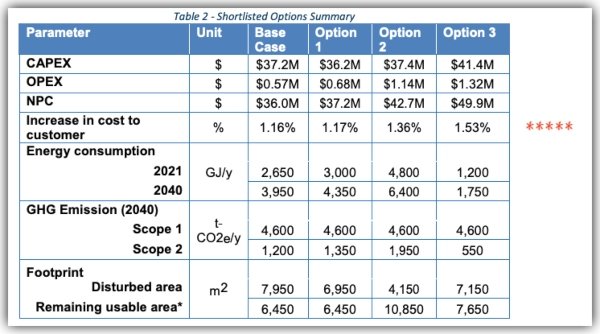
People, naturally, become nervous when Wannon Water talks about higher customer bills to cover the cost, but here is a photo of a beautiful Scarlett Johansson, under which we can see a beautiful graph showing the costs.

You will see that between the various options, it is really not that different – a range of 1.16% to 1.53%.

Is Wannon Water really that strapped for cash or ways to find it?

How bizarre that Lyndoch Living – a not-for-profit, community owned aged care home – can roll out out a $100 million masterplan, yet Wannon Water can only come up with $40 million for a major treatment plant expansion to service our city for the next 20 years.

Water treatment is complex, but I know we can do better than this, our kids deserve to inherit something better than this, and the Clean Ocean Foundation is right behind Warrnambool in its quest to ask for more.

The COF will appear in the blockbuster sequel to this story tomorrow night, offering us non-science-minded folk some starting tips for our submissions.

In the meantime, you can find out more about Wannon Water’s plans via its website here.

Good night, credits roll, lights dim.

I am tip toeing back into the Tip Jar. If you would like to see The Terrier keep digging, please throw what is affordable into the tip jar below. 

The Tip Jar


100 dead birds and rising in Lake Pertobe botulism outbreak

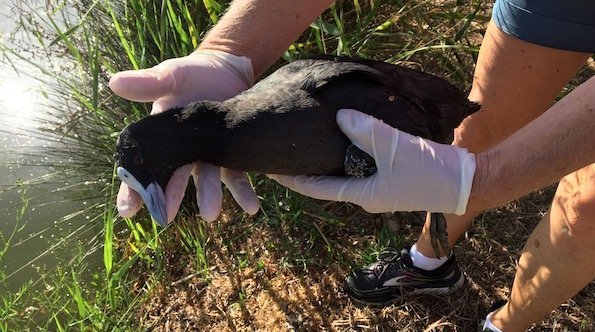
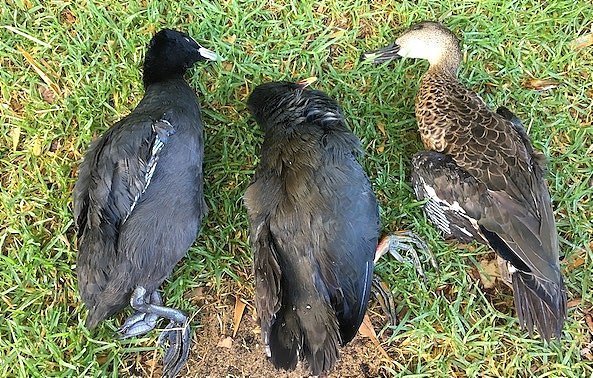
A dead Eurasian coot, one of more than 100 birds that have died at Lake Pertobe in the past five weeks from a botulism outbreak that is rolling on.

Carol Altmann – The Terrier

Within the calm surrounds of Lake Pertobe, there is a mass killing underway and not enough is being done to stop it.

More than 100 birds have been wiped out since an outbreak of avian botulism began to claim the birds of Lake Pertobe five weeks ago – among them ducks, cygnets, moorhens, Eurasian coots, cormorants, swans, seagulls and a crane – and the death toll is still climbing.

Most visitors to Lake Pertobe are blissfully unaware that just metres from where they are enjoying the open spaces, there are native birds unable to hold their necks up from the creeping paralysis of the botulism toxin.

These birds will most certainly drown. (Warning: the video below may be distressing).


Wildlife rescue volunteer Alexis Creed-Sycopoulis has been walking the accessible parts of the lake shore most days, and often twice a day, to collect the carcasses and the stricken, paralysed birds which she takes to the vet to be euthanised.

It is a heartbreaking job, but a critical one, as the science shows that every dead bird left in the water contaminates it only further. The threat is even greater if the carcass has become flyblown.

Three of the four dead birds collected in just half an hour during a morning pick-up this week by wildlife volunteer Alexis Creed Sycopoulis.

I joined Alexis on one of her morning pick ups, during which she found four carcasses within half an hour. Another two would be found when she returned later that night. Last Sunday, the grim count included several birds covered in maggots.

“I shouldn’t have to be doing this. I really shouldn’t have to be out here doing the work of the council to make sure these birds are not left in the water,” Alexis says.

The Warrnambool City Council parks and gardens team at Lake Pertobe also collects the dead and dying birds, but there are just not enough workers allocated to the job.

This was proven last weekend, when Alexis left a bag of dead ducks she had collected on Sunday morning at the small council depot at Lake Pertobe, thinking they would be disposed of by staff when they arrived later that day.

The bag was still there when Alexis returned on Monday morning. So were the flyblown carcasses, still in the water. There had been no council check of Lake Pertobe on Sunday, even after the two-day heatwave.

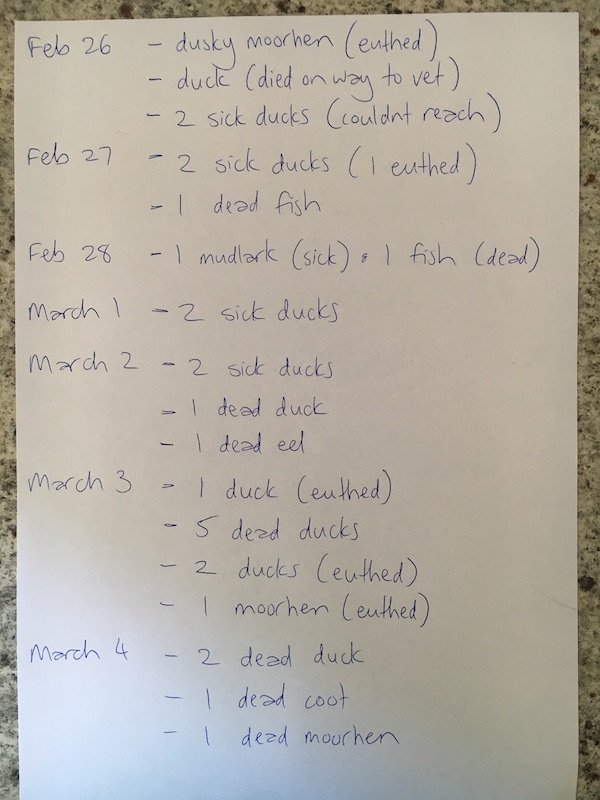
The grim count: the casualties at Lake Pertobe from just the past week, as counted by Alexis Creed Sycopoulis. These figures are added to the council’s tally.

And this morning, Tuesday, Alexis found a dead duck floating in the lake at 10am, hours after the morning pick-up should have started. Meanwhile, up in town, four parks and garden staff were tending to a roundabout.

The council’s small Lake Pertobe team is no doubt trying its best, but they have many tasks, and retrieving dead birds is just one of them. Alexis is also trying her best, but she is a volunteer, with a job and kids.

Meanwhile, the avian botulism continues its deadly march in the warm, soupy conditions of Lake Pertobe that follow days of little rain, hot weather and a build-up of rich nutrients in the water.

While nature controls the first two conditions – heat and no rain – we can reduce the nutrients.

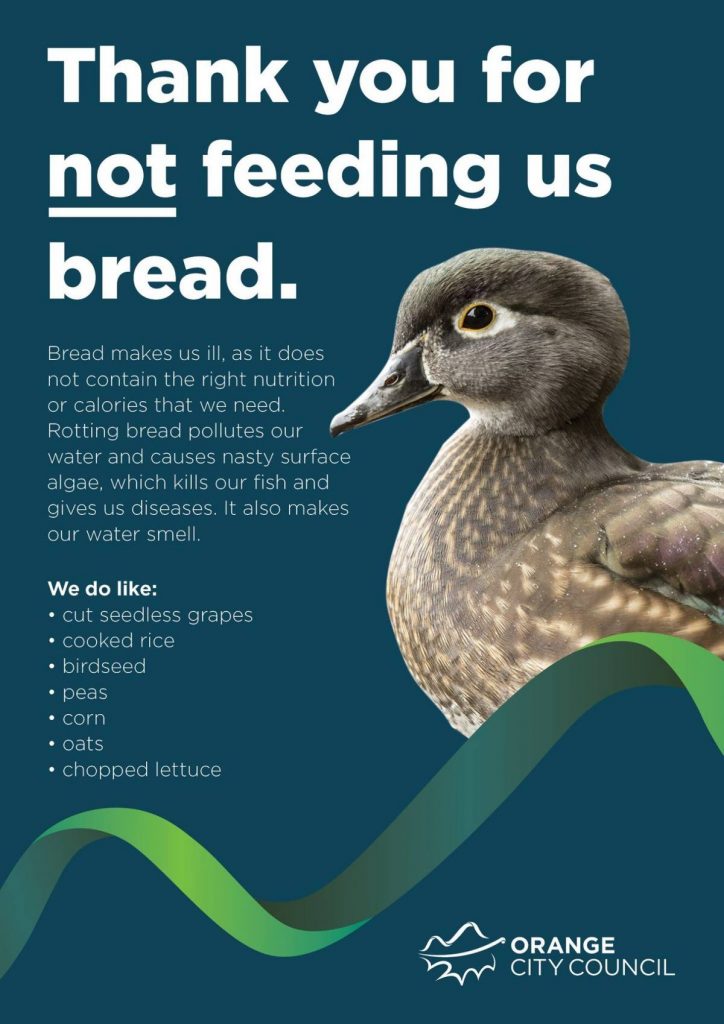
Orange City Council started its a no bread for ducks campaign in 2018, erecting signs like these around its waterways.

It is for this reason that Alexis is also pushing for an immediate council ban on feeding ducks bread within Lake Pertobe and elsewhere, as has been done by other councils.

Bread can be easily replaced by other duck-friendly foods, but so far the council is reluctant to issue such a ban, saying there is no proof that bread kills ducks.

Well, no, bread doesn’t kill ducks – although I am not sure how good processed bread is for them either – but it also doesn’t help Lake Pertobe to get healthy and adds to the conditions that cause avian botulism.

I suspect if the 100 dead birds found so far were all laid out on the Civic Green, we would all be justifiably horrified and asking the council to throw everything it can at the disaster.

For now, however, that burden sits largely on the shoulders of one or two people and the mortality rate grows higher.

(In the time it took me to write this story today, another nine birds were found by Alexis, including four that needed to be euthanised. The total is now 105 110.)

If you would like to see The Terrier keep digging up, sniffing out and chewing on local issues, please make a small contribution below.

Donate


Drawing deep for a long, tough journey

Original painting, oil on canvas, Graeme Altmann. (Altmann Studios, Highett, Melbourne.)

Carol Altmann – The Terrier

On days like this, we need hope.

On days like today, when we see laws passed that allow even greater damage to our wild coast than what we have already inflicted, it would be so easy to just give up, because the battle is exhausting.

But on days like today, when I need to draw deep on hope, I think of my late uncle Alf Altmann.

In March 1970, almost 50 years ago, Alf attempted to become the first person to row solo across Bass Strait, from Tasmania to Victoria, in a home-built kayak.

He built that kayak piece-by-piece in his garage under his home on Riverview Tce, here in Warrnambool.

To train for this epic journey of more than 200km, he would row out to Deen Maar, (Lady Julia Percy Island) and, once or twice, he carried native saplings in his boat to plant on the barren island.

The saplings never survived. Neither did my uncle. His attempt to cross Bass Strait ended just 1.5 miles from the Victorian coast. So near. So close.

And when I think of his story, I think of an anecdote that stays with me each day as I do my bit to try and turn around decisions that hurt our local environment more than protect it.

“Why do you bother taking those saplings with you?” someone asked Alf. “Nobody will see them out there.”

“I see them,” Alf replied. “I know they are there, and that is all that matters.”

This painting is how my artist brother, Graeme Altmann, often captures the essence of Alf’s journey: a boat, suspended above the turbulent sea, with the proud thylacine pointing toward an unknown future.

We can’t change the mistakes of the past. Alf never came home. The thylacine is gone. But I keep trying to do what I can, whatever I can, to turn other mistakes around.

Because we know. And we see. And that is what matters.


All go, go for FOGO? Well, yes, yes and no, no

Carol Altmann – The Terrier

The Warrnambool City Council’s new organic waste collection is a terrific move, but it could take a year or more before the service actually reaches your street.

Until this week, I didn’t know that the new service – best known as FOGO – could take up to three years to roll out fully across Warrnambool. Did you?

Let me explain.

As has been well publicised, the council ran a pilot of the FOGO service with about 1700 householders in the first half of this year and it was wildly successful. No surprises there; we are a green-minded city.

Buoyed by this success, the council decided several months ago to roll out the service to everyone and I, like most others, couldn’t wait to get that extra bin so organics could be sent off to be composted, rather than dumped in landfill.

In the meantime, the council sent out its 2018/19 rates notices which included a $69 increase in the waste management fee, up from $287 to $356 per household.

As then-Mayor Robert Anderson explained, the sharp increase “covers the rollout of a Food Organics, Garden Organics (FOGO) collection service and also the increase in cost to process recyclable materials”.

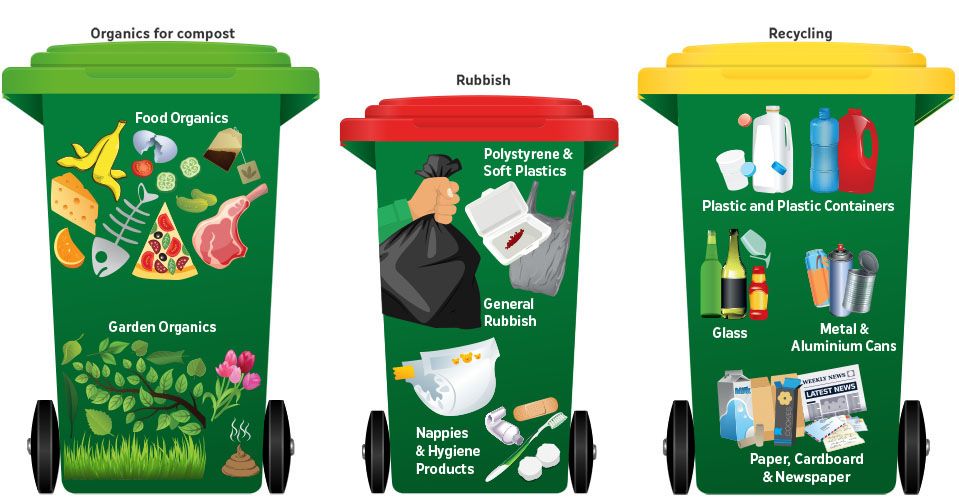
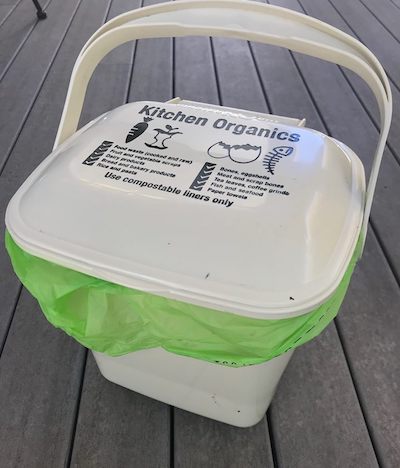
Coming to a kitchen near you – the FOGO rollout includes delivering kitchen caddies and bin liners to each home, like these recently delivered to residents at the Mill.

But this is where things get confusing: just because you are now paying $356 for your rubbish collection doesn’t mean you will get the FOGO service immediately.

It could take months and possibly even years, depending on where you live in Warrnambool.

The council hopes it won’t take that long, of course, but in July this year it flagged that the full roll out across nine pick-up areas, each of about 1600 bins, could take up to three years.


I must admit that I missed that memo and, like others, was wondering why I still hadn’t got my FOGO bin?

Just last week the council announced the winning tenders for picking up the organics, processing it and composting it, with all of these contracts to start from July next year.

So the situation for now is that some Warrnambool residents already have FOGO, some Warrnambool residents are getting FOGO as we speak, and others, like my little household, are waiting to find out when it will arrive.

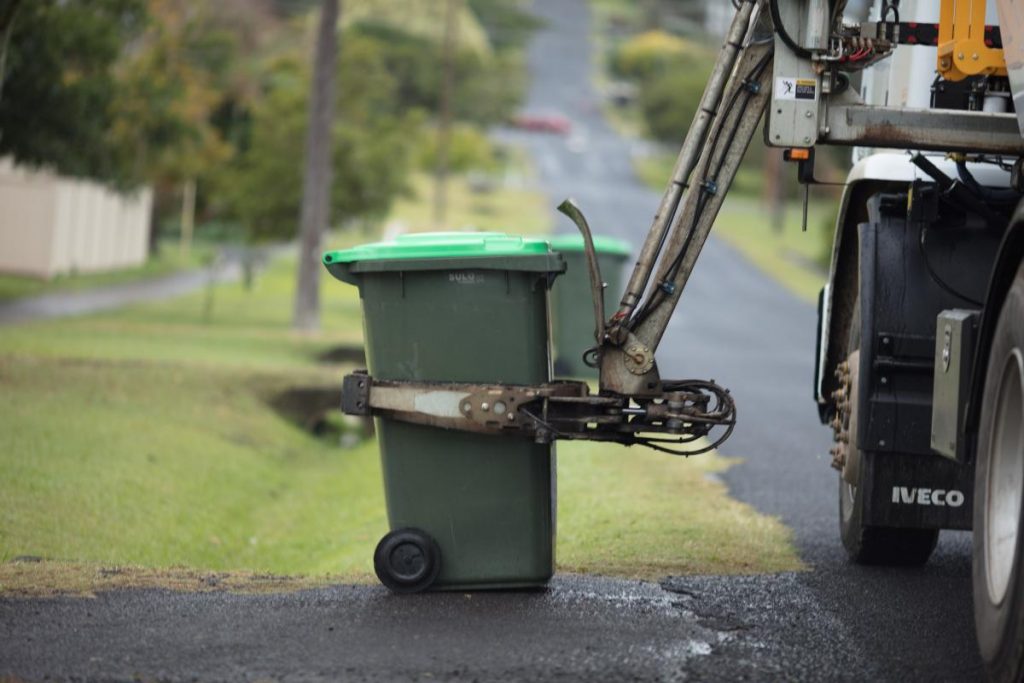
Green bins are on the march in councils around Australia, like Richmond Valley (pictured).

One astute reader asked me earlier this week whether a council can legally charge all ratepayers for a waste collection service that is only being used by some.

It is a good question, but the answer is yes, because, as the council points out, it is still collecting all of your rubbish – including organics that are now going into landfill via our normal old rubbish bins – and this all costs money.

“The FOGO component is allowing us to progressively roll out the FOGO collection which means that we will transition out of collecting (organics) in rubbish bins and move towards the separate collection of (organics), which will then be processed into compost,” council spokesman Nick Higgins said via email.

“While it may have been seen as preferable to roll out a complete FOGO service simultaneously across the city there were practical challenges with doing this,” he said.

Mr Higgins said the council was keen to get things moving as fast as it can and had applied for funds to help speed up the process.

“Council has applied for a grant to assist with the rollout of the dedicated FOGO collection and it is hoped that the full rollout of FOGO across Warrnambool will occur quickly,” he said.

What this all means is that, for the time being, FOGO is slow-go, but we are at least making a start on reducing the 3000 tonnes of food and other organics that are now being dumped into landfill.

Keep the Terrier typing!

Donate