Inside Lyndoch Living and why we need to be worried
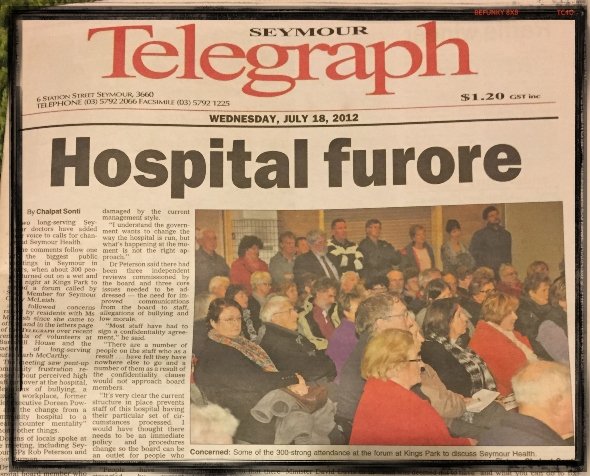
Just weeks after the resignation of then Seymour Health CEO Doreen Power, a record crowd of more than 300 people turned out to a public meeting held in Seymour to address the many troubles of the hospital.

Carol Altmann – The Terrier

This Lyndoch Living story has gone to places that I never expected it to go and that includes wading into the work history of CEO Doreen Power which, to be frank, is why I am so troubled by what is unfolding here.

I will write more about Ms Power’s back story in the near future, but for now I just want to lay out the context for my concern and why I am latching on to this story for the long haul.

In the seven years before Ms Power became CEO of Lyndoch in December 2014, she held three senior positions:

First as CEO of Seymour Health for almost five years before resigning in May 2012 in the face of a virtual uprising by the small town of 7000 people.

Then as CEO of Plenty Valley Community Health for less than two years, before an interim CEO was appointed in December 2013.

And, lastly, working briefly as Director of Nursing at Tweddle Child and Family Health Service until that role was taken over by another person in February 2014.

I have spent many hours researching and talking to people about Ms Power’s time at Seymour and Plenty in particular and a disturbing pattern has emerged, one which I believe is being replicated at Lyndoch:

– a culture of bullying and dismissal

– extremely low staff morale

– a compliant board or attempts to create one

– an impact on residential care and services

– a culture of secrecy and a lack of transparency


Journalists, I can tell you, don’t have either the time or inclination to go digging into people’s work history unless it is relevant to a story unfolding now.

Ms Power’s back story is absolutely relevant and it is why I am committed to writing all that I know – based on a huge amount of research and dozens of interviews – because you need to know.

We need to know because Seymour Health and Plenty Valley Community Health, in particular, are the red flags.

Both took years to recover.
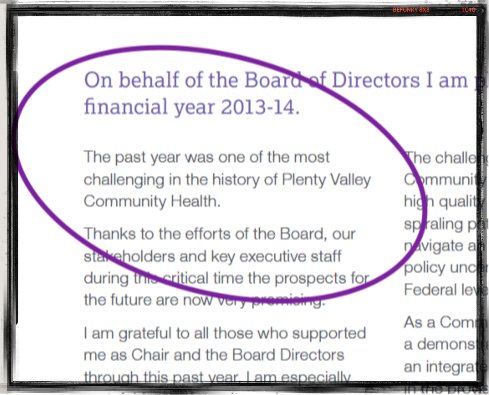
The opening sentence of the chair’s annual report to Plenty Valley Community Health, the year after Ms Power left the organisation. Ms Power was less than two years in the position.

Thanks to your help, I am going to pick apart what is happening at Lyndoch – all of it – because Lyndoch was set up by the community, to care for some of the most vulnerable in our community. Full stop, end of story.

Over the coming weeks, I am going to write about:

where Lyndoch is heading, its priorities, the breaking down of resident care, its venture into building and running a commercial medical clinic, who is paying for what, who is running what, who is in charge of what, whether Lyndoch is still primarily a charity and public benevolent institution, how the board is handling complaints, the change of the Lyndoch constitution, how the board is chosen, how the public can become members, the lack of transparency around its full financials, its support for gambling via a horse race, other sponsorship deals, potential conflicts of interest, who is involved in the new company Lyndoch HealthCare, and anything else worthy of forensic examination.

I will also be telling you much more about Ms Power’s time at Seymour Health, and Plenty Valley Community Health, and explore how she became employed by Lyndoch.
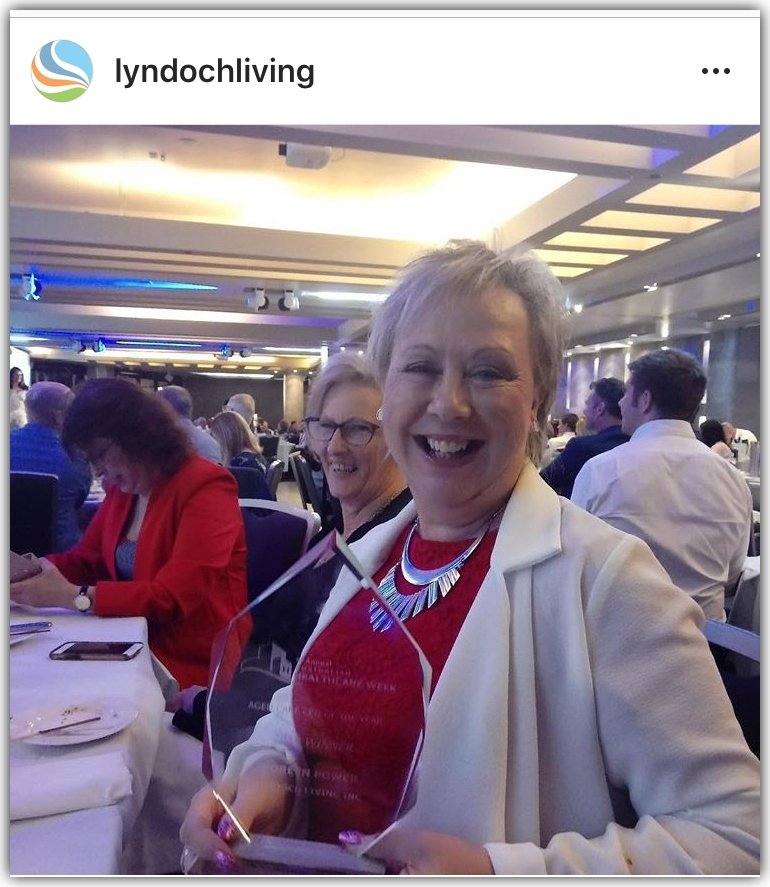
Lyndoch CEO Doreen Power having won the inaugural Aged Care CEO of the Year by Australian Healthcare Week awards in 2019. Lyndoch chair Kerry Nelson and Director of Nursing Julie Baillie also attended the Sydney event. Image: Lyndoch Living.

It’s going to be a long, slow haul, but it is an essential one.

It’s going to be tiring work, but we have done this before, you and I – the terriers and The Terrier – and we know we can make a difference.

We can be a voice for the workers (past and present) and the residents and for the Lyndoch we know and love, and together we can step up to where the majority of the board seemingly refuses to go.

If there is one thing I have learnt from my research around Seymour and Plenty Valley, it is that we need to start now.

Strap yourselves in and on we go.

More soon.

If you would like to support the work of The Terrier, please consider throwing something small in the tip jar.
Terrier Tip Jar


Lyndoch: champagne at the races, but no sheets and towels

Carol Altmann – The Terrier

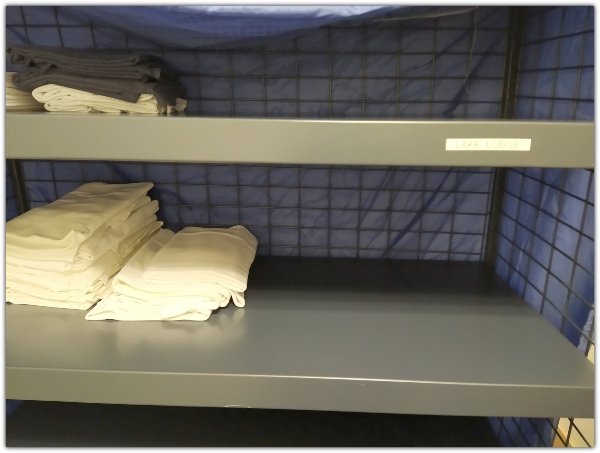
If there was ever a picture of how Lyndoch Living is losing touch with its priorities, it is this one.

This is a linen shelf that should be stacked with towels, sheets and face washers that is almost empty half way through a shift.

This is allegedly not unusual, despite Lyndoch  – a charity – getting geared up to spend millions of dollars to build a “super clinic” on its Hopkins Rd site as part of a $100 million masterplan.

Unbelievably, some nursing staff are cutting up old towels to use as flannels for showering and freshening up residents   – sorry, they are now called consumers – rather than rely on the back-up of wet wipes.

Other staff are hiding linen on Fridays so they have enough towels, sheets and face washers to get through the weekend.

Has it really come to this, you ask? Yes it has, and we need to know about it.

Lyndoch – a charity – has also just signed on to again sponsor the Grand Annual Steeplechase (at a cost of what, $70,000? $80,000?), yet a machine used to pulp cardboard urinal bottles has been out of action for months.

This means the cardboard bottles are carried by nurses across a dining room to another machine for disposal.

These are just some of the cracks that start to appear when a short-staffed system is under rising stress, and, my word, we need to know about it.

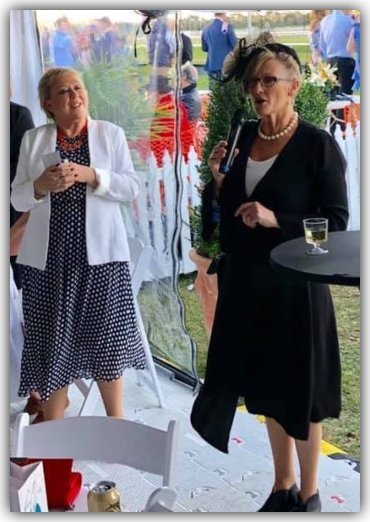
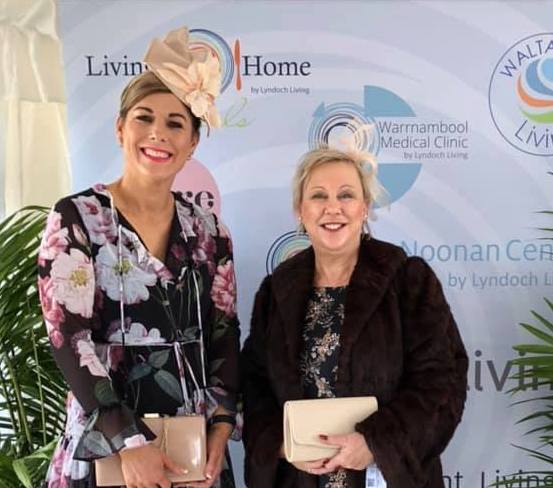
Lyndoch board member (and Warrnambool City Councillor) Sue Cassidy and Lyndoch CEO Doreen Power in the Lyndoch corporate tent at the 2019 May Races. Image: Lyndoch Living FB page.

In recent years Lyndoch has somehow lost sight of its core business, which is caring for the aged and infirm both in the nursing home and in-home care.

To most residents, this means tasty, nourishing food, having someone to talk to, and being cared for by nursing staff with the time, support and full resources to do their jobs properly.

This should be the number one and only priority for any aged care home, especially Lyndoch.

Lyndoch, we need to remember, is a not-for-profit, benevolent, charitable organisation that was set up more than 60 years ago by the Warrnambool community for the community.

We ultimately own Lyndoch, but it is run by a board on our behalf who, in turn, hire the CEO.

Lyndoch has plenty of money to fulfil its core business, receiving almost $30 million last year in government funds and another $6.1 million from client fees, with net assets worth $51.2 million.

You would think that every dollar would be directed toward the care and comfort of residents, including hiring and keeping quality nursing staff who are paid well, treated well and given all the resources they need to do their jobs well.

But no.

Instead, as I wrote last week, the staff are run off their feet and even when they do the best they can – like cut up towels for face washers – it is not enough.

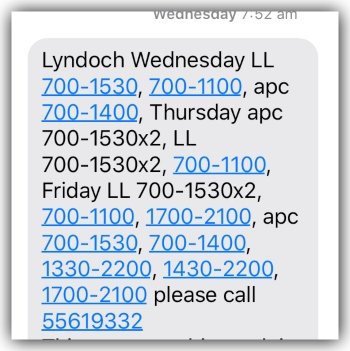
Roster shortages inside Lyndoch Living from last week.

At the same time, the Lyndoch board and CEO Doreen Power are pressing on with a $100 million masterplan, including borrowing money to build a multi-million dollar medical clinic on site for GPs, dental services and a chemist that nobody has proven is wanted or needed.

And at the same time, the number of admin staff at Lyndoch – a charity – has ballooned in the past three years from 37 to 59, with many having titles straight out of an episode of Utopia:

Director of People and Resilience; Social Inclusion and Entrepreneurial Manager; Operational Support and Improvement Manager; Project Manager Safety and Wellness.

All of those soapy titles and yet the culture is turning toxic and staff morale is sliding to rock bottom.

And then there is a revolving door of consultants who, between them, cost thousands for their expert advice.

I wish I could tell you exactly how much is being spent on consultants, but Lyndoch is yet to release its full financial figures and, given its new-found secrecy around such things, I doubt we will find the answers there.

Lyndoch Living CEO Doreen Power and Lyndoch board chair Kerry Nelson in the Lyndoch corporate tent at the 2019 May Races. Image: Lyndoch Living FB page.

Lots of really wonderful people work at Lyndoch and terrific things happen there as a result of their efforts, but I also know that so many are struggling to hold it all together.

We can either hold our head in hands, or we can actually hold the Lyndoch board to account and ask “what is being done about it?”

Chair Kerry Nelson has not responded to my questions. There is silence from all the other board members: Sue Cassidy, Ron Page, Peter Downs, Lorraine Mielnik, Percy Eccles, Kane Grant and Andrew Paton.

Are they so bedazzled by Ms Power’s “big vision” that they are not asking the tough questions? Do any board members or Ms Power ever wander down to chat with nursing staff and ask how they are managing?

As I understand it, some nursing staff have never met the CEO after almost five years.

I have never met the CEO and she will not return my calls or my emails, so – again – I can’t tell you Ms Power’s response to any of the above.

This silence is familiar territory to me, but just as with the Warrnambool City Council credit card scandal, I am slowly building a picture and the questions will keep coming because the community created Lyndoch, we care for Lyndoch and we have every right to know what is really going on.

More soon.

If you would like to support the work of The Terrier, please consider throwing something in the tip jar.

Terrier Tip Jar


Staff morale slipping to rock bottom at Lyndoch Living

Carol Altmann – The Terrier

Hear that? Alarm bells are ringing and they are coming from inside Lyndoch Living.

What follows comes from talking to dozens of people who have all expressed the same fear: the Lyndoch culture is turning toxic.

Many of the staff at Lyndoch are under so much pressure from staff shortages or low morale that they are starting to crack under the strain, or have already left. Others have been allegedly pushed out.

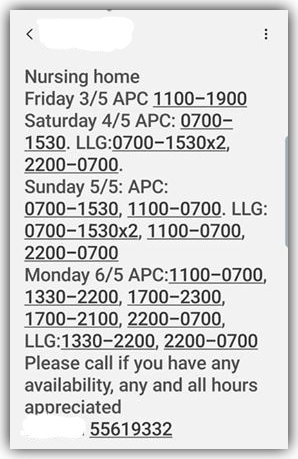
The images posted here are just a slice of the ‘please help’ messages of the past nine months, desperately asking for nursing staff to fill roster gaps.

Note that these gaps include during the week of the May Racing Carnival, where Lyndoch had a corporate tent and sponsored the Grand Annual Steeplechase (and has signed on again for 2020).

I have to tread very carefully here, because I know each word will be read forensically, but I believe this issue goes far deeper than the staff shortages suffered by many aged care homes across Australia.

What I am hearing is that since CEO Doreen Power took over in 2015, there has been a complete change in workplace culture that has brought an upheaval way beyond what you expect with a new chief.

This upheaval also goes further than nursing staff and into areas like catering, kitchen, supplies, maintenance, finance and administration. I am told that, as a result, up to 80 people have left Lyndoch in the past two years – an extraordinary number by any measure.

For many people, Lyndoch is no longer a very happy place, despite the “good news stories”, #hashtag slogans and Facebook snaps that would have you think otherwise.

The brave people who talked to me took an enormous risk because of fears of reprisals, but they have done so because they care deeply about the residents and for each other.

Tonight I am giving them a voice, because it seems nobody within the Lyndoch executive or on the Lyndoch board is listening.

This is what we need to hear:

So many long-serving Lyndoch staff are no longer there, with some devoting 15, 20, 30 years of their lives to Lyndoch, only to find that they were no longer wanted.

This was not how they imagined Lyndoch would treat them after such service, but their careers ended in ways that left them feeling either disillusioned or, in some cases, devastated.

Many other staff, including experienced nursing staff, have left because they could no longer tolerate the stress and how it was starting to affect their personal lives.

I know the methods that can be used: the unreasonable workload, the nit-picking, the micro-managing, the criticism, the sudden outsourcing of your job, the constant fear of dismissal, the slow wearing down of confidence.

In that environment, people choose to leave, rather than tolerate one more day.

This is allegedly what happened to many long-serving staff at Lyndoch, and to others who thought they had a career path ahead of them, only to have it suddenly fall away.

The stories I have been listening to revealed the same management pattern over and over again and I believe them.

People talked of certain staff allegedly having “targets on their backs” and the fear of who would be next, which is exactly the sort of terror that is designed to keep people silenced.

Others told of distressed staff crying in the carpark as they left work, or as they prepared to enter it.

The old Lyndoch culture, with more warmth, empathy and understanding, appears to have become collateral damage toward a big corporate, pumped-up dream that someone decided was where Lyndoch needed to go.

From the hours of interviews I have now done, I can say the new Lyndoch culture appears to be one infused with bullying, intimidation, gaslighting and a poisonous game of divide-and-rule where some people are looked after at the expense of others.

In this world, not all staff suffer, only some: there are the insiders and the outsiders.

This is how a toxic culture works and it crushes people.

Worse, it can all filter down to the most vulnerable in this story: the residents.

Staff shortages following the days of the 2019 May Racing Carnival, where Lyndoch had a corporate tent and sponsored the steeplechase.

So many people I talked to were wracked with a sense of guilt and “feeling that I let the residents down”, because even if they worked themselves to the point of exhaustion, they felt it was not enough.

It was always the residents they worried about most.

It was not that they wanted more pay, or that they wanted less hours: they just desperately wanted more help.

I have been told there is often just one Registered Nurse on night duty for the entire Lyndoch building – around 200 residents. This nurse is also phoned by staff at the Lyndoch May Noonan Hostel in Terang, when there is often no RN on night duty at all.

I understand that there are only two unit managers for all of Lyndoch: there used to be four.

This means each unit manager is overseeing the care of 100-120 residents – including those with high needs such as dementia, psychosis and schizophrenia – plus overseeing all of the nursing staff.

It’s an impossible task.

Things can get missed, or not followed up, and the leadership that used to be there to support the nurses and care workers – to allow proper shift handovers, guidance and so on – falls away.

To try and cover the gaps, some senior nursing staff in the past 12 months have worked shifts for no pay.

One senior Registered Nurse, who worked part-time, worked for free on weekends at least three times during her contract, because there was nobody else available and it became her problem to fix.

Lyndoch has again signed on as sponsor of the Grand Annual Steeplechase at the May Races. Former W’bool Racing Club CEO Peter Downs, who has relocated to Melbourne, remains on the Lyndoch board. Image: WRC.

Lyndoch says it is trying to hire more RNs and it is advertising a range of jobs, but word is now spreading that Lyndoch is not the place it used to be.

Highly qualified or experienced aged care staff can choose where they want to work, such is the demand for their skills, and many are not choosing Lyndoch.

They are, instead, choosing Moyne Health, or Mercy, or Southwest Healthcare.

I understand that four RNs hired by Lyndoch over the past 12 months each lasted barely more than a week before before moving on.

All of the above I have put to Ms Power, who, despite winning an award for aged care CEO of the year, refuses to talk to me about what is allegedly happening in the aged care facility she runs.

I have also asked questions of the board chair, Kerry Nelson, which have been similarly ignored.

This on top of its increasing secrecy makes me think that Ms Power and the nine-member board have forgotten that Lyndoch is a public institution, not a private company – at least not yet.

What is unfolding at Lyndoch is unfolding on our watch and we, as a community, need to be asking questions and demanding answers from Ms Power and the board.

To look away and just leave Lyndoch to it is not an option, so I am ringing the bell loudly and I am going to keep ringing it.

More soon.

If you would like to support the work of The Terrier, please consider throwing something in the tip jar.

Terrier Tip Jar


Is Lyndoch Living stitching up a deal for Scoborio Reserve?

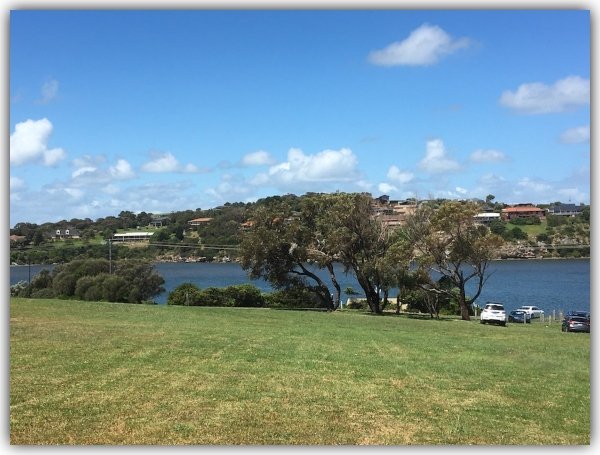
Part of the Scoborio Reserve public land that fronts the Hopkins River and sits next to Lyndoch.

Carol Altmann – The Terrier

My team of trusty terriers tell me Lyndoch Living is stitching up a deal with the Warrnambool City Council to take over a piece of prime public land: the Scoborio Reserve on the Hopkins River.

Scoborio Reserve sits off Hopkins-Otway Road between Lyndoch and Proudfoot’s Boathouse, part of the Peek Whurrong lands, and covers almost 3 ha of prime waterfront real estate.

This is public space.

As we know, Lyndoch Living is in the throes of rolling out a $100 million masterplan over the next eight years, but there has been no mention publicly – so far – of Scoborio Reserve being a part of the mega expansion.

The elected councillors have also not had any recent briefings about the proposal.

Despite this, I have now had three good sources tell me that, behind the scenes, discussions between Lyndoch Living, the WCC officers and Mayor Herbert are well advanced and that a formal proposal is being put together.

Cr Sue Cassidy is on the Lyndoch board, so I can only assume that she would also be well across any Lyndoch plans to expand into public space.

The council’s City Growth Manager Andrew Paton is also on the Lyndoch board.

The official line from the council today is that “council has not received any formal request from Lyndoch Living in relation to acquiring any part of Scoborio Reserve”.

Read that sentence very carefully.

“Any formal request” does not rule it out. It just means that it is not in writing, yet.

In fact what happens these days with so many council decisions is that deals are all stitched up behind closed doors and we, the public, are left to play catch up.

Instead of being included in the process from the start, we are left to fight it at the end.

There are six things that make me think this Lyndoch deal is real:

the sudden desire by the WCC to formally name the unnamed road that services the Scoborio Reserve. This could be a coincidence, of course;

the council also saying it received a suggestion (from who?) that the road be named after George Rolfe, who once owned the Lyndoch land;

suggestions that Lyndoch has been interested in building a childcare centre next door to the aged care home;

that this centre would be run by a private operator;

Cr Herbert’s belief that the council should not be in the business of running childcare centres and they should be privatised;

that the council is now in the business of trying to sell off public spaces: just ask the good people of Swan St, who this year had to put up a fight to save their patch of green space.


The word “public” is fast losing its meaning in Warrnambool.

This is public land. It is a reserve. It should not be for sale, “gifted”, or given away for virtually nothing.

We are watching.

If you would like to support the work of The Terrier, please consider throwing something in the tip jar.

Terrier Tip Jar


Lyndoch Living pulling down the shutters on scrutiny

Lyndoch Living can’t wait to talk about all the good stuff happening, but digging into the financials is getting harder.

Carol Altmann – The Terrier

What the heck is happening at Lyndoch?

It’s behaving more and more like a private corporation than a community owned home for our elderly and infirm.

Its unadvertised, annual general meeting held earlier this week was, by all accounts, one big self-congratulatory, PR exercise rather than a critical analysis of the last 12 months.

While it’s terrific to celebrate the good stuff, we also want to know the nitty gritty behind the growing “brand”, because Lyndoch is now very much a brand.

So where are the financials?

How are the Lyndoch board and CEO Doreen Power spending our money, be it via residents’ fees, taxpayer dollars or donations?

Was there a surplus or a deficit like the $1.77 million loss of last year?

How many staff have come and gone?

How much is being spent on food for the residents? On medical and health items? How are the public donations going?

And – I ask, one more time with feeling – where is the $100 million coming from for the eight-year masterplan?

The annual report released this week answers none of these questions, in fact, it deliberately avoids them.

The financial statements have been reduced to three, very basic graphs and about 125 words of text – that’s it – for a multi-million-dollar, publicly funded, not-for-profit organisation that is fully accountable to the public.

Well, it used to be.


Things have changed dramatically since Lyndoch changed its corporate structure late last year.

Now, trying to get any detailed information is like prising open the jaws of Barry the Bull Terrier.

I am still trying to get a copy of Lyndoch’s constitution, which it is zealously guarding like a first-edition copy of Harry Potter.

Even old annual reports that were posted on the Lyndoch website were pulled down yesterday.

Maybe this is because I actually read them and crunched the numbers and found a rather large skeleton lurking in the closest: Lyndoch last year recorded its largest deficit in recent years at $1.77m.

Thankfully I took notes and kept copies of the annual reports that could be downloaded, and took screenshots of those that couldn’t.

Good grief, when did it get this hard to find out basic information about our much-loved aged care home?

What on earth is there to hide?

Perhaps it’s because, as I believe, Lyndoch recorded another deficit in 2019, which would be its fourth deficit in the past five years.


I am not an accountant by any stretch, but using the scant details released this week, and my earlier notes, I think Lyndoch Living recorded another operating deficit, this time of around $750,000 and that’s before any other unusual items – if there were any – are added.

Please, Lyndoch, correct me if I am wrong.

The back page of the Lyndoch annual report for 2019 reflects its growing business model.

Using my same, very high-tech accounting methods, I believe its net assets also dropped by a whopping $11 million in the past year from $62.7 million down to $51.2 million.

Hmm, could that be because Lyndoch just borrowed $11 million from the bank to pay for the first stage of the masterplan?

Please, please, Lyndoch, correct me if I am wrong.

There is no question that Lyndoch needed to freshen up some spaces, try different things, move with the times, but surely when big decisions are made and millions are being spent, it must all be open to rigorous scrutiny?


As it sits, to get even close to the full story, we will have to wait until early next year for the full financial reports and all of the gritty details to be released via a government website that oversees charities.

In the meantime, this Terrier is just going to keep digging. More soon.

If you would like to support the work of The Terrier, please consider throwing something in the tip jar.

Terrier Tip Jar