A one-day inquest hearing has been held into the disappearance of former WCC engineer Barry Collins more than 30 years ago. Image: Shutterstock.
Carol Altmann – The Terrier
I have just learned that an inquest opened today into the disappearance of Barry Collins, a former executive of the Warrnambool City Council, who went missing 30 years ago. This is big news.
Mr Collins, an engineer, disappeared after being accused of a misappropriation of council resources and funds. I remember this terrible story, as I was a wide-eyed cadet at the Warrnambool Standard at the time.
Mr Collins’ disappearance sent shockwaves through Warrnambool. It was terrible.
There has never been a full explanation as to what happened, or the full back story to the allegations. His family, no doubt, have continued to seek those answers.
Now, 30 years after this tragedy, an inquest has opened in the Coroner’s Court in Melbourne, before Coroner Paresa Spanos.
I will follow this up tomorrow, but for tonight, I am just putting this on the public record and hope that it may finally lead to some answers for Mr Collins’ family and for the wider community.
Update: The ABC’s Matt Neal has written a comprehensive piece on this case, which is set to officially clear Mr Collins of any wrongdoing. You can read Matt’s story here.
Goodbye to the original terrier, my mum
I have been and will be under the radar for a bit as I farewell my dear old Mum. Mum was the original terrier, although she was born in a time when few women were able to become journalists.
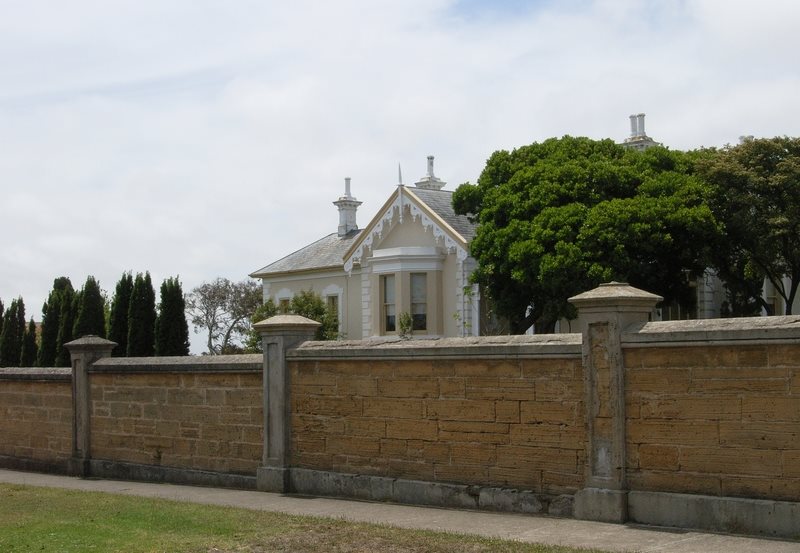
Mum, instead, wrote letters to the editor of the Standard, read all of my university text books and protested long and hard with others to save “Murweh”, the mansion at the top of Liebig St that was – incredibly – destined for the bulldozers in the 1980s.
Murweh is still there. Mum, after almost 95 years, is no longer, but her love and care for Warrnambool lives in me.
On we go, Mum. On we go.
Time.
Peter Hogg photographed in 2013 inspecting the workings of the T&G clock, taken from the book “Warrnambool: This is Home”.
[box] This column is normally reserved for comment on local issues, but occasionally it will also be used for short thoughts about every day life. This is one of those occasions. [/box]
SHORT THOUGHTS – Carol Altmann
[dropcap style=”font-size: 60px; color: #ABCCAB;”] T [/dropcap]he sudden passing of Warrnambool watch repairer Peter Hogg was a shock, not because I knew Peter well, but because I didn’t.
Instead, Peter represented to me all that we love about living in a small city like Warrnambool – and I am sure it is the same for Portland, Camperdown, Terang, Koroit and all of the other towns that make up south-west Victoria – where certain names and certain families have been a part of the community for so long that you feel like you know them all.
The Hogg family was like that. For more than 40 years they ran one of several jewellery stores in the main street of Liebig St and, for the past 15 years, Peter was responsible for maintaining the iconic T&G clock on the corner of Liebig and Lava streets.
When the clock stopped, for whatever reason, it would be Peter who would be called to climb up the stairs, across the rooftop and into the clocktower to check the mechanism.
Even in these days of digital and mobile devices, everyone knows when the T&G clock is “off” and feels a strange sense of unease until it is working again, as if the timepiece is the quietly beating heart of the city: as long as it’s still going, we’re doing okay.
As the keeper of the clock, Peter was an important part of all of our lives, even if we didn’t know it.
It was for this reason that I contacted Peter in early 2013 to ask if he would be photographed inside the T&G clocktower for a small book of 30 Warrnambool icons – the known and the less well-known – and he readily agreed.
The photo shoot for Warrnambool: This is Home gave me a casual connection to Peter where we later felt comfortable having a conversation if we bumped into each other “down the street”, which is where Warrnambool does a large portion of its casual socialising.
A scene from the Bette Midler concert in Los Angeles earlier this year, with concert goers holding up their mobile phone lights during a rendition of The Rose.
[dropcap style=”font-size: 60px; color: #ABCCAB;”] S [/dropcap]trangely enough, one of our last – if not our last – such conversations was about how we were starting to lose people from our generation: the one’s who passed through school together in the late 70s and early 80s at either CBC, St Anne’s, Warrnambool High School, North Tech and Caramut Road, as they were then known.
We were entering an age, we lamented, where health problems did not always “get better” and we really needed to remember that old cliche about pursuing your dreams and grabbing hold of life.
Many of the people we profile for Bluestone Magazine are doing just that, which is why their stories resonate with so many.
And I may have even told Peter, but then again, I may not have, that I was going to do just that by flying 13,000km to see Bette Midler in concert in Los Angeles to celebrate my 50th birthday.
I felt embarrassed telling people that I was going to spend my savings travelling across the world to see a concert, but such has been my life-long admiration of Bette Midler, that the first thing my old high school teacher Allan Scarfe asked me after not seeing each other for more than 25 years was: “Do you still love Bette?”
I had to do it, and I did and it was worth it, really worth it.
And now Peter, the time-keeper, the person who sustained Warrnambool’s quietly beating heart, is gone and I am acutely aware of just how important that journey was.
[button link=”http://the-terrier.com.au/subscribe-2/” type=”icon” icon=”people” newwindow=”yes”] Become a Bluestone supporter by subscribing here.[/button]
Brauer College Year 11 student Alex Jones with the work of his fellow art students behind him. Alex’s work is part of the school’s Art & Design exhibition at the Lighthouse Theatre.
Words and photos by Carol Altmann
[dropcap style=”font-size: 60px; color: #DC943C;”] A [/dropcap]lex Jones is one of those young creatives who has been drawing for as long as he can remember and whose natural talent just oozes out of him, much like the images he creates.
The Year 11 Brauer College student from Bushfield is making his mark as a young artist to watch, with his exploration of life, death, mythology and the darker, surreal elements of fantasy and reality.
“Ever since I was little I have loved books about mythology and fantasy and using my own imagination to create those worlds,” Alex, 17, says.
“I have always drawn pretty dark stuff, much to the disgust of my grandmother,” he adds, laughing.
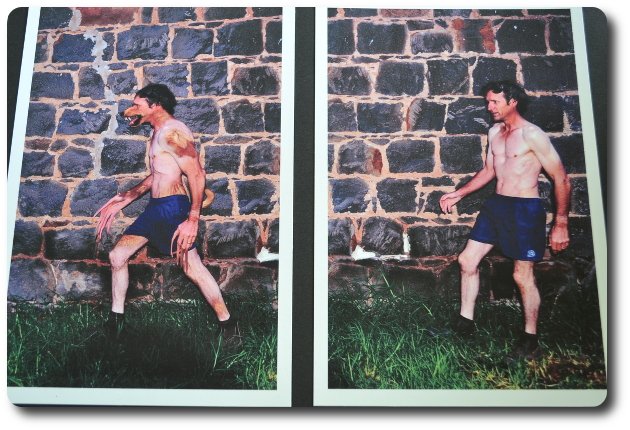
A digitally manipulated image – featuring Alex’s father and golden labradors.
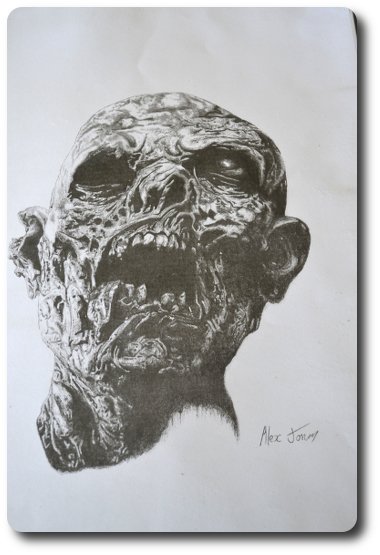
Perhaps not one for Grandma, but the detail in Alex’s drawing is remarkable and won the people and staff choice awards in the 2013 WRAD Art in Schools Competition
[dropcap style=”font-size: 60px; color: #DC943C;”] A [/dropcap]lex works across a range of mediums, including pencil, paint, sculpture, photography and printing, to create images that are often morbid or foreboding, yet mesmerising.
“I like to convey messages about life and death and different ways of looking at life, while also making the work really detailed,” he says.
Alex’s favoured themes are a stark contrast to his cheerful disposition and love of the sea, and he laughs as he admits that most of his work is not displayed at home (his mother, Yvonne Lefebure, is a textiles teacher at Brauer).
But his attention to detail and a willingness to explore different approaches and techniques is inspiring.
At an age when most young artists are still mimicking the work of others until they find their own style, Alex will take an idea and then push it, pull it and stretch it around until it becomes his own.
Alex’s roadkill lantern, which is part of an installation at the Brauer Art & Design Exhibition.
Life, death and decay are common themes in Alex’s work, including this photograph of a fungi that is reproduced in a scratch drawing.
[dropcap style=”font-size: 60px; color: #DC943C;”] G [/dropcap]ail Higgins, head of the Brauer Art Department and one of Alex’s teachers, tells a story of how he found some roadkill, let it dry out, and used the skull together with moulded, clay horns and bits of fur to create a new work.
“He puts a great deal of thought into how he approaches each piece,” Gail says.
And Alex himself explains how he experimented with making his own paint pigments from wine, blueberries and raspberries which he then used for a printmaking piece on the crucifixion of Christ.
But perhaps his most striking work is one of three that are included in the Brauer College Art & Design Exhibition now showing at the Lighthouse Theatre, Warrnambool (until Nov 16).
It is a highly detailed eagle that has been etched onto individual panes of painted perspex that are mounted into a vintage window frame.
Alex’s winning work from the Portland Rotary Art Show: the eagle etched into panels of painted perspex (detail).
[dropcap style=”font-size: 60px; color: #DC943C;”] T [/dropcap]he majestic bird has its wings outstretched, as if in flight, but its head flops to one side and a medieval sword runs down the centre of its body.
“The window symbolises the interface between life and death,” Alex explains.
“You only get to see glimpses from one side – not the whole picture. And the sword, well it symbolises mans killing of an innocent creature.”
Gail is right: Alex puts a lot of thought into each of his pieces.
The eagle image recently won best contemporary painting at at the Portland Rotary Art Show and Alex’s work has also been recognised with a people’s choice and staff choice award in the 2013 Western Region Drug and Alcohol Art in Schools competition.
Despite his talent and love of art, however, Alex intends to put his attention to detail and inquisitive mind to work in another career, as a scientist.
Given the synergies between science, life and death, it seems the perfect fit.
Alex experimented with making his own pigments using blueberries, wine and raspberries for this work on the crucifixion of Christ.
[box]The Brauer College Art & Design Exhibition is open until Sunday November 16, Lighthouse Theatre, Warrnambool. It was curated by Gareth Colliton, from the Warrnambool Art Gallery, with the assistance of two Brauer College students Gemma Stormer and Emily Bakic. Free entry.[/box]
[button link=”http://the-terrier.com.au/subscribe-2/” type=”icon” icon=”heart” newwindow=”yes”]Bluestone needs 500 subscribers to thrive. If you enjoyed this story, please click here to become one![/button]
Alf Altmann’s attempt to cross Bass Strait solo in a home-made kayak in 1970 is the stuff of legend. Bluestone has pieced together the full story about this Warrnambool man’s brave quest …
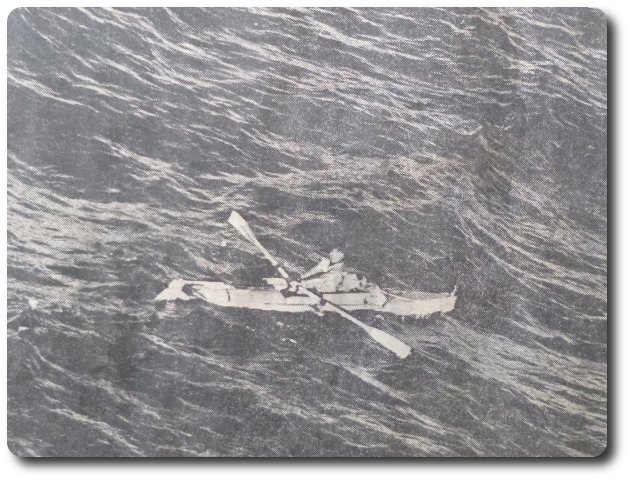
The last shot taken of Alf alive, photographed by The Herald and published on March 4, 1970, as he powers from Hogan to Cliffy islands – just 58km from the end of his 300km journey.
By Carol Altmann
The recent Bass Strait crossing by three men on paddleboards has revived memories of an epic feat by Warrnambool’s Alf Altmann, who became the first man to row solo across the same treacherous passage – at the cost of his life.
Precisely 44 years earlier, on the morning of February 25, 1970, Alf set out to do the same perilous journey.
He pushed off in his home-made, 4.5m kayak from Little Mussel Bay, north-east Tasmania, and headed out for what he thought could be up to a two-week journey to Port Albert, Gippsland, depending on the weather.
It was a trip for which Alf, a builder by trade, had meticulously prepared both mentally and physically, and followed many years of experience on the water.
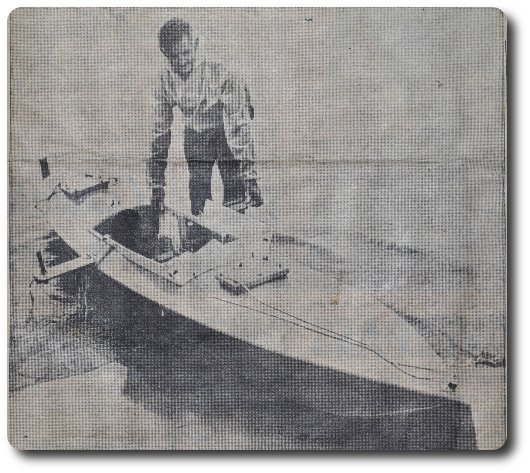
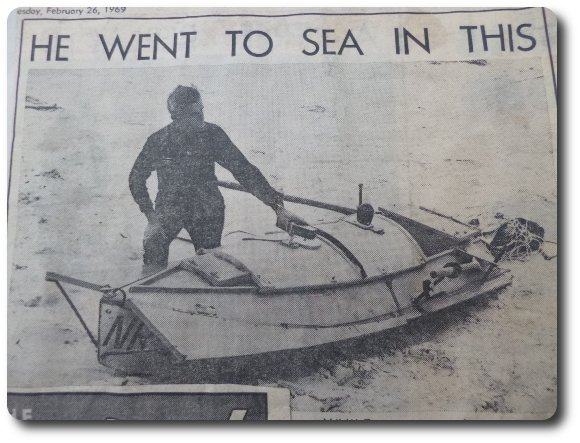
The kayak Alf made for his journey was plywood over a timber frame and declared by Alf to be unsinkable.
Indeed Alf, who was my uncle, had sailed for 18 years and had crossed Bass Strait eight times before in various motor-powered craft, many of which he built himself.
It was during one of these crossings that his engine failed and he was forced to row his boat to the safety of an island, after which he was so exhausted that he vowed to learn to row properly and promptly joined the Warrnambool Rowing Club upon his return.
Unlike the paddleboarders, who were all aged in their 30s, Alf Altmann was 56 years old – and a grandfather – when he decided to take on rowing across Bass Strait entirely on his own. There would be no support crew or anyone to rush to his aid if he struck trouble.
He also had none of the high-tech, water-resistant, fail-proof navigation and flotation equipment that is now commonplace in marine sports.
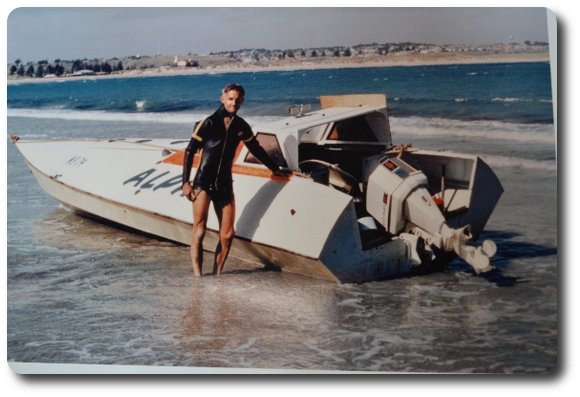
Boat maker: Prior to rowing his kayak across Bass Strait, Alf had crossed the strait eight times in various powered boats, including this home-made vessel.
Instead, Alf made his own bright-orange kayak from a timber frame and plywood shell, with a 30cm long, 27-kg steel keel and various sealed compartments so that if one area sprung a leak, it would not sink the boat.
His on-board equipment included a small sail and portable mast, a tent, flares, waterproof matches, a sea anchor, a radio transmitter, a compass and a life jacket that, by today’s standards, was more likely to leave you floating face down than face up.
No wonder everyone, including his wife, Isobel, thought he was mad to attempt to cross a stretch of water notorious for its high seas and battering winds.
Alf, however, was used to such scepticism and loved to live on the edge.
When he left from Melbourne in a powerboat to circumnavigate Tasmania in 1968 – a total distance of 1930km – the local fishermen thought he was crazy, but he simply responded: “what challenge is there in retracing common routes?”
Bass Strait is the ultimate challenge, even for those in maxi yachts, let alone a plywood, home-built kayak, but Alf was convinced that his kayak was unsinkable.
“This is a survival boat, not a luxury one,” he told reporters in the days before his departure.
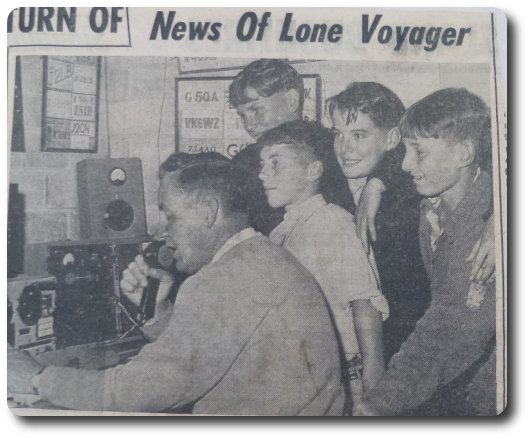
Everyone was gripped by Alf’s voyage, especially people from Warrnambool: here YMCA radio club leader Bill Wines tunes into an update, surrounded by eager listeners.
Alf arrived in Burnie, Tasmania, on board a trading ship and made his way with his kayak to the north-east of the state via train and then friendly locals who were prepared to give him a lift to Little Mussel Bay. Isobel, who was home with three of their four sons (the youngest, Philip, was 16), would meet him at the finish.
Once on the high seas, Alf – like the paddleboarders have done since – planned to island hop his way across the strait, from Cape Barren to Flinders, up the coast of Flinders and across to Deal, to Hogan, to Cliffy and then the 45km run home to Port Albert.
And while some of these islands were inhabited, if only by a lighthouse keeper, Alf intended to mostly camp and live off his supply of nuts, dried fruits, honey, powdered milk and special bran biscuits that Isobel always made for him.
It takes a special courage to push off into the ocean knowing that you will be utterly alone at sea, but the first days of Alf’s journey could not have gone more smoothly.
Setting off in beautiful weather, Alf ploughed through the water: far from taking up to two weeks, he was soon on track to make the crossing in a week.
Australians were riveted by the unfolding story as Alf checked in with lighthouse keepers at each island: first one, then another, then another…
Although born in the bush, Alf adored the ocean and always set himself new sea-faring challenges, like circumnavigating Tasmania in this powerboat in 1968.
It was only when Alf reached Cliffy Island, the last island before home, that the weather began to turn sour. Despite being so tantalisingly close to the finish – so close that Isobel was already waiting on the wharf at Port Albert – Alf was forced to bunk down at the lighthouse for two nights.
The acting lighthouse keeper, Sjoerd Boontra, would later say that Alf, despite having just rowed more than 200km, helped with odd jobs around the lighthouse while itching to get back on to the ocean.
Come the morning of March 6, Alf was determined to start out early for the last 45km of his journey, even though the weather forecast suggested rough conditions for a kayak and Sjoerd urged him to wait.
“His reason for leaving was that he wanted to surprise his wife…who was not expecting him until 3pm,” Sjoerd later recalled.
“It will have to be pretty bad for something to go wrong now,” Alf said.
These were among his final words. A minor storm blew in an hour after he left Cliffy Island, whipping up 25 knot winds and 4m waves.
Alf failed to arrive at Port Albert by his expected time of 11.30am, and the crew of the Marjorie Phyllis, a lighthouse supply boat that was assigned to meet him offshore, began to worry.
By 1pm, the local police launched a full-scale air and land search, with Isobel still holding out hope that he had taken refuge on a scrap of an island.
But at 5.58pm, the Marjorie Phyllis received a crackled radio call from the search plane: “It’s all off”.
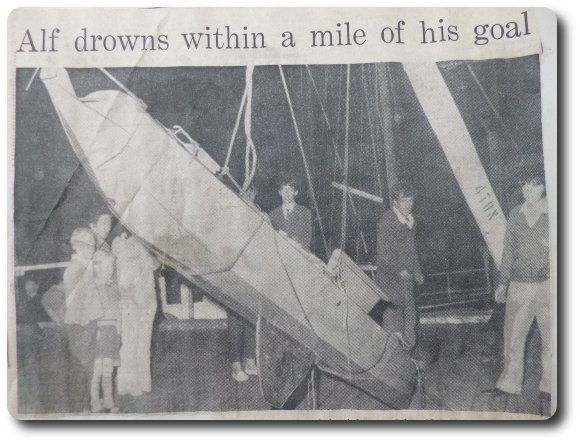
The adventure comes to a tragic end: Alf’s kayak was retrieved just 2km from land.
Alf’s body, wearing the top half of a two-piece wetsuit and a spray jacket, was spotted less than 2km from Snake Island, part of the Gippsland lakes. His kayak was found nearby, intact, but for the splintered oars: it really was unsinkable.
How Alf came to drown is still not known, but abrasions across his face suggest he capsized and was knocked unconscious by hitting his head, perhaps on one of the oars. From there, it was over. A life packed with determination, daring and adventure had come to an end.
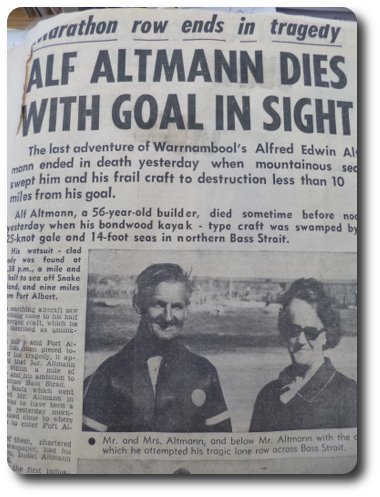
More than 500 people crowded into the Warrnambool Presbyterian Church for Alf’s funeral, where he was described as a man of great courage and a “pilgrim adventurer”.
And Isobel, even within her own grief and that of her sons, Keith, Ken, Philip and Alan, reminded us that Alf would have wanted to die knowing he had pushed the boundaries.
“Where would we be if nobody had taken a risk?” he once told her.
* Bluestone Magazine would like to thank Alan and Philip Altmann for their assistance in researching this story. Other details have come from original media reports and documents housed in the Public Record Office Victoria. Alf’s widow, Isobel, passed away in 2003.



 You might also enjoy…


 You might also enjoy…