WCC CEO’s dismissal relied on most expensive option

Former Warrnambool City Council chief Peter Schneider. Image: WCC.

Carol Altmann – The Terrier

I have learned that one of the options for sacking former Warrnambool City Council chief Peter Schneider would have cost ratepayers around $30,000, instead of more than 10 times that amount – $365,709.

If getting rid of the CEO just 18 months into his contract was such a matter of urgency, why did the councillors involved have to rely on the most expensive option?

It turns out Mr Schneider’s contract contained a number of clauses for termination, including two for instant dismissal.

The first of these two – let’s call it the “CEO Stuffs Up Big Time” clause – sets out a number of specific grounds for instant dismissal that, if proven, result in a much smaller payout.

The thrust of these grounds is as follows:

is negligent in carrying out his duties (ie. the responsibilities, duties and functions set out in his contract);

commits an act of serious misconduct;

seriously or persistently breaches a term of the contract;

breaches the council’s policies that apply to the CEO including occupational health and safety, privacy, anti-discrimination, and use of council IT’s systems;

engages in conduct that may cause imminent and serious risk to the health and safety of another person;

is declared bankrupt;

fails to immediately notify the council that he has been charged with or found guilty of any criminal offence;

is charged with a crime, or found guilty of a crime, that brings the council into disrepute;

is unable to work in Australia.


Under this clause, the CEO would only be entitled to his salary, holiday pay, sick leave and long service leave up to the time he was sacked.

As of 13 July 2020, when Mr Schneider was dumped, this total came to around $30k.

As we know, the four councillors who voted to sack Mr Schneider didn’t – or couldn’t – use this clause and I can only speculate as to why, given it contains the sorts of grounds that most of us would expect behind a CEO getting the boot.

The councillors instead used another clause in the contract, which I will call the “Not Telling” option.

Under this option – as we now know –  the council could sack the CEO for “any reason or no reason”, which pretty much covers everything from leaving the hot tap running in the tearoom through to serious misconduct.

Not surprisingly, the payout for pulling the lever on this trapdoor is much higher: 12 months remuneration OR the remaining value of the contract, whichever is less.

With 30 months to go on Mr Schneider’s contract, the 12 month payout is what came to pass – $365,709.

The “Not Telling” option is the most expensive of all the options and, I can only assume, is used when the other “instant dismissal” option can’t be justified, or doesn’t apply.

All of this, I am afraid, only raises more questions and takes us further away from the answer that everyone is seeking about Mr Schneider’s rapid demise: why?

The full story will be slow in coming, if at all, as the dismissal heads to the Supreme Court in February.

Speaking of questions, one of I have left with the council today is whether it has acted on the recommendation of the Victorian Ombudsman to refer the misuse of a council credit card by former tourism manager, David McMahon, to police.

It is now 10 days since the Ombudsman’s eye-popping report on the ratepayer funded booze fest was made public, so I am sure an answer is imminent.

If you would like to support The Terrier, please consider throwing something in the tip jar.

Terrier Tip Jar


No bones about it, WCC pet rego fees are astronomical

Pet registrations in Warrnambool are already the second highest in Australia and continue to climb. Stock image.

Carol Altmann – The Terrier

Well this is enough to make pet owners barking mad.

Tucked within the pages of the Warrnambool City Council draft budget is a little note that pet registration fees are set to rise – AGAIN.

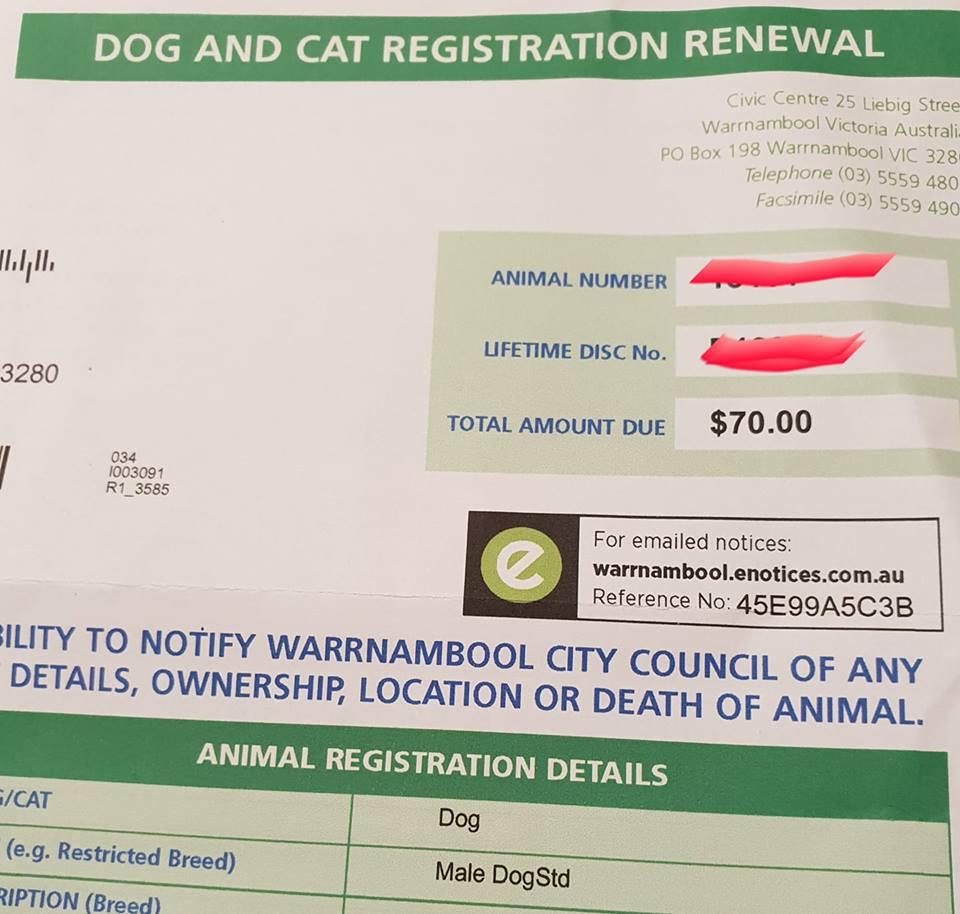
If this rise goes ahead – as I suspect it will – this time next year a single desexed dog or desexed cat will cost $72 to register, up from $70. It was $54 just a couple of years ago.

The CEO said at last Monday night’s meeting that our rego fees are, “not dissimilar to some other municipalities”.

This is untrue.

We now pay the second highest pet regos fees in Australia, behind only Brighton, in Melbourne.


In Ballarat, the fee is $40. In Traralgon, it is $43. In Portland, it is $35. Over in Port Fairy, it is $39…you get the drift.

The reason we are being fleeced, it seems, is that in 2017 the council signed on to a three-year deal with the RSPCA that saw an explosion in its fees for running the council pound – the cost tripled overnight.

Not only that, the cost of running the pound has risen astronomically for EACH year of the three-year deal.

The RSPCA charged the council $328,000 in 2018-19.

Next financial year, which is the last year of its contract, it will charge $425,000: almost half a million dollars!

Holy malooza! It’s enough to make you have kittens.

In response to a question from a ratepayer on Monday night, our CEO explained that the RSPCA is all about saving animals, rehousing them, returning them home etc all of which costs money and is supported by any animal lover, including me.

But here is the rub.

The RSPCA also runs the pound in Portland and they ain’t payin’ anywhere near $70 a dog or cat. Why not? Because, to put it simply, Glenelg Shire negotiated a better deal.

The RSPCA runs very few animal shelters in Victoria now and no doubt those they do run are top notch, but charging $425,000 a year for a city the size of Warrnambool?

I would rather see these funds used to subsidise desexing – of cats, in particular, as happens in South Australia.

As it also happens, the WCC has just advertised a tender to run the pound from 2021-22. Will the RSPCA be, again, the only one to apply?

Or maybe the council, post C19 when people need to be redeployed, could think about using that half a million bucks a year to run the pound again itself?

Unless we want to see pet regos go up and up and up, it could be the best option.

[The WCC draft budget is open for public comment and feedback until 3 June.]


It’s official: Warrnambool is being fleeced for dog rego fees

Dog registration fees have skyrocketed in Warrnambool for reasons which are unclear. Image:Dog Health

Carol Altmann – The Terrier

Thanks to some great digging by all of the terriers out there, we now know that Warrnambool is the second most expensive place in the whole of Australia to register your desexed dog.

The most expensive place is Bayside Council, the council that covers the multi-million dollar suburbs around Brighton, Melbourne. It charges $78.

Our council will this year charge $70, up from $54 last year, because of a 300% increase in costs passed on by the RSPCA that runs the Warrnambool City Council-owned pound on behalf of the council.

In 2017, the council put out a tender to run the pound for the next three years and got only one response, which was the RSPCA.

Despite the RSPCA jacking up its fees by a whopping 300% this year to $331,918, this monopoly option was still chosen by the council as the best option.

As a result, we are now paying more than just about everyone, including councils the same size as Warrnambool:

Warrnambool: $70

Ballarat City: $40

Greater Bendigo: $45

Greater Geelong: $41.40 

Greater Shepparton: offering discounted fees to encourage registration: fee $32. Normally $40

Horsham Rural: $42

Latrobe City (Traralgon): $43

Mildura Rural: $44

Wangaratta Rural: $43

Wodonga: $50


Now look at how we compare with our neighbouring councils:

Moyne Shire: $39

Glenelg (Portland) Shire: $35


Until last year, Moyne Shire shared the costs of the Warrnambool pound, but decided a 300% increase was off the scale, so it looked elsewhere. It now uses the Southern Grampians Shire pound in Hamilton.

In Port Fairy, it costs $39 to register your desexed dog and in Hamilton, it costs $43.50.

Glenelg Council was similarly cost savvy. In 2016, the RSPCA in Portland told Glenelg Council it would have to increase its pound fees by 400%, The council effectively said “don’t be so ridiculous”, the RSPCA backed down and the council still uses the pound.

In Portland, it costs $35 to register your desexed dog: half of what Warrnambool is expected to pay just 90km down the road.

Let’s now go further afield.

Humane pound services are essential, but registration fees are also becoming a disincentive. Image: Lostdogs

Greater Bendigo Council this year announced it was taking back control of its pound from the RSPCA because of the rising costs over which, of course, it would continue to have no control. Bendigo charges $45 per dog.

There is an RSPCA shelter in Castlemaine, but the council there (Mt Alexander Shire) doesn’t use it and runs its own pound. It costs $46 to register your desexed dog in Castlemaine.

There is also a big RSPCA shelter in Burwood East, but the local council there (City of Whitehorse) switched from the RSPCA to Animal Aid in 2017. It costs $55 to register your desexed dog in Burwood.

There is also an RSPCA shelter in Wangaratta, but the council there uses the pound run by the city of Albury/Wodonga. It costs $43 to register your desexed dog in Wangaratta.

There is also an RSPCA shelter in Ballarat, but in 2017 the Ballarat council moved across to the new, government-run Ballarat Animal Shelter. It costs $43 to register your desexed dog in Ballarat.

There is another RSPCA shelter in the City of Casey, in Melbourne, but that council uses the Cranbourne Animal Shelter and Lost Dogs Home. It costs $54.50 to register your desexed dog in the City of Casey.

Do you see a pattern here? I don’t know what is going on within the RSPCA that has seen it move to a “full cost recovery model” for its pound services, but it hasn’t gone down well.

Except in Warrnambool, where we are sticking with the RSPCA and going solo. We didn’t even try and stare the 300% price hike down, like Glenelg.


The council did, apparently, look at the cost of running the pound again itself, but decided the RSPCA was the better option. Really? At the second highest cost anywhere in Australia?

We have to trust the council on this, because the cost of the alternative – running the pound itself – has not been made public.

Bill shock: W’bool dog owners who last year paid $54 are getting a surprise in the mail this year.

This year the cost is $70 per desexed dog, but that will most likely increase in the next two years, when the RSPCA will jack up the price again to $417,146 and then $429,666 in 2020-21.

On a simple measure of equity, it is grossly unfair that pet owners of Warrnambool who do the right thing and register their dogs will pay the second highest fees in Australia.


On a broader level, it exposes an inequity across Victoria, which is yet to follow the lead of  WA, NSW and South Australia, where there is one set government fee, whether you live in Port Pirie or Port Adelaide.

In WA, a desexed dog costs $20. In SA it is $40 and in NSW, $57.

When you look at these fees, you can only conclude that we are paying far too much in Warrnambool and nobody has explained why. (You can sign an online petition via the link above).

There is also now zero incentive for anyone to register their new dog in Warrnambool. Why would you?

What this means is that instead of reducing the problem of unregistered dogs, this fee hike will only add to it, creating even more business for the pound. How ironic.

If you would like to see The Terrier keep digging up, sniffing out and chewing on local issues, please consider throwing something in the tip jar.

Terrier Tip Jar


How Bruce Anson appears to have a job for life

bruce anson abc
Warrnambool City Council chief executive officer Bruce Anson is poised to be appointed for another three years, without the position being advertised. Image: ABC Radio.

Analysis – Carol Altmann

As anyone who has ever been hired on a contract knows, there is no guarantee you won’t have to compete for your job when that contract ends: except if you happen to be the Chief Executive Officer of the Warrnambool City Council.

As was announced by way of a public notice yesterday (15/8/15) CEO Bruce Anson is set to be reappointed for a third consecutive term on a salary package close to $300,000, although this time it will be for three years from January 2016 rather than the usual four, taking him up to 2019.

All up, Mr Anson will have been CEO for 11 years and employed by the council in various capacities for more than 20 years.

Since Mr Anson took up the CEO’s position in 2008, it has never have been advertised.

While some might argue this gives a council stability, others, like Bluestone, would argue it also stifles any chance of bringing fresh thinking into the council’s top job and ensuring that the city still has the best person in that powerful role.

Mr Anson might well be that person, but surely Warrnambool deserves to be able to throw open the doors and see what other talent might be out there, while also, of course, encouraging Mr Anson to apply.

This happens all the time at the most senior levels of the public service, and at the top level of the higher education sector, so why isn’t it happening here?

The answer is astonishing.

By law, a council can choose to either reappoint its CEO, or re-advertise the position: these two options are always on the table every time a CEO’s contract comes up for renewal.

But Bluestone has learned that the highly secretive review committee that oversees the assessment of the CEO’s performance and recommends what should happen at the end of each contract, has categorically ruled out advertising as an option.

In fact, Bluestone has learned, the performance development review committee says to expect Mr Anson to apply for his own job is an implausible scenario.

The committee also believes that advertising the role would be “a very remote and unlikely possibility” and the only way it could happen is if the council no longer wanted Mr Anson to be in the role.

In other words, under this system, Mr Anson could have a job for life, as long as he wants it.

That is some rare air in today’s world.

The majority of the review committee – made up of Mayor Michael Neoh, Cr Jacinta Ermacora and Cr Kylie Gaston, with Rod Coutts as the independent chair – justifies this approach because, despite what the law says, councils apparently do this all the time: only advertise the CEO’s role if the CEO is leaving.

Maybe they do, but that doesn’t make it right.

Ballarat City Council has this month been grappling with the very same issue, with up to four of the nine councillors in favour of making sure CEO Anthony Schink’s position was advertised.

It wasn’t, and a majority of councillors (although we don’t know how much of a majority) recently voted to sign on Mr Schink on for another three years.

With the way the numbers currently fall at the Warrnambool City Council, the recommendation to reappoint Mr Anson for another three years on around $300,000 a year will also be passed by a narrow majority of 4/3.

It’s great work, if you can get it.