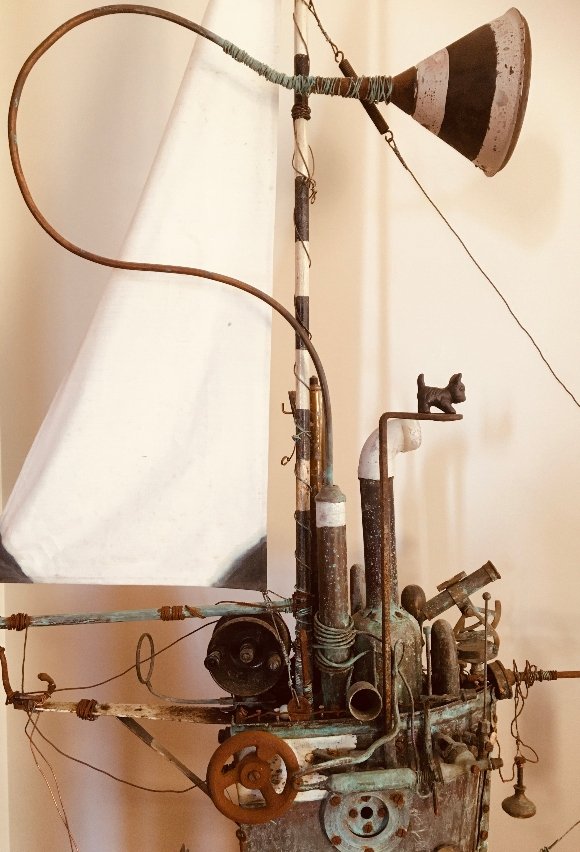
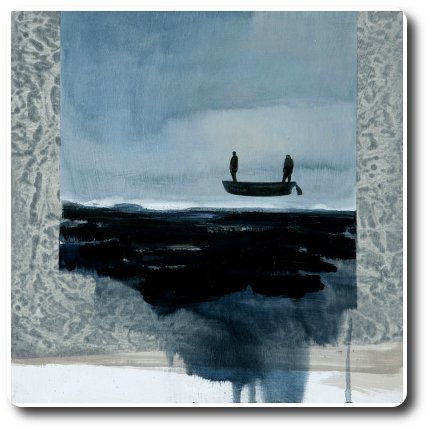
2021 will be a year of both diving deep into ongoing projects and setting sail into new ones – junk boat by Graeme Altmann; Terrier from a friend.
Carol Altmann – The Terrier
Ahoy there from the good ship Terrier and a Happy New Year + 17 days!
What lies ahead for The Terrier in 2021? New voices, a new project and tackling unfinished business.
I spent the summer break recovering from last year, which was exhausting and exacting and yet full of so much change, and also thinking a lot about this year.
After much thinking and sleeping and walking and talking and more thinking, I am ready for a year of diving deep into unfinished business and setting sail into new waters.
There are a couple of important stories that remain unfinished for me.
These stories take time, often a very long time, and I never know for sure where they might end, but I always know when I have reached the end, and I am not there yet.
There is also unfinished council business from last year, including the sacking of former Warrnambool City Council chief Peter Schneider, which goes before the Supreme Court on 1 February to determine if he was denied natural justice and should be reinstated.
Running alongside this is the Local Government Inspectorate investigation into the acting WCC CEO Vicki King being re-hired – by delegation – for another five years to her old job.
The outcome of both cases has the potential to change the face of the new council, and will tie off – one way or the other – the shadow that has lingered over 25 Liebig St since July last year when Mr Schneider was given the boot.
I plan to share other voices, including that of Jim Burke, who many of you will remember ran in the WCC election. Jim is a long-time council watcher and a guy with an overflowing bookshelf and a brain to match.
Jim will continue to write on his own Facebook page about council issues and analyse what it all means for Warrnambool with the intelligence and insight that comes from watching every council meeting, and poring over the hundreds of pages of documents that lie behind every worthwhile story.
I am rapt that Jim has agreed to let me share his work as the new council is given a chance to settle and find its feet.
There are other writers I also hope to bring into the fold to help me tackle other unfinished business, such as the $40 million Wannon Water treatment plant upgrade near Thunder Point which has been on pause since the EPA responded to public concerns and demanded a raft of extra information.
I hope in 2021 that The Terrier can be a platform for many voices, not just my own, as we continue to dig into the issues and ask the hard questions and keep pressing for answers.
I also have a new project, which is actually a project I have been quietly working on for years, but this year it will finally come to the surface – the restoration of Alf Altmann’s kayak and my revisiting his journey for a book that I have been wanting to write for at least a decade.
Alf was my uncle who, in 1970, attempted to be the first person to row solo from Tasmania to Victoria in a kayak he built by hand here in Warrnambool. He nearly made it, drowning just 1.5 miles offshore from the Gippsland Lakes.
I now have his kayak and this year it will be restored by boatbuilder Garry Stewart in Port Fairy and, thanks to Dean Montgomery, will eventually be displayed in the Warrnambool Motor Museum at the former Fletcher Jones factory.
So this year I will also be spending some time in Tasmania, building and writing a story that is worth telling.
My younger brother and artist, Graeme Altmann, has donated one of his incredible “steam punk junk ships” (pictured above) to help me raise funds for the restoration which I will be documenting here. You will have a chance to own this gorgeous boat and be a part of this story.
Welcome to Terrier 2021.
It is so great to have you on board.
Where would we be if nobody took a risk?
Carol Altmann – The Terrier
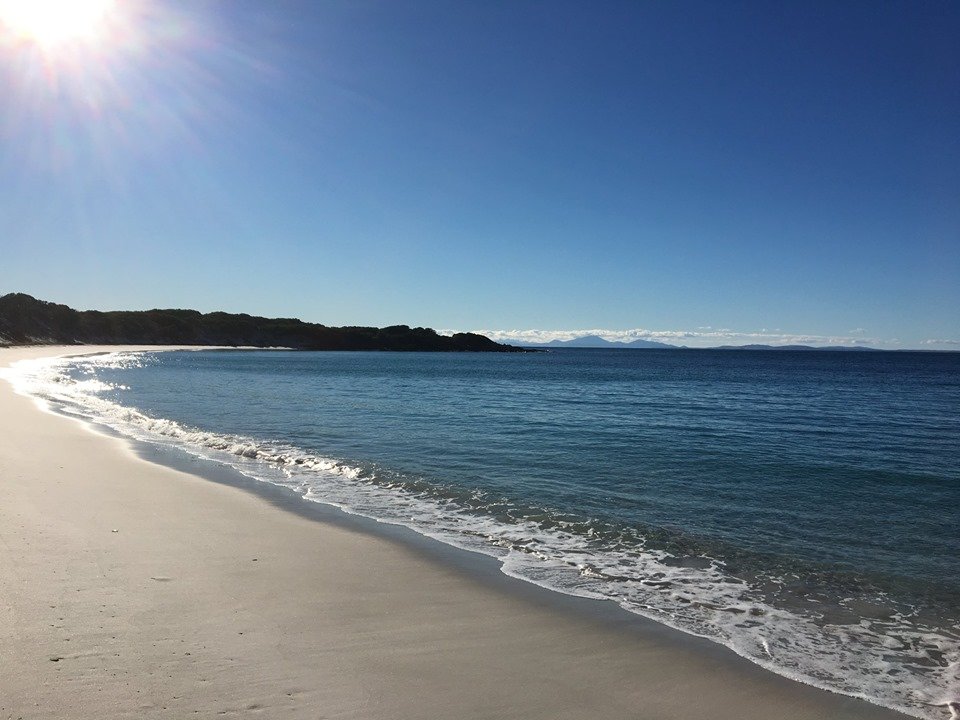
I have been spending some winter time in Tasmania for a number of reasons and this is one of them – to finally visit this isolated place called Little Musselroe Bay.
This is where my uncle Alf Altmann, from Warrnambool, pushed off in his home-made kayak to try and become the first person to row solo across Bass Strait from the very top of Tassie to the bottom of Victoria.
He set off from Little Musselroe Bay on 25 February 1970 and died 10 days later, less than 2km from shore off the Gippsland Lakes, after being caught in a storm and knocked unconscious.
He almost made it.
Alf was 56 years old, two years older than I am now. I cannot imagine the courage, the fitness, and the sense of determination Alf must have had to push off from that isolated shore almost 50 years ago.
I think I am the first member of my family to visit this spot since Alf’s death.
It is so ruggedly beautiful, with Cape Barren Island visible in the distance. It takes hours of slow driving to get there and I cried when we did.
Even though I barely remember Alf, his journey has long been something of an obsession with me.
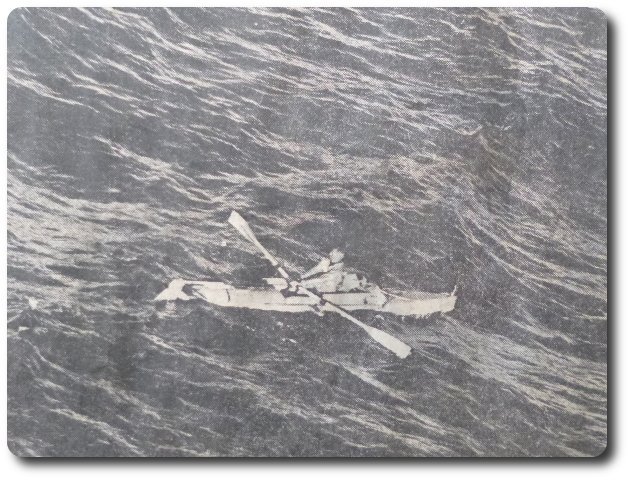
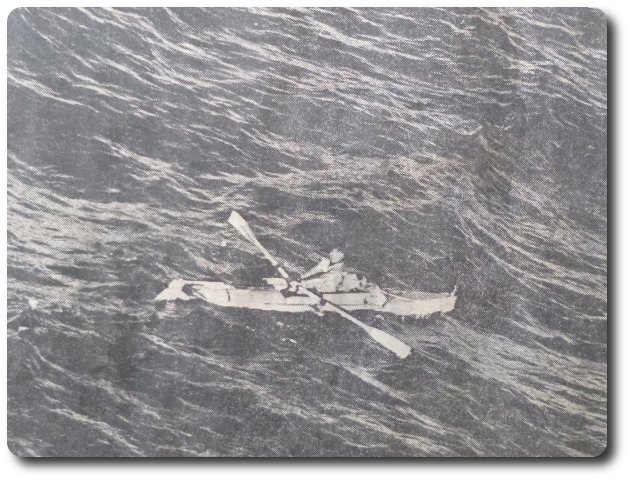
The last photo taken of Alf alive, making his way across Bass Strait from Tasmania to Victoria in his home-made kayak. Image: The Herald, March 1970.
In recent years, I tracked down the kayak which was found to be in a shed at Flagstaff Hill. Unfortunately, Flagstaff Hill had no long-term plan for the kayak, which was pulled from the water intact, but which has since suffered substantial damage.
The kayak is now back in my garage in, of all places, Altmann Avenue, not far from where it was built.
Later this year, it will be restored by Port Fairy master boat builder Garry Stewart to the point where it can be put on display at what will be the Warrnambool Motor Museum, hopefully by next year.
I am a journo, but I am also a writer and this is one story I am determined to keep alive. Not because Alf was my uncle, but because he – to me – embodies what life is about: taking a chance, pushing your boundaries and being true to your self.
On we go.
Drawing deep for a long, tough journey
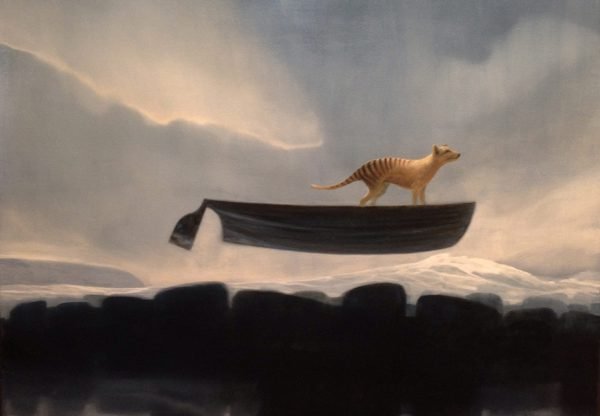
Original painting, oil on canvas, Graeme Altmann. (Altmann Studios, Highett, Melbourne.)
Carol Altmann – The Terrier
On days like this, we need hope.
On days like today, when we see laws passed that allow even greater damage to our wild coast than what we have already inflicted, it would be so easy to just give up, because the battle is exhausting.
But on days like today, when I need to draw deep on hope, I think of my late uncle Alf Altmann.
In March 1970, almost 50 years ago, Alf attempted to become the first person to row solo across Bass Strait, from Tasmania to Victoria, in a home-built kayak.
He built that kayak piece-by-piece in his garage under his home on Riverview Tce, here in Warrnambool.
To train for this epic journey of more than 200km, he would row out to Deen Maar, (Lady Julia Percy Island) and, once or twice, he carried native saplings in his boat to plant on the barren island.
The saplings never survived. Neither did my uncle. His attempt to cross Bass Strait ended just 1.5 miles from the Victorian coast. So near. So close.
And when I think of his story, I think of an anecdote that stays with me each day as I do my bit to try and turn around decisions that hurt our local environment more than protect it.
“Why do you bother taking those saplings with you?” someone asked Alf. “Nobody will see them out there.”
“I see them,” Alf replied. “I know they are there, and that is all that matters.”
This painting is how my artist brother, Graeme Altmann, often captures the essence of Alf’s journey: a boat, suspended above the turbulent sea, with the proud thylacine pointing toward an unknown future.
We can’t change the mistakes of the past. Alf never came home. The thylacine is gone. But I keep trying to do what I can, whatever I can, to turn other mistakes around.
Because we know. And we see. And that is what matters.
My greatest challenge: Alf Altmann’s diary
[printfriendly]
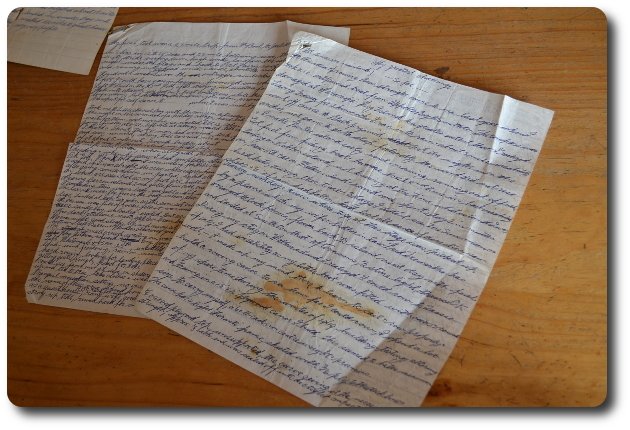
Last week we brought you the full story of Alf Altmann’s ill-fated attempt to row solo from Tasmania to Victoria in 1970. Alf, of Warrnambool, kept notes during his journey and at least a portion of these were found in a waterproof section of his kayak after it was retrieved off the Gippsland Lakes. His son, Alan, transcribed them in 2004. This is the first time they have been published.
“My Greatest Challenge”
– So Far –
The idea of rowing Bass Strait came to me last year when I took a 10’ outboard powered boat from Apollo Bay to Smithton.
The compass was damaged at Naracoopa, King Island to a greater extent than I realised. Leaving Grassy for 3 Hummocks Is. I ran into rain & about 3 miles visibility went off course to Black Pyramid, put the night in on the anchor, not game to sleep, fortunately the wind did not rise & I made Hunter island early next morning, running out of fuel.
Got fuel from fishing boat & became lost a second time in bad visibility, landing on Robbins island, not knowing at the time which island I was on, (I) saw old car on Walker island and rowed over, spent 2 days in mutton bird huts, during this time – 3 days – I didn’t see the sun, moon or stars & 6” of rain had fallen, had lost all sense of direction.
Saw Stanley (Tasmania) next day and knew where to go, at this stage was picked up by a plane which my wife & brother in law Fred Trewartha had arranged to look for me, flown back to (Robbins) island next day with fuel and landed at Smithton that afternoon, ½ stone light otherwise OK.
During my stay on Walker island I realised I could row to Tassie if only I had visibility, as my little boat was fitted with oars & rowed well.
I made up my mind there to learn to sail & row properly, build a rowing canoe to see how far I could row.
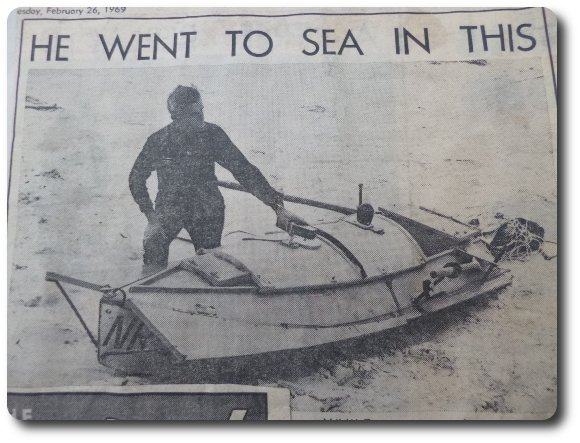
I spent a lot of my spare time during the winter of 1969 building – testing – altering and training in a 15’ by 2’ plywood canoe I built. This seemed to be the minimum size to carry myself, a 60 lb cast iron centre weight & provisions.
The canoe has a light ‘Meranti’ frame, sheeted with 3/16 ply to the deck line & 1/8 curved plywood top, unsupported, the curve giving it the necessary strength. Approx. 1/3 each end was sealed off into airtight compartments to assure floatation with airtight hatches to hold food, clothes & equipment and finally filled with plastic bottles.
I also packed foam floatation in the centre compartment where I rowed, this was fitted with a well, to house the centre-weight, which I bolted in. If the centre-weight was lost in this narrow craft, one would hardly survive at sea. After all this is a survival craft, not a showpiece.
Waiting for high tide, by Graeme Altmann. Graeme, who is Alf’s nephew, has drawn upon Alf’s story for a series of works depicting men at sea.
I learnt to sail it, it ran well with the wind and I could do a fair reach with a small sail & jib. To cut down equipment I rigged an extension to an oar for a mast, one could be under sail in about 10 minutes, but this was only to run back if I struck strong head winds.
The idea was to be the first to row Bass Strait.
During tests I found out I could not capsize the craft and it would ride out strong winds & big seas, however it was possible to have it blown over with too much sail, with an unexpected gust.
I found out one could get out and soon get in the lee side, the craft righting itself, however I almost made as much speed with the wind with the oars running with the wind without much effort, without the risk of capsizing.
The rudder fitted keeps the craft on a much more even course, particularly running with fresh winds and big swells. Also set for beam winds to avoid rowing on one oar to keep on course which is tiring.
I purchased a pair of broken teak oars from our rowing club for $1 which when repaired were long enough for my craft. Light & strong!
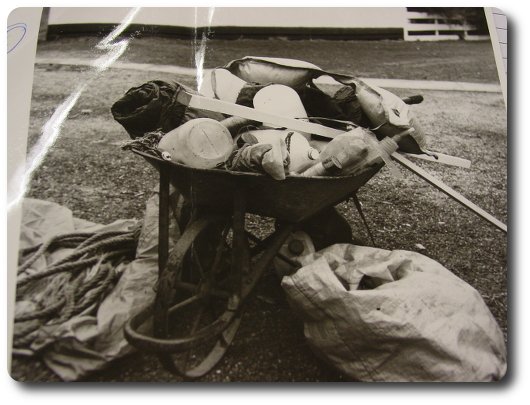
I carry 2 sea anchors – essential for offshore boating, $1 each at disposals. A sand pick and 200’ rope, 2 smoke, 2 flame & 1 parachute flares, torch, alarm clock, floating fish knife, compass, tent, 2 sails, canvas cover which allows me to sleep in boat, tommy axe, multi grips & screwdriver, camera, 1 aluminium saucepan, 1 spoon. Yellow windcheater & trousers which I row in, in rough or cold weather, sleeping bag, plywood, copper tacks & ‘Pabco’ for repairs, one can tack 3/8” copper tacks through 1/8” ply for temporary repairs straight onto existing plywood & clinch them over making fast waterproof repairs.
Only enough clothes to be acceptable when landing & to keep warm. About 2 lb’s of bran biscuits, I have been eating these for 37 years, I must have eaten tons of them by now, a terrific health food, dried fruit, honey, powdered milk, nuts, ‘Granose’ biscuits & water. These are my main foods.
Equipment salvaged from Alf’s kayak after it was retrieved from the ocean off Snake Island, Gippsland.
I also carry flour, rice and cheese in case one is stuck on an island, fishing lines to catch fish, can usually get mutton birds this time of year. I carry a survival bag in case I have to leave the boat, this would be the last resort, I would only leave it if I looked like getting washed onto rocks.
In the bag, a complete wet suit, which keeps one afloat and warm. I feel I would always make it to land in one of these, also about 2 days supply of food and water with a knife, and a 30” beach ball which can be blown up to attract attention.
My final test was a 27 mile trip from Warrnambool to Julia Percy island in 7 hours in 12’ to 15’ seas and 25 mile following seas. The canoe took it in it’s stride surfing down high swells, landed on the island, slept the night under the stars and back to Port Fairy the next day in 90° heat and running into head winds & swell, about 14 miles return. I found out a weakness in the outrigger rowlocks, otherwise all OK. I felt I could have gone as far again, however got some chafe on legs from rolling seat.
Left Warrnambool on the 23rd of February, after studying our weather for years feel from late Feb. into March – we get our best conditions while the days are still reasonably long & warm.
Put the canoe on the ‘Empress’ & got a cabin, arrived at Burnie and got train transport for self and canoe to (illegible), where I was met by Jim Petrio of Gladstone who took me to Little Mussel Bay with the canoe on a trailer, unloaded near beach & slept waiting the night on the verandah of a holiday cottage.
Hard bed, little sleep, TV asked me to wait for them next morning, so waited till 12, and was about to go when I heard a shout, the TV man had arrived, took film for 10 to 15 minutes, got away, good seas, no wind, strong tide carried me a mile or two to west before I got out of it about 5 miles out.
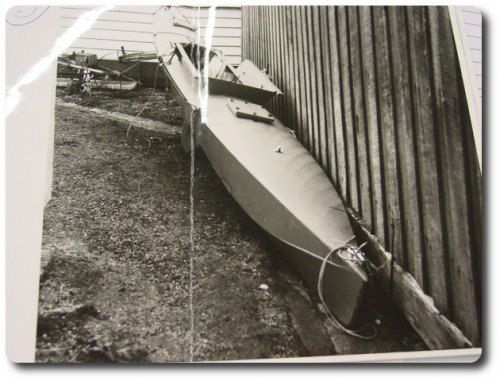
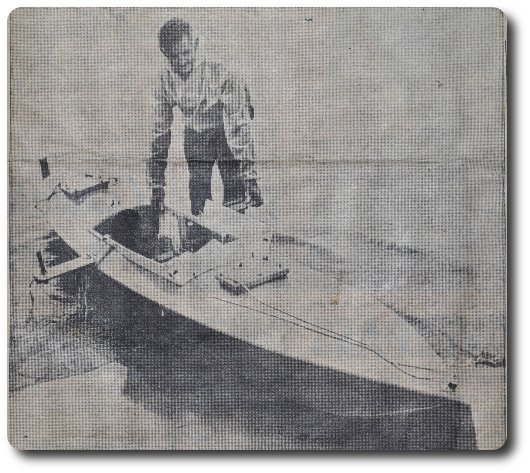
The home-made kayak that was tested off the waters of Warrnambool and Port Fairy before the Bass Strait crossing.
Rowed briskly, about (illegible) miles to go, late start, about ½ way to Barren Island, my first stop, saw some big fishing boat which swung my way, he swung in a wide arc following and finally blew his whistle for me to slow down. When alongside the ‘Skipper’ asked me where I was heading & when he saw I had completely stripped he said only 2 words ‘Oh God’.
When I told him I was making for Cape Barren island he appeared concerned & asked if I was alright, the crew were eagerly hanging over the side having a good look. After some directions we parted, rowed all day in the raw, only sand shoes on which are essential as my feet are built in to give power on the rolling seat.
Nearing Barren island 2 seagulls flew over, one turned back & had a second look, I concluding this was a lady seagull and it was time I put clothes back on. The less one wears the freer the body moves, also my swimming trucks where chaffing my legs.
Landed at Cape Sir John as the sun set, only about 3 miles from the settlement, but as the sea was full of rocks felt it was unsafe to go any later, pulled canoe up in nice sandy bay, unloaded and erected tent as fast as possible in sheltered scrub. Now dark, ate some nuts, apples & bran biscuits & honey, drink of water & off to bed. Warm night, good sleep.
Up and away at 7 a.m., lumpy & easterly winds funnelling between Cape Barren & Flinders, otherwise good run, some wind assistance, landed at Whitemark 1 p.m., small crowd waiting on wharf, a good welcome, stayed at Interstate Hotel. Left Whitemark 8-15 a.m. on 25th, unsettled weather, headwinds, can always turn back or land, wind freshening, rain on mountains, wind change to west, now beam on, hard rowing, looking for landing places, strong rip at (illegible), decide to press on.
The Sweep, another of Graeme Altmann’s works that reflect the relationship between the ocean and man.
Getting quite rough, head for Cape (illegible), finally land at Pine scrubs near a road I could see from out at sea on sheltered beach, easy to land, no breakers, pull canoe up and tie to tree, take clothes & walk up road, over hill. See large home in beautiful tranquil mountain setting, no one home, so sunbake.
Mr. & Mrs Syd Millyard of Leeka, the name of this area, arrived home about 6 p.m., had been shopping, they ran home as a guesthouse. ABC rang for news, rang wife, good nights rest, left for Kelliecrankie at 8-15, thru a strong rip tide, rowed hard for some 20 minutes and got thru, was baling out, looked up and found out I was being swept back at about 4 knots almost back into tidal rip, around Cape Frankland, almost hit sunken rock, it suddenly uncovered about 8’ away.
Good run along coast with some wind assistance to Killiecrankie, children waiting on beach, a very pretty sheltered little bay. Met Alf Stackhouse & wife, also local people, very friendly. Alf had full knowledge of all the islands & landing place right thru to the mainland. Also had his private plane, stayed the night with them. ABC reporters rang up.
Decided to miss Craggy island after seeing it and discussing it with Alf. Stayed the night with them, no sleep, thinking of 38 mile (illegible), hadn’t been this far before, arranged with Alf to fly over about 4p.m.
Set alarm for 3 a.m., in water at 3-20 a.m., can see Deal (Island) light flashing & head for it. Conditions good, slight side winds off Craggy island at 7 a.m., pleased with progress.
Winds freshening, thinking what have I done to deserve this, pray for good conditions.
Sighted Deal Island at 8 a.m., quite high in haze, winds dropping off (illegible) rock at 10 -15 a.m., strong tide pull… [notes end]
Postscript: The notes finish about half way through Alf’s journey which came to a fatal end on March 6, 1970, just 2km from the Gippsland Lakes. Before his death, Alf was already plotting his next adventure: to row from mainland Australia to Papua New Guinea.
Reviving Alf Altmann’s epic adventure
Alf Altmann’s attempt to cross Bass Strait solo in a home-made kayak in 1970 is the stuff of legend. Bluestone has pieced together the full story about this Warrnambool man’s brave quest …
The last shot taken of Alf alive, photographed by The Herald and published on March 4, 1970, as he powers from Hogan to Cliffy islands – just 58km from the end of his 300km journey.
By Carol Altmann
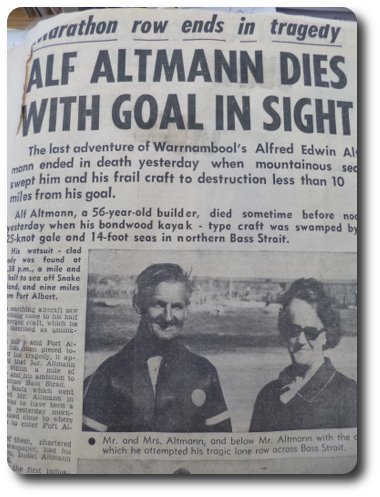
The recent Bass Strait crossing by three men on paddleboards has revived memories of an epic feat by Warrnambool’s Alf Altmann, who became the first man to row solo across the same treacherous passage – at the cost of his life.
Precisely 44 years earlier, on the morning of February 25, 1970, Alf set out to do the same perilous journey.
He pushed off in his home-made, 4.5m kayak from Little Mussel Bay, north-east Tasmania, and headed out for what he thought could be up to a two-week journey to Port Albert, Gippsland, depending on the weather.
It was a trip for which Alf, a builder by trade, had meticulously prepared both mentally and physically, and followed many years of experience on the water.
The kayak Alf made for his journey was plywood over a timber frame and declared by Alf to be unsinkable.
Indeed Alf, who was my uncle, had sailed for 18 years and had crossed Bass Strait eight times before in various motor-powered craft, many of which he built himself.
It was during one of these crossings that his engine failed and he was forced to row his boat to the safety of an island, after which he was so exhausted that he vowed to learn to row properly and promptly joined the Warrnambool Rowing Club upon his return.
Unlike the paddleboarders, who were all aged in their 30s, Alf Altmann was 56 years old – and a grandfather – when he decided to take on rowing across Bass Strait entirely on his own. There would be no support crew or anyone to rush to his aid if he struck trouble.
He also had none of the high-tech, water-resistant, fail-proof navigation and flotation equipment that is now commonplace in marine sports.
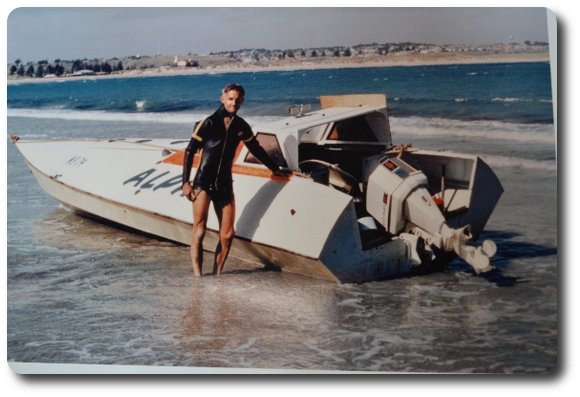
Boat maker: Prior to rowing his kayak across Bass Strait, Alf had crossed the strait eight times in various powered boats, including this home-made vessel.
Instead, Alf made his own bright-orange kayak from a timber frame and plywood shell, with a 30cm long, 27-kg steel keel and various sealed compartments so that if one area sprung a leak, it would not sink the boat.
His on-board equipment included a small sail and portable mast, a tent, flares, waterproof matches, a sea anchor, a radio transmitter, a compass and a life jacket that, by today’s standards, was more likely to leave you floating face down than face up.
No wonder everyone, including his wife, Isobel, thought he was mad to attempt to cross a stretch of water notorious for its high seas and battering winds.
Alf, however, was used to such scepticism and loved to live on the edge.
When he left from Melbourne in a powerboat to circumnavigate Tasmania in 1968 – a total distance of 1930km – the local fishermen thought he was crazy, but he simply responded: “what challenge is there in retracing common routes?”
Bass Strait is the ultimate challenge, even for those in maxi yachts, let alone a plywood, home-built kayak, but Alf was convinced that his kayak was unsinkable.
“This is a survival boat, not a luxury one,” he told reporters in the days before his departure.
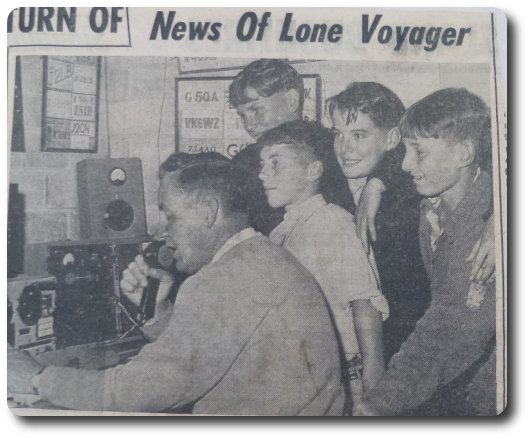
Everyone was gripped by Alf’s voyage, especially people from Warrnambool: here YMCA radio club leader Bill Wines tunes into an update, surrounded by eager listeners.
Alf arrived in Burnie, Tasmania, on board a trading ship and made his way with his kayak to the north-east of the state via train and then friendly locals who were prepared to give him a lift to Little Mussel Bay. Isobel, who was home with three of their four sons (the youngest, Philip, was 16), would meet him at the finish.
Once on the high seas, Alf – like the paddleboarders have done since – planned to island hop his way across the strait, from Cape Barren to Flinders, up the coast of Flinders and across to Deal, to Hogan, to Cliffy and then the 45km run home to Port Albert.
And while some of these islands were inhabited, if only by a lighthouse keeper, Alf intended to mostly camp and live off his supply of nuts, dried fruits, honey, powdered milk and special bran biscuits that Isobel always made for him.
It takes a special courage to push off into the ocean knowing that you will be utterly alone at sea, but the first days of Alf’s journey could not have gone more smoothly.
Setting off in beautiful weather, Alf ploughed through the water: far from taking up to two weeks, he was soon on track to make the crossing in a week.
Australians were riveted by the unfolding story as Alf checked in with lighthouse keepers at each island: first one, then another, then another…
Although born in the bush, Alf adored the ocean and always set himself new sea-faring challenges, like circumnavigating Tasmania in this powerboat in 1968.
It was only when Alf reached Cliffy Island, the last island before home, that the weather began to turn sour. Despite being so tantalisingly close to the finish – so close that Isobel was already waiting on the wharf at Port Albert – Alf was forced to bunk down at the lighthouse for two nights.
The acting lighthouse keeper, Sjoerd Boontra, would later say that Alf, despite having just rowed more than 200km, helped with odd jobs around the lighthouse while itching to get back on to the ocean.
Come the morning of March 6, Alf was determined to start out early for the last 45km of his journey, even though the weather forecast suggested rough conditions for a kayak and Sjoerd urged him to wait.
“His reason for leaving was that he wanted to surprise his wife…who was not expecting him until 3pm,” Sjoerd later recalled.
“It will have to be pretty bad for something to go wrong now,” Alf said.
These were among his final words. A minor storm blew in an hour after he left Cliffy Island, whipping up 25 knot winds and 4m waves.
Alf failed to arrive at Port Albert by his expected time of 11.30am, and the crew of the Marjorie Phyllis, a lighthouse supply boat that was assigned to meet him offshore, began to worry.
By 1pm, the local police launched a full-scale air and land search, with Isobel still holding out hope that he had taken refuge on a scrap of an island.
But at 5.58pm, the Marjorie Phyllis received a crackled radio call from the search plane: “It’s all off”.
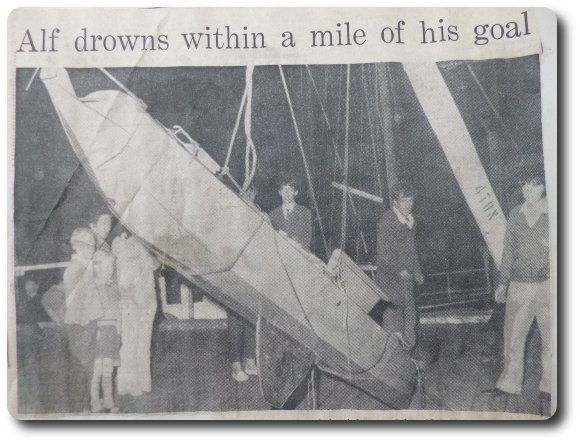
The adventure comes to a tragic end: Alf’s kayak was retrieved just 2km from land.
Alf’s body, wearing the top half of a two-piece wetsuit and a spray jacket, was spotted less than 2km from Snake Island, part of the Gippsland lakes. His kayak was found nearby, intact, but for the splintered oars: it really was unsinkable.
How Alf came to drown is still not known, but abrasions across his face suggest he capsized and was knocked unconscious by hitting his head, perhaps on one of the oars. From there, it was over. A life packed with determination, daring and adventure had come to an end.
More than 500 people crowded into the Warrnambool Presbyterian Church for Alf’s funeral, where he was described as a man of great courage and a “pilgrim adventurer”.
And Isobel, even within her own grief and that of her sons, Keith, Ken, Philip and Alan, reminded us that Alf would have wanted to die knowing he had pushed the boundaries.
“Where would we be if nobody had taken a risk?” he once told her.
* Bluestone Magazine would like to thank Alan and Philip Altmann for their assistance in researching this story. Other details have come from original media reports and documents housed in the Public Record Office Victoria. Alf’s widow, Isobel, passed away in 2003.