WCC leasing deals: a wall of silence…and a shiny new shed

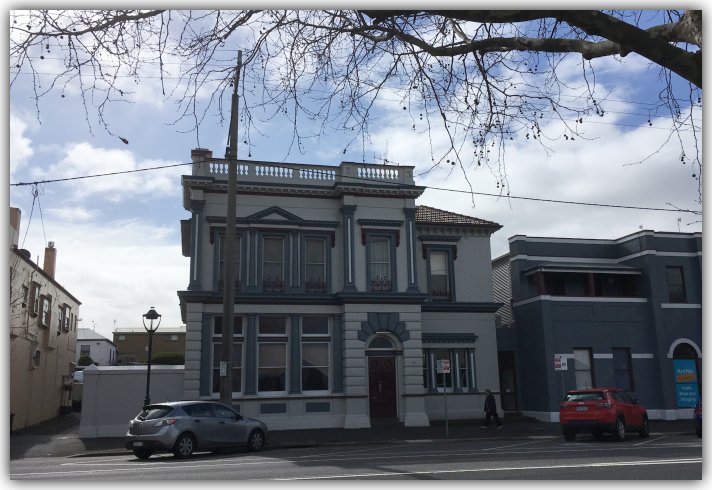
The council-owned residence at the Archie Graham Centre is part of a former bank building.

By Carol Altmann

The Warrnambool City Council has pulled down the shutters on its leasing rules that have allowed a senior staff member to rent a council-owned apartment for more than 30 years.

It is two weeks since the story broke about a senior staff member renting a central apartment at the Archie Graham Centre for 31 years (@ $190 per week) and another staff member renting a beachside house for 14 years (@ $221 per week), with no end date for either lease.

Despite an enormous response to the story from people wanting to know more, the person in charge of such things, Revenue and Property Manager Glendon Dickinson, has declined to be interviewed.

A whole series of questions I sent to both him and the WCC media manager, Nick Higgins, have been left hanging.

These questions include basic things like who sets the rent? How often is the lease renewed? How were the tenants selected? How is the rent paid? Does the rent include utility bills?

After several days, the only comment forthcoming was this:

“Our leases are guided by State legislation including the Residential Tenancies Act.”

Do you find that answer satisfying? I find it insulting: not to me, but to all WCC ratepayers, who actually own these buildings.

The public service has very different rules around transparency, compared to a private company, but what we are seeing at WCC is not transparency, but secrecy.

One thing that is impossible for the WCC to ignore, however, is the new garage and sealed driveway that has appeared behind the apartment in question at the Archie Graham complex and has cost ratepayers $43,000.

The single garage was built by council to replace a dilapidated three-bay garage (two bays of which were used to store council junk) that was demolished to make way for new works at Heatherlie homes.

I understand the single garage was budgeted at $12,000. The project came in “around” $43,000.

Mr Higgins said the final cost included the garage ($11,638), rebuilding a collapsed retaining wall, restoring a garden bed and “the sealing of a previously gravel laneway”.

This laneway, which is the expensive part, is not used by Archie Graham clients, but, according to Mr Higgins, only “used by neighbouring tenants and the residential tenant at Archie Graham”.

The $43,ooo was pulled from the capital works budget for the Archie Graham Centre, the managers of which must be either scratching their heads, or beating it against a wall, at such an expense.

In explaining the cost, Mr Higgins said the council had received more rent from the “flat” over the years than it had spent on maintaining it.

You would hope so.

The rental income from the “flat” had also helped subsidise the maintenance of Archie Graham, he said.

Again, you would hope so. Paying rent, after all, is part of the deal when leasing a property.

But both of these things, really, are beside the point.

The point is that we still don’t know the full details of this lease agreement and how it came about.

The WCC – unlike dozens of councils I have looked at – does not have a property leasing policy which is designed to keep things transparent.

The only way WCC ratepayers would know these leases exist is to visit the council offices and ask for a physical document that very few people know is there.

So why does any of this matter? What is the public interest?

Well, first, the properties are owned by Warrnambool ratepayers. They are the “landlords” here and I think they deserve to know what is going on.

Second, these two leases are unlike any of the WCC’s other residential leases. Every other WCC residential lease either provides public housing for disadvantaged tenants, or short-term accommodation for new staff.

Thirdly, the leases are not part of a salary package and are not required as part of a job description, such as a caretaker at a caravan park.

So, combining all of these factors, the crux of this issue is twofold:

  1. How did two council staff, out of more than 350 staff, manage to secure leases in prime-location, council-owned and maintained houses, that have lasted for decades?

  2. Do these arrangements breach the Local Government Act?

I still don’t know the answer to #1 and I may never know.

But I do know that under the Local Government Act, if a council lease is to be for more than 10 years, the details must be publicly advertised. This is to allow people to a) know about it and b) have a say.

So how does an ongoing lease of 30-plus years slip under the radar?

Simple.

Break the lease into, say, five year lots – and keep renewing that lease each time. Presto, you have a lease that stretches for decades, with very few people knowing about it, and nobody having a say.

Something doesn’t add up here and until it does, we need to keep asking the questions, no matter how uncomfortable. And this is what I plan to do.

If you would like to support local investigative journalism, please make a small contribution below.

Donate


Lifting the lid on 30-year-rent deal for WCC staff member

The Timor St building that is owned by Warrnambool City Council and includes a subsidised apartment that has been occupied by a senior council staff member for more than 30 years.

By Carol Altmann

Did you know that a senior member of Warrnambool City Council staff has lived in a subsidised, council-owned apartment in a prime location for more than 30 years?

I didn’t believe it, but it is true.

The council lease register confirms that the same staff member has rented the top floor of a prime property at 130 Timor St since 1987.

The grand old bank building is part of the Archie Graham complex owned by the council and is a two-minute walk from the council offices.

According to the council’s lease register, the current annual rent being charged on 130 Timor St is just $9900, or $190 a week, which is low for Warrnambool.

I had a quick look at realestate.com.au and the rent for a decent two-bedroom property in Warrnambool is usually at least $250 and that is for a place in the suburbs.

According to the WCC enterprise agreement, the salary for this staff member is estimated to be somewhere between $76,000 and $83,000 plus super.

Strangely, the lease between the council and the tenant is also classed as “on-going”, which means it has no renewal or end date.

What the….?

And for the past 31 years since the lease began, the council – meaning ratepayers – has paid for maintenance, repairs and other improvements to the property.

What the…?

The senior staff member is one of two council staff members on a long-term residential lease, although the 31-year-lease is by far the longest tenancy.

The former caretaker’s residence at the Warrnambool foreshore that has also been under a long-term, on-going lease.

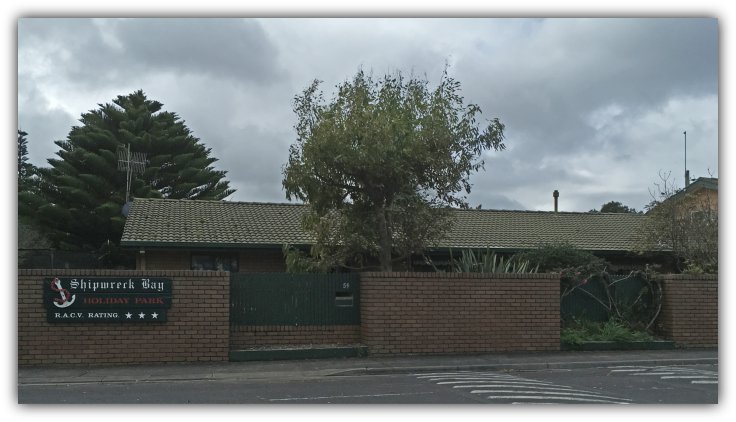
The second property operating under a similar, on-going lease to a WCC staff member is the former caretaker’s house within the Shipwreck Bay caravan park at Pertobe Rd.

This foreshore property has been leased by the staff member for the past 14 years.

The current annual rent on that property, however, is closer to market rates at $11,532, or $221 a week.

Having spent a lot of time looking at what other councils do around property rentals, I can tell you that these two residential leases are highly unusual.

I have to stress at this point that I would not normally write about the affairs of a private tenant, but in this case the tenants are public servants, leasing publicly owned houses and the lease arrangements are therefore of public interest. This is why councils have to keep a lease register in the first place, even if very few people look at it. Despite this, I have chosen not to name the individuals involved. Both were contacted for comment, but declined.


I also need to be clear that many councils, including Warrnambool, own a number of houses that are made available to people who can’t afford the rental market or who are vulnerable, like the elderly.

It is also quite normal for a council to offer short-term housing to new staff who have relocated from elsewhere.

Council-owned houses in Koroit St and the Warrnambool Botanic Gardens are used for this purpose.

Some councils, like Moyne Shire, also offer a house as part of the salary package for specific jobs such as caretakers of caravan parks who need to, obviously, live onsite.

That is all absolutely normal and – usually – transparent. (I was able to get a copy of the salary package for the caretaker position at Gardens Caravan Park in Port Fairy via one call to Moyne Shire.)

But what is happening here with Timor St and Pertobe Rd is highly unusual.

So what is going on and who is making the decisions?

I think ratepayers deserve to know who sets up such lease agreements, are they part of a salary package, who sets the rents and how often they are reviewed, does the rent include power and water, and are other people ever given the chance to apply for the same property?

Most councils have some form of property leasing policy that could help answer most of these questions.

The WCC doesn’t have such a policy, or not one that they could produce.

So, I asked WCC media manager Nick Higgins for answers.

Who sets the rents?

“Rents for Council properties are set at market rates based on independent valuations,” Mr Higgins wrote in an email.

These “rental values are reviewed annually as part of Budget preparations”, he added.

Yes, but who makes the final decision? A panel? The CEO Bruce Anson? Another senior officer? The councillors?

And where does the “independent valuation” come from?

“…a private company,” Mr Higgins wrote.

Which private company, I asked?

No answer.

Okay, what about the leases? Who writes and renews the leases? And are these renewed leases advertised, as per the Local Government Act?

“Leases are renewed where there is agreement between Council and tenants,” Mr Higgins wrote.

Really? The tenant and council can agree to just keep renewing a lease on a prime CBD property for 30-plus years?

Wow, that is some deal if you can get it.

I pressed on and asked Mr Higgins, in a nutshell, if this sort of  “ongoing” lease ever actually expired.

“A fair landlord does not evict tenants or fail to renew leases if the tenants have acted in accordance with a lease agreement,” he replied.

So if a residential tenant sticks to the initial lease agreement with the WCC, they can pretty much stay on forever, it seems.

“Can you send me a copy of the lease agreement,” I asked Mr Higgins by return email.

“And, again, can I ask the name of the private company that reviews the rents in accordance with market values. I am not sure why the name of the company is being withheld.”

The response is below:

Hello Carol,

We have nothing further to add.

Regards,

Nick


Well, in my humble view, there is plenty further to add and that process starts with a Freedom of Information application for the lease agreements.

Thanks to those people who have donated to help keep these investigative stories coming, I lodged that FOI application yesterday.

I think this story is only beginning.

If you would like to support local  investigative journalism, please make a small contribution below.
Donate


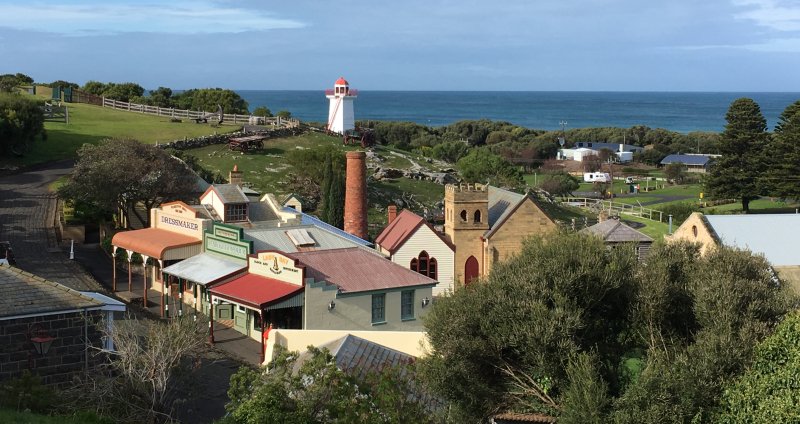
Are we being told the truth about Flagstaff Hill?

By Carol Altmann

I have been looking at visitor numbers for Flagstaff Hill and, I have to tell you, there are worrying signs.

Before I go any further, I need to say three things:

The figures are from Sept 2017 to Feb 2018. The media unit at the Warrnambool City Council will not give me more recent ones. I don’t know why. It also refuses to answer any questions about the figures that have been released.

In the past 15 years, at least $15 million of public money has been poured into Flagstaff Hill to keep it alive. Most recently, $3 million was spent on a new light/sound show and other improvements that opened in June last year. A year on, I think we need to know how things are travelling.

None of what follows is a reflection of the hard work done by the volunteers and many WCC staff who, in recent years, have busted their guts for Flagstaff Hill.

So how are things going?

The expectation was that once the $3 million upgrade was launched in June 2017, visitor numbers would boom.

As the council CEO Bruce Anson said himself, the colonial village needed at least 80,000 paying visitors a year to break even. This would stop the WCC having to spend $500,000, $600,000 or $700,000 a year to help it cover costs.

It was a big ask. Three years ago, paid visitor numbers were below 55,000.

The head of WCC’s tourism arm, David McMahon, who two years ago was handed the whip to flog Phar Lap, remained optimistic. In June last year he told The Standard:

A 30% jump by January was a lofty goal, but here is an awful, ugly, unadulterated fact: the overall visitor numbers at Flagstaff Hill are going backwards.

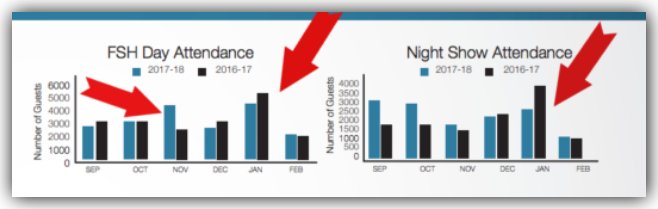
I have checked and re-checked the numbers and you can look at them yourself right here:

Let me take you through the red arrows:

  • In December and January of 2018 – our peak summer holiday season – less people went to Flagstaff Hill than the summer before.
  • The same applies to people who saw the new $2 million night show. After an initial spike in the months after the show opened, many more people actually went to the OLD show, in the summer of 2016-17, than they did in the summer just gone.
  • In February, when the weather was still warm, less than 2000 people showed up for the whole month, about the same as last February.

This is a shock.

Maybe the person who drew this graph for the council got their colours mixed up, but I don’t think so, because you can see a clear ‘spike’ around November last year.

Why was there a spike? I suspect because Flagstaff Hill had a free open weekend to celebrate its $3 million upgrade.

Did you see the word FREE in that sentence? This brings me to another very important point: how many have people actually paid to get in or paid for tickets to the night show since last Sept?

I don’t know. It’s one of the questions that those who have access to these figures – David McMahon, Flagstaff Hill manager Paul Pinkerton and WCC media head Nick Higgins – won’t answer.

But this question is critical to whether these figures are being fudged. Are these numbers a true reflection of what is going on, or is it even worse?

Free entries do not help the bottom line and if free entries are being included in these numbers, then we are being duped and that, to me, is very serious.

We have been here before, with Fun4Kids.

After many successful years as an annual winter event, Fun4Kids started to bleed money. Then it started to haemorrhage.

Here is David McMahon again being quoted by the paper during last year’s Fun4Kids:

Seven months later, the WCC dumped Fun4Kids.

The cut came without warning, without any fallback plan, without any replacement and, it must be said, without giving the scaled-back F4K festival a chance to see if it could do better than the big-budget stuff of years before.

This is not how we should be planning our future as a prime tourist destination.

We need honest, transparent conversations about how we are tracking, what we can expect and what, if anything, we need to change.

I have written many times before that a fake colonial village that opened in the 70s and still flies the Union Jack high above its premises is no longer appropriate to where Warrnambool is going today.

What could replace it is a topic I will wade into later, but for now we deserve to be told the full story.

If you would like to keep seeing more pieces like this about local issues, please make a small contribution below.
Donate


Plastic dump investigation needs a whistleblower

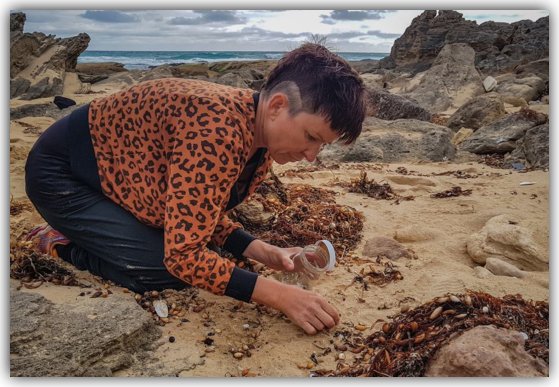
Warrnambool film maker and environmental activist Colleen Hughson, meticulously collecting tiny plastic ‘nurdles’ that were illegally dumped through the Wannon Water system last November. Photo: Rosana Sialong.

By Carol Altmann

Every time I look at the above photo of Warrnambool woman Colleen Hughson, I am struck by the humility of it.

There is Colleen, at Shelly Beach, on her knees, deeply focussed, picking up tiny plastic beads – aka an environmental nightmare called “nurdles” – between her fingertips, one by one by one by one….the number appears to be endless.

That shaved spot you can see above her right ear was where she had surgery to remove a brain tumour not long before this photo was taken by fellow ‘nurdler’ Rosana Sialong*.

I am sure surviving a brain tumour must change you. It would make some of us, I suspect, become more selfish. In Colleen’s case, however, it has made her generous spirit even more generous.

When Colleen, a film maker, discovered that tens of thousands of nurdles had been illegally dumped through the local Wannon Water sewerage system last November, she started a community action and clean-up group, Good Will Nurdle Hunting, that is still going gangbusters today.

Colleen and Rosana and dozens of others have now been cleaning up this plastic pollution for months, including days of blazing heat and finger-freezing cold.

So far, they have picked up more than 650,000 nurdles from our local beaches and it ain’t over yet. They just keep coming.

Wannon Water has also been cleaning up this mess for months.

It recently announced it had so far spent $334,000 on collecting nurdles: imagine the cost if Good Will Nurdle Hunting was not helping out for free? It would probably be at least $500,000.

What happened here was a major environmental crime.

A crime that is equivalent to someone stealing half a million bucks from a bank, except unfortunately crimes against the environment are not measured that way.

And yet nobody has been held responsible and nobody will because Wannon Water, despite its best efforts, has run out of leads.


I asked Wannon Water’s general manager (service delivery) Ian Bail a bunch of questions about where the investigation was up to and, in a nutshell, this is what he said:

  • 20 sites have been visited. There are no more visits to come;
  • the nurdles have been inspected by two independent labs and they still don’t know what specific type of plastic it is or what it might be used for;
  • investigator and retired police officer Mick Fennessy, who was hired by Wannon Water, has finished his immediate task;
  • the multi-million dollar upgrade to the Warrnambool Sewage Treatment Plant will include a new system for accepting sludge which, hopefully, means this won’t happen again.

Wannon Water is keeping the investigation open. It still hopes for a breakthrough, but that won’t happen unless someone who knows what happened speaks up.

And somebody knows.

The person who poured the zillions of the nurdles into the system knows.

The person who delivered the sludge to Wannon Water’s treatment plant containing all of these zillions of nurdles also knows, or should know.

Was somebody paid to look the other way?

Somebody knows.

And while we wait for somebody to grow a conscience, people like Colleen and Rosana and Keith and Brenda and Donna and Luke and Megan (the list of names goes on), will keep picking up the pieces.

*Rosana’s photo provided the inspiration for this year’s Warrnibald portrait prize winner, Megan Nicolson, who reproduced it in needlepoint.

If you would like to see more stories like this, please consider making a small contribution below.

Donate


We just signed up to 76,800 horses on our wild beaches

By Carol Altmann

The full power of the horse racing industry in Victoria has been laid bare.

In 118 pages, the Belfast Coastal Reserve Management Plan released this week ties itself in knots to justify the unjustifiable: allowing full-scale racehorse training along one of the few, accessible wild beaches in our area.

At no time, unlike with the dirt-bike riders or off-road drivers, did the State Government consider banning racehorse training on the stretch of beach between east Killarney and Levy’s Beach, which is home to a breathtaking array of endangered birdlife and indigenous cultural heritage.

No, from day one, it has been a case of the government working out how to accommodate racehorses, as if they have been on our beaches for thousands of years and have wings and feathers, or gills and scales.

Let’s do the maths on what is now going to happen:

Up to 40 racehorses a day, five days a week, all year round, will be allowed to train on ‘Hoon Hill’, a long sand dune area west of Levy’s Beach. This equals up to 200 horses a week.

Up to 120 horses a day can train on Levy’s Beach foreshore, five days a week, all year round. This equals up to 600 horses a week.

This means up to 800 horses a month will be running up the dunes and 2400 running along the beach.

In one year, this is the equivalent of up to 9600 horses on the dunes and 28,800 on the beach.

In two years time, when the government plans to assess the impact, there will have been – potentially – a combined total of 76,800 horse movements along Levy’s Beach and up the dunes at Hoon Hill.

Up to 76,800 horse movements in just two years of a 15-year plan.

Will it have an impact on the beach? Hmm, let me think about that for one nano second.

This entire “problem” of what to do about professional racehorse trainers has been created by the sheer power of an industry that has huge clout well beyond our little patch in south-west Victoria.

You only have to see the cosying up that goes on between politicians and the Victorian Racing Club.

Free passes. Memberships. Tickets to the Cup. Heck, some of them even own racehorses themselves, like our local MPs Dan Tehan and James Purcell who, in an Orwellian twist, receives lavish praise for looking after his own interests and that of his son, Aaron, a professional racehorse trainer.

And if anyone dares to mention that racehorses can be trained in purpose-built facilities, that they don’t actually need to be trained on our wild beaches, they are whacked with a thinly-veiled form of blackmail: the trainers will go “elsewhere” (although I am not sure where “elsewhere” is), all the jobs will dry up and the local racing industry will collapse.

What a load of bullshite.

The Warrnambool Racing Club would not be investing millions into the Warrnambool racecourse if its whole survival depended on continued access to a stretch of coastline.

Let’s not forget that these professional racehorse trainers just started showing up at Levy’s one day, using the beach without permits or permission, and when one of those horses won a Melbourne Cup in 2015, they began to arrive by the truckload.

But instead of telling these trainers to pack up and leave a coastal reserve, it was decided there was no option but to bend the rules around them. Not only that, carparks and tracks will now be added to give them better access!

The motorcross riders and off-road drivers must be feeling hard done by.

They have been tearing around the dunes at Levy’s Beach for years and – quite rightly – have been given notice that they will no longer be tolerated.

So as one form of horsepower moves out, another much stronger horsepower is moving in.

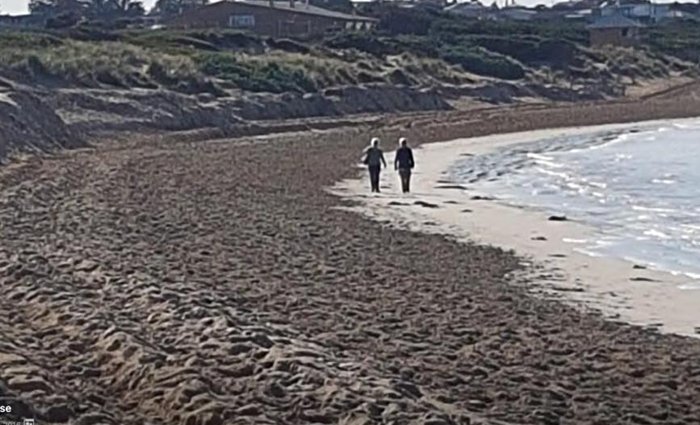
The churned up sand at Lady Bay, Warrnambool. left by racehorses in training. Image Bill Yates.

Don’t be fooled for one second by the romantic images of horses wading into the surf to soothe their weary muscles, or swimming gently behind a row boat as they swim out their strains. They can do that now at Lady Bay.

This is not horse riding, this is racehorse training, on a massive scale.

This is about conditioning, this is about pace and strength: the hard, powerful stuff, up dunes and down dunes and along long stretches of beach, dodging the walkers and birdwatchers and startled birds, and squashing the starfish and worms and bugs and shellfish and little pids and pods that make up the full and brilliant ecosystem of a wild coastline.

It makes me want to weep, this sort of destruction, all for no other reason than convenience, ease and greed.

And nobody else, nobody, but the powerful racing industry would ever get away with it.

If you would like to stories like this, please consider making a small contribution below.

Donate