Rumblings growing louder about racehorse training at Levy’s
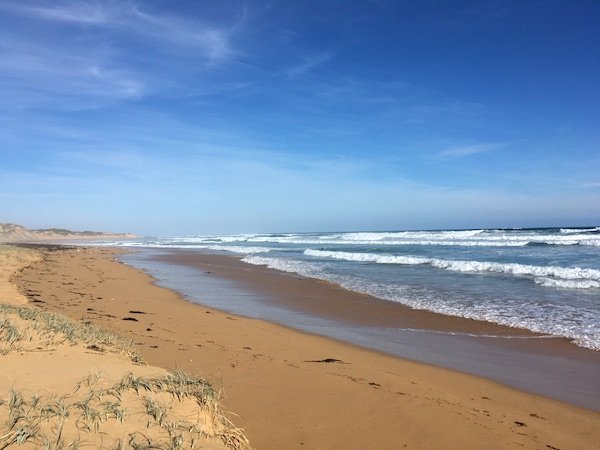
The main stretch of sand at Levy’s Beach, Warrnambool, on a spring day. The racehorse industry was hoping to gain access to the beachfront by December 1, until it hit a legal hurdle.

Carol Altmann – The Terrier

Things have gone eerily quiet on the push to get racehorse training up and running at Levy’s Beach in Warrnambool, which makes me suspect something is afoot, because the billion dollar racing industry is not going to give up that easily.

As we know, plans to have up to 160 racehorses a day training on Levy’s Beach (120 on the beach and 40 in the dunes) by December 1 were thwarted when it was found to be against the law under the Warrnambool City Council planning scheme.

That pressed a big fat pause button while the state election was held and the man who could change things for the racing fraternity, Planning Minister Richard Wynne, found out whether he kept his seat in Richmond. He did.

The word is that, since then, the racing industry has been pressing hard to have Mr Wynne step in and do something to fast track their access to Levy’s.


What Mr Wynne can do is intervene and issue an interim order allowing racehorses to train on the beach, while the council goes through the much longer process of changing its planning laws to accommodate them.

From my understanding, even with Mr Wynne’s intervention, the council would still need to finalise licence arrangements with the Warrnambool Racing Club, but given its forelock tugging so far, that should not be a problem.

Damage to the dunes at Levy’s Beach caused by years of unfettered and illegal access by dune buggies, four-wheel-drives, motorbikes and horses. Image: Google Earth.

As a sweetener, the WRC even generously offered to add more asphalt to the Lady Bay waterfront and build a $400,000 bespoke carpark and horse wash-down facility for its own needs.

The idea of this, as pointed out by club, was so horses could train their guts out on the dunes and foreshore at Levy’s, then hop on a float and be whisked down to Lady Bay for a refreshing swim and aqua aerobics.

So, as you can see, the industry is not about to give up easily on establishing a convenient, low-cost, one-stop-shop racehorse training facility just a few minutes drive from the racecourse, subsidised by our unique natural environment.


For all this, trainers will pay an annual licence of a few hundred dollars, plus the princely sum of $6 per horse per day for Lady Bay and probably $3 per day for Levy’s beach.

I pay more than this to use the Aquazone swim centre and I am not a wealthy racehorse trainer.
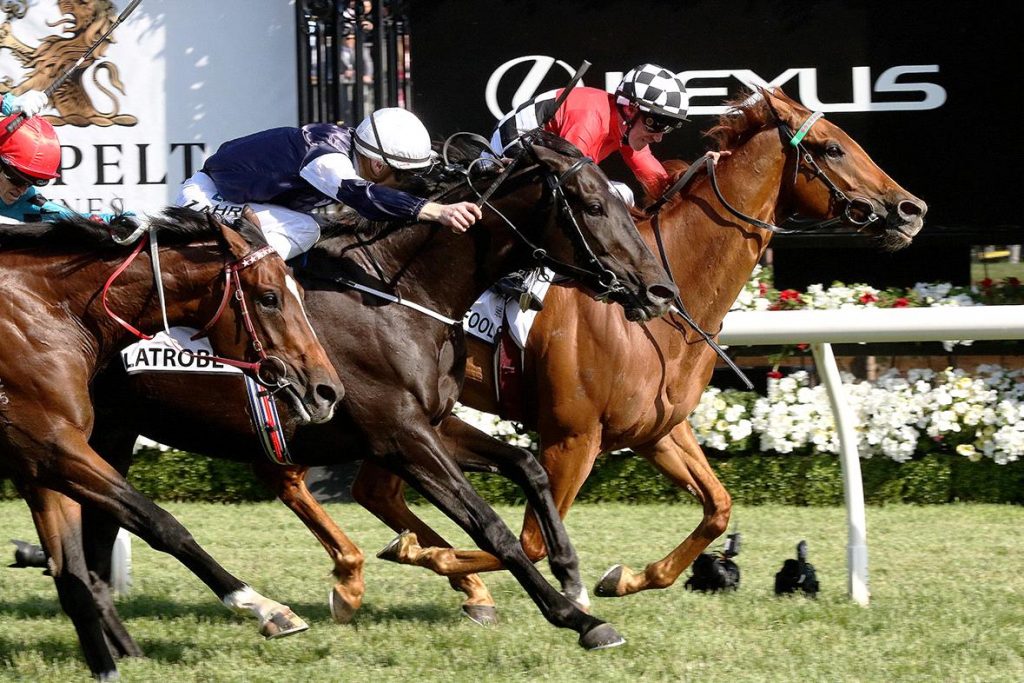
Trap for Fools, winner of the $2 million 2018 Mackinnon Stakes, is among the racehorses trained in Warrnambool by local trainer, Jarrod McLean. Image: Darryl Sherer, www.racenet.com.au

While we wait to see what happens next – and something will happen – it is worth remembering that the majority of us, including those who love and support horse racing (#notallracehorsetrainers #notalljockeys), did not want this.

More than 60% of people who responded to the Belfast Coastal Management Reserve draft plan said they did not want commercial racehorse training in the coastal reserve.

There are some key words here: “commercial racehorse training” and “coastal reserve”.

To be clear, Lady Bay is not part of the Belfast Coastal reserve, it is a separate issue.

Commercial racehorses are not recreational horse riders, they are a separate issue.

Racehorses are not Rundell’s horse trails, they don’t use the dunes for strength training.

What people did want was a management plan for a spectacular, remote, wild, yet often neglected and abused part of our coastline that is home to rare and endangered birds, rare plants and a rich indigenous history.

There was no management plan for the area. Now we have a plan…but there are racehorses stuck right in the middle of it.

Parks Victoria is not happy either. They can’t say that, of course, because they are public servants, but they have been forced to hammer this square peg into a round hole.

The last time Parks staff spoke to the public in Warrnambool about the plan, that anguish was palpable.


But the racing industry is powerful. It uses terms like “dollars” and “jobs” and “tourism” and “Darren-Weir-will-move-his-stable” to try and shame anyone who says, hold on, we like horse racing, but why do you need to tear up our wild beach?
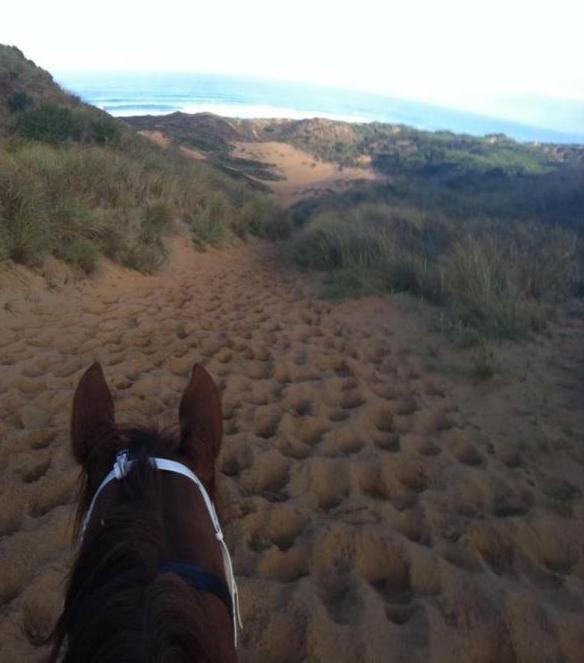
Racehorse trainer Jarrod McLean’s website promotes dune and beach work in Warrnambool as one of the attractions of his services. Image: Stealth Lodge Racing.

To date, Cr David Owen has been the lone voice of dissension on council. I don’t expect that to change.

The racehorse industry will get what it wants from the State Government*. That won’t change either.

But what can change is our understanding of this issue and what it means, long-term, for a coastal reserve in our backyard.

We need to get a full grip on that and then decide if we want to join the push to stop this race, because believe me, it ain’t over yet.

* The State Government last week announced another $33 million will be made available as prize money for racing in 2019-20. The total prize money now available in Victoria is $255 million, up 47% from 2015.

If you would like to see The Terrier keep digging up, sniffing out and chewing on local issues, please make a small contribution below.
Donate


All go, go for FOGO? Well, yes, yes and no, no

Carol Altmann – The Terrier

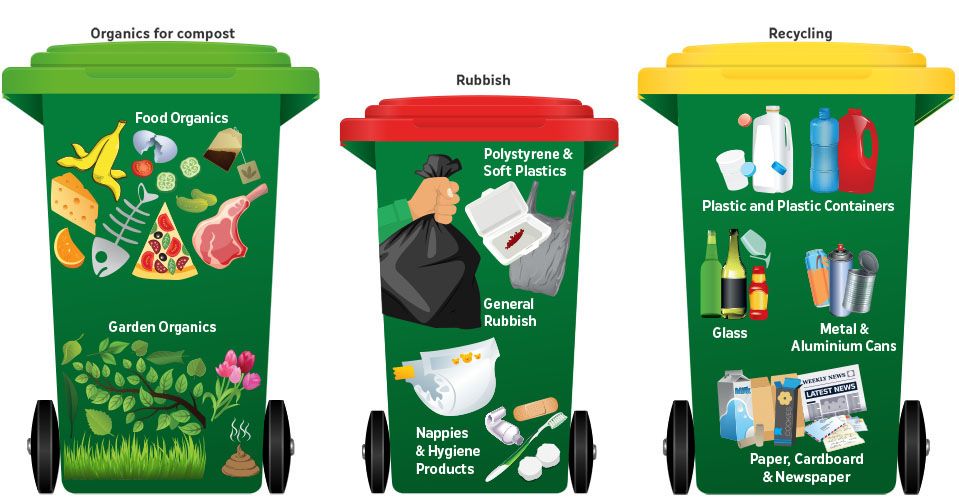
The Warrnambool City Council’s new organic waste collection is a terrific move, but it could take a year or more before the service actually reaches your street.

Until this week, I didn’t know that the new service – best known as FOGO – could take up to three years to roll out fully across Warrnambool. Did you?

Let me explain.

As has been well publicised, the council ran a pilot of the FOGO service with about 1700 householders in the first half of this year and it was wildly successful. No surprises there; we are a green-minded city.

Buoyed by this success, the council decided several months ago to roll out the service to everyone and I, like most others, couldn’t wait to get that extra bin so organics could be sent off to be composted, rather than dumped in landfill.

In the meantime, the council sent out its 2018/19 rates notices which included a $69 increase in the waste management fee, up from $287 to $356 per household.

As then-Mayor Robert Anderson explained, the sharp increase “covers the rollout of a Food Organics, Garden Organics (FOGO) collection service and also the increase in cost to process recyclable materials”.

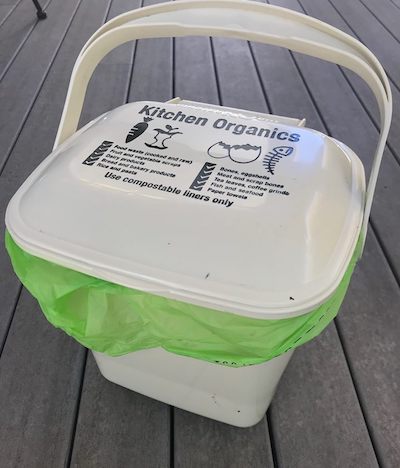
Coming to a kitchen near you – the FOGO rollout includes delivering kitchen caddies and bin liners to each home, like these recently delivered to residents at the Mill.

But this is where things get confusing: just because you are now paying $356 for your rubbish collection doesn’t mean you will get the FOGO service immediately.

It could take months and possibly even years, depending on where you live in Warrnambool.

The council hopes it won’t take that long, of course, but in July this year it flagged that the full roll out across nine pick-up areas, each of about 1600 bins, could take up to three years.


I must admit that I missed that memo and, like others, was wondering why I still hadn’t got my FOGO bin?

Just last week the council announced the winning tenders for picking up the organics, processing it and composting it, with all of these contracts to start from July next year.

So the situation for now is that some Warrnambool residents already have FOGO, some Warrnambool residents are getting FOGO as we speak, and others, like my little household, are waiting to find out when it will arrive.

Green bins are on the march in councils around Australia, like Richmond Valley (pictured).

One astute reader asked me earlier this week whether a council can legally charge all ratepayers for a waste collection service that is only being used by some.

It is a good question, but the answer is yes, because, as the council points out, it is still collecting all of your rubbish – including organics that are now going into landfill via our normal old rubbish bins – and this all costs money.

“The FOGO component is allowing us to progressively roll out the FOGO collection which means that we will transition out of collecting (organics) in rubbish bins and move towards the separate collection of (organics), which will then be processed into compost,” council spokesman Nick Higgins said via email.

“While it may have been seen as preferable to roll out a complete FOGO service simultaneously across the city there were practical challenges with doing this,” he said.

Mr Higgins said the council was keen to get things moving as fast as it can and had applied for funds to help speed up the process.

“Council has applied for a grant to assist with the rollout of the dedicated FOGO collection and it is hoped that the full rollout of FOGO across Warrnambool will occur quickly,” he said.

What this all means is that, for the time being, FOGO is slow-go, but we are at least making a start on reducing the 3000 tonnes of food and other organics that are now being dumped into landfill.

Keep the Terrier typing!

Donate


Sweet potatoes: how Purcell pushed Britnell over the line

Carol Altmann – The Terrier

Ah, the sweet irony of politics. Independent candidate James Purcell, having tried his darnedest to edge Liberal Roma Britnell out of her seat, ended up being the one who kept her in it.

Remember a few weeks ago we talked about the importance of potatoes, aka preferences? (If you missed that explainer, you can find it here).

Having had a good close look at the numbers now that the state election result for the south-west has been finally declared, it all came down to James Purcell’s bag of potatoes as to whether Labor won, or Liberal.

It was that close.

To win, Roma Britnell needed every single potato/preference she could get her hands on.


Unlike in other years, the Liberals didn’t start with a huge truckload of first-preference votes: Labor’s Kylie Gaston started with 10,074 and Roma received 13,296. James Purcell was next in line with 6763.

In a big old blue-ribbon Liberal seat like the south-west, this is extraordinary and a sign of just how on-the-nose the Liberal Party is right now. (Keep it up, south-west! We have a federal election next year.)

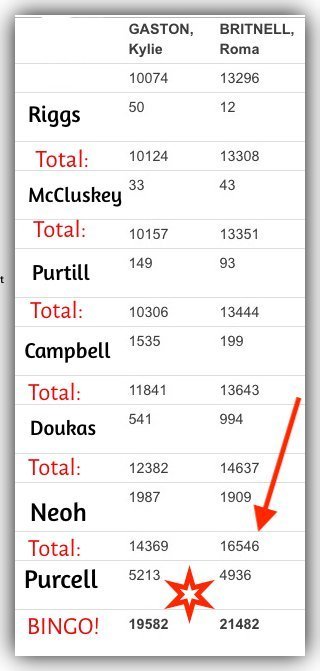
As the distribution of the preferences began, it really was neck-and-neck the whole way between Kylie and Roma, as you can see by this image:

After the distribution of all the preferences from Terry Riggs (Socialist), Mike McCluskey (Independent), Joseph Purtill (DLP), Thomas Campbell (the Greens), Jim Doukas (Country Liberal Party) and even right down to Michael Neoh (Independent), the two main candidates were still only a couple of thousand votes apart.

All that remained to be distributed was James Purcell’s preferences.

Oh the tension, the drama! Which way would it go?

Would the south-west defy every single prediction before the poll and elect a new member?


Would we have an ALP local member for the first time in 2000 years? (I exaggerate, but you get the picture).

You can see by the numbers that, in the end, James’s preferences were split almost 50-50, but MORE went to Kylie than to Roma… just not quite enough to get her past Roma.

If another 1000 of Purcell’s potatoes had dropped into Kylie’s bag, she would now be sitting in Parliament House at the top of Spring St.


It was that close.

James did not quite do what he set out to do, which was to win the seat, but he achieved what we all hoped he would do, and that was to help make this seat marginal.

As predicted by the ABC’s number cruncher Antony Green on election night, the south-west is now on a margin of less than 4% at 3.8%. (Until November 24, it was on a margin of 11%).

What are we going to do with this gorgeous little margin next time around, in 2022?

Are we going to relax back into the easy chair and put all of our potatoes back into one big blue bag with “Liberal safe seat” written across the front?

Or are we going to push it even further and go for a real change?

We might never get the same chance for another 20 years.

One thing is for sure, there will be a swag of candidates all lining up to try and drag that margin back even further and I suspect James Purcell will be among them.


Ten local takeaways from the state election

Ten little local takeaways from the amazing state election, as of 9.30am this morning:

1. Roma Britnell’s primary vote has nose-dived from 15,486 to 12,240. Just by way of comparison, Dr Denis Napthine’s primary vote last time he ran was 23,234.

2. The ALP’s Kylie Gaston received 9250 primary votes There was a swing away from the ALP, but preferences from the independents flowed thick and fast to Kylie, which made this seat a very, very close race.

3. Independent James Purcell had an amazing result with 6387 primary votes. This put him well ahead of Independent Michael Neoh (3440) and Country Party Jim Doukas (3100) and the Greens Thomas Campbell (2231). 

4. The Liberals started on a very fat 11% margin in the south-west – that should be more than halved by the end of the count, making us marginal.

5. This election has not been kind to the Greens.

6. Preferences will see Liberal hold this seat, but not by nearly as much. A couple of thousand votes may be all that separates Roma from Kylie in the end.

7. The independents have shown that there is a mood for change in our neck of the woods. (We are, after this poll, more Liberal Lite rather than deep indigo blue.)

8. It is now up to us to make sure we maintain that mood. 

9. What does this all mean for Wannon MP Dan Tehan (Lib) at the next federal election? He must be feeling nervous! Who will the ALP endorse to take him on in a few months time?

10. Don’t ever think that your one little vote doesn’t count – it does.


Survey reveals staff stress and discontent within WCC

Anecdotal stories about staff stress and unhappiness within the Warrnambool City Council have now been confirmed through the results of an internal survey. Image: Shutterstock.

The Terrier – Carol Altmann

An independent survey of Warrnambool City Council staff has confirmed what, anecdotally, has been leaking out of the council for months: that many of its workers feel stressed, undervalued and frustrated.

About 300 staff – around 50% – responded to the internal survey, which was held in April this year by consultants Insync, and follows up an identical survey held in 2014.

In a big red flag for the council, the 2018 results reveal it has gone backwards on every key measure in the past four years, including leadership, people, customer focus, and strategy and planning.


This suggests that either the council has not done enough to address the issues raised in 2014 or what it has tried is not working.

Either way the figures, which have not been released publicly, speak for themselves: the council is not a very happy place and something needs to shift dramatically when the new CEO, Peter Schneider, takes over in February.

Perhaps the most telling indication of the WCC workplace culture is that while 71% of all staff said they felt proud to work at the council, only 51% said they looked forward to coming to work each day. (In one department, only 39% enjoyed coming to work each day).

It appears that being proud of working at the council and the reality of doing so, are poles apart for many of its people.


The number of staff who said, overall, they were happy with their job fell by 10% to 64% and less than half of the respondents (49%) said they had a strong sense of “belonging” which was an 11% drop from 2014.

Not surprisingly, given those figures, only 45% said they could imagine a fulfilling future for themselves at the Warrnambool City Council.

Among the main issues highlighted were workplace stress, feeling valued, feeling listened to, building trust, a need for stronger leadership and working more cooperatively across departments, with managing workplace stress at at the top of the list.

These issues are among 12 that have emerged as “significant” areas of dissatisfaction in 2018, compared to only two listed in 2014.

But enough of the dry statistics.

What this survey mirrors for me is the string of anecdotal stories I have been told about employees being shouted at, sworn at, disciplined for minor issues, people being appointed to positions for which they are not qualified, staff left in tears, staff being “frozen out” for making complaints, various departments not communicating with each other…on and on it goes.


The frustration when hearing these complaints is that while I believed they were happening – there were too many people, all saying the same things, for there not be a pattern – how could these anecdotes be proven?

Proof is difficult because it involves such a personal risk for the complainant if they are identified.

As is often the case in large workplaces, the “systems” might be in place to handle such issues, but being brave enough to raise them in the first place is the terrifying part, particularly for women in casual/part time work or in jobs that they simply cannot afford to lose.

It is far easier, of course, to say nothing, absorb the hurt and hope that things might change, or leave.

No doubt the staff who raised their concerns in the 2014 council survey hoped that “things might change”. They didn’t.


Not only did things not improve, they went backwards, significantly.

This survey of 300 people finally provides the proof of the dissatisfaction behind the council walls, even if it doesn’t describe the detail.

New W’bool City Council CEO Peter Schneider will inherit the internal staffing issues when he takes over in February 2019. Image: Eastern Metropolitan Regional Council.

As CEO Bruce Anson prepares for his retirement in January and reflects on his successes, the council must also reflect on this staff culture as a leadership failure.

The survey reveals a problem that extends wider than a couple of disgruntled staff members – you will find those in any large organisation – it is instead a dis-spiriting trend that has been allowed to settle and cement.

Here’s hoping the new CEO Mr Schneider brings his metaphoric sledgehammer to bust that trend wide open and build a better, happier workplace for one of Warrnambool’s largest employers.


I emailed the council spokesman Nick Higgins yesterday morning for a comment on the survey results, the council’s response to the issues raised, and also asked how many staff have reported bullying or stress in the past two years. Here is the response in full:

“Warrnambool City Council conducts staff surveys – as do other large employers – as part of an effort to improve the working environment for all staff and to provide better service for our customers.

The survey’s broad outcomes are provided confidentially to all staff.

Council is liaising with a staff consultative committee and with all staff generally to implement improvements following the survey.

Council has sound processes in place to address issues or concerns staff have.

Your questions seek detail on internal staffing matters.

Council will not disclose details in relation to internal staffing matters.”

If you would like to see The Terrier keep digging up, sniffing out and chewing on local issues, please make a small contribution below.

Donate