Liebig St was in desperate need of an upgrade, but is the lack of free parking killing the CBD?
Carol Altmann – The Terrier
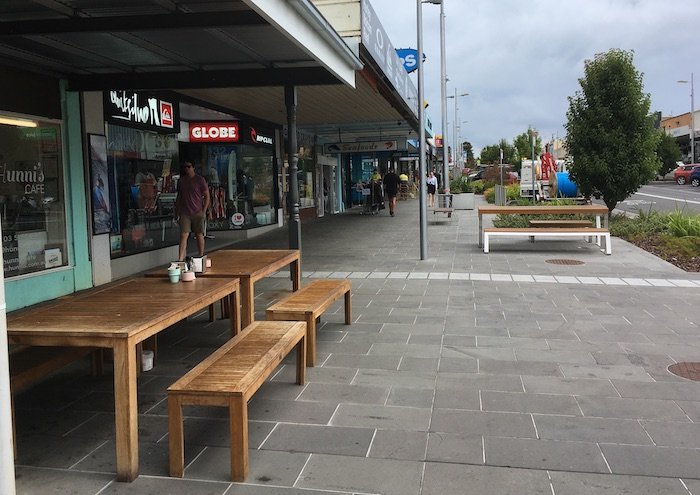
There was no doubt that Warrnambool’s grotty, rundown old Liebig St needed a serious makeover, but is the $18 million upgrade being stuffed up by a lack of free parking?
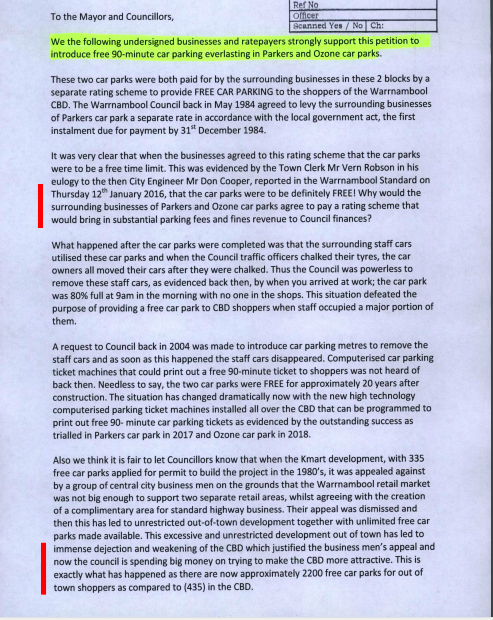
Almost 3000 people who physically signed a petition for the return of central, 90-minute free parking say it is.
The 2833 signature petition – no small number – was tabled at the Warrnambool City Council meeting last Monday but barely raised a mention because of the much bigger news story that night – racehorse training on Levy’s beach.
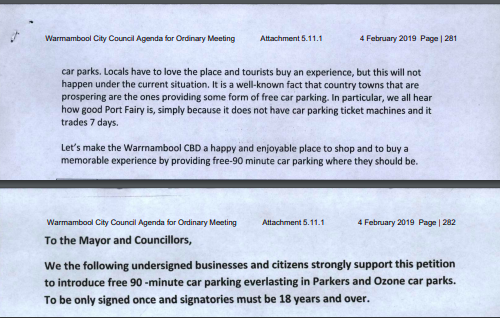
The petition is pushing for permanent, 90-minute free parking in Parker’s Carpark (behind the Commonwealth Bank) and the Ozone carpark (behind the new post office) and was gathered by long-term CBD trader Max Taylor, from Taylor’s clothing and surf store, which has been trading in Liebig St for decades.
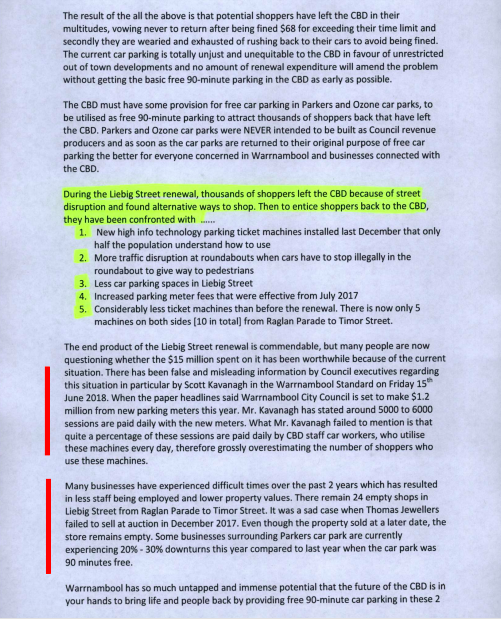
Max pulls no punches in the three page-document (see images at end of story) he added to the petition.
“Potential shoppers have left the CBD in their multitudes”, he says, because of damaging combination of expensive parking, confusing meters and lack of meters (only 10 in the whole street) that leave people worried they will be fined $68 for overstaying.
Some traders around Parker’s carpark, he says, have experienced a 20-30% loss in trade compared to when the 90-minute free carparking was in place during the street works.
And there are still 24 empty shops between Raglan Parade and Timor St (we won’t go into how many others sit empty along Lava and Timor).
Max also accuses the council Director City Infrastructure, Scott Cavanagh, of making misleading claims to the local newspaper about the number of shoppers parking in the CBD. The 5000-6000 people who parked every day included a lot of city workers, Max claims, thereby “grossly overestimating the number of shoppers”.
He also points out that local traders around the Parker and Ozone carparks paid a special levied back in 1984 to build the new FREE off-street carparks in Parker Arcade and the Ozone. Meters were added in 2004.
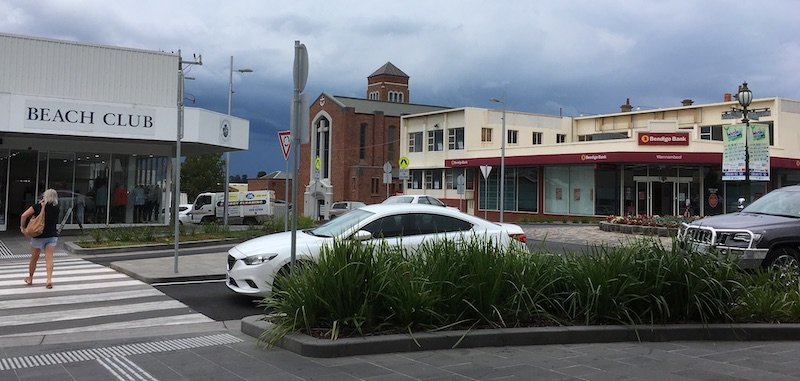
Stormy weather: navigating the roundabouts in Liebig St can mean a lot of stopping and starting.
A lot has changed since 2004. Online shopping arrived. More shopping centres have been built on the fringe of Warrnambool, offering more than 2000 free car parking spaces.
And then there are the new, pedestrian friendly crossings in and around Liebig St which are so pedestrian friendly that drivers potentially have to brake before they get to the roundabout, in the roundabout, and leaving the roundabout.
My personal favourite is driving from Liebig St down Lava St, past the Centrelink, where you give way to pedestrians coming into and leaving the roundabout, then cross an ugly road hump, give way to buses leaving the bus zone and roll up to another pedestrian crossing – all within 50 metres.
I am all for slower traffic, but that really is ridiculous…and messy.
Maybe we just need more time to get used to it. Maybe we can all download the app and pay for parking that way.
Or maybe, as Max fears, people will avoid Liebig St unless it is absolutely necessary and shop somewhere else. For our long-suffering, high rent paying traders, that would be the worst scenario.
It is worth mentioning, as Max does, Port Fairy has no parking meters and seven-day trading. The little town won yet another award for being the most popular among tourists.
They just might be on to something over there.
Max’s petition, as per standard council procedure, sits on the table for 30 days and will be discussed at the next council meeting.
If you would like to see The Terrier keep digging up, sniffing out and chewing on local issues, please make a small contribution below.
Weir scandal offers WCC a chance to ditch Levy’s plan
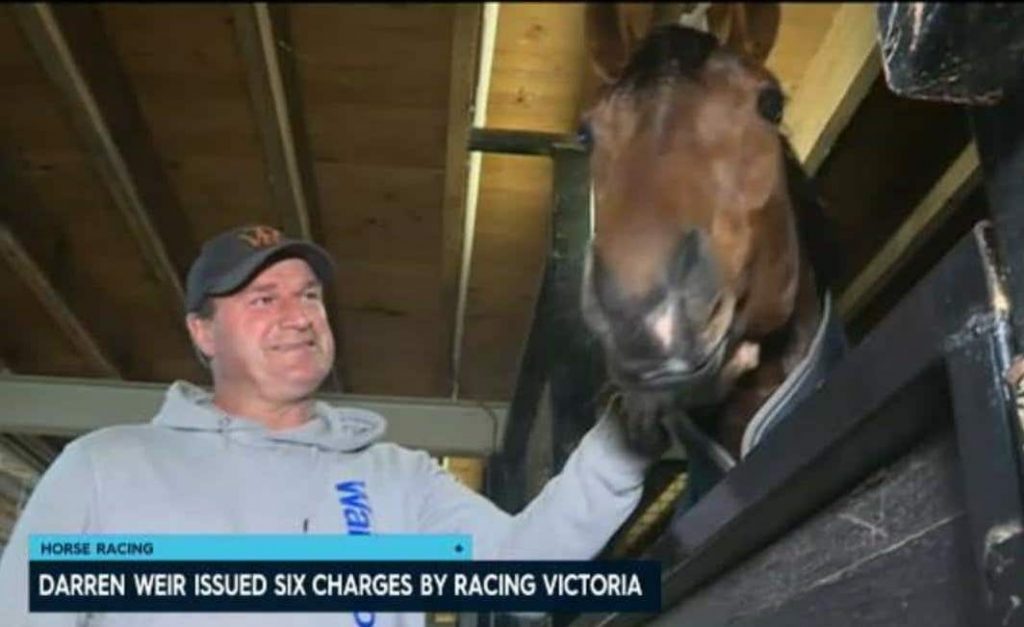
Melbourne Cup winner and racing king pin Darren Weir is facing multiple charges which should prove a game changer for the racehorse training at Levy’s plan. Image: Fox News
Carol Altmann – The Terrier
The Weir-McLean scandal gives the Warrnambool City Council the perfect “out” from the disastrous plan to allow 160 racehorses a day at Levy’s Beach.
As it happens, the council will meet tomorrow night (4/2) to give its consent to another part in the approval process.
This time it must give assurances to the Environment Minister, via a letter to the Warrnambool Racing Club, that the horse training is “consistent” with all coastal and marine management plans and policies for the Levy’s area.
This could be awkward, because as far as I know, nobody has yet produced any evidence to say that it is “consistent”. In fact it appears to be the complete opposite.
This fact is just one more inconvenient truth in a whole string of inconvenient truths which the council has had to overlook and tie itself in knots about.
The entire mess has all come about because of political pressure from the Victoria Racing Club, the Warrnambool Racing Club and Racing Minister Martin Pakula to primarily accommodate the once-powerful Mr Weir, but – like Mr Weir’s career – it could end tomorrow.
The council can stop the charades, dust itself off and start healing an increasingly diverse community that was co-existing quite nicely until it was torn apart by totally unnecessary greed.
Here are 10 more reasons why it should do so:
1. Darren Weir has been winning despite not having access to Levy’s beach since late 2016. (He won more than $31m in 2017-18 alone).
2. Jarrod McLean has been winning despite not having access to Levy’s beach since 2016. (He won the $2 m Mackinnon Stakes last November.)
3. Their claims that access to Levy’s and the dunes gave them an “edge” look doubtful in light of the allegations they are now facing, including the use of electric shocks as part of training.
4. Weir had 77 horses training in W’bool in 2016. He now has more than 100, despite not having had access to Levy’s beach since 2016.
5. All trainers can still apply for access to run and swim their horses at Lady Bay beach from March right through to December. Swimming is all year round.
6. Former MP and racing supporter James Purcell, whose son is a trainer, said in 2017 that no beach dunes should be used for training, anywhere in the reserve.
7. There is no environmental impact study and no “baseline” study of what it looks like now.
8. There is no economic impact statement, showing how the move will increase jobs or the local economy above what racing already provides.
9. Local indigenous people are devastated by the move and senior elders – including 2018 Victorian Senior of the Year Rob Lowe – are fighting to save the reserve.
10. Millions have been spent building a sand track and other facilities at the Warrnambool racecourse.
So much has been written about this ill-advised plan. So many arguments have been raised. And now the racing industry itself is dealing with a scandal of unprecedented proportions.
Surely, surely, tomorrow night offers a chance for this plan to ride off into the sunset and we can then direct our energies into building a sustainable environment and a sustainable, ethical, local racing industry – based on truths and substance.
If you would like to see The Terrier keep digging up, sniffing out and chewing on local issues, please make a small contribution below.
The chequered past of Darren Weir and Jarrod McLean
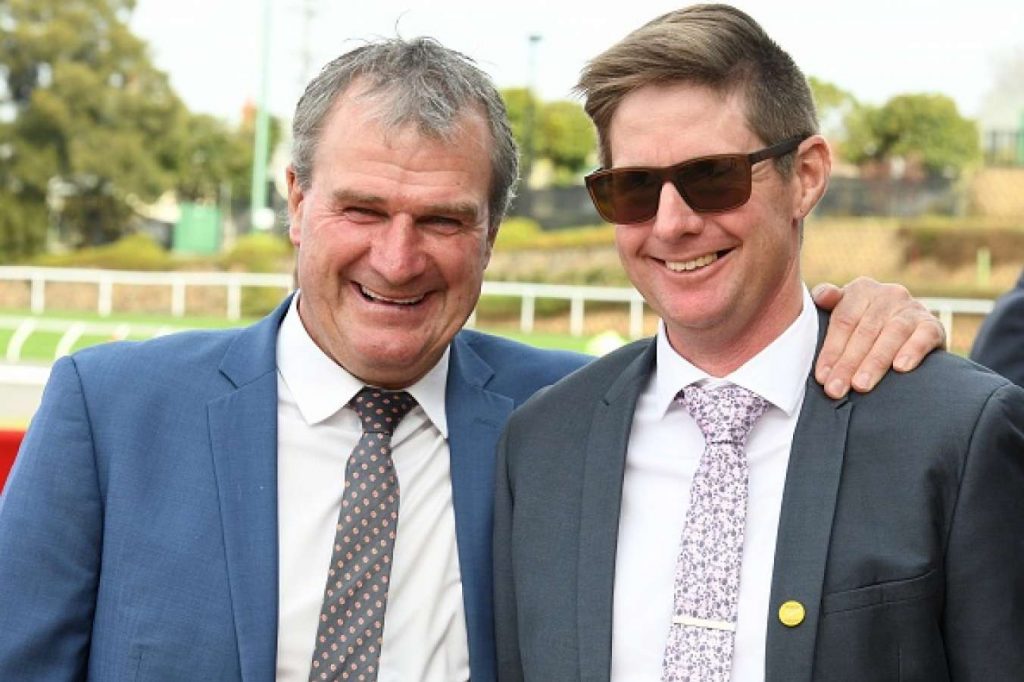
Leading trainer Darren Weir and his Warrnambool stable foreman, Jarrod McLean, who is also a trainer. Image: www.punters.com.au
Carol Altmann – The Terrier
This morning’s (Wed 30/1) raids and arrests at the Warrnambool and Ballarat stables of racehorse trainer Darren Weir are yet another dramatic chapter in what has been a career studded with illegal activity by Mr Weir and his Warrnambool foreman, Jarrod McLean, who is also a trainer.
It is important to note that, at the time of writing, no charges have yet been laid against the three men still being questioned, including Mr Weir, and an unnamed 38-year-old man from Yangery, and a 26-year-old from Warrnambool.
Police, however, are investigating all three in relation to “sporting integrity matters including obtain financial advantage by deception, engaging in conduct that corrupts or would corrupt a betting outcome of event or event contingency, use of corrupt conduct information for betting purposes, and attempt to commit indictable offence namely obtain financial advantage by deception.
“A number of items including a firearm and what is believed to be a conducted energy device were also seized from the properties,” the police statement says.
Deception, corruption and animal welfare abuses: this is serious stuff.
The arrests come just two days after Mr McLean ended a six-week suspension for lying to racing officials about where his horse, Trap for Fools, had been stabled the night before a race at Caulfield on October 20 last year.
Now Mr Weir and Mr McLean are again in the spotlight – for all the wrong reasons.
As one journalist close to the action said to me late last year, racing stewards have been watching Mr Weir and Mr McLean like hawks.
This close attention has been driven by two factors: phenomenal success and a history of previous, illegal, activities as defined under racing rules.
Here is the list so far:
Mr Weir:
Sept 2018: Fined $5000 after providing false “jump out” information about seven horses. “Jump outs” are trials that can lead to a horse being given a permit to start in a listed race.
Sept 2017: Pleaded guilty after Air Guitar, a three-year-old colt, tests positive for phenylbutazone and oxyphenbutazone (non-steroidal anti-inflammatories) after a swab at the Burrumbeet racecourse where the horse was running in a ‘jump out’ for the purpose of gaining a permit to start. The guilty plea set the maximum fine at $5000. Fined $2500.
March 2016: Stripped of race win, but not charged, after his horse, Signoff, tested positive to anti-inflammatory drug ibuprofen after the Lord Stakes at Caulfield on Boxing Day 2015.
May 2013:Fined $7000 after a diuretic was found in Doing Our Best at the Ballarat races in February 2013.
Nov 2013: Fined $2000 after claiming his horse, Platelet, was stabled at Ballarat instead of Warrnambool before the $1 million VRC Sprint Classic. The horse was scratched from the race.
April 2011: Fined $500 for using abusive language against a female trackwork supervisor at Ballarat racecourse.
Nov 2009:Fined $1500 stewards found his horse Lethal Gal had been taken to another stable prior to racing at Ballarat. The horse was also scratched.
Feb 2008: Fined $15,000 after pleading guilty to charges arising from his horse, Grey Jeune, recording an elevated TCO2 level at the Murtoa races.
May 2006: Major inquiry into the scratching of 4/1 favourite Glebe Run from the Warrnambool May Race Carnival after tubing equipment was found on Mr McLean’s property where the horse, among others owned by Mr Weir, had been stabled before the race meeting. After Mr McLean changed his evidence to the inquiry, Mr Weir was not charged, but officials castigated Mr Weir for not telling the truth and being part of a “ridiculous and half-baked plan”. Mr McLean was fined $7500 (see below). The scratching cost Mr Weir the chance of winning a new Mercedes for having four winners at the May Carnival. He won the car in
Sept 2003:Suspended for three months after “tubing” maiden galloper, Kinther King, on the way to the Murtoa races. Tubing involves giving a horse a dose of bicarb soda via a long tube through the mouth, into the stomach. In the industry it is called also called a “milkshake”.
Sept 2002: Fined $1000 at the Manangatang races for having equipment in his possession that could be used for tubing.
January 2001:Suspended for eight weeks after giving false evidence to an inquiry into the scratching of his horse, Amanda Huggenkiss, at Warrnamabool in January 2001. A racetrack detective saw Mr Weir remove the horse from the stalls 90 minutes before its race and take it into his float, emerging 13 minutes later. Mr Weir was also fined $1000 for having a needle in his possession and removing the horse from the saddling paddock.
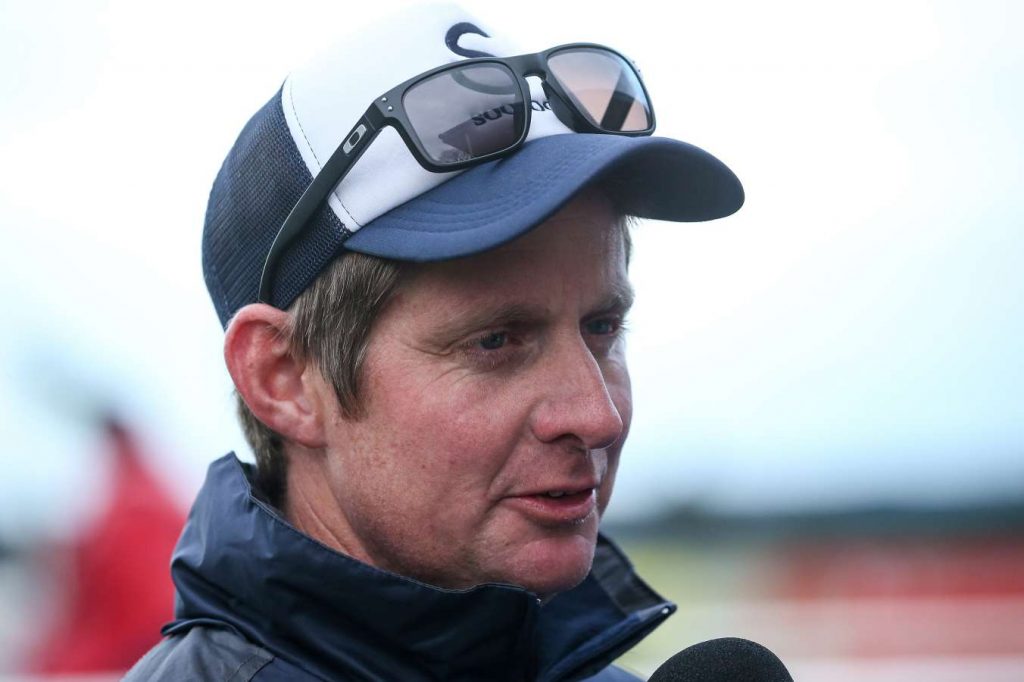
Yangary trainer Jarrod McLean, who is Mr Weir’s stable foreman in Warrnambool, had just come off a six-week suspension before the raid. Image: www.punters.com.au
Mr McLean:
Dec 2018:suspended for six weeks for lying to officials about the stabling of Trap for Fools.
Sept 2017: fined a total of $13,000 after pleading guilty to three charges of illegal medical treatments for his horse, Wee Frankie, involving corticosteroid injections before a race in Sandown and also in Warrnambool, and for failing to record the treatments.
Dec 2013: banned for six months after his horse, Prymslea, was found to have an elevated carbon dioxide (TCO2) level when competing at Mildura. He pleaded guilty, but could not give an explanation. Also fined $2000 for failing to keep records for a year of any treatments administered to horses under his care.
A steward visited the stables on race day and noticed blood in the nostril of Prymslea, which lead officials to conclude the horse had been given a large dose of bicarbonate soda probably by stomach tubing via the nose that morning.
“It is the inevitable conclusion that this was done by Mr McLean for the purposes of enhancing the horse’s performance in the race later that day,” the officials said.
The judge presiding over the hearing described the incident as: “A serious and highly culpable example of substance administration by someone with a relevant prior conviction.”
March 2010: pleaded guilty and fined $1000 after his horse, Taste Test, tested positive for phenylbutazone and oxyphenbutazone at Colac on 21 December 2009.
July 2008:fined $8000 and given a suspended sentence (28-day licence ban) after his horse, Jerrymac, had an elevated TCO2 level from a sample taken prior to a race in Warrnambool.
May 2006: fined $7500 on two charges of giving false evidence to the long-running inquiry into the scratching of Mr Weir’s horse, 4/1 favourite Glebe Run, from the Warrnambool May Race Carnival after tubing equipment was found on Mr McLean’s property. The horse, among others owned by Mr Weir that were running, had been stabled at the Yangary property before the race.
As to whether these lists are added to with even more serious offences remains to be seen. The Victorian Crimes Act was recently altered to include racing-related activities, resulting in much heavier penalties, including jail terms.
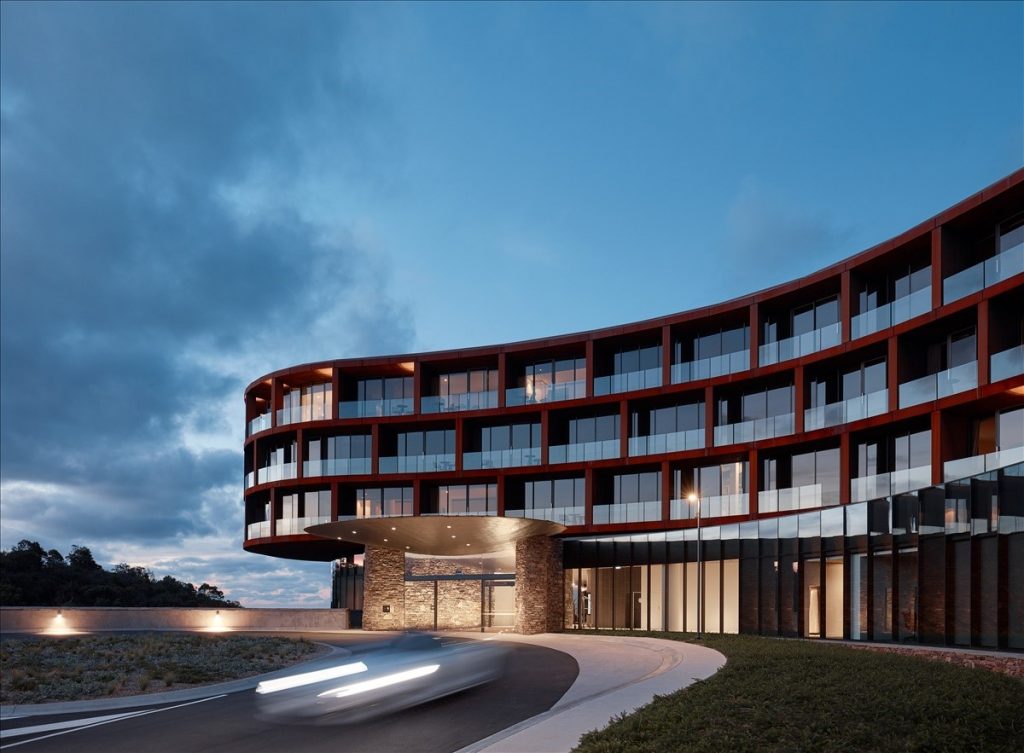
The RACV Cape Schanck resort which hosted the Victorian Tourism Industry Conference last July. Image: RACV/Business Events Mornington Peninsula.
Carol Altmann – The Terrier
The Warrnambool City Council is claiming its budget is tight, yet it spent more than $10,000 to send seven people – including the CEO of the Warrnambool Racing Club – to a tourism conference at a Mornington Peninsula resort last July.
The council has put the total bill for the conference at $9034, including $3934 in accommodation and $4830 in conference fees and only $270 in food.
I have received reliable information, however, that the final cost also included more than $1000 in drinks in the resort’s Lighthouse Lounge and more than $400 on meals and drinks in its cafe.
A council spokesman said “any food /drinks beyond (the $270) would have been settled by the individual(s) themselves as a personal expense”. Perhaps the big drinks bill was repaid, but I have not seen any evidence of that.
Those who attended the conference included now-mayor Tony Herbert, who is chair of the council’s Visitor Economy Advisory Committee, fellow committee member Cr David Owen (both funded their share through their councillor allowance), the council’s head of Visitor Economy, David McMahon, and three other council staff from Visitor Economy.
The final delegate was racing chief Mr Downs, who nominated and was chosen to join the council’s Visitor Economy Advisory Committee when it started in May 2017.
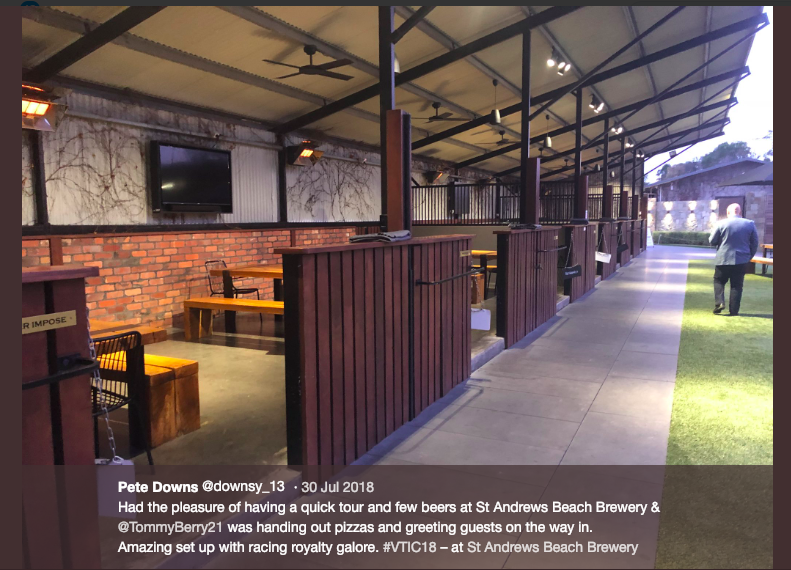
The conference, by the way, included sunset drinks at the St Andrews Beach boutique brewery which has been converted from first class racing stables and was worthy of a tweet from Mr Downs (see below).
There are two things about this story that don’t sit right.
First, as we know, the council is surveying ratepayers right now as part of a process to try and lift rates above the 2.5% cap.
The council is saying that it must save at least $700,000 a year for the next three years and the only two options we have been given are to either cut services, or raise rates.
Given this, what a double-standard – or perhaps a better word is insult – for the council to have sent seven people off to Cape Schanck to learn the latest in tourism trends, funded by an obviously healthy professional development budget.
The issue here is not only the money, but the mindset: while ratepayers have to expect cuts to services like childcare, council networking opportunities can roll on as normal.
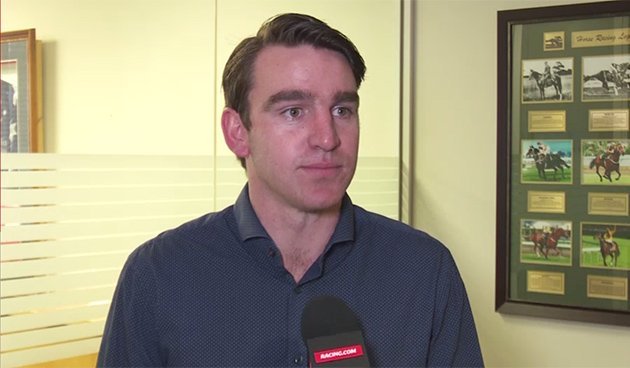
Warrnambool Racing Club CEO Peter Downs was among seven Warrnambool City Council delegates at the tourism conference last July. Image: Racing.com
The second unsettling aspect of this story is the inclusion of Mr Downs.
It is no secret that Mr Downs’, as CEO of the WRC, has been a major player in pushing for commercial racehorse training at Levy’s Beach, in the Belfast Coastal Reserve, and lobbying to make sure this happened.
In fact when Mr Downs was chosen for the council committee in 2017, it was just eight months after racehorse training was banned at Levy’s because of concerns raised by Aboriginal Victoria and the push by the WRC to get racehorses back on the beach was in full swing.
This council doesn’t seem overly fussed by potential conflicts of interest around the racehorse training issue, but I would have thought the decision to appoint Mr Downs’ to the visitor economy committee in the first place – given the political context – was questionable.
The issue here is not that Mr Downs has done anything wrong – he is only taking what is offered – but that the council considers all of it acceptable.
On any measure, Mr Downs has been given the sort of out-of-hours access to key members within council that others could only dream of, if they were lobbying in the same manner.
In this case, it has even paid the bill.
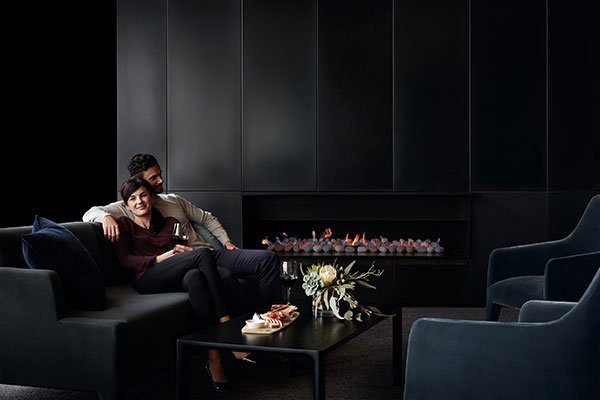
A promotional shot of the Cape Schanck Lighthouse Lounge where the WCC delegates spent more than $1000 on drinks across two days. Image: RACV.
According to a lengthy council statement in response to my questions, Mr Downs was chosen for the conference after the council asked for “expressions of interest” from all six community members of its visitor economy committee and only Mr Downs responded.
The statement also says it is appropriate that Mr Downs is on the council committee, because the WRC is a significant player in the local economy and tourism.
Further, the council says, nothing about racehorse training or the Belfast Coastal Reserve Management Plan has been raised in the committee meetings. Nothing at all? Really? What about before the meetings, or after?
By coincidence, the final Belfast Coastal Reserve Management Plan, which said racehorse training should resume, came out during the tourism conference.
Was this hot potato raised during drinks at St Andrews brewery or over dinner at Cape Schanck? We don’t know.
We do know, however, that Cr Tony Herbert – within three days of becoming Mayor on October 29 last year – placed sorting out the racehorse training issue at the very top of his to-do list.
In a nutshell it justifies the conference by saying the council values professional development opportunities, that the funds came out of a professional development budget and that there were several important outcomes, including: a follow-up meeting by VTIC in Warrnambool, a range of new marketing tactics, valuable networking and contacts, and passing on “key learnings” to other staff and councillors.
Worth every cent? I will leave you to decide.
(Mr Downs was contacted for comment last week on this piece. He is yet to respond.)
If you would like to see The Terrier keep digging up, sniffing out and chewing on local issues, please make a small contribution below.
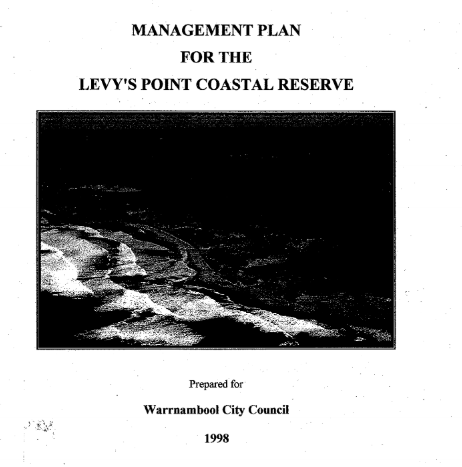
Here is yet another plan for Levy’s Point that was started, never really finished, and then forgotten.
Warrnambool Mayor Tony Herbert recently claimed that the Belfast Coastal Management Plan was the first plan for the area in 150 years.
This is not true.
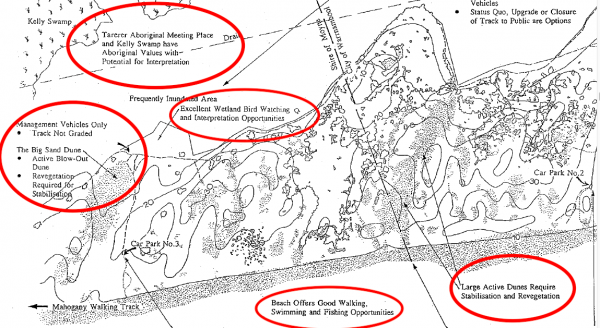
There have been several plans, including this one commissioned by the Warrnambool City Council back in 1998.
Nowhere does it mention using the area for large-scale racehorse training.
In fact it doesn’t mention racehorses at all, only recreational horse riding and a small horse riding ring.
It also mentions the potential for illegal four wheel driving and motorbike riding to worsen, due to numerous management tracks leading into the dunes.
Some of these dunes, the plan says, had already blown out, and other “large, active dunes” needed “stabilisation and revegetation”.
These “large, active” dunes are in the very area where commercial racehorse training will now be permitted – having been illegal – and up to 40 racehorses a day, five days a week, will be allowed to pound up and down what is called “Hoon Hill”.
How this fits into any plan for “stabilisation and revegetation” is beyond me.
Just the fact that – 20 years on – authorities now refer to this area as “Hoon Hill” says it all really.
Those in charge of looking after Levy’s Point gave up on the place.
The illegal four wheel driving and motorbike riding was not stopped, so it worsened, until it got to the point where some dunes were so damaged that they are now considered suitable only for large-scale racehorse training, which, of course, will ruin them even further.
For any councillor to claim that they did not know the history of this area and the extent of the damage done is ludicrous, unless, like the current President of the United States, they don’t read, don’t research or don’t want to know.
This 1998 plan follows the government’s Land Conservation Council plan of 1978, and pre-dates the council’s Coastal Management Plan of 2013.
They all say the same thing: the need for conservation, restoration, protection, promoting low-impact activities and eco-tourism, controlling four-wheel-drive access, and not repeating the mistakes of earlier times when sand mining and rendering plants were considered okay.
And yet here we are, not only about to repeat a mistake, but doing so with our eyes wide open.