Animal faeces among EPA concerns for Wannon Water plant
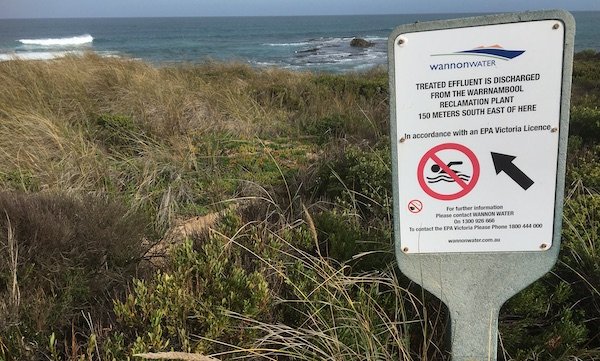
A decision on the Wannon Water treatment plant expansion has been delayed further while the EPA seeks more information on what will end up in the ocean near Thunder Point.

Carol Altmann – The Terrier

If you’re wondering what’s happening with Wannon Water’s $40 million Warrnambool treatment plant upgrade, here it is – a decision has been delayed amid concerns that waste collected from the abattoirs and saleyards contains animal faeces that could cause disease.

Charming, huh?

The Environmental Protection Authority (EPA) was due to make a decision on the controversial plant expansion by 12 March, but is now asking Wannon Water for more information.

According to the EPA notice issued on 26 February, Wannon Water denied that effluent collected from the abattoir would contain animal faeces, but the EPA was on to it:

“In contrast with what was claimed in the (Wannon Water) report, it is also to be noted that abattoir effluents do contain slurries and animal faeces”, the notice says.

The EPA sent Wannon Water back to the drawing board for a “deeper assessment of the pathogens that may be present in the wastewater” which – remember – will continue to be discharged into the ocean off Thunder Point.

This is a spot where, despite the warnings, people still fish and dive and collect shellfish, as you do, when at a beach.

The EPA is rightly worried about humans coming into contact with animal waste.

“Specifically, we believe that the report (from Wannon Water) does not consider the pathogens most likely to be present in the trade wastewater from the saleyards and the abattoirs.

“Rather than having a dilution effect, these wastewaters will add protozoa and bacterial pathogens.”

Pathogens = disease causing microbes.

Lovely.

Wannon Water no longer tests for micro-organisms such as E.coli, coliforms and enterococci within the so-called “mixing zone” off Thunder Point. As such, its planning submission quotes figures from 2018 and 2015 to estimate what levels can be expected after the upgrade.

Wannon Water must now re-evaluate these risks and, the EPA says, take into “proper account the risks posed by animal wastes” including from different types of animals.

Animal waste, however, is just one issue raised by the EPA in what is called a Section 22 notice.

The EPA has also asked Wannon Water to explain how adding an extra two processing tanks – from four to six – will cope with an almost doubling of the amount of effluent coming into the plant to 27.9 megalitres a day when it barely copes already.

As the EPA confirms and as has been captured on video by Good Will Nurdle Hunting, the plant “has failed multiple times”.

“Currently the plant is hardly rated at 16.4 megalitres a day as the plant has failed multiple times (dirty decants, failed nutrients discharge limits),” the notice says.

The EPA wants to know how much waste the expanded plant could reliably handle, and how it will cope if a tank breaks down, or is offline for repair, or – heaven forbid – both.

In that last, worse-case scenario, four tanks – the same as now – will be handling almost double the volume of sewage and trade waste.

No wonder the EPA is drilling into that detail.

In addition, the EPA wants more information on how much phosphorous and nitrogen will be coming in from (mostly) the dairy industry each year, and discharged into the ocean, and how these annual loads will be measured.

Lastly, the EPA has asked for a concise summary of exactly what Wannon Water has planned for the upgrade, given the many changes, public comments and back-and-forths that have happened since the project was first unveiled in 2017.

If the EPA is confused with the final proposal, no wonder the rest of us are.

I am, however, grateful to the EPA for making sure that Wannon Water nails all of this detail, as this upgrade is intended to last for the next 20 years.

Wannon Water had until 1 March to respond to the EPA notice but has not yet done so.

You can read all of the documentation on this upgrade and keep track of its progress through the EPA here.




Bruising Supreme Court battle will leave lasting scars on city

After three days of hearings in the Supreme Court, the fate of former W’bool City Council chief Peter Schneider comes down to three options. Image: Forbes.com

Carol Altmann – The Terrier

After a three-day hearing in the Victorian Supreme Court, the fate of sacked Warrnambool City Council CEO Peter Schneider now comes down to three options:

First, he loses his case.

Second, he wins his case and accepts an untold amount of damages that are yet to be decided.

Third, Mr Schneider wins his case, his termination is quashed, and the new WCC councillors are left to decide whether they would like to keep him or replace him.

Any move by the new council to sack Mr Schneider would require a fresh motion and – no doubt – the opportunity for him to defend his record: an opportunity which his lawyers say he was denied on 13 July last year when the axe fell by way of a 4/3 vote. (Mr Schneider’s contract was due to expire in Feb 2023.)

The presiding judge Justice Michael McDonald says he hopes to hand down his judgment by 28 June and my word, it can’t come soon enough.

Because regardless of the outcome, this bruising court battle has done our city no favours.

By the time this is settled, our city will have been left sitting in grid lock for almost a year, unable to move ahead with a permanent leader.

Just as bruising is the spotlight on the tribalism within the old council.

By way of the written affidavits and evidence lodged with the court, the factionalism, infighting and petty nastiness within the previous council has been put on display outside of the Liebig St bubble.

We might have become used to it as part of our Stockholm Syndrome (since cured), but those exposed to it for the first time must have been astonished.

It’s perhaps not surprising that Justice McDonald dismissed most of the “he-said, she-said” evidence with one swipe on day one of the hearing on Tuesday, saying he wasn’t interested – “for heaven’s sake” – in the inner workings of the WCC.

He was attuned, however, to the implications of allowing a senior public official to be “caught in the cross-fire of factional warfare between councillors”.

As Justice McDonald said with punch yesterday, any CEO caught in this crossfire could be “figuratively get taken out the back and shot”.

He repeated this theme today, saying there were specific laws to protect a public official, like a council CEO, from “the capricious and whimsical actions” of others.

“Because of the close contact between a CEO and a council, this is the very example of (an officer) needing that protection.”

As I wrote last night, the case hinges on whether Mr Schneider’s individual contract and its “no reason” clause holds more sway than section 94 (c) of the Local Government Act, which, by law, says all council workers must be treated fairly.

As Justice McDonald outlined yesterday, it is a case with potential implications for every council CEO across Victoria.

In fact we learned in the final day of the hearing today that this is the first time in 28 years that the Local Government Act (1993) has been challenged in this way.

No other council in Victoria – in recent history at least – has had a legal battle between a sacked CEO and a council make its way to the Supreme Court.

So Warrnambool will make history and Schneider v Warrnambool City Council will probably find its way into the text books of the next generation of civil lawyers.

But no doubt ratepayers, who one way or the other are paying for this battle and the fallout, would prefer this chapter had never been written.


Court case may set brutal precedent for all council CEOs

A legal challenge by sacked Warrnambool City Council chief Peter Schneider could have implications for councils around Victoria. Image: ABC

Carol Altmann – The Terrier

If you think the Supreme Court battle between the Warrnambool City Council and dumped CEO Peter Schneider is just a local bunfight, think again.

The potential implications of this case for council’s right across Victoria was made clear by the presiding judge today.

The Honourable Justice Michael McDonald said if Mr Schneider loses his legal fight on the grounds argued by the WCC, every council CEO across Victoria was at risk of “figuratively (being) taken out the back and shot”.

If you are successful, then any local government within Victoria would then have the power to terminate a contract for no reason at all,” Justice McDonald told counsel for the WCC, Ragu Appudurai.

Justice McDonald said, “looking at the very broad, non-legalistic picture”, the outcome of this case had wide-reaching implications for councils far beyond Warrnambool.

One is the “no reason” clause – like that used to dismiss Mr Schneider – left all council CEOs vulnerable to tribalism of councillors.

“A CEO could be caught in the cross-fire of factional warfare between councillors and figuratively get taken out the back and shot,” Justice McDonald said.

Justice McDonald said the CEO position was “an extremely important position” and if the WCC was found to be able to sack Mr Schneider without reason or fairness, the impact on good governance would be devastating.

“That would be an extraordinary outcome and extraordinarily destructive for good governance,” he said.

“(It would be) quite an extraordinary outcome …a council can simply employ someone on a contract which permits the council to (dismiss them) for no reason at all.”

The nub of the case is whether Mr Schneider’s individual contract holds more sway than section 94 (c) of the Local Government Act, which guarantees all council workers will be treated fairly.

Mr Appudurai today spent several hours outlining the council’s argument that Mr Schneider is not a regular council employee, but a senior employee on a specific contract.

As such, the council could sack him using the “no reason” clause in this contract and had no obligation to treat him “fairly”.

This lack of fairness included the four ex-councillors not giving Mr Schneider a chance to defend himself on the night of his sacking.

Lawyers for Mr Schneider, however, argue that no individual contract can over-ride the Act, which is the law.

They say that Mr Schneider was sacked unlawfully and so is – technically – still the CEO of the Warrnambool City Council.

This is part of what Justice McDonald will have to determine in his judgment that he hopes to hand down by 28 June.

In the meantime, an interesting question raised by the Justice today was, if Mr Schneider wins his case, what happens to the $200,000 payout he received last year?

Would it need to be repaid?

Not according to Mr Schneider’s lawyer David Grace QC, who argued that because Mr Schneider was sacked illegally, this money (after tax) was the wages he would be entitled to keep from the day he was sacked to the day he is reinstated.

In other words, Mr Schneider is still – technically – the CEO.

The WCC, however, saw this payout as “the price it had to pay” to sack Mr Schneider without reason.

To quote Justice McDonald: “there are plenty of curly questions being thrown up by this case”.

That might be the understatement of the year.

Final submissions will be heard in the Supreme Court tomorrow.


Supreme Court hearing opens into WCC chief’s sacking

Former W’bool City Council CEO Peter Schneider is now challenging his sacking.

Carol Altmann – The Terrier

Lawyers for sacked Warrnambool City Council CEO Peter Schneider today argued in the Supreme Court that he was a victim of “subterfuge” and a “concerted plan” by four former councillors to get rid of him.

Today (23/3) was the opening of a two-day hearing into whether Mr Schneider was denied natural justice when he was sacked on 13 July last year on a 4/3 vote of the then-councillors.

The day started with a surprise move from the council’s lawyer, Ragu Appadurari (Russell Kennedy lawyers), suggesting witnesses could be called to give evidence and cross-examined, rather than the court relying solely on written affidavits already lodged.

This move would have potentially blown out the length of the hearing and delayed the delivery of a judgment until the end of the year: making it impossible for the WCC to appoint a CEO until late 2021.

The Honourable Justice Michael McDonald said, if witnesses were called, he could no longer aim to meet a 26 June deadline that he set after last week’s injunction hearing.

Perhaps not surprisingly, this move to call witnesses was dropped by the WCC after a short adjournment.

The rest of the day was spent by Mr Schneider’s counsel, David Grace QC, outlining the key points of his case, including the seeking of legal advice by then Councillors Kylie Gaston, Michael Neoh, David Owen and Sue Cassidy.

Mr Grace argued this legal advice from Maddocks lawyers was not approved by the full council, was not shared with the other three councillors and was used to map out “the easiest way” to get rid of Mr Schneider with less risk of court action, or public outrage.

That “easiest way” outlined by Maddocks was to sack Mr Schneider using the “no reason” clause in his contract, rather than sack him for poor performance, Mr Grace said.

The case hinges on whether this “no reason” clause holds more weight than the protections of the Local Government Act.

The court also heard that former Mayor Tony Herbert, having learned of the move to sack Mr Schneider on 13 July, prepared 31 questions to ask at the meeting.

These questions included whether the councillors would give Mr Schneider a chance to defend himself.

The four councillors, however, “stayed mute” to all 31 questions, having received legal advice not to respond.

If they did respond, they would then have to justify the “causes” for sacking the CEO, Mr Grace said.

Justice McDonald earlier in the day indicated he had had some taste of the dysfunctional relationships within the former WCC from the affidavits lodged by the four councillors, Mr Herbert, the acting CEO and Mr Schneider.

“I will not be having any regard to any of the material about so-and-so had an unprofessional relationship with so-and-so…for heaven’s sake,” Justice McDonald said.

“I don’t have any enthusiasm at all for hearing evidence on the inner workings of the WCC…(and) it is of no legal bearing on the legal questions which will determine the case.”

The hearing continues tomorrow with Mr Grace, followed by Mr Appadurari for the defence.


WCC poised to close door on racehorse training in wild coast

The Belfast Coastal Reserve area covering Levy’s Beach and Spooky’s is finally gaining the attention it deserves as a place of wild beauty and indigenous significance. Image: Supplied.

Carol Altmann – The Terrier

UPDATED: All seven of the new Warrnambool City councillors are poised to step up and ban racehorse training on beaches west of Thunder Point.

[I have updated this story to include Cr Max Taylor, who has replied tonight.]

With the recent release of the council’s draft Wild Coast Landscape Management plan, they are in the box seat to do it.

And based on answers to questions I sent to all seven councillors last week, they are ready to put this long-running and ugly fight to an end.

If they don’t, the WCC might as well set up a vegetarian burger bar outside 25 Liebig St and sell steak sandwiches, such would be the hypocrisy in a management plan that is packed – at long last – with ways to protect the wild coast from Levy’s Beach to Spooky’s Beach from further harm.

For some reason the Warrnambool Racing Club – apparently in defiance of the changed mood of many local trainers – can’t seem to let Levy’s and Spooky’s go.

This is despite the demise of king-pin trainer Darren Weir, sustained community anger, no racehorse training on the beach for more than four years, a loss of social licence, and the absolute privilege of training at Lady Bay.

Despite all of this, the WRC, according to a recent media report, just keeps picking the scab.

The WRC keeps waving a red rag….it might still come back in and use Spooky’s beach….maybe it will, maybe it won’t.

For this, we can thank the majority of former councillors who ignored the wishes of the wider community, agreed to the law change, split the place open, and left behind another shit show for the new council to clean up.

Given we now have fresh eyes on this old headache, last week I asked our new councillors two simple questions: the first was whether they supported commercial racehorse training in the wild coast area.

Six of those who responded said no, they did not, or as Mayor Vicki Jellie put it, “absolutely not”.

(Cr Taylor responded after the deadline but tonight said he was opposed).

Cr Angie Paspaliaris said she was a WRC member, sponsor, and a race goer, but she, too, was “hesitant” to support racehorse training in the area, given the strong community opposition.

Seven out of seven, even including a “hesitant”, is a whopping turnaround.

I also asked the councillors a second question, which was whether they would support an amendment to change the planning rules to once again ban racehorse training in this area.

Four of the six who responded said a firm yes, they would.

Mayor Jellie went further, saying not only did she support changing the planning rules, she was asking WCC staff how it could be done.

Cr Paspaliaris said she would consider it, and Cr Blain said he thought the council saying no to racehorse training would be enough.

[You can read the councillors’ answers in full here.]

All of this is a big vote of support not only for the community’s wishes, but for the draft management plan.

This draft plan really gets it.

It sets out plans for CCTV cameras to catch hoons, for unofficial tracks to be closed off, for ravaged areas to be revegetated, for the indigenous community to be intimately involved in future decision making and management, for better dog walking controls, and for the wildness of this area to be preserved for future generations who, like us, will wonder how motorbike rallies were ever allowed at Tower Hill.

Yet tucked in the middle of this plan is the steak sandwich – the racehorse training that would allow up to 100 racehorses a day.

The experts who put this management plan together are powerless to change the law, but our new councillors can.

That time is now.

[You can read more about the wild coast plan and have a say until 30 March here.]