Roma Britnell: law reform needed to better protect women
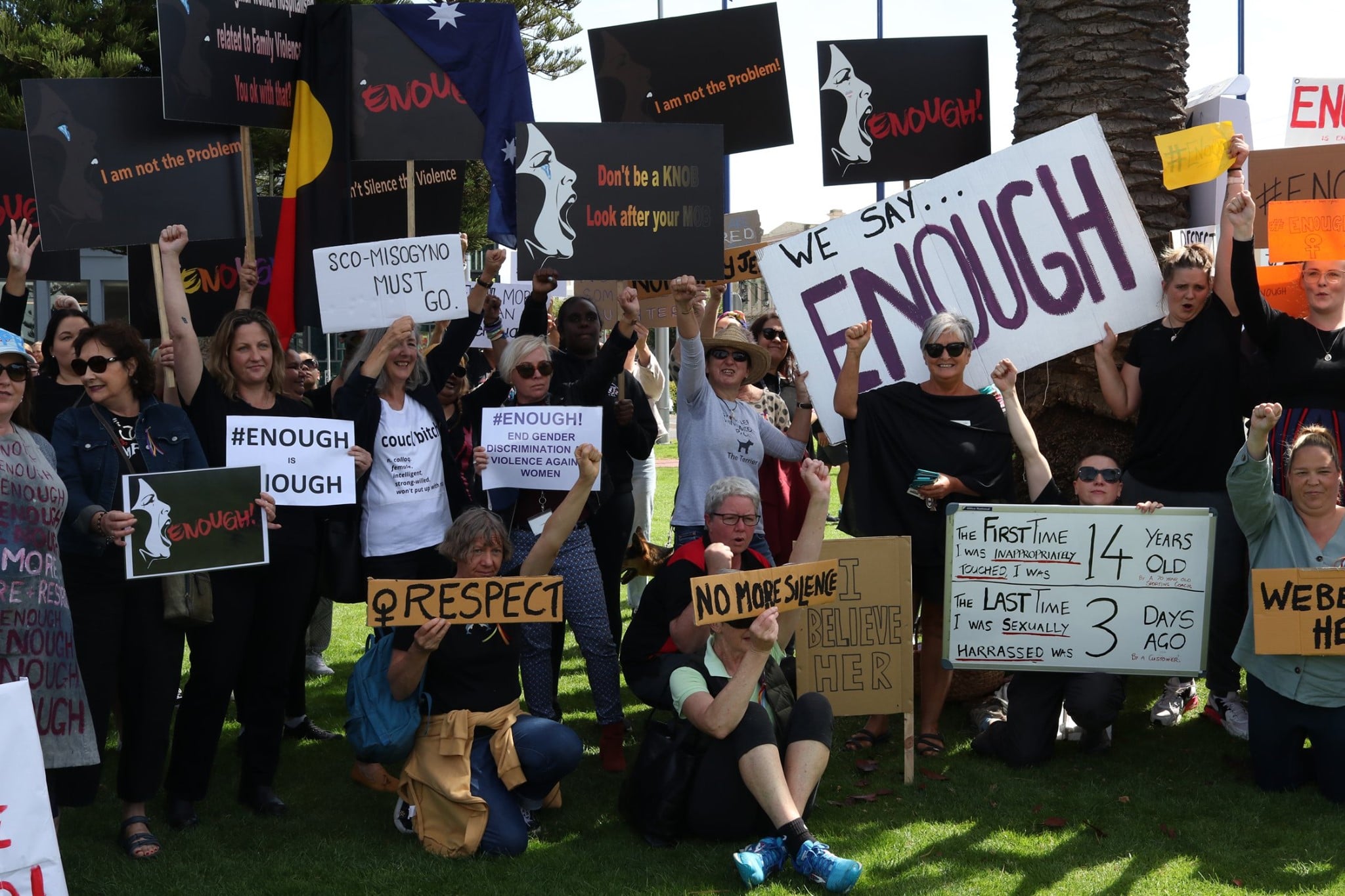
Hundreds of people turned out for the March4Justice gathering on the Warrnambool Civic Green. Image: Emily Bissland/ABC South-West Victoria.

This is a slightly edited version (for brevity) of South West Victoria MP Roma Britnell’s speech to State Parliament on 18 March 2021, following the March4Justice rally:

Ms BRITNELL (South-West Coast) (14:44): I rise to speak on the Cemeteries and Crematoria Amendment Bill 2021. The purpose of this bill is to protect affected persons against further significant harm, pain or suffering that may be caused as a result of the exercise of a right of interment…

This bill effectively has come about as a result of a shocking case of the murder of a woman by her husband. A headstone was placed on her grave which had ‘In loving memory’ or words to the effect that her husband was respectful, and there was nothing further from the truth. It was upsetting for her children, her family, her brothers, her sisters. Obviously it was completely inappropriate.

Not only that, but the man who murdered her, her husband, had the right to in time, when he died, lie beside her. So it makes complete and utter sense to change that for those who have been, like in this case, murdered, harmed, and in some cases it even applies to a victim of sexual assault, where a family member may be able to lie beside them. That is completely wrong, and this bill goes exactly to where that needs to be changed. This discussion actually happened before Karen’s death. In 2016 the Victorian Law Reform Commission made a recommendation. That was five years ago, so it is a real shame that it has taken the government this long to fully adopt—which is what we are doing here—those recommendations. It is simple, and it has been far too long coming.

This makes me think about what we are really doing to support women. Are we doing enough? Clearly we are not.

Not when you see the figures that my colleague the member for Lowan just raised in her speech around the people who are victims of family violence. They are on the increase. Violent crime stats just out today demonstrate the increase in family violence, not decrease, of those cases that are being reported to police. It is just not okay. Women have the right to feel safe. They have the right to feel safe wherever they are, be it at work, be it on the street or be it at home. Are we doing enough? Clearly we are not.

I was at the March 4 Justice just this week with my colleagues, and I back the fact that we as a group of community members, as females together—both sides of this house—must work together. Colleagues—be it my male colleagues, my female colleagues—we can all do so much more…

There was a real white-hot anger at that rally, and I could feel the women just so intent on making a change. You can understand the anger, particularly from women who were present who have been abused. Sexual assault is a really serious crime, and we are not seeing the results in convictions that we see in other serious crimes like murder. Why is that?

I am reminded of when I was at school in year 11 studying legal studies, and I remember learning about momentous change that was happening in the legal system where, for the first time—and I learned this I reckon in 1983—women, instead of being in the box facing their perpetrator, could actually do what was called a hand-up brief. The very fact that it was called a hand-up brief or is still called a hand-up brief—I know it is a fairly common legal term still; I am not sure if it is the right one anymore—is kind of bizarre in itself.

What it means is that women, instead of facing their perpetrator, could write their report and hand it in as a written format rather than as a verbal format in front of the perpetrator—a great and momentous change. But it made me think: have we done enough? I know we have got the Royal Commission into Family Violence results and we have had 227 recommendations, 64 of which are still to be implemented, but have we really actually looked at what we can do?

I suggest we get the legal minds of this state and perhaps this country together—the brightest and best—and look at the meaningful reform we really need to have so that we get the convictions just like we get in other serious crimes. Because it makes no sense that we are not getting the same level of convictions. It is not that the women are making it up, it is not that it is not true; it is that we need to find ways to support them.

There must be an opportunity for us to look around the Western world and see how other nations are perhaps doing it better. I am not saying we should undo the very important rules of law that we have in place, the foundation of our very democracy, but I am wondering: have we really put those minds together and formed a panel that can actually do that review?

I think it is time we made a difference, and I believe that meaningful reform is absolutely possible. I had in my office just a few weeks ago a woman who was terrified for her safety. The intervention order that she had out on her husband was coming to an end. I do not want to give any more details than that, but it struck me as strange that she was relying on that IVO. She was terrified for her life and she gave me lots of reasons and stories that made me also very concerned about her life. The very fact that she was being put into such a fearful place really sent a chill down my spine. I wrote to the minister that day with a sense of urgency, via email, which obviously is instant. I am actually still waiting to hear back, and I think it was three weeks ago. So we must be able to do better.

I know we have got to support our women, and sexual abuse, murder and being treated like this woman was—with absolute fear—is no way for any human being to live.

I think the bill does do one thing that will help change what has happened to Karen, and I pay my respects to the family for the pain and suffering that they have gone through, which no family should have to go through. But it is time, well and truly past time in fact, to make these changes. I hope that we do more than make these changes in this legislation, but we look at the figures today of 1800-plus people being treated by ambulance call-outs in the 2019–20 year that are victims of family violence where 30 per cent of children are actually witnessing these events.

We need to support women so they can call these situations out early, know that they will get help and not be like another woman who came to my office having left a marriage situation where there was a lot of emotional violence and withdrawing of ability to see friends and withdrawing of finances. Four years later she said to me, ‘I’m couch surfing and I really did think, given all the support they talk about for women, that I would at least be supported with a home’. After 3½ years of couch surfing, for the last six months she has joined up with her friend, pooling their funds and living in motels. But she is on a national disability insurance scheme package. She cannot drive. She has to walk to services that do a great job, she said, supporting her. She cannot move out of the area because those support services are critical for her disability. But come May when we have the May races in Warrnambool, when the motels are full, she is out on the street.

And that is just last week’s story.

How many stories do we get in our offices where we are just not doing enough? She left her husband in that abusive situation—it was not physical abuse, it was emotional abuse but fairly significant—believing that she would be supported, because that is what we say to women these days. But it is not; it is just not happening enough and that was why the rally occurred.

We can do more, and my suggestion is we get the best legal minds in our nation together, particularly in the state of Victoria, and lead the way of finding better ways to support women. That hand-up brief, the example that I spoke about, was 35 years ago at least. So I think it is time for change, and there are ways to do that.

[Note, this is an uncorrected proof from Hansard, so may have minor changes in the final published version.]


Saying “enough” to sexual violence against women and girls

Carol Altmann – The Terrier

Standing up: In the absence of any other events that I have (so far) seen planned in Warrnambool for the #enough national event happening next Monday, 15 March, I am planning one.

It will be simple, but it will – I hope – still have meaning.

Next Monday, 15 March, I am asking everyone who wants to express support for women and girls in the ongoing battle against sexual violence and sexual assault to meet at the Civic Green from 12.30pm to 1pm for what I am calling a circle of solidarity.

We will stand 1.5m apart, as is the new norm, in a circle. If three people turn up, it will be a small circle. If more people turn up, it might be a little bigger. If lots of people turn up, we may even need two circles.

There will be no speeches, but bring a sign with the #enough hashtag or whatever else you would like to say.

As I say, this is a simple protest, but I cannot let the events of the past few weeks pass without standing in solidarity with those who have spoken up and said “enough”.


After Don and Harvey, can we stick with Rolf Harris?

Mixed messages: rather than get rid of a mural painted by sexual abuser Rolf Harris, the W’bool City Council opted to cover it up. Image: ABC South-West.

What message does this black perspex send to women and girls in Warrnambool?

To me, it screams hypocrisy.

At a time when sexual predators – who also happen to be famous – are finally being outed for the scum that they are, surely Warrnambool can no longer hold on to this.

For those not familiar with this piece of black perspex, it is covering a kitschy mural painted spontaneously by Rolf Harris on a wall behind the scenes at the Lighthouse Theatre, way back in 1986.

A lot has changed since 1986.

We now know that Rolf Harris is a sexual abuser, down there with the likes of Harvey Weinstein, Don Burke, Lewis CK, Kevin Spacey, Bill Cosby and others who have finally been outed as the grubs so many people knew them to be.

In Harris’s case, his disgusting crimes – for which he has been jailed – were against young girls. Kids.

And yet Warrnambool is sticking with Rolf.

We are still making excuses.

We have not yet had the courage, it seems, to actually paint over this work but to let it remain covered up, like a dirty little secret for somebody else to deal with down the track.

In the light of what is coming out now about Weinstein and Burke, does that “nothing to see here” approach sound familiar?

That decision was made on our behalf by a majority of the Warrnambool City councillors in 2015 who, using logic I still can’t understand, saw the covering up – rather than complete removal – as a sign of support for victims of sexual violence.

The main argument was that this mural was ART! and all ART! – even a slap-dash mural by a convicted child molester – is worth preserving at all costs.

Really?

Would we seriously consider hosting a gardening talk by Don Burke at the Lighthouse Theatre? Or a film night in honour of Harvey Weinstein, because, hey, their talents are quite separate to their being sexual abusers?

Fortunately a lot has changed since 2015.

We now have a new council. And we have now entered a time – AT LAST – when the powerful and the famous are no longer being given social immunity because of their particular talents, personality, wealth or likeability.

And right this minute, the council itself has the perfect opportunity to correct its mistake of hiding this mural and instead make a strong, symbolic gesture that we, as a city, do not tolerate sexual abusers – no matter who they are.

How?

Well, I saw on Facebook this morning that Connect Warrnambool (which is run by the WCC) is proudly supporting 16 Days of Action to support Gender Equality (#16days) and it talks about things like promoting respect for women and increasing women’s safety and well-being.

All very stirring stuff, but such words, without action, are as hollow as Peter Dutton’s heart.

So here is my idea for Connect Warrnambool, and it is one that I have been pushing since 2015:

  1. borrow a Makita drill and remove the screws that are holding up the perspex on the Harris mural;
  2. ask for willing volunteers to come and run a paint roller right over the space (you will be inundated, Connect Warrnambool, I promise);
  3. invite a young woman artist to paint a fresh mural and;
  4. lastly, install the black perspex on the stage at the W’bool Civic Green and let little kids draw their art all over it.

What a message to say that we are absolutely serious about respect for women and girls.

I have my painting overalls ready…


Jackie Carruthers and I are ready to roll!


How we get from topless bars to abuse

By Carol Altmann

[dropcap style=”font-size: 35px; color: #8cc7d0;”] A [/dropcap]fter I published this piece, a reader wrote to me, asking how I “joined the dots” between a strip show and domestic violence.

I was really glad she emailed me, because not only did it mean that she was thinking and talking about this critical issue – along with her work colleagues who, she said, had talked about it in the tearoom – but it also made me write down, for the first time really, what has been swirling around my head.

This was my (slightly edited) response:

“The bottom line to my thinking is that it comes from the perspective of tackling domestic violence well before the first punch, rape or other act of violence occurs.

Lots has been written about this, by much greater feminist writers (and researchers) than myself.

But in this sense, it is all about how women/girls are perceived and how they come from an entirely different position (ie. far less powerful) than men/boys, simply by being born girls in the first place.

This is why so much emphasis in the battle to end domestic violence is on empowering women/girls and, at the same time, educating boys/men to respect women.

So, to the strippers.

I have no problem with women choosing to strip for whatever reasons they may decide to strip, which I would argue are mainly economic reasons and there is another whole discussion around that. (Indeed the woman who wrote this piece that I just published said she applied to work in a men’s club in Melbourne, purely for the money when she was a struggling student, but in retrospect she was so glad that she never got the job.)

I certainly didn’t judge the women at Last Break for what they were doing, but was angry at the fact that there remains a market for that kind of “entertainment” which I thought had been left behind in the 80s.

The issue is that stripping, topless work, private dancing all reinforce the entrenched power imbalance between genders and, in so doing, reinforce women as something to be objectified, oggled, highly sexualised and valued for their ability to appeal to men.

This is why male strippers are not on the same scale.

They don’t start from the same place as women in terms of power and, even when taking their clothes off in a strip show, they retain that power as part of the dominant gender.

(To use a really simple analogy about how they retain this power in the real world, would a male stripper ever feel afraid if he was confronted, alone, by a group of women? Would a female stripper ever feel afraid if she was confronted, alone, by a group of men?)

I don’t think that every man who goes to a strip show is going to beat his partner – of course not – but these shows do not empower women and girls and negates the message that we hope to educate the next generation with: that women/girls are not simply sexualised objects.

It is this devaluing of women that is the hardest thing to turn around in our culture and I am really dismayed that at a time when we are working to turn this thinking around, that we still have this form of “entertainment” on offer in Warrnambool.

My thinking around this has taken time to develop and there are times when I am still not sure how I can best explain that in no way do I want to shame/patronise the women involved in stripping/topless barwork/private dancing, while at the same time hating the industry in which they work.

I had a conversation with an escort the other day about this very thing: she once ran a brothel. I asked her how she felt about strip clubs and she summarised my thoughts so much better than me.

She explained the difference between how it felt to be involved in a private, quiet, one-on-one business transaction between a sex worker and a client, and women stripping or shaking their breasts, or lap dancing in front of “the mob” (as she termed it).

I certainly don’t come at this argument from a place of superiority – I am the last person to judge a woman on how she chooses or has to make a living – but I am saddened, truly saddened, that at a time when our domestic violence rates are astronomical, women are still valued for their ability to strip for men.

Again, these are not my thoughts alone, but based on years of trying to make sense of it all by reading and thinking and talking to others.

One of the best pieces on “false empowerment” I have read recently was by the feminist writer Clementine Ford, you may enjoy it too: here is the link.

I am sure you will have your own views on what I have written, and perhaps disagree with most of it, but I appreciate you asking and hopefully at least something I have written here helps to flesh out the connections.”

Carol


The power of a single, anonymous note

This piece was submitted by a reader. I will keep her name anonymous.

[dropcap style=”font-size: 35px; color: #8cc7d0;”] I [/dropcap]t was with a heavy heart that I read the angry backlash to a Facebook post by Bluestone Magazine* on topless dancers performing in Warrnambool during what was also 16 days of activism against gender violence.

Reading the stream of comments, it became very clear to me that we have such a long way to go in educating people about the link between the objectification of women, gender inequality, and domestic violence.

Increasingly, I have felt a deep sense of powerlessness about the social and political issues currently plaguing our world. While there seems to be collective outrage on social media, there also seems to be a corresponding amount of despair.

Donate

With the far right increasingly gaining momentum and power, and with basic human rights being used as a political pawn, I often feel the problems are just too enormous and insurmountable for any individual to effect any positive change. Perhaps we also feel this way about domestic violence: what can we do, as an individual, to make a difference?

When I reflect on what was personally a game changer for me in domestic violence, it was actually a small and individual act of kindness and bravery from a stranger. 

In my early 20s I was at a pub with my new boyfriend. He was drunk, abusive and out of control, flinging insults at anyone who crossed his path and throwing himself around like a human grenade.

Although the relationship was only new, a series of abusive relationships beforehand had me feel responsible for his behaviour. During the night, however, a woman came up to, looked me in the eye and asked, kindly but firmly, “what are you doing with him? He is a dickhead and you are beautiful.” I laughed in her face and turned away, but those words were like a tiny seed planted in my heart.

The night ended with me climbing through a laundry window to escape my wonderful new boyfriend. Earlier in the night, backing up to me in the street, he had tried to piggyback me, but instead I was thrown straight over his head and face planted the concrete.

In terror, I had made a run for it, with him trailing behind shouting my name. I remember frantically banging on the locked front door of a house party I had left, trying to get someone to hear me over the loud music.

Over the coming months something changed in me.

I slowly came to believe the stranger’s words. I was beautiful, and although I still wasn’t sure I deserved better, I was also resolved not to put up with any more crap. The decision was finally in my own hands, not in the hands of an abusive partner. Quite rapidly my life choices began to change. While it felt awkward and unfamiliar, I eventually let myself fall in love with a man who treated me with kindness, respect and adoration. We are still together to this day.

Recently I tried to plant a similar seed in another young woman’s heart.

I had just witnessed a raging fight between her and her partner in a caravan park. He had taken her mobile phone and refused to give it back. She had eventually barricaded herself in the camp kitchen when his anger reached a terrifying peak. After the police attended, a fragile silence enveloped the campground, but I knew this was far from the end of it for her.

Too scared to intervene, I left a note for her under the passenger side door handle of their car. I told her that she was young and beautiful and that her partner was abusive. I told her that I struggled to leave a similar relationship, but did not regret it for one second. I told her that she may think she can be the one to change him, but that he will never change enough for her to live a happy and healthy life. I told her to get out while she could and not look back.

I often wonder what happened to that young woman. Where was she now? Was she able to escape the toxic cycle of abusive relationships and diminishing self-esteem?

A common strategy in psychology when someone is feeling overwhelmed with an issue is to break it up into smaller, more achievable goals.  Indeed, the lesson I learnt from my kind and brave stranger is that seemingly small acts can have a huge impact.

While we have a long way to go in ending domestic violence, we all have the power to make a difference.

Tell the females in your life that they are beautiful, strong and worth it. Not just young girls, but women of all ages: we all need to hear it.

Plant the seed of hope in someone who needs to hear it. Do small things and do them often. Because you just never know when your ‘small’ may be someone else’s ‘big’.

[box]*The Facebook post was in November last year when, on the same day as the 2016 White Ribbon campaign launch, a local bar hosted a fundraiser around topless women, lap dancing and private dances. The response to the post was vitriolic, with accusations of women shaming, demeaning professional dancers and undermining an attempt to raise funds for a good cause. As it happens, the manager of the bar and I had a correspondence and agreed that the timing was poor, even if we had differing views on the event itself. That is open to a much bigger discussion. – Carol[/box]

Follow up piece: How we get from topless bars to abuse