Breaking down: WCC staggers under the weight of old ways
Carol Altmann – The Terrier

It’s 12 months since the Warrnambool City Council started a new chapter under a new CEO, but still it staggers under the weight of the old regime that is pulling the place apart.

As I write, I have just heard from solid sources that two high-level staff have taken leave amid allegations of bullying.

Other senior staff  have taken sick leave or unexplained leave, including the head of governance who has not been seen for months.

Over the past six months, staff have continued to resign, paying tribute to their workmates, but saying they can no longer deal with the workplace culture and a lack of leadership.

One senior staffer who left put it this way in a letter to colleagues: “I urge you to stick to your values, call out things that are not in line with the organisation’s values and most importantly, be kind to each other.”

The elected council, meanwhile, remains riven with deep rivalries that pit the Cr Gaston/Neoh faction against the Cr Hulin/Cassidy/sometimes Herbert faction, in a bitter struggle which is circular and exhausting.

To be frank, despite the polite smiles in the council chamber, most of the time they want to rip each other’s heads off.

Whistleblowers have been isolated and the CEO’s supposed “open-door” policy remains blocked by gatekeepers, so staff  are reluctant or unable to step through.

Even the CEO is kept in the dark, having allegedly not been briefed about the looming credit card scandal until June last year, which is when the scandal broke publicly.

In that environment, faith is broken and people learn to just shut up and get on with it.

Or they resign.

I say all this being fully aware – and grateful – that the council is full of decent, solid, hard-working, loyal people who give their absolute best to Warrnambool as true servants of the public and they make up the vast majority of council staff.

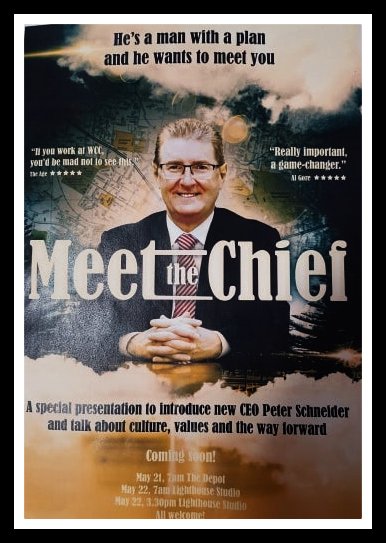
But the fact is the new CEO, Peter Schneider, inherited a shite sandwich which he has been unable to turn around.

Just three months before Mr Schneider started, the results of an independent staff survey leaked into the public domain and it was not a pretty picture.

It found that since 2014, the council had gone backward on every key measure, including leadership, people, customer focus, and strategy and planning.

Most telling was that while 71 per cent of all staff said they felt proud to work at the council, only 51 per cent said they looked forward to coming to work each day.

In one department, only 39 per cent enjoyed coming to work each day.

That is not a sign of a happy place, but a place where good people keep hanging in there, hoping things will get better.

They haven’t – I have seen resignation letters and spoken to some of those who have left – and they won’t until three things happen:

a full, open and independent assessment of the workplace culture with a commitment to act on the results;

an end to the bunker mentality by being open and honest with the public;

a changing of the guard at the next council elections in October.


Without these, I fear that the WCC will continue to lumber along like a bus on broken wheels, wondering why it’s losing all of its passengers.


Why WCC whistleblowers don’t go to the boss

Carol Altmann – The Terrier

A REMINDER. Mayor Tony Herbert was on ABC radio yesterday (8/10/19) and pondered why the WCC whistleblowers didn’t just wander in and talk to CEO Peter Schneider about their concerns.

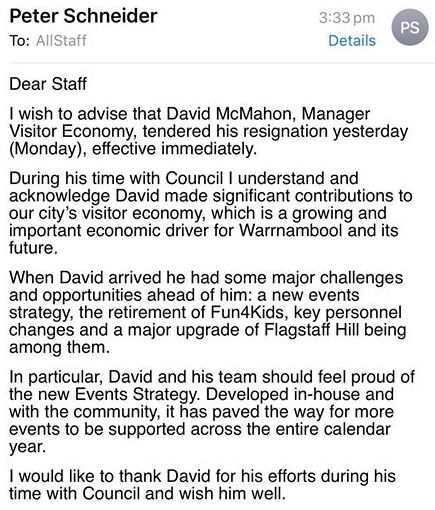
Let me answer that question by starting with this text message (pictured).

This message was sent to all Warrnambool City Council staff when former tourism chief David McMahon resigned in mid July.

It was sent by CEO Peter Schneider: the new guy, the one who brought great hopes of a clean slate, a fresh start, a new way of doing things.

In it, the CEO praises Mr McMahon, thanks him for his efforts and wishes him well.

Mr McMahon quit because his gross misuse of ratepayers’ money had been exposed publicly here.

Mr McMahon was also a foul-mouthed bully and his behaviour, for which he was never called to account by his superiors, broke a lot of people.

There were people within council who knew about both of these things.

Yet, until July 16, Mr McMahon kept his job; unscathed and intact.

And when he did quit, he was praised by the new man in charge – the boss.

For many council staff, this was gutting.

Perhaps Mr Schneider now regrets this message, but wait, there is more, there always is.

From the minute I published my stories about the credit card abuse, the council has been trying to uncover my sources. They want to flush out and punish anyone who told the truth.

This is happening under Mr Schneider’s watch.

And still the Mayor and CEO wonder why nobody is coming to them with their allegations, concerns and fears.

I can sum it up in a word: trust.

And, right now, there is none.

Restoring trust, as Ratepayers Victoria has made clear, is the challenge.

The next few months will be telling.


Silencing councillors tightens grip on public right to know

gagging
Speaking to journalists will become much harder for Warrnambool City Councillors if a proposed change to its media policy goes ahead. Image: Third Sector.

ANALYSIS – Carol Altmann

The attempted shaming of three Warrnambool City councillors for speaking to a journalist is yet another step toward shutting off information to the public.

And if you care about freedom of speech and freedom of the media, then the events of the past few days should be very troubling.

First, some background.

Late last week, the agenda for this Tuesday’s council meeting was released and contained a report given to chief executive officer Bruce Anson from the Local Government Investigations and Compliance Inspectorate following its investigation into the leaking of confidential council documents to The Age early last year.

The inspectorate concluded that it could not determine who leaked the documents.

But it did conclude that three councillors – Brian Kelson, Peter Hulin and Peter Sycopoulis – met with a journalist from The Age the night before it ran the first of several stories about links between then-Premier Denis Napthine and Midfield Meats owner, Colin McKenna.

It was not hard to reach this conclusion, because the councillors told the inspectorate about this meeting.

After all, it has never been an offence for an elected official to speak to a journalist and it happens every day.

The assumption, of course, is that the three councillors used this meeting to hand over secret documents, but this is wrong.

The Age journalists, Royce Miller and Ben Schneiders, have issued a statement to say that they were already in possession of the documents before this meeting.

How did they get the documents? Who knows, but in a world dominated by public relations officers and media managers, leaks and whistleblowing are often the only ways that information in the public interest can come to light.

psycopoulis
Cr Peter Sycopoulis was one of three councillors being shamed for having met with a journalist from The Age. Image: Warrnambool City Council.

The inspectorate knew the three councillors had done nothing illegal, and it prepared a confidential report naming the three councillors that could only be released with the approval of the CEO, Mr Anson.

Ironically, Mr Anson decided to make this confidential report public, and included it in the agenda. In other words, what is and isn’t kept confidential by council is entirely at Mr Anson’s discretion.

front page headline by The Standard followed but, in what I believe is unprecedented for a newspaper, it didn’t defend the profession of journalism that relies on research, well-placed sources, whistleblowers and leaks, but instead leapt on the “revelation” that three councillors had met with a journalist, as if this was a crime.

Its sycophantic editorial went even further and defended the former Premier against such “damaging” behaviour, saying that he must “be itching” to ask what was discussed between the councillors and The Age journalists.

This is coming from an organisation that knows the trust between a journalist and a source is fundamental to flushing out what those in power don’t want you to know, but is in the public interest: like the fact – as reported by The Age – Dr Napthine (and our Federal MP Dan Tehan) held shares in a racehorse with Mr McKenna.

A compliant newspaper and a media-managed council is a powerful combination in a regional city, and it could soon get even worse.

secret-meeting
The public right to know hinges on the ability of journalists to ask questions of sources. Image: Disclose This.

Lost within the story is a recommendation by the inspectorate that the Warrnambool City Council put its boot even harder on the neck of elected members.

It has suggested – and the council will now consider – changing its media policy so that councillors MUST tell the council’s communications manager, Nick Higgins, when they speak to a journalist, about anything.

What right has a government inspectorate got to try and gag elected councillors?

It is an outrageous recommendation and one designed purely to ensure that the only information released to the media (and therefore, to you, the public) is that which suits the council’s chief executive or the mayor of the day, whoever they may be.

This closing down of voices in local government is a growing trend across Australia, and comes as newsrooms are shrinking.

Indeed academic papers* have been written on this increasing secrecy and the restraining of elected members by tightening a council’s media policy.

We need to ask ourselves, who does such secrecy benefit? It is certainly not intended to benefit you, the humble ratepayer.

No, it is designed for councils to move more and more information behind closed doors so that decisions can be discussed – and made – by those with power without any “distractions” from the public.

This means decisions, when they are made public, are virtually a fait accompli, such as the nine-storey apartment block proposed for 1A Liebig St, or the sale of land to Midfield for an enormous milk processing plant.

And it is designed to keep all of the potential “hot spots” under wraps, such as the true state of affairs of the Fun4Kids festival finances, or the declining patronage at Flagstaff Hill, or the actual salary package paid to the chief executive, or who was invited into the May Races marquee...

We here at Bluestone Magazine have already been cut off by the council’s media unit: our questions now go unanswered and our requests for interviews with certain council staff are denied.

This is what happens when you don’t play by the rules or you refuse to stick to “the message” – but Bluestone will keep investigating nonetheless.

Warrnambool should not be distracted by the public shaming of three councillors for talking to the media – this is not the problem. The much more worrying issue is the move to stop councillors talking to journalists at all.