Starting a new life, right off the bat
bundy_5
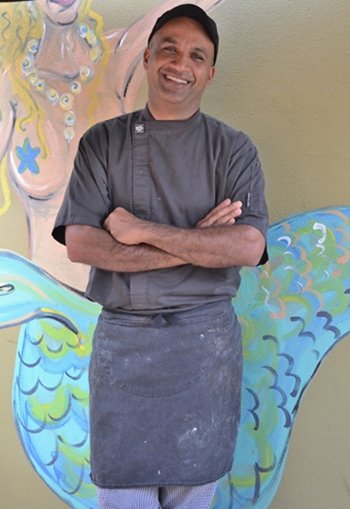
Jayaweera ‘Bundy’ Bandara started from scratch when he decided to move to Australia from Sri Lanka in the mid 1990s.

Most people know him for either his cricketing skills or his equally impressive cooking, but the story behind Jayaweera “Bundy” Bandara is also one of starting over to build a new life.

Bundy – who’s full name is Ganegala Walawwe Jayaweera Bandara – has been living in Warrnambool for 18 years since relocating from his native Sri Lanka and has become the cheerful, energetic force behind the popular FishTales Cafe, in Liebig St, where he is manager and head chef.

Since moving to South-West Victoria, Bundy, 43,  has also established himself as one of the best cricketers in the region and was earlier this year named as the Warrnambool and District Cricket Association’s Division 1 Cricketer of the Year for his consistent batting. (His batting average was 69.29.)

Cricket has been a driving force behind Bundy’s life since playing the sport as a school boy in Colombo, Sri Lanka. His precocious talent saw him earmarked as a potential Sri Lankan test player and also gave him the opportunity to play in Australia.
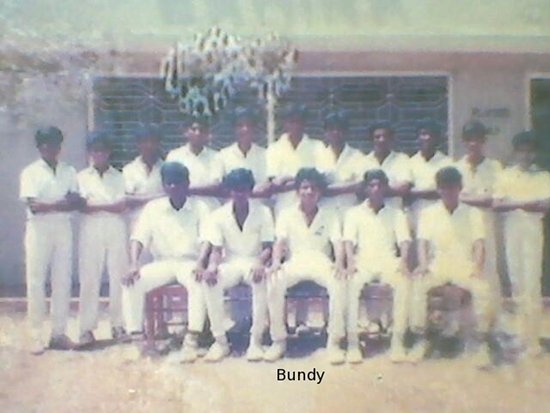
bundy-under 17
Bundy – front centre – in the school boy Under 17s in Colombo, Sri Lanka.

In his late teens, he was sponsored by the North Melbourne Cricket Club for the summer of 1989-90 and, the following year, he spent a season with the Footscray Cricket Club, where his team mates knew him as “Jaya”.

“I would be in Australia for six months and then return home and play there,” Bundy said.

Bundy’s cricketing career peaked in the early 90s when he played first-class cricket – one level below test cricket – in Sri Lanka for almost six years.

“Many of the Sri Lankan test players were my playing mates – we had nine players from the test team,” he said.

At the same time, Bundy was building a successful career off the field as a marketing executive with Bartleet Finance in Colombo.

Then, in the mid 90s, came one of those turning points in life when you decide to either keep following the familiar path, or try something completely different.
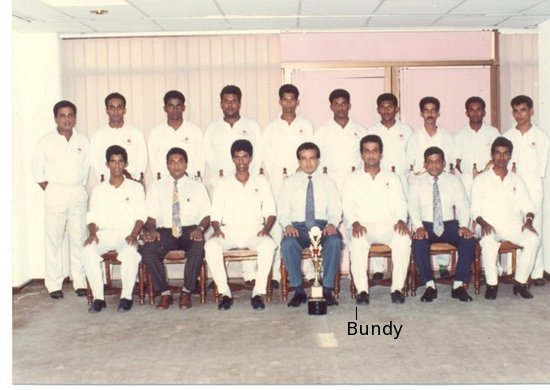
bundy c division bartleet
Bundy, third from right, during his playing days with the Barleet Finance group team in Sri Lanka.

Having made some friends in Warrnambool during his cricketing trips to Australia, Bundy grew to love the city  – “it is so friendly, so lovely” – and so decided to accept a sponsorship to play for Dennington.

“I also decided to enrol in a cooking course at TAFE, because I wanted to become a chef,” he said, smiling.

“My first job was right here (pointing to the floor at FishTales), washing dishes.”

The former marketing executive and first class Sri Lankan cricketer found himself up to his elbows in soap suds, but it is this humility that has made Bundy such a well-loved person in his adopted home, where he is now very much one of the city’s personalities.

He and his wife Kylie, whom he married in Warrnambool in 2000, run a Sri Lankan Community group that welcomes Sri Lankans who have moved to the area and organises cultural events throughout the year. The group has also been involved in fundraising activities for underprivileged children in Sri Lanka.

And then there are the famous “curry nights” that Bundy introduced to FishTales, where locals flock to try the delicious flavours of Sri Lanka.

“At first people were a little unsure about the curries, but they try them and they are very happy,” he said, laughing.

The local cricketing scene is also smiling, but not because of Bundy’s cuisine. Instead it is his son, Dominic (one of three children), who is already showing signs of being a champion batter.

“He has just been chosen for the Victorian Under 12 team – the only boy from this area – so we are very proud of that,” Bundy said, saving his widest smile for last.
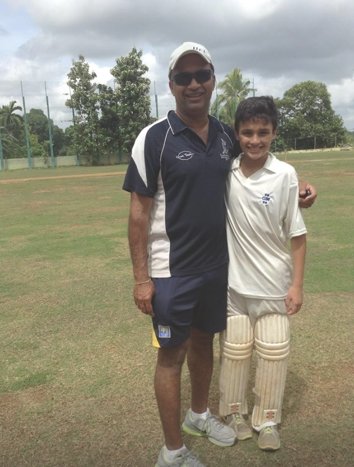
dominic
A chip off the old block: son Dominic is already showing signs of becoming a top cricketer like his Dad. Bundy also has two daughters, Selena and Sriyani.


Secrets of an old shoe

ol shoe

[box] Bluestone Magazine recently brought you the story of the rejuvenation of 222 Timor St, Warrnambool. This week, we tell the story of one fascinating find during its restoration.[/box]

[dropcap style=”font-size: 60px; color: #A99E90;”] O [/dropcap]ld shoes, perhaps more than any other item of clothing, have the power to tell stories.

What is the story behind a single shoe discarded by the roadside? Did it land there by accident, through misfortune, or part of prank?

We throw old shoes over powerlines and tie them to wedding cars, and we refer to shoes in our folklore and our fairytales: “if the shoe fits, wear it”; Cinderella and the famous glass slipper.

Old shoes are personal. They hold an imprint – a literal footprint – of their owner that cannot be replicated and makes them so hard to throw away, especially when they were once worn by a loved one who has also gone.

Some shoes can outlive us, surviving for centuries beneath the dirt and rubble of demolished homes and ruined cities until they are at last unearthed by new activity.


222 timor old
How 222 Timor St, Warrnambool, used to look in 1968. (Image: J.T. Collins Collection, La Trobe Picture Collection, State Library of Victoria.)


[dropcap style=”font-size: 60px; color: #A99E90;”] A [/dropcap] shoe that had been hidden for possibly more than 70 years was recently found at my grandmother’s former property at 222 Timor St, Warrnambool, opposite Swinton’s supermarket. It was the house in which my mother spent a large part of her childhood.

It is also one of the oldest commercial buildings in Warrnambool and is believed to have been built around 1850.

As we wrote about earlier this month, the building recently passed into new hands and its long-hidden secrets are being slowly uncovered: a hidden doorway down to the cellar, shoebox-size windows that had been boarded up and wallpapered over, and a child’s single leather boot that had been placed under the floorboards.

The boot is about 18cm long, with tacks around its sole and seven pairs of metal eyelets securing a cloth shoelace.

222 timor st floorboards
The old floorboards in 222 Timor have revealed their own secrets. Image courtesy Luke Taylor.

[dropcap style=”font-size: 60px; color: #A99E90;”] I [/dropcap] thought it might have belonged to my now 89-year-old mother, but when I showed her the boot, she suggested it had most likely been hidden under the floorboards by a boot repairer – a Mr Long – who had rented part of the property from her father in the 1930s.

My mother told me she had read an article in the Reader’s Digest about shoe superstitions, including the placing of a shoe under floorboards for good luck. I couldn’t trace the Reader’s Digest article, but an online article by British shoe historian June Swann confirmed that in Britain, in particular, it was not uncommon for a shoe to be hidden somewhere in a house to bring stability and good luck to the household.

Hiding a child’s shoe – in either a wall, chimney or under the floorboards – was also believed to increase fertility.

Perhaps Mr Long, if he did hide the boot, hoped it would bring prosperity to his business. Or perhaps it wasn’t Mr Long at all, but a previous owner of 222 Timor St who stowed the boot away for good luck.

The full story is yet to be revealed and the boot, of course, is holding its tongue.

[box] A version of this story first appeared in the Warrnambool & District Historical Society newsletter, Warnimble, April 2013. The new owners of 222 Timor St, Luke and Nat Taylor, plan to hide one of their children’s shoes in the restored building…for good luck. [/box]


A long way from Pomonal to Pip

pip&lily_15
Made by hand: Kate Bouman first explored art as a child, but has only recently returned to her love of making and creating things by hand.

[dropcap style=”font-size: 60px; color: #DC943C;”] K [/dropcap]ate Bouman has taken the long way round, but she has finally come back to creating the delicate art she first began to explore as a child.

Growing up in Pomonal, a speck of a town between Halls Gap and Ararat, Kate loved to draw realistic pictures of the people and things around her and, at the age of 12, displayed her paintings in the Pomonal art show.

There were no major prizes to be won, but the high praise she received for her work encouraged Kate to keep going and, after finishing secondary school, she applied to study art in Bendigo and Ballarat.

Unbelievably, an administrative mistake meant that Kate was assessed as a Year 11, rather than a Year 12 student, and was rejected by both universities, so she applied to study childcare at TAFE instead.

“Childcare wasn’t really for me, so I ended up getting into horticulture (her parents owned a nursery in Pomonal)…by this stage I had come to believe that to make it as an artist you had to be either completely mad or dead, so horticulture seemed like the best option,” she said with a laugh.

wrapping the presents

[dropcap style=”font-size: 60px; color: #DC943C;”] K [/dropcap]ate, 25, is now an orchid grower with Warrnambool Orchids, but this year she has also returned to her first love of creating beautiful things by hand and, in September, started a market stall as Pip & Lily Boutique crafts.

The care, patience and precision required for growing orchids is reflected in Kate’s creative work, which includes hand-drawn and painted cards, hand-painted jewellery, hand-made dolls, felt work and hand-drawn designs on clothing.

“I wanted my main point of difference to be the hand-made element, in that everything I do is hand drawn or designed,” she said.

oh howley night

[dropcap style=”font-size: 60px; color: #DC943C;”] K [/dropcap]ate’s collection of hand-drawn cards, including a range designed for Christmas, pay homage to classic children’s books such as the Beatrix Potter collection, Noddy and Winnie the Pooh, and she is unashamed to admit that she owns more children’s books than adult books.

“I love the characters, the little animals, and the incredible illustrations,” she said.

A love of small animals also explains, in part, the choice of name: Pip & Lily.

“When I was a kid, I always wanted two zebra finches that I was going to call Pip & Lily, but then I came to realise that keeping birds in cages was not such a good thing, so I have kept the names, but I never got the birds,” Kate explained, laughing.

“And I also tried about 10 other names, but they were all taken, so Pip & Lily it is.”

christmas pudding

[dropcap style=”font-size: 60px; color: #DC943C;”] A [/dropcap]lthough Kate has only been selling at local markets since September, she has been delighted with how well her work has been received.

“I make things for the love of it and as a creative outlet, rather than as a money making thing, but it has actually gone a lot better than I expected, which is wonderful.”

[box type=”bio”] Pip & Lily Boutique crafts will be at the Made by Me Market, Saturday November 30, 9am-4pm, Pavilion function room, Warrnambool breakwater. You can find also Pip & Lily on Facebook. [/box]

newsletter Why Not Stones  If you enjoyed this story, you might enjoy:


No time limit on this wearable art: Helen Bunyon

This jellybean is really jumpin’: Johanna Glennen

Stitching it all together: Joella Hill

Udderly beautiful: Make Mine Milk

The sensational drawings of Ella Webb


A little less conversation, a little more action

streets_3
How to improve the CBD: offer financial incentives for property owners to paint the glorious shop tops along Timor St.

[dropcap style=”font-size: 60px; color: #A02F2F;”] W [/dropcap]hat is this inertia that appears to be holding Warrnambool in an iron-like grip and preventing this beautiful city from reaching its full potential?

It was with a heavy heart that I read respected lawyer Roy Reekie’s recent letter to the local paper, lamenting that he had returned to Warrnambool after five years to find the Warrnambool City Council locked in a petty, schoolyard stand-off and he pondered if he had made a mistake in coming home.

A mistake! What an indictment: intelligent, energetic people like Roy should feel delighted to be back, not disappointed.

streets_9
How to improve the CBD: paint a mural on the hideous Koroit St toilet block and, later, close it down. Relocate the bus transit to the old Post Office area.

I don’t regret coming home after more than 20 years, but I, too, have been astounded by how the city appears to have lost its way. There is endless talk – usually accompanied by endless reports – about what could and should be done to revive the CBD, but there is no over-arching vision or leadership to actually make it happen.

Instead, our new-old Mayor wants us to be excited by new housing developments – projects that extend out into the country and make it even more critical to retain a vibrant city centre, or we will end up like the ‘doughnut’ regional cities of the US, where everybody lives in the ‘burbs and shops in malls and the city heart is left for dead.

It is my fear that Warrnambool is at a critical juncture where, unless it gets its act together, we are at risk of that happening. We will have a city centre full of “services”, but no heart.


streets_13
How to improve the CBD: offer up high-profile but ugly walls, like this eyesore, to public art.


[dropcap style=”font-size: 60px; color: #A02F2F;”] I [/dropcap] recently lived near a city like that: Morwell, in Gippsland. It was once a vibrant ‘SEC town’, but once the power companies were privatised, the jobs went and so did the families who shopped, ate and socialised in the town. It now relies on being a “service” centre, full of bland state and federal government offices providing health, welfare and social support services.

Morwell’s main street is full of empty, dusty shops that were once restaurants, clothing stores, jewellers, butchers, bakers and newsagencies, some of which have moved out to the MidValley Shopping Centre – halfway between Morwell and Traralgon – because that’s where people now linger. Does this sound familiar?

Warrnambool, however, has a huge advantage over a place like Morwell and that is tourism. People flock to see the whales, and the beaches, and even good old Flagstaff Hill, but the CBD is letting us down, badly.

We have some of the most gorgeous and historic buildings in Victoria, but you wouldn’t know it. We have an incredible, vibrant arts scene, but – judging by the lack of public art – you wouldn’t know it. We have a deep and important indigenous history right around this area, but you wouldn’t know it.

I walked around the entire CBD last week and did not see one bit of indigenous public art and only a handful of public art. Perhaps I was looking in the wrong places.


streets_15
How to improve the CBD: stop patching and start paving. Especially on high-profile corners like this one.


[dropcap style=”font-size: 60px; color: #A02F2F;”] W [/dropcap]hat I did see were many empty, dusty shops; dirty and stained bitumen pavements that had been patched and repatched to the point of being unsafe; a dark toilet block and a noisy bus transit zone dominating the hub of Liebig and Koroit streets; and, as always, pedestrians trying to skip between cars at intersections and being grateful when somebody stopped to let them pass.

And it appears that when some people DO try and make a difference, they are blocked at every turn. Take, for example, the artist who tried to open a pop-up market in an empty shop but was unable to find anyone (among the 20 or so people who apparently, between them, own the CBD) who would take it on. They would rather leave their shop empty. (What a contrast to Revive Newcastle, where property owners actively encourage such ideas.)

And so the inertia continues…and more reports are written (another Liebig St revival plan is next) and older reports gather dust (remember the 2010 report on revitalising the Warrnambool Railway Station precinct?) and everybody sighs and says, “that’s just how it is here”, while cities and towns like Bendigo, Castlemaine, Daylesford, Ballarat, Kyneton and even Birregurra, power ahead.

We deserve better leadership and this is Mayor Neoh’s greatest challenge: to unite the council and business community around a common purpose and to actually get things done.

streets_17
How to improve the CBD: free (timed) parking, bike lanes and a 40 kph speed limit between Lava and Timor Streets.

streetart47
What CAN be done: for more examples of creative street art click here.

[learn_more caption=”Ten ideas to improve the CBD, in some cases, almost instantly – click the arrow”]

1. All outdoor eating in Liebig St must use quality furniture – not cheap, plastic tables and chairs.

2. Paint a mural on the ugliest toilet block known to feature on a major intersection anywhere in Victoria…until you can close it down.

3. Relocate the bus transit area from Koroit St to outside the former Post Office Building in Timor St.

4. Provide financial support for all of the historic shop tops along Timor St to be repainted.

5. Repave all of the footpaths along Liebig St.

6. Free parking in the entire CBD, but with time restrictions enforced by local laws.

7. At least half a dozen bare and ugly walls around the CBD to be offered up for public art.

8. Ban all exposed skip bins.

9. Add bike lanes along Liebig St and reduce traffic speeds to 40 kph between Lava and Timor streets.

10. Cars entering roundabouts must give way to pedestrians.

Do you have anything to add?

[/learn_more]


newsletter Eat And Drink Stones

  Find other opinion pieces here:


Restoring a treasure back to life

lukefamily
Behind the renovation of 222 Timor St, Warrnambool: Luke and Nat Taylor, with their son Lucas. They have since had another child, Penny.

[dropcap style=”font-size: 60px; color: #A02F2F;”] A [/dropcap]fter years of decay, the old piano shop opposite Swintons, in Warrnambool, is being brought back to life by a young lawyer who has taken on a restoration project of monumental proportions.

Luke Taylor, and his wife Nat, bought the double-storey, derelict building at 222 Timor St more than 12 months ago with the intention of turning it into an investment, but what they didn’t count on was just how much hard work would be involved, or how much they would come to love the old place.

“At first it was very much about building an investment for the future, rather than being passionate about restoring an old building, but that has completely changed,” Luke said.

shop_65
BEFORE: The front left room was restored from top to bottom, including the ceiling, floorboards and walls.

222 after pic
AFTER…

[dropcap style=”font-size: 60px; color: #A02F2F;”] A [/dropcap] turning point was when architect Peter Brooks, from Heritage Victoria, visited for an on-site assessment of the property, which is listed with the National Trust and Heritage Victoria as a significant building. Where most saw a decaying hulk that had to be restored from the ground-up, Peter saw an historic and precious gem.

“He was blown away by it,” Luke explained. “There are basically so few properties like this that are still in their original condition and have not been modified or altered in any significant way. Peter’s enthusiasm and excitement about that was infectious.”

The sandstone building is the oldest, intact commercial building in Warrnambool and dates back to around 1850. It has had many lives since then, including as a piano repair shop owned by my grandfather, Bill Goodall, who bought it in 1932. It was largely because Bill never had an spare money for renovations that the building has remained unchanged, perhaps apart from the wallpaper: Luke removed nine layers from each of the rooms.

shop_64
BEFORE: Layers of wallpaper and plaster had to be removed and damp walls dried out as part of the renovation.

222 after lounge
AFTER…the ‘lounge room’ has been given a new lease of life.

[dropcap style=”font-size: 60px; color: #A02F2F;”] L[/dropcap]uke and a group of skilled, local tradesmen have spent countless hours since February slowly bringing the place back to life, and it has been backbreaking work. Floorboards have been lifted, replaced and then the old ones recycled. Barrow loads of dirt and dust and debri have been removed. Leaks have been plugged, walls re-plastered, windows replaced…and on it goes. And then some.

“The tradesmen have been amazing, because everything was crooked and had to be made square again,” Luke said.

Luke has taken only two weekends off since taking on the project, including one weekend when his second child, Penny, was born.

“I have spent so many hours in the building, and because I have spent so much time there, on my own, I have really come to appreciate it and feel the emotion of it,” he said.

shopfront
BFEORE: The 1850s building was rundown, but still in much of its original condition when the Taylors bought it last year.

222 shop finished
AFTER: Hours of back-breaking work have seen the shop slowly restored to how it would have looked in the mid 1800s, right down to the colour scheme.

[dropcap style=”font-size: 60px; color: #A02F2F;”] I [/dropcap]t is this emotional connection that has pushed Luke through what he calls the “dark times,” when the job ahead seemed overwhelming. He has also applied the same disciplined approach that he uses for his triathlons – one step at a time.

“It has been a huge challenge, a huge amount of work, but we are breathing new life into the building. It may look plain, but it represents an era and reflects that time,” Luke said.

The bottom storey of the building will have a tenant by the end of this month, but it will be another year before a residence and a serviced apartment upstairs are complete. Luke is determined to see it through.

“The way I see it is that if Nat and I can do this, what can’t we do?”

[box] 222 Timor St, Warrnambool had been painted cream for many years, but this was not its original colour. The new salmon-pink and burgundy facade reflects the original colour scheme that was uncovered by peeling back layers of paint. Pig’s blood was often used to tint paint in the 1800s, reflecting a step-up from the whitewash used on working class cottages.[/box]

newsletter Eat And Drink Stones

 If you enjoyed this story, you might enjoy… 


Who is the Granny behind Granny’s Grave?

Art is the heart of old Hawkesdale home

Behold this bluestone beauty: Fennessy’s at Rosebrook

Colonial oven still makes a crust, Dunkeld

‘Glass’ house starts a new life

Restoring the Rosenbloom store in Heywood