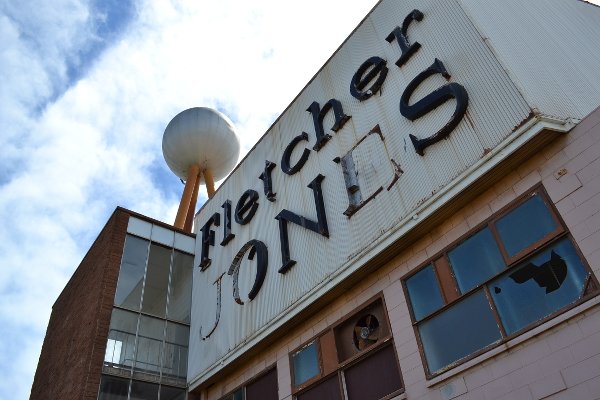
Rare silver ball images emerge from collection

man on ball
Vertigo? What vertigo? One of the rare images of the iconic silver ball water tower being erected at the Fletcher Jones factory in 1967 from the collection of engineer Ralph Jones. (Citation: Ralph Jones Water Tower Submission and Business Papers, 2014.0112, Box 1, University of Melbourne Archives.)

Words: Carol Altmann

[dropcap style=”font-size: 60px; color: #DC943C;”] R[/dropcap]are images of the Fletcher Jones silver ball water tower have emerged from the private collection of engineer Ralph Jones who designed and supervised the construction.

Bluestone Magazine has been privileged to gain access to the images courtesy of the Melbourne University Archives which has been archiving the story behind the iconic silver ball as part of the Ralph Jones Engineering Services collection.

See all of the images here.

MUV archivist Melinda Barrie said the collection – donated by Mr Jones, who is now aged in his late 80s and living in Melbourne – included detailed documents and correspondence from 1965-1967 when the silver ball was being built.

It also includes Mr Jones’s submission to the 1975 Association of Consulting Engineers Australia -Engineering Awards, where his firm hoped to win a prize for the silver ball that, as far as we know, is without peer in Australia. (Unfortunately, the ball missed out on an award).

ball phone book
The brand new water tower, red-legged and silver-topped, graced the cover of the local phone directory the year after it was assembled. Image from the Ralph Jones collection and reproduced courtesy of Melbourne University Archives.

[dropcap style=”font-size: 60px; color: #DC943C;”] T[/dropcap]he documents reveal that Mr Jones’s inspiration for the ball’s design came from US advertisements for water towers made by the Pittsburgh-Des Moine Steel Company, one of which included tripod legs.

The unique design was also borne of necessity because of the “poor mains water pressure” on the east side of Warrnambool at the time, Mr Jones wrote in his submission.

It also had to take into account potential earthquakes – given that the Fletcher Jones factory was in the middle of an area that in 1903 experienced two of the worst earthquakes in modern Australian history – and was built to withstand “moderate” earthquake loading.

With the Ralph Jones Engineering Collection ready to view at MUA, Melinda and her team are now turning their attention to a significant collection of photographs, documents, personal items and archival films donated by the family of Sir Fletcher.

The collection includes more than 3000 photographs – including many from the Warrnambool factory in the 70s, 80s and 90s – all of which will be cleaned and then 300 selected for digitalisation.

Melinda described the contemporary Fletcher Jones story as a vital part of documenting Victoria’s manufacturing industry.

“We view it as very important, as it celebrates the narrative of manufacturing and retail in Victoria…and so many of those stories have been lost,” she said.

Silver lining: Melbourne University Archive academics Melinda Barrie (centre) and Sophie Garrett (centre right) catch up with working party members Mark Rashleigh, Emma Charlton and Julie Eagles (right) - and some of the artwork that has been inspired by Fletcher Jones and the iconic silver ball. Image: Bluestone Magazine.
Silver lining: Melbourne University Archive academics Melinda Barrie (centre) and Sophie Garrett (centre right) catch up with working party members Mark Rashleigh, Emma Charlton and Julie Eagles (right) – and some of the artwork that has been inspired by Fletcher Jones and the iconic silver ball. Image: Bluestone Magazine.

[dropcap style=”font-size: 60px; color: #DC943C;”]M[/dropcap]eanwhile, in Warrnambool, moves are afoot to start documenting the local, personal stories around Fletcher Jones and Pleasant Hill.

A steering committee has come together with representatives from the Save the Silver Ball and Fletchers Gardens group, the Warrnambool Planning and Heritage Group, the Warrnambool Historical Society and the F Project, with MUA also helping out.

The group has already secured $5000 from the Gwen and Edna Jones Foundation (no relation to Fletcher), which will be used to record those stories considered a top priority because of people’s age or health.

“The next step for us is to sit down and determine who these people are and to capture those stories now,” said group convenor Julie Eagles.

The committee has applied for a further $15,000 from the Public Records Office of Victoria for a much broader project similar to the Silver Ball Screening Festival, where workshops are held to help people record their own FJ story, or that of someone they know.

“There is still such a strong connection between Warrnambool and the Fletcher Jones site, both as part of Warrnambool’s history and part of our individual histories,” Julie said.

fletcher jones staff
The staff behind the name: the stories of everyday workers and those with a strong connection to the Fletcher Jones site will be recorded as part of a new project. Image: Save the Silver Ball and Fletcher Jones Gardens.

[dropcap style=”font-size: 60px; color: #DC943C;”]T[/dropcap]he individual projects of MUA and the local group may eventually lead to a collaborative exhibition or something similar in Warrnambool.

“Most of the people behind these great manufacturing stories want to see their stories out there and their work out there,” Melinda said.

“It is also part of our mandate here at MUA to make our collections accessible to the people, otherwise, what is the point?”

Melinda said the combination of the Ralph Jones collection, the personal collection from Sir Fletcher’s family and the work of the local steering committee would create a “well rounded archive” on one of Australia’s iconic businesses.

[button link=”http://the-terrier.com.au/subscribe-2/” type=”icon” icon=”heart” newwindow=”yes”]Bluestone is aiming for at least 500 subscribers in 2015. If you enjoyed this story, please click here to become one![/button]

newsletter Why Not Stones You might also enjoy…


Glorious remnants of ‘Googie’ groove in south-west

Deep into the cellars of KM Lynch

Victoria’s oldest building right in our backyard

Turning in to the Turn In Motel

The enduring legacy of ‘Tag’ Walter


Community vision needs to extend city wide

sandilands2
The imminent sale – and at least partial demolition – of the former Sandilands Hotel/Maddens Lawyers building in W’bool is expected to pave the way for new apartments in the CBD.


OPINION – JULIE EAGLES

A vision without a task is but a dream.  A task without a vision is drudgery.  But a vision and a task are the hope of the world.  – Church in Sussex England, 1730.

[quote]

[dropcap style=”color: #a02f2f;”] I [/dropcap]n 2008, over several months, a great process of community consultation involving hundreds of people developed a community vision for the Warrnambool CBD called the Warrnambool City Centre Structure Plan.  The vision was for an ‘alive, thriving, culturally rich city heart.’

We not only developed a community vision for the CBD, but also community values, community goals, preferred development scenarios and five future directions with strategic objectives – in other words – amazingly, we came up with a detailed framework to work towards achieving our community vision!

The people who facilitated this process were incredibly skilled and experienced. The process was fun, creative and interesting and there were lots of ways to participate.

Perhaps most amazingly – because I had never experienced it in Warrnambool before – was the ongoing and detailed feedback and updates to participants and to the whole community throughout the process.

It was, to quote Tanya Egan, (The Warrnambool City Council’s Business Support Manager)  “the most exhaustive public planning process ever undertaken by Warrnambool City Council……in collaboration with the community.”

It was developed in response to a recognition that people were often “frustrated in the past because they hadn’t been asked for input from the beginning”  – underpinned by the principle “that if a community is to own the plans that will shape their future, then it has to participate in developing them from the outset – not somewhere along the way.”

Very big tick.

laneway festival tafe
The series of W’bool laneway events, like this print workshop run by South-West TAFE Creative Arts students, show what can happen when a community works together.

[dropcap style=”color: #a02f2f;”] I [/dropcap] felt very satisfied with that visioning and planning process six years ago. I am sure I’m not alone, however, in being frustrated that nothing much seemed to happen for a long time afterwards.  Or was it that the communication lines seemed to falter and then stop?

After all, we’ve had the wonderful Lighthouse theatre re-development and then the fantastic laneways festival led by The F Project and supported by Council.

Most recently, in the past month, there’s been a follow up, and by all accounts also a very good, community planning process that honed in on re-designing the streetscape for two blocks of Liebig St stretching from Koroit St to Raglan Pde.

This time I chose not to take part, but I’m glad lots of other people did.  I couldn’t quite understand how this process linked to what we’d done six years ago and so either the communication didn’t convey this clearly enough or I missed it.

It could be that I was just not that interested in redesigning two blocks of Liebig St – we don’t all have to be involved in every plan!


fletcher-gardens_21
The campaign to Save the Silver Ball and Fletcher Jones Gardens grew from concerns about the loss of iconic buildings and structures in Warrnambool.


[dropcap style=”color: #a02f2f;”] I [/dropcap]n 2009, just after the community visioning process for the CBD, I joined the council’s City Development Advisory Committee where we received lots of information and requests for our input into all sorts of plans.

All of these plans were important at various levels, but I got lost in the detail and I couldn’t see the guiding vision and values that held them all together: I was interested in seeing the community vision, values and goals that guided all of these plans.

And this is what I would still love to see and what I think we really need: a community vision that inspires, guides and drives all our plans for development in Warrnambool (and our town centres of Woodford, Dennington and Allansford).  

A community strategic plan, a city wide structure plan… whatever ‘planning speak’ might label it.

Developing a city-wide community vision is about shaping our future within the context of the changing and challenging global, national, regional and local worlds in which we exist.  The people who ran the CBD visioning process six years ago understood this.

One of the questions they asked was – what are the external trends and issues affecting the City Centre today that may influence the future?  The facilitators believed that within any community all the skills, knowledge, passion and capacity necessary to progress already exist.

They were guided by a set of principles for “helping groups move from uncertainty to purpose.”

These include that:

  • Council is part of the broader community team and not the fount of all knowledge and power.
  • Council’s role is to show leadership by bringing people together in an environment where everyone feels secure about sharing their hopes, aspirations and views and that, in a safe space, people will focus on common ground, not on difference.
  •  For things to happen, Council must work collaboratively with all the players in that complex network of organisations and individuals that make the community function every day.

I was always thinking during that process – wouldn’t it be great if we were doing this not just for the CBD, but for the whole of our city!

city warrnambool
A revamp of the northern end of Liebig St is the first major project to grow from the community driven CBD plan developed six years ago.

[dropcap style=”color: #a02f2f;”]A [/dropcap] city wide visioning process would allow community debate and discussion about our strengths and what we think are the key issues and challenges facing our city now and in the future.

It would allow us to talk about our aspirations and dreams and what we most value about our community and our natural and built environments.  To talk about what give us our sense of place and belonging?  What do we want to preserve, what do we want to create, what do we want to change?

Community visioning projects are now fairly commonplace across municipalities around Australia (and the world).  The community visioning process for the CBD, that began 6 years ago, deserves to be replicated to a city wide plan.

In many ways, we can’t afford not to do this.

As somebody said to me recently “if you don’t know where you’re going, you’ll probably end up anywhere.”

[box] Julie Eagles has been a leader of the Warrnambool Planning and Heritage Group (WPHG) since 2006. ‘Save the Silver Ball and Fletcher’s Gardens’ campaign is an offshoot of WPHG and their work to highlight issues that contribute to demolition by neglect of important heritage places.[/box]

[button link=”http://the-terrier.com.au/subscribe-2/” type=”icon” icon=”heart” newwindow=”yes”] Did you enjoy this story? Please subscribe here to help Bluestone thrive.[/button]

newsletter Eat And Drink StonesFind more Opinion pieces here…


Ignore Shaw and focus on the real issues: Roy Reekie

Scrap trader levy and start over

Motor museum to revive Fletcher Jones

Traders are right to be asking questions

Be all things, or stick to the basics?

What is holding Portland back?